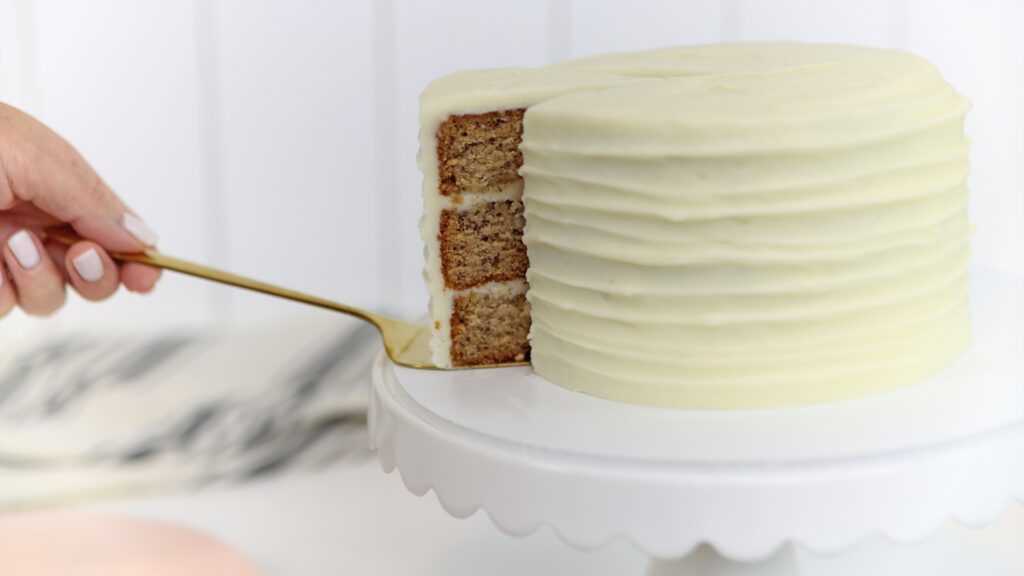
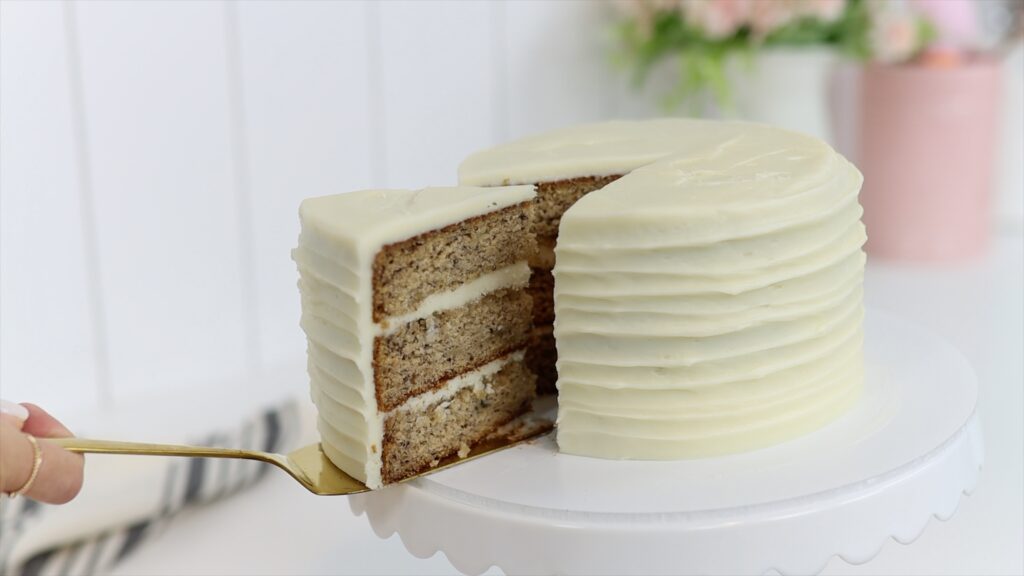
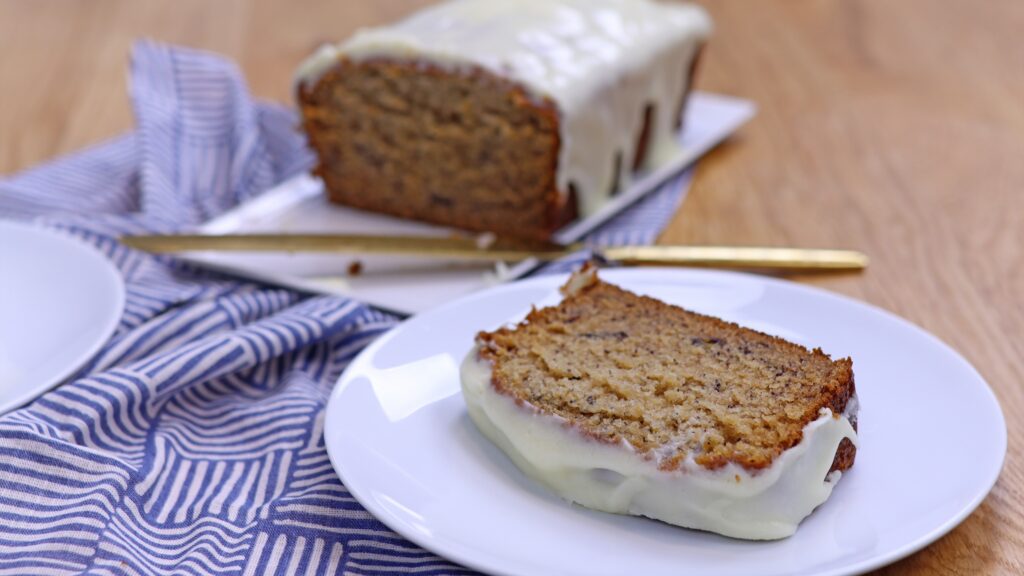
This banana layer cake is full of banana flavour and it’s incredibly moist without being overly sweet.
How to make this banana layer cake
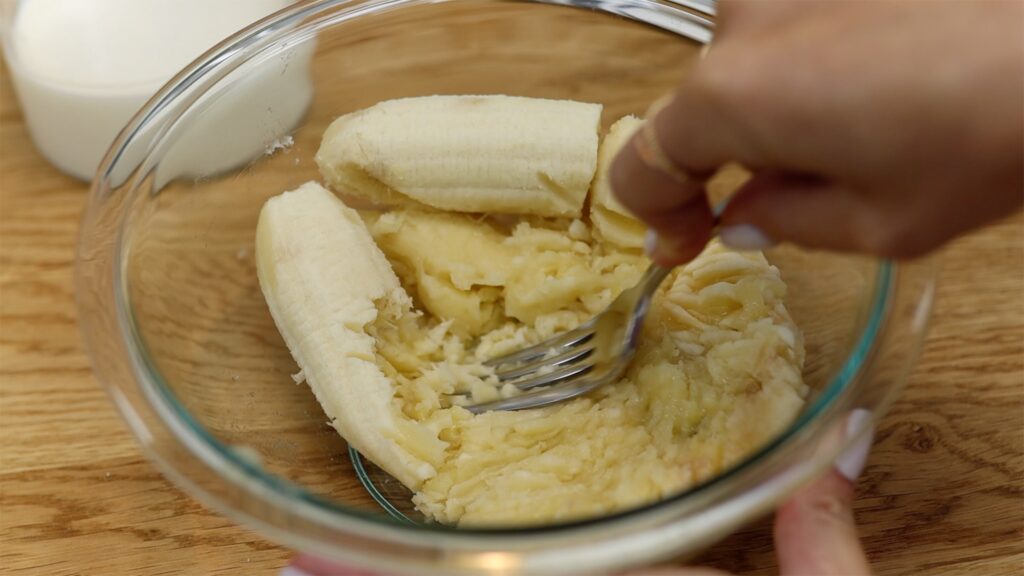
To make this banana layer cake you'll need... bananas! Mash two bananas or use a blender or food processor to blitz them. Use very ripe bananas for the most flavour and sweetness. If the skins don't have brown specks on yet, they're not ripe enough. Try this hack below to ripen them in ten minutes!
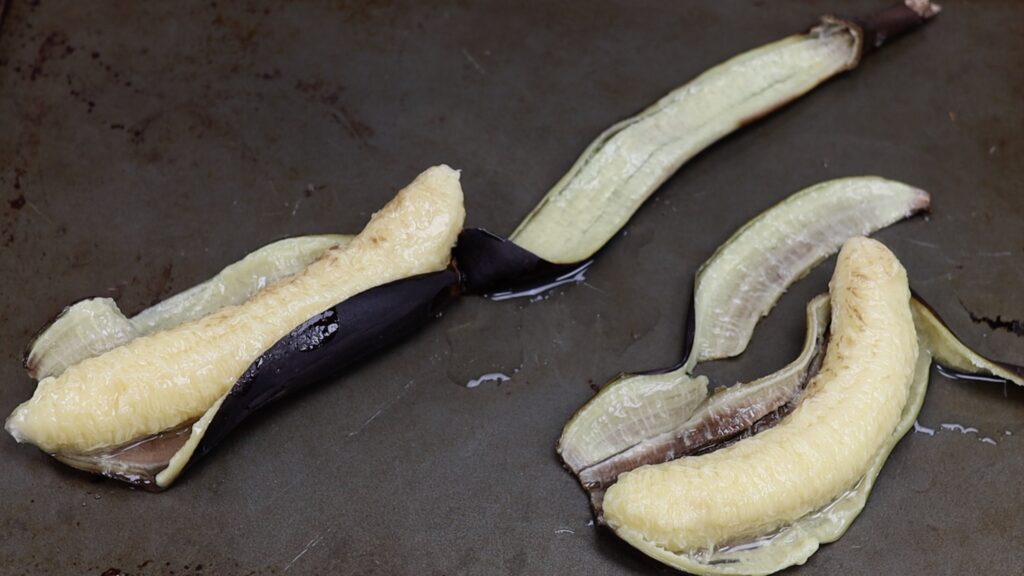
Put the bananas on a baking tray in the oven at 350F or 190C for 10 minutes. You’ll see the skins turn black but don't worry! They're still edible! Leave them to cool and then peel them over the tray to catch any liquid that oozes out. The bananas will be soft and you’ll notice their sweet smell straight away. Now they're ready for this banana layer cake recipe!
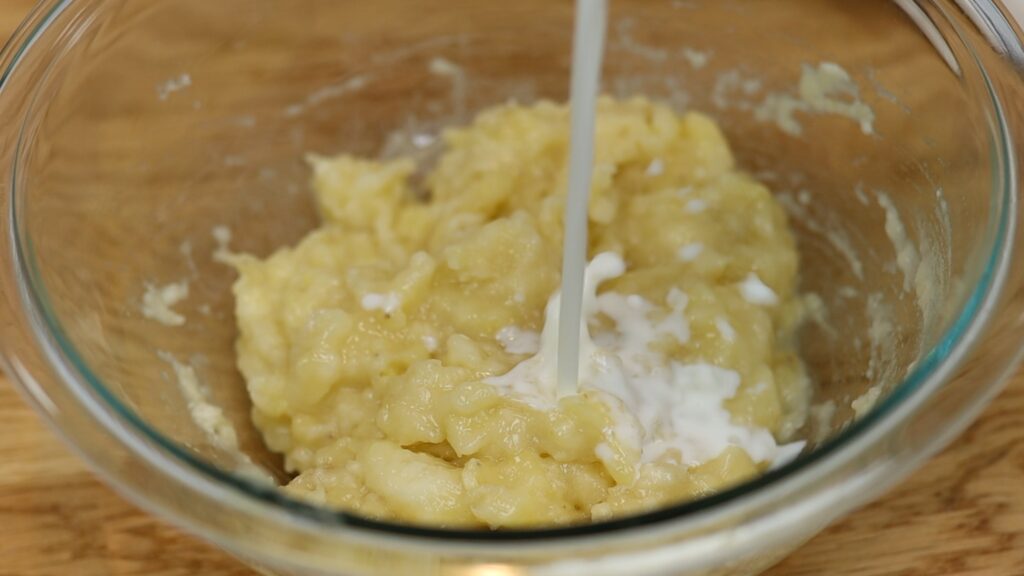
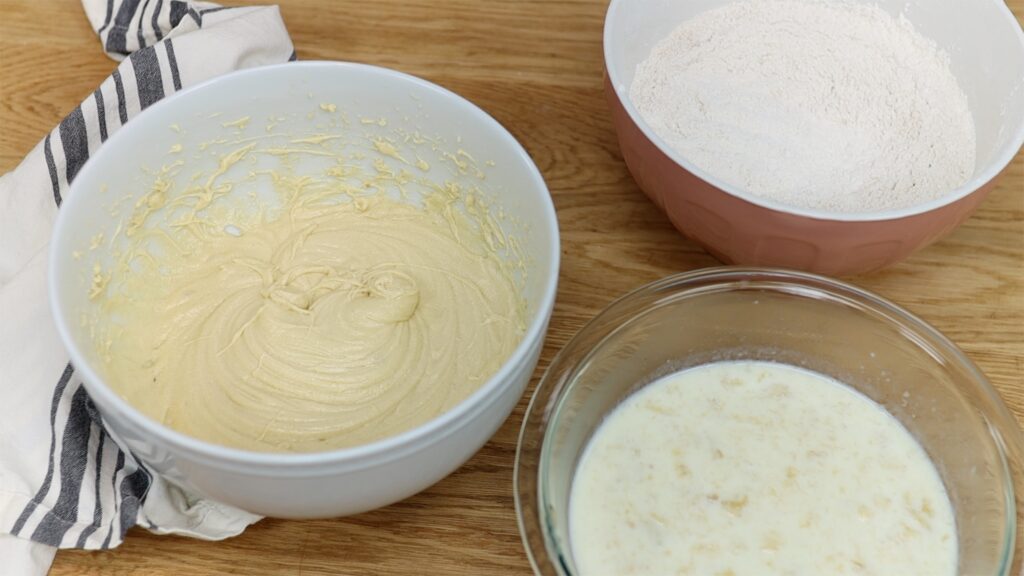
Once the bananas are mashed, add milk that’s been out of the fridge for at least 2 hours. All of your ingredients need to be at room temperature for your cake to rise properly. If you've used a blender or food processor you can just add the milk to that. Set these liquid ingredients aside for later.
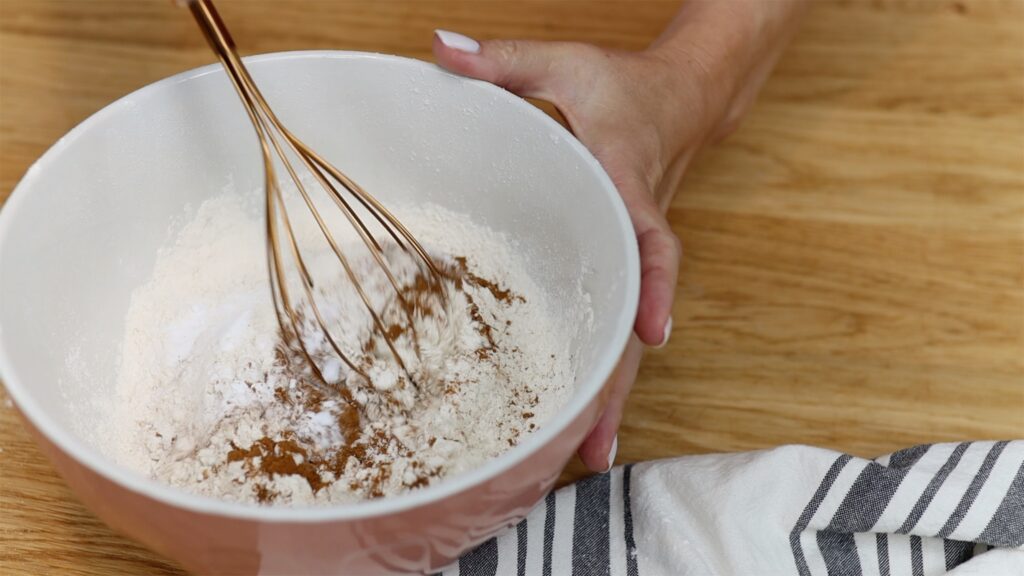
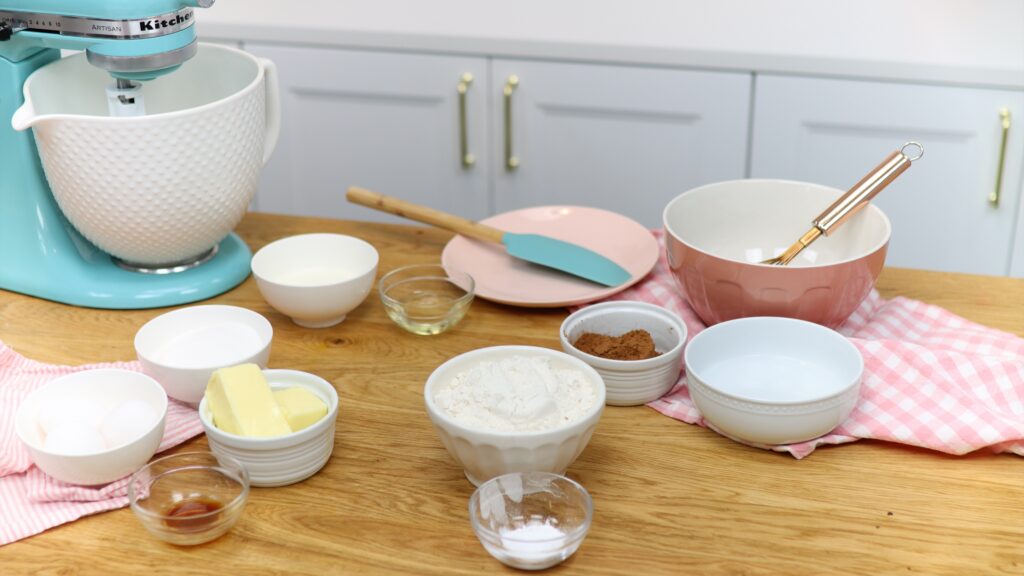
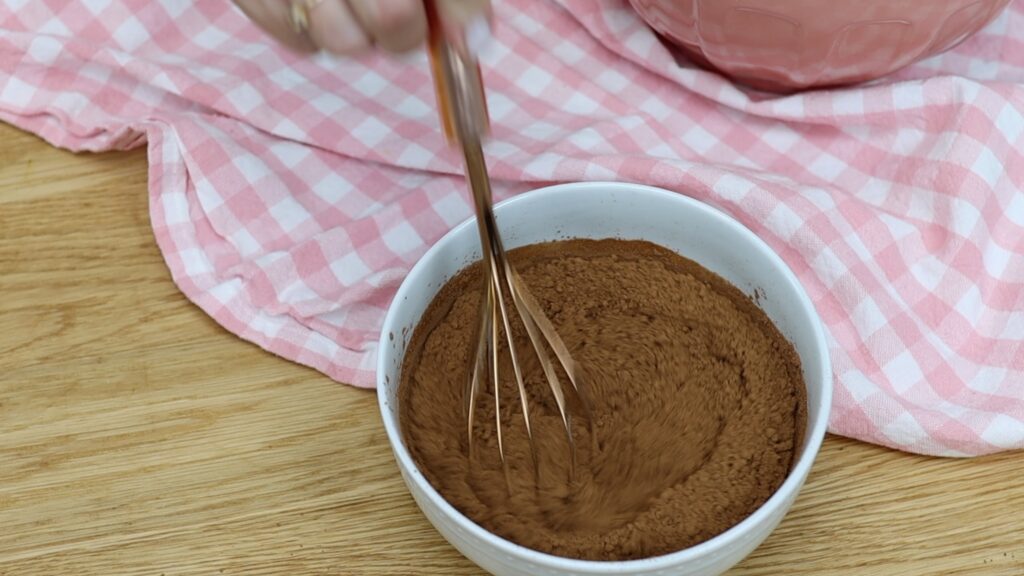
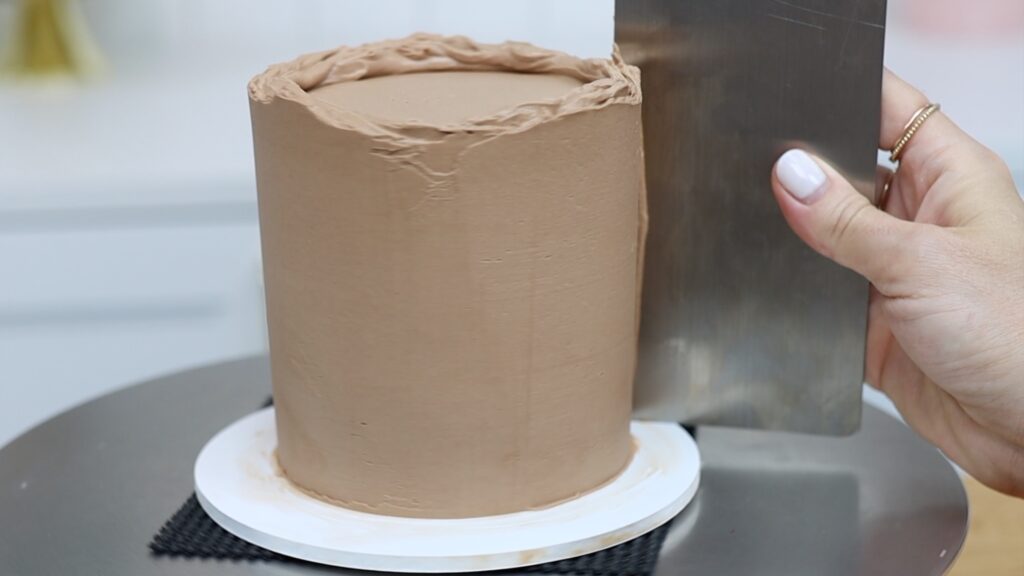
The other ingredients to prepare for this banana layer cake are your dry ingredients: all purpose or plain flour, cinnamon, and baking soda. Whisk these together so that they’ll all mix evenly into the cake batter later.
Your eggs should should also be at room temperature so take these out of the fridge at least two hours before baking, too. Now you’re ready to mix the batter!
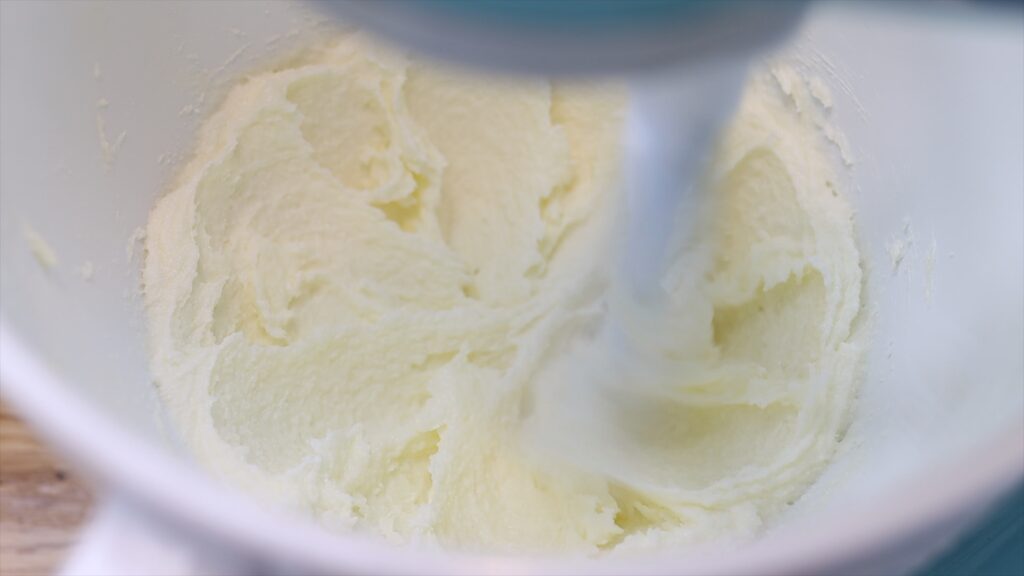
Mix butter, brown sugar, white sugar and vanilla with an electric mixer. This can be either handheld or a stand mixer. You can do this by hand but to make a light cake that rises well you need to really cream the butter and sugars together. This takes about three minutes with an electric mixer but a lot longer if you’re using a spoon or spatula.
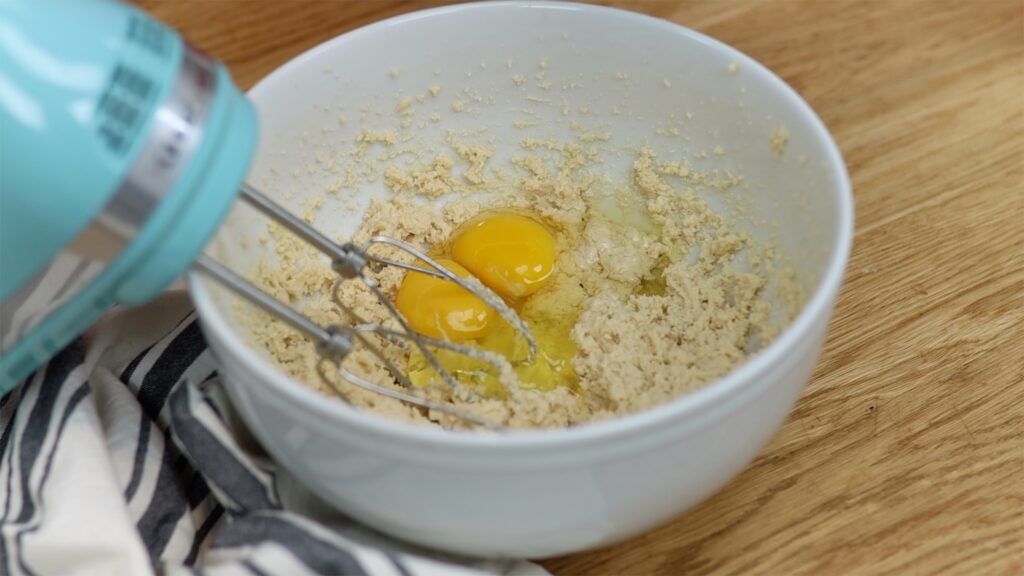
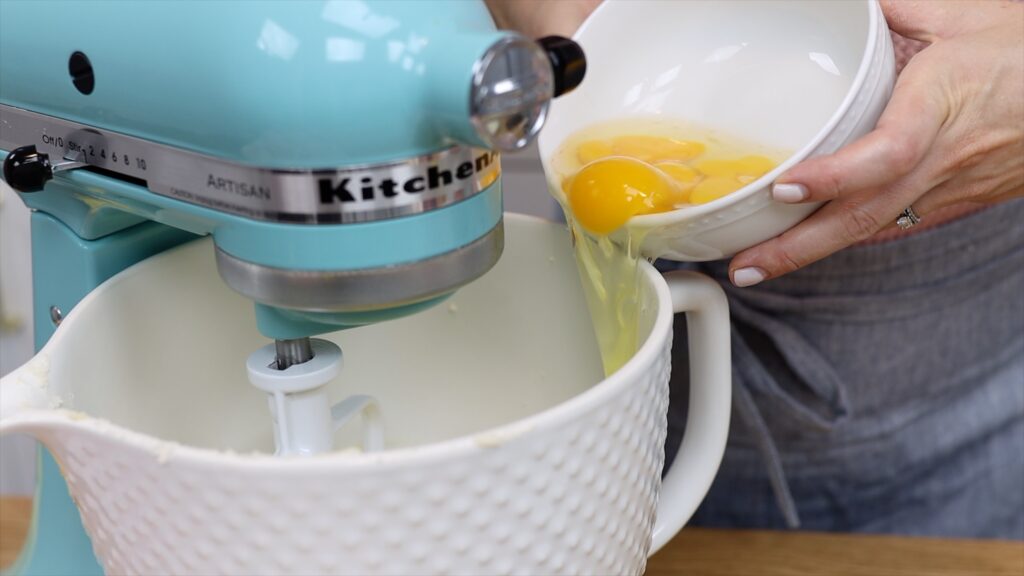
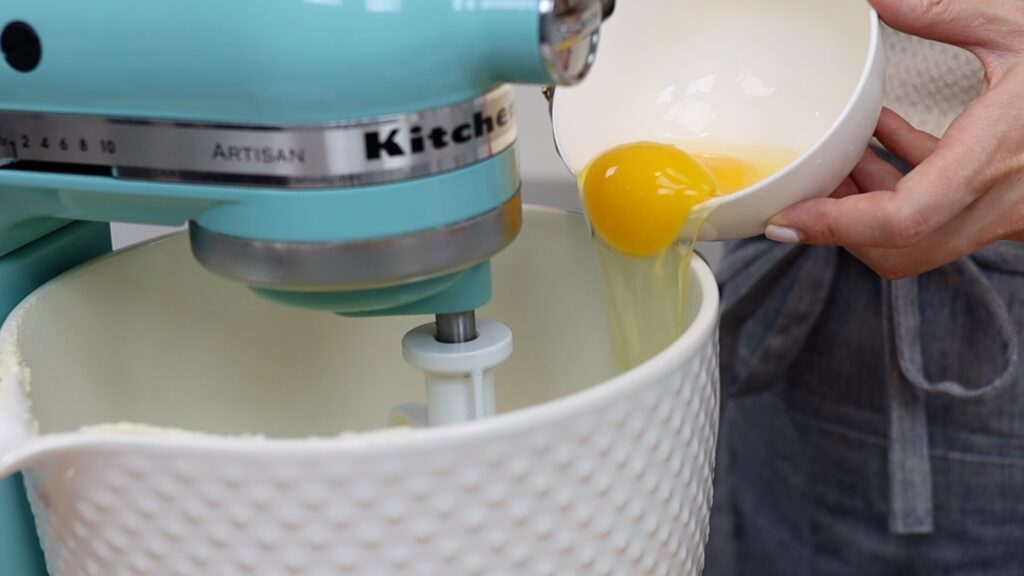
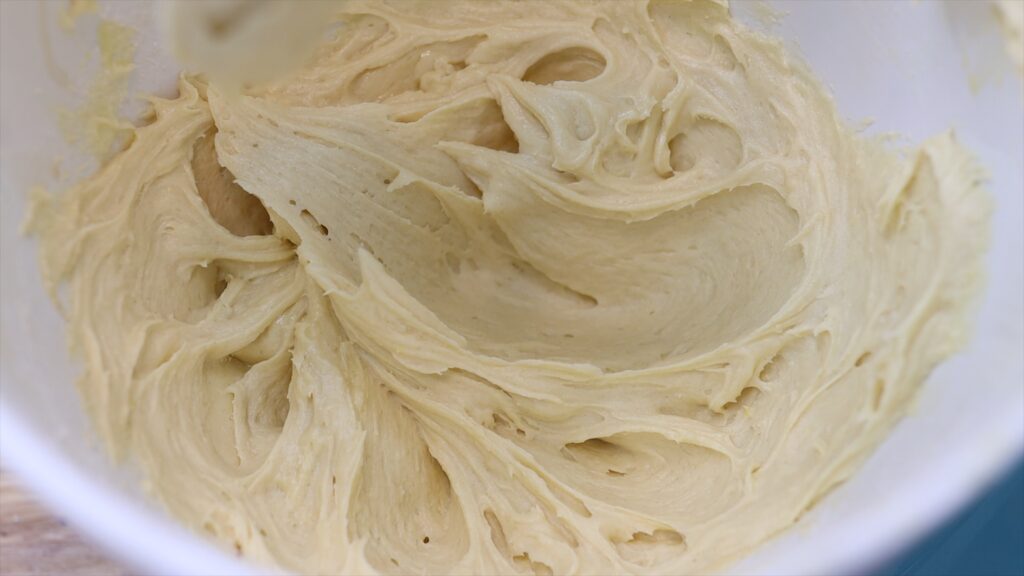
When the butter and sugar mixture gets lighter in colour and looks creamy instead of chunky or grainy, add the eggs. Mix them in until the batter becomes smooth and now we’re going to alternate between the dry and wet ingredients.
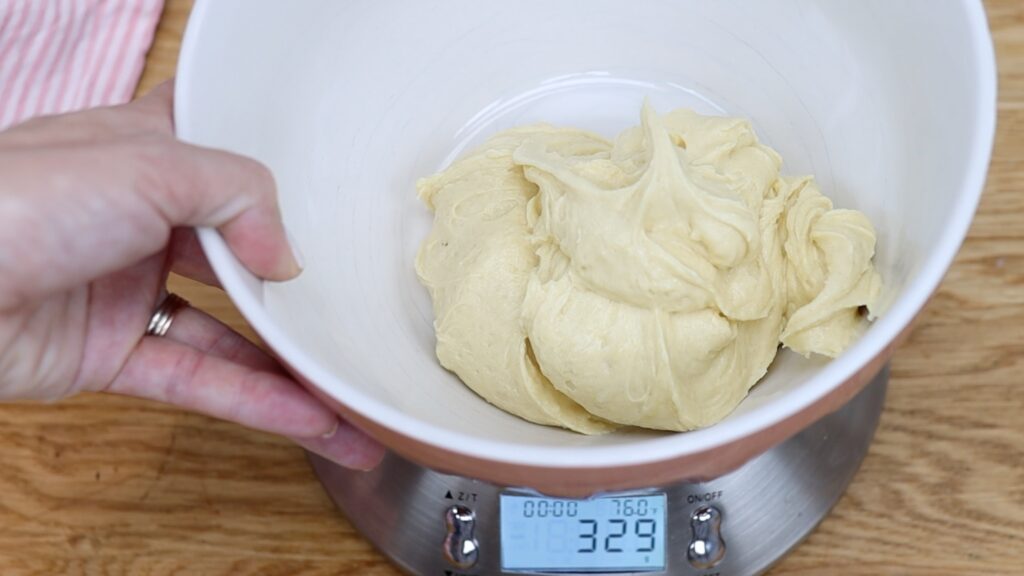
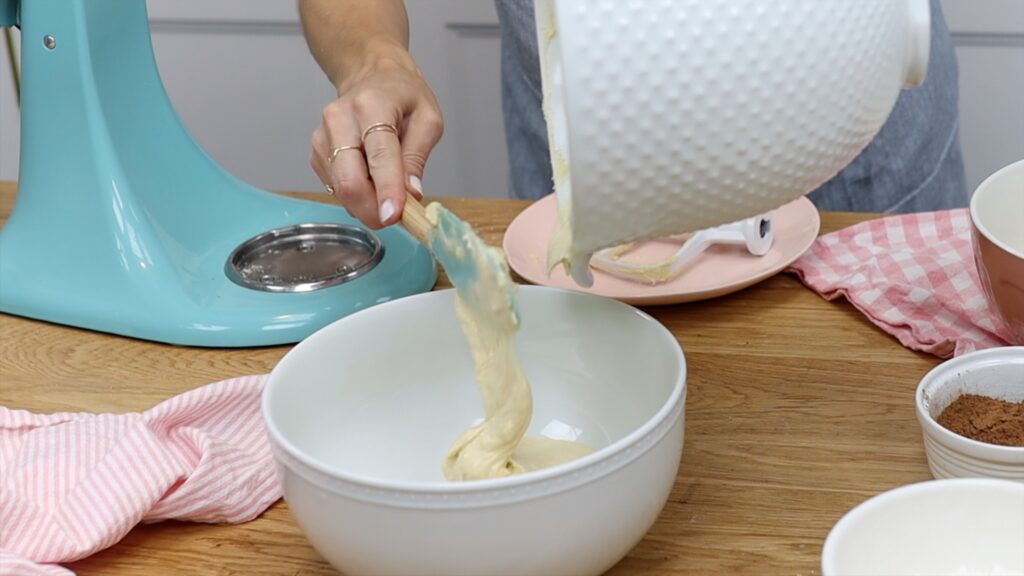
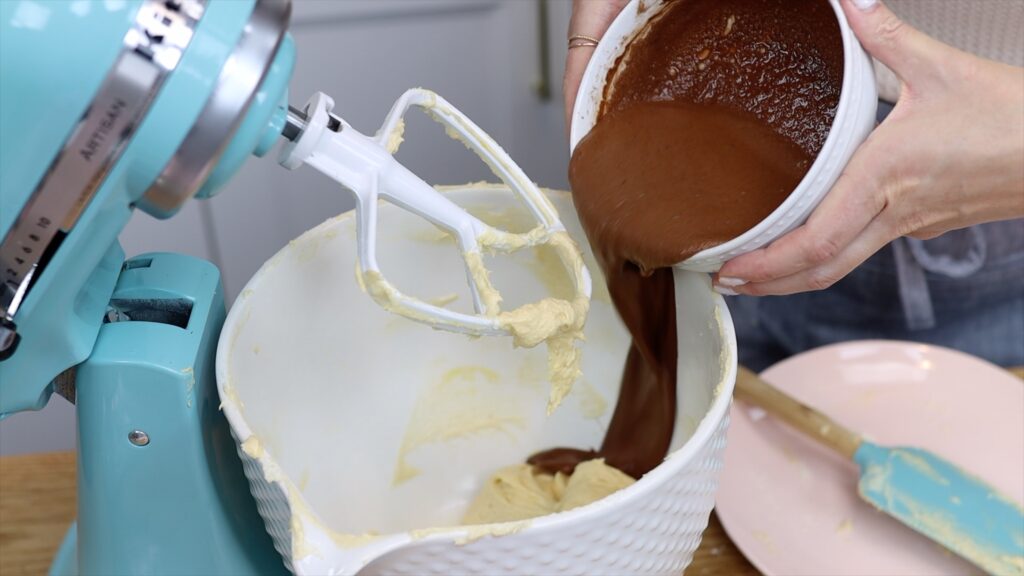
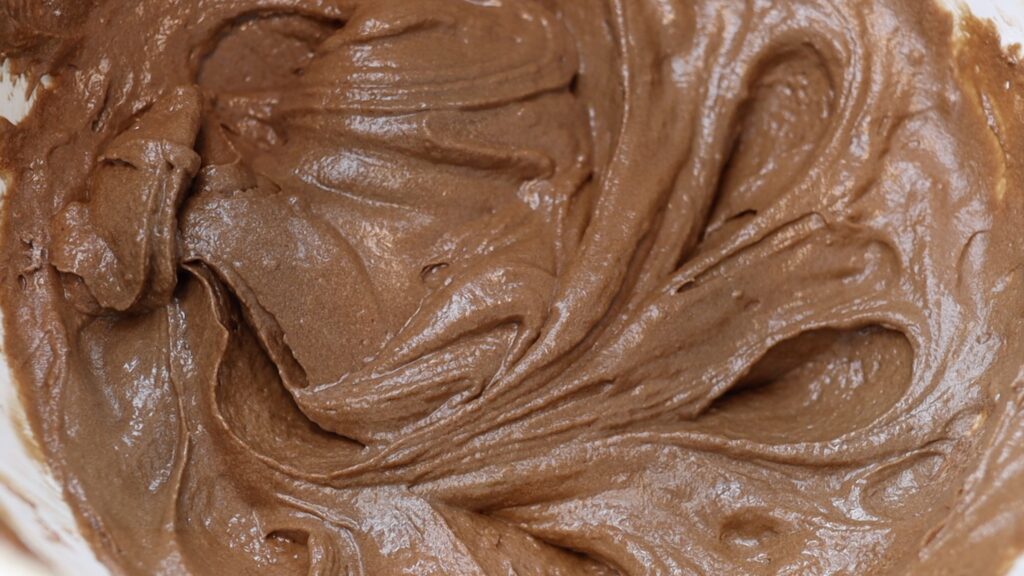
Start by adding about half of the dry ingredients and mixing those into the batter just until you can’t see any flour anymore. Then add the wet ingredients. Only mix until everything is incorporated because over-mixing will make the cake tough and dense. Add the rest of the dry ingredients and mix to combine. I like to use a spatula to scrape down to the bottom of the mixing bowl to check that everything has mixed together and there aren’t any clumps of flour stuck down there.
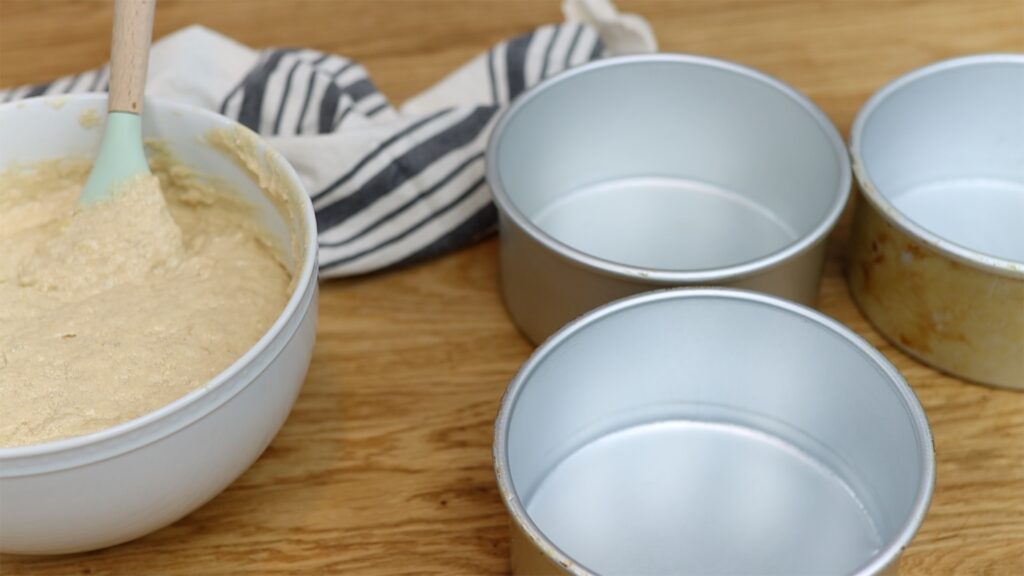
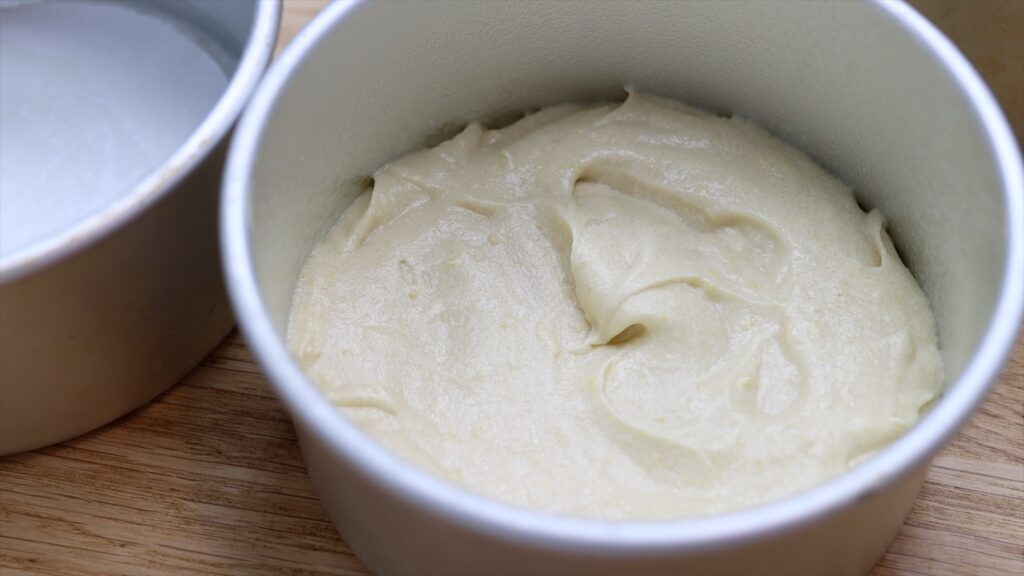
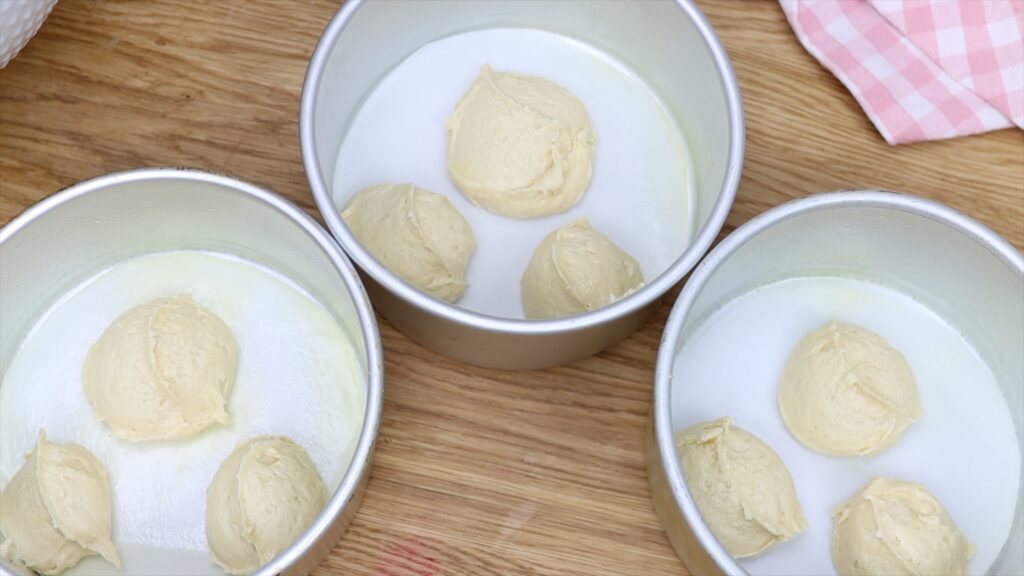
Now it's time to prepare the layers for this banana layer cake! Divide the batter between three greased pans. The recipe listed below is for a three-layer 6" cake but you can click the "X2" button to double it and make a three-layer 8" cake.
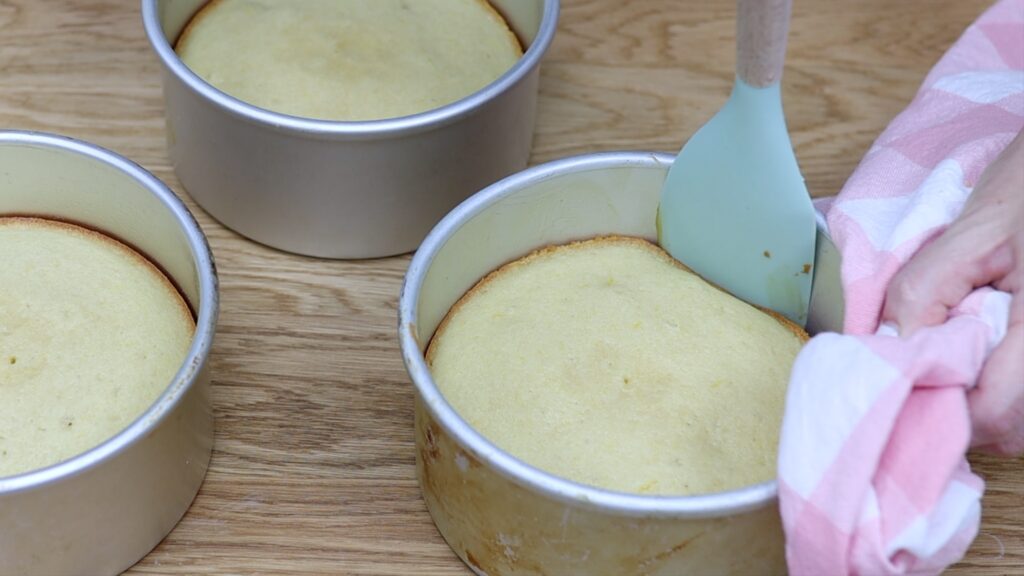
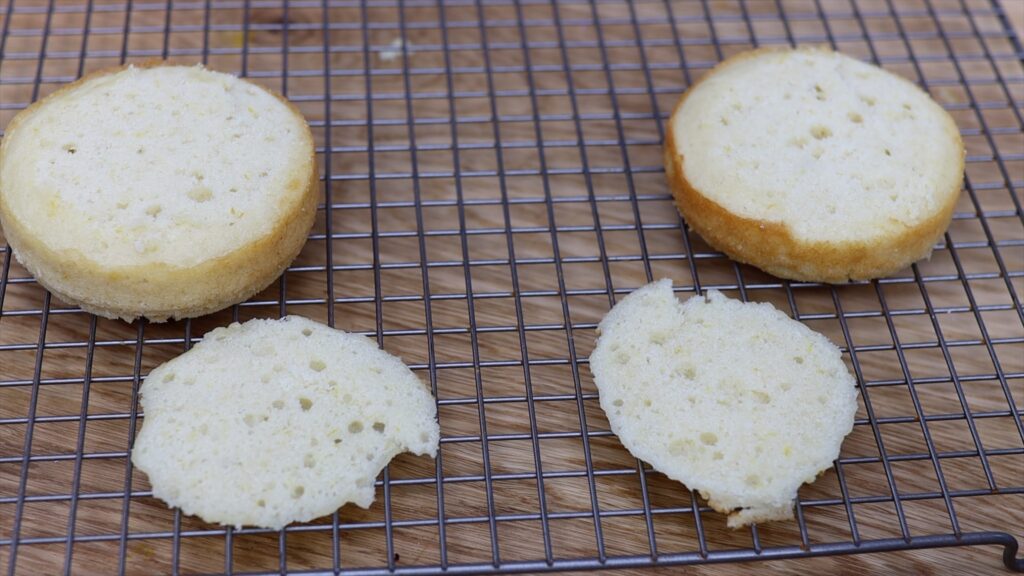
Bake the cakes at 325F or 160C for 35 minutes. Tryto resist that rich banana scent when they come out of the oven! Let the cakes cool slightly in the pans for five minutes before you turn them over onto a wire rack. This gives them a chance to firm up slightly so they don’t crumble. When they’ve cooled completely you can trim any domes with a serrated knife to make perfectly flat cake layers. Then assemble your cake!
How to assemble this banana layer cake
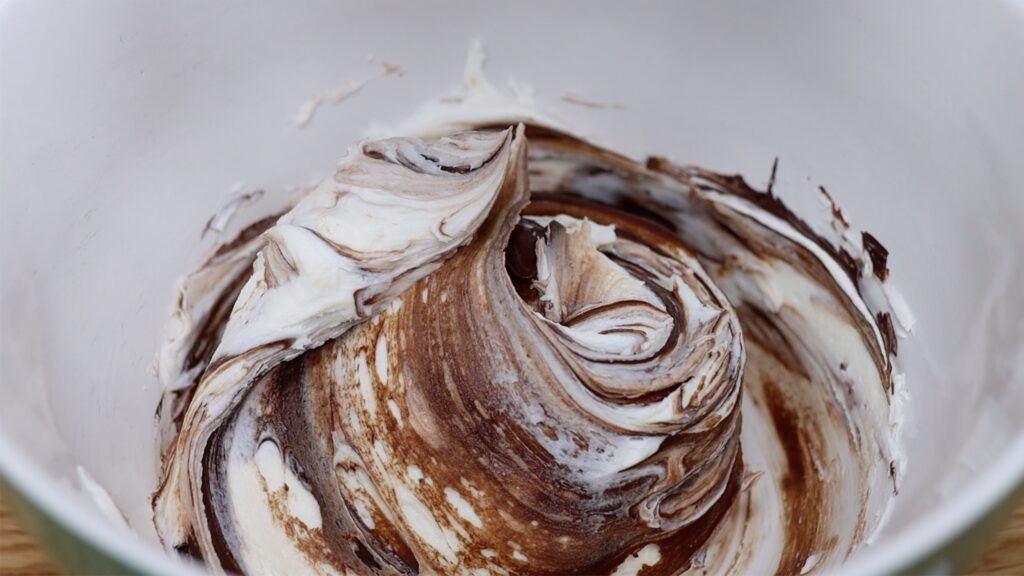
My favourite filling and frosting for this banana layer cake is my cream cheese frosting. My 4 Minute Buttercream pairs well with it too, either plain or after adding caramel or melted chocolate.
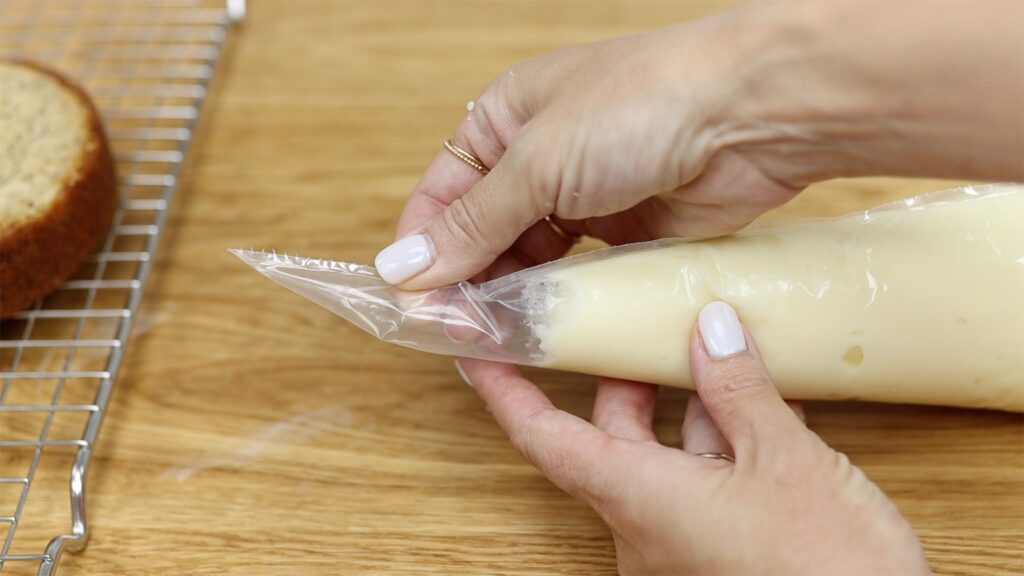
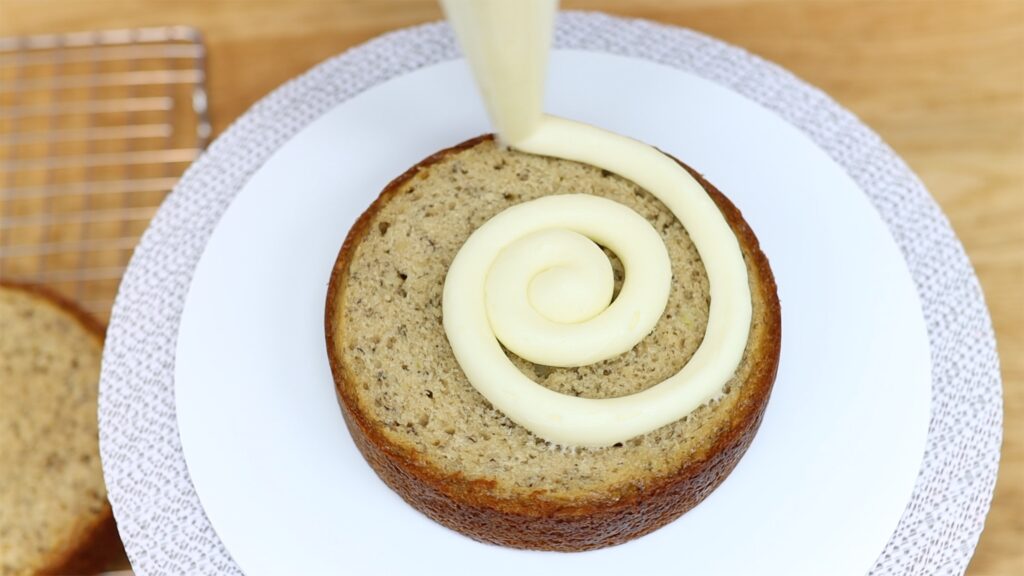
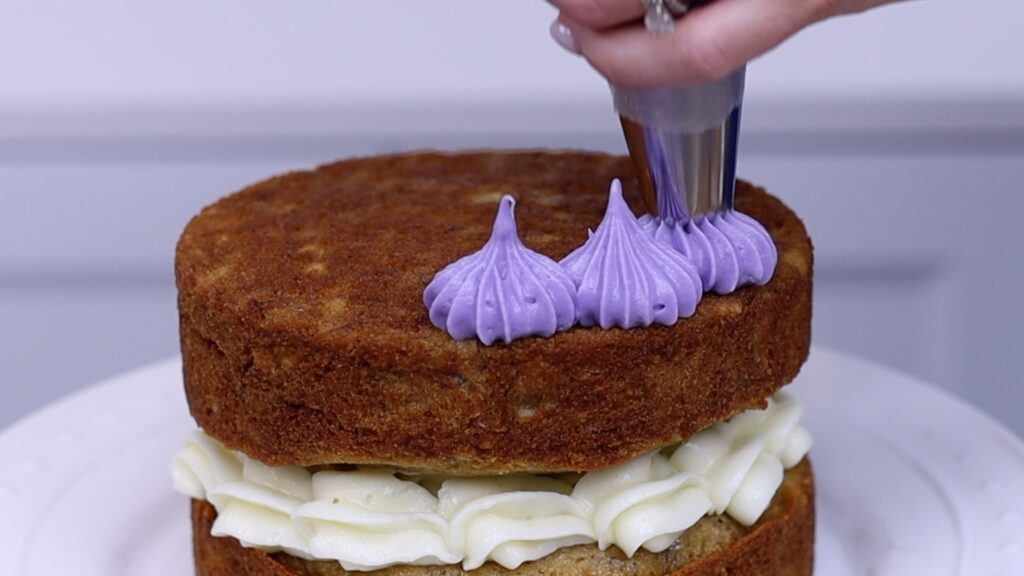
I like to pipe filling and frosting to save time. You don't need a piping tip to do this, just spoon the frosting into a piping bag and cut the tip off.
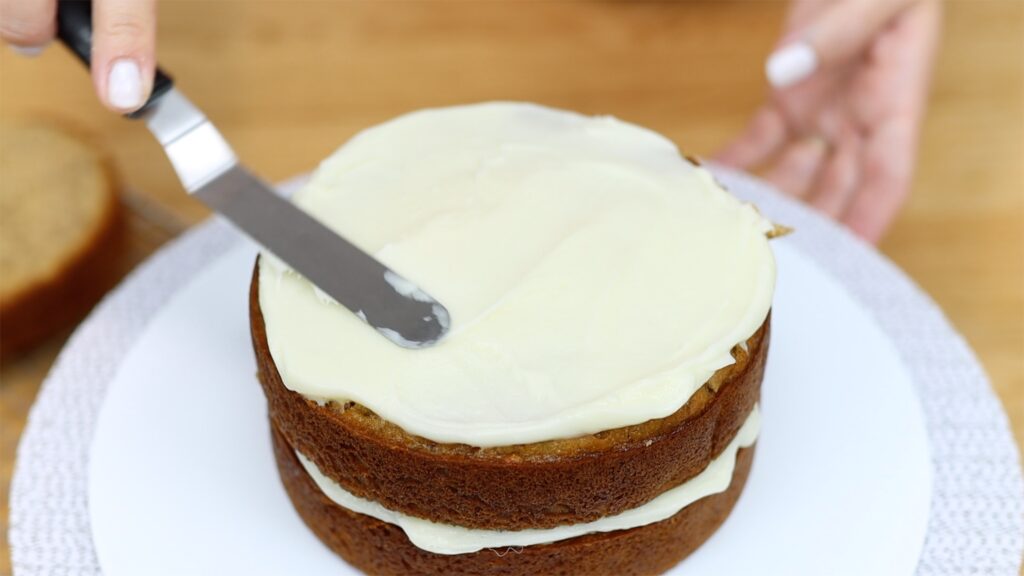
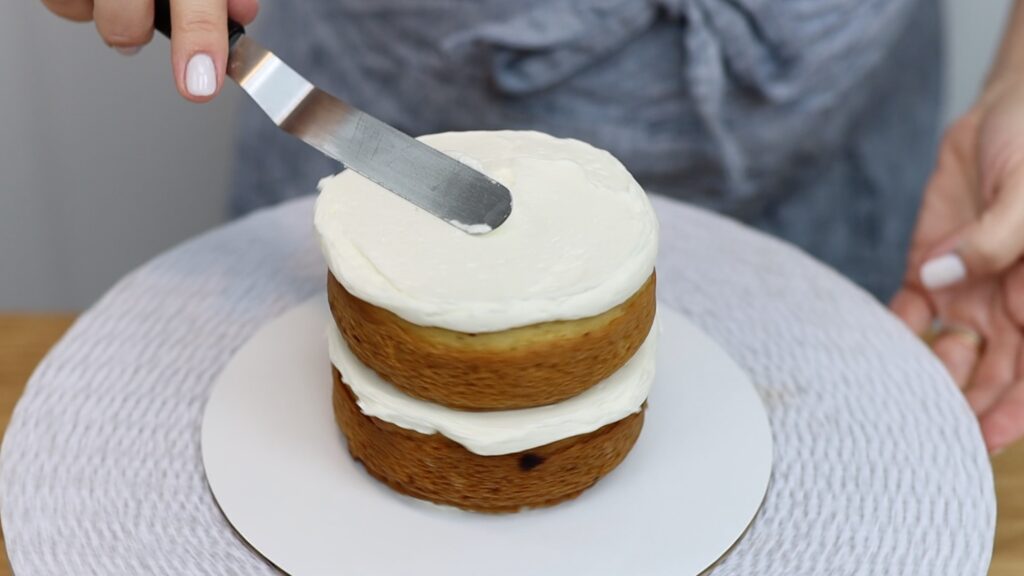
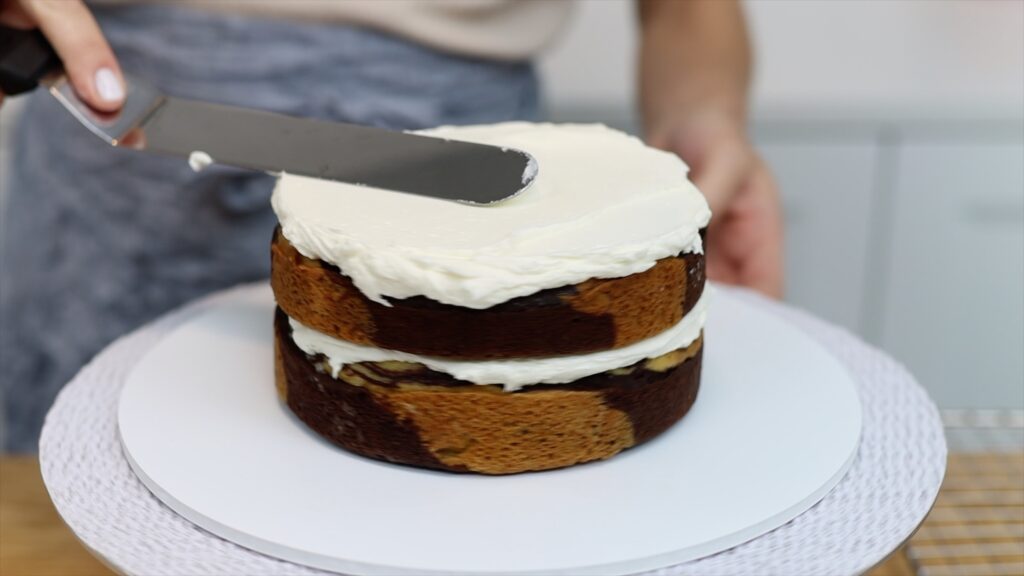
Pipe a dot of frosting onto a cake board and press the first layer of cake onto it. Pipe or spread filling onto it and then place another cake layer on top.
For the neatest frosting chill your cake in the freezer for 15 minutes before frosting it. This will make it less wobbly so you can spread and smooth the frosting more easily.
How to frost this banana layer cake
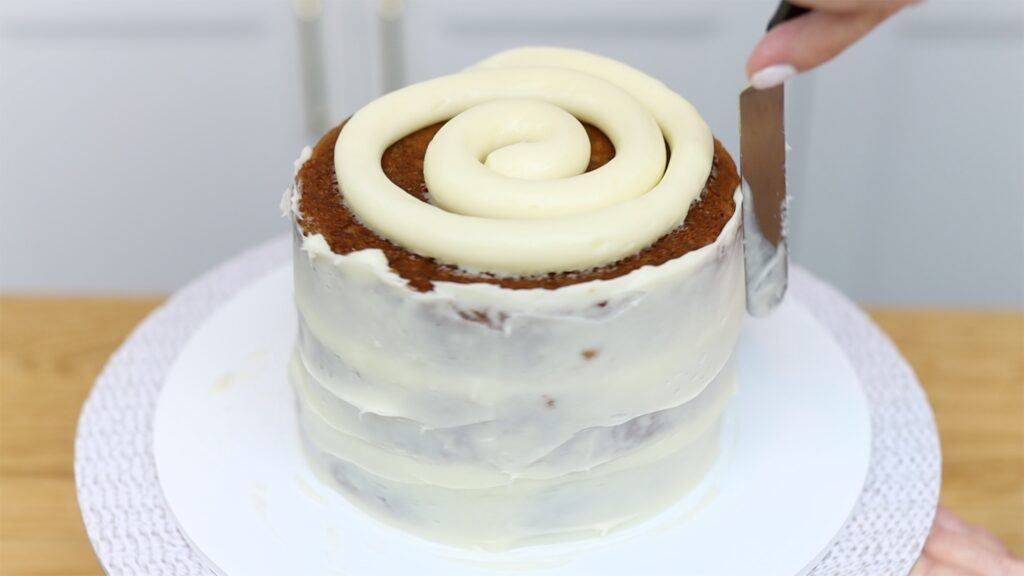
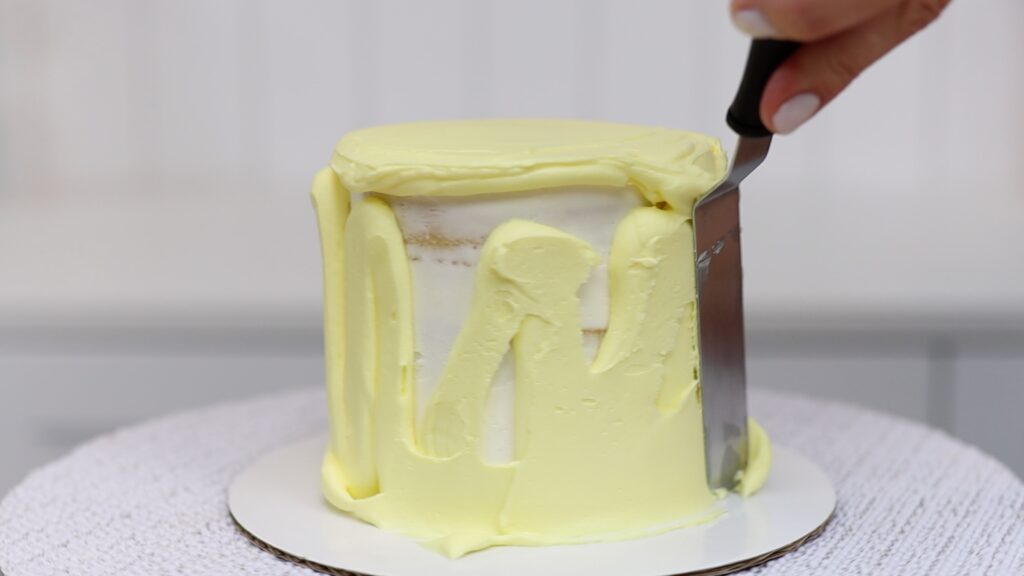
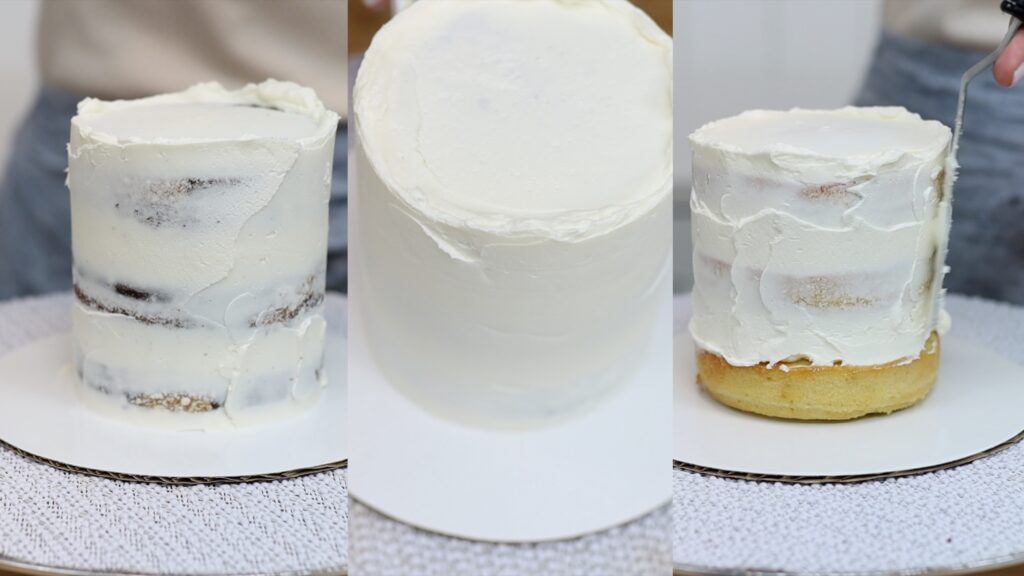
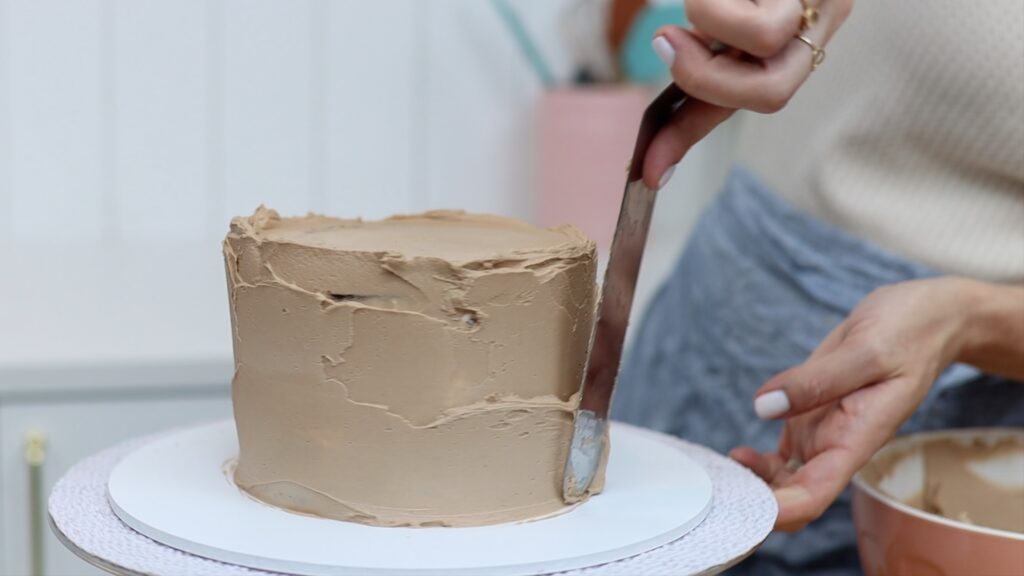
I always recommend doing two layers of frosting. Start with a very thin layer called a crumb coat, which traps any crumbs that come off the cake.
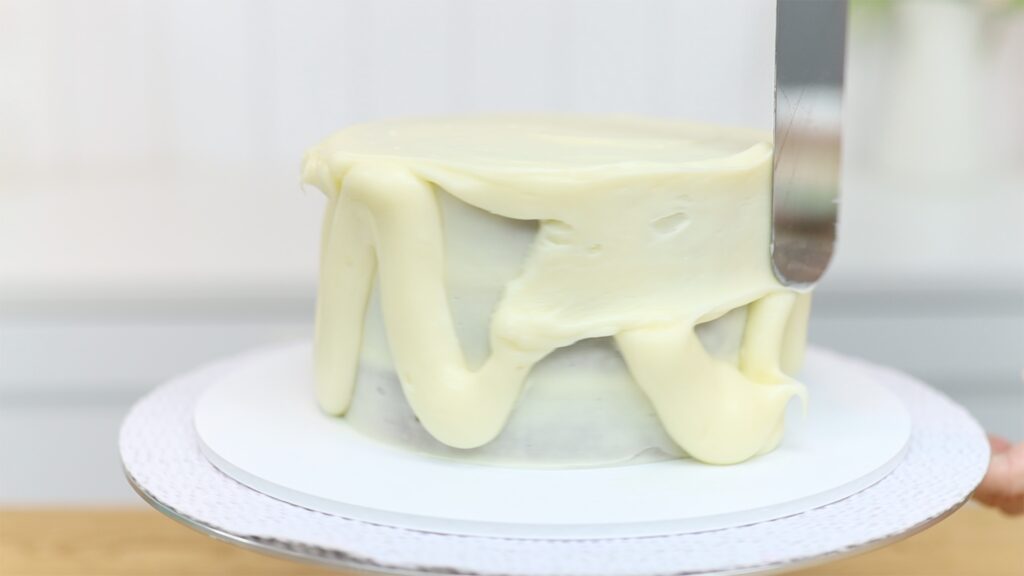
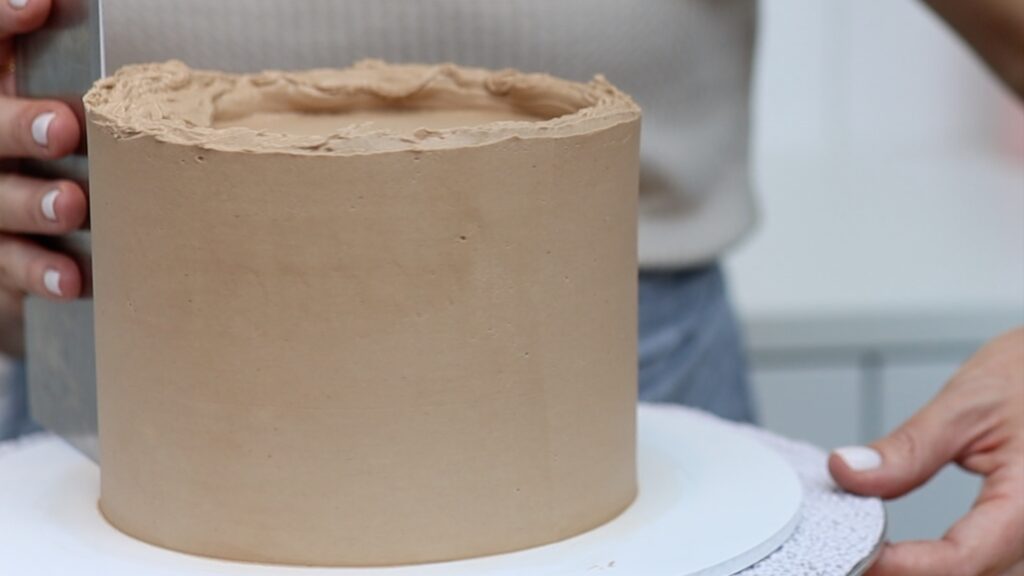
Then spread on a final coat, which sits on top of the crumb coat so no crumbs get into it. This layer of frosting will be thicker and since it will be visible, it’s worth taking the time to get the frosting smooth. I share all of my tips and tricks for frosting and piping with cream cheese in my cream cheese frosting recipe.
How to decorate this banana layer cake
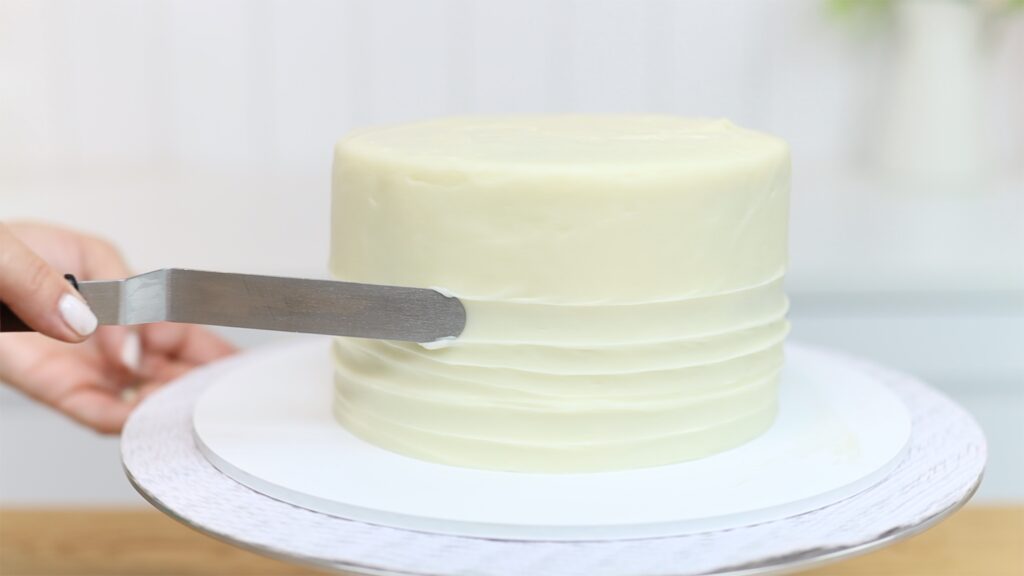
To decorate this cake really quickly I like to add texture. Spin the cake on a turntable as you slowly drag an offset spatula or the back of a spoon up the sides of the cake. You'll leave grooves in the frosting that look simple but stunning!
This banana cake can be stored in the fridge for a week. It tastes best at room temperature so take it out 2-4 hours before you serve it so the cake and frosting warm up and soften. For the neatest slices, run your knife under hot water before cutting into this. Yum yum yum!
This banana layer cake is full of banana flavour and it’s incredibly moist without being overly sweet.
Ingredients
UnitsScale
1/2cupunsalted butter at room temperature
1/2cupwhite sugar
1/2cupbrown sugar
1 teaspoon vanilla
2 eggs at room temperature
2cupsflour
1 teaspoon baking soda
1/2 teaspoon cinnamon
1/4 teaspoon salt
1cupmashed bananas (about 2 bananas)
1cupmilk at room temperature
Instructions
Take all of the refrigerated ingredients out of the fridge two hours before baking. Ingredients will mix together best at room temperature, preventing the cake from being dense and dry.
Mix the butter, sugars and vanilla at medium speed until light and creamy. This will take about three minutes with an electric mixer.
Add the eggs and mix until combined.
In a large bowl, whisk the flour, baking soda, cinnamon and salt together. Add half of this mixture to the batter and mix to combine, only until the flour is no longer visible.
In another bowl, mash the bananas and add the milk. Pour into the batter and mix to combine.
Add the rest of the flour mixture to the batter and mix to combine.
Divide the batter between three greased pans and bake at 325F or 160C for 35 minutes, until you can poke the cakes without leaving an imprint in the top.
Leave to cool and then assemble with the filling and frosting of your choice!
Notes
To make a three-layer 8" cake, double the recipe by clicking "X2" at the top right of this printable recipe
If you use salted butter, leave out the salt in the recipe
Use this cream cheese frosting for piping, smooth frosting and glazes. It's not too sweet and pairs perfectly with loads of cake and cupcake recipes, like my Banana Layer Cake and One Bowl Carrot Cake. In this tutorial I'll show you everything you need to know about making it, colouring it and storing it, too!
How to make cream cheese frosting
To make cream cheese frosting, the key is to use room temperature ingredients. This will prevent a lumpy bumpy mess.
It’s important to use cream cheese from a block, not a tub. Avoid whipped cream cheese because that will be too soft and since it’s whipped and aerated, it will create air bubbles in your frosting.
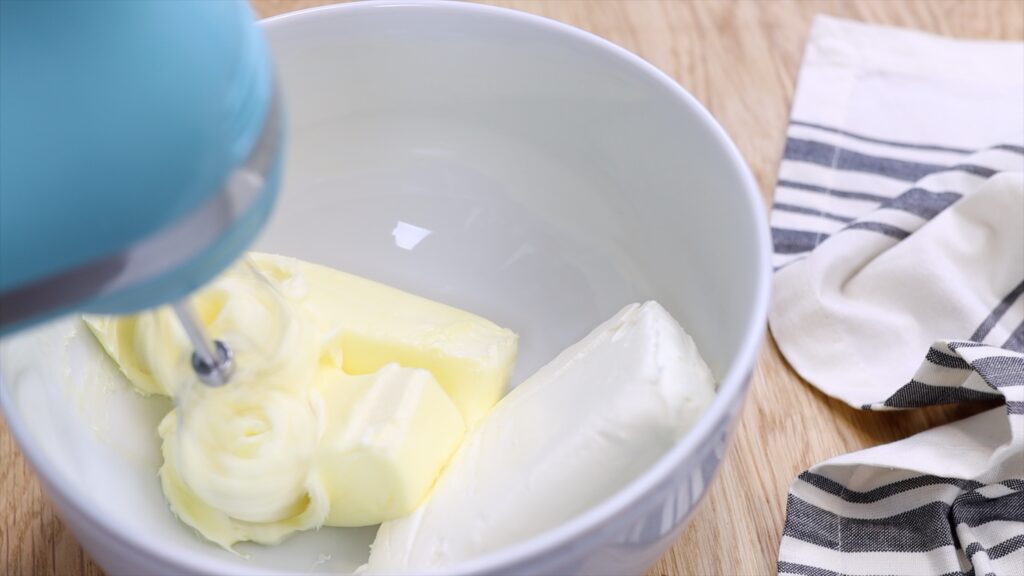
Take your butter and cream cheese out of the fridge four hours before you use them so they soften. This prevents lumps in your cream cheese frosting. The first step is to mix them together until they’re combined into a pale, smooth mixture.
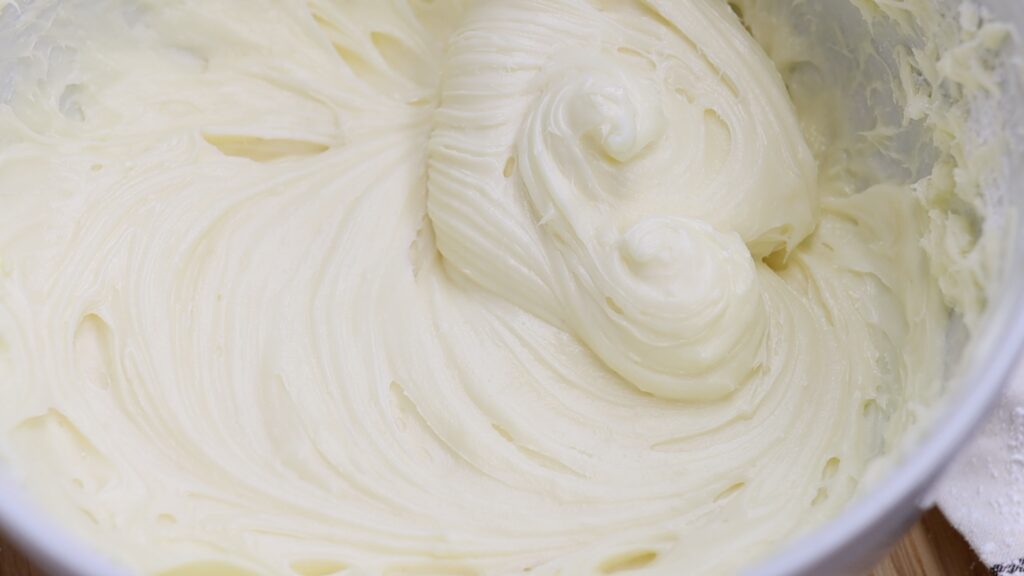
Add icing sugar or powdered sugar, which needs to be sifted so there are no lumps in that either. Don’t over-mix because you’ll break the cream cheese down and make the frosting too runny. Stop when its smooth and add vanilla and salt. Mix those until they’re combined, and now it’s ready to use!
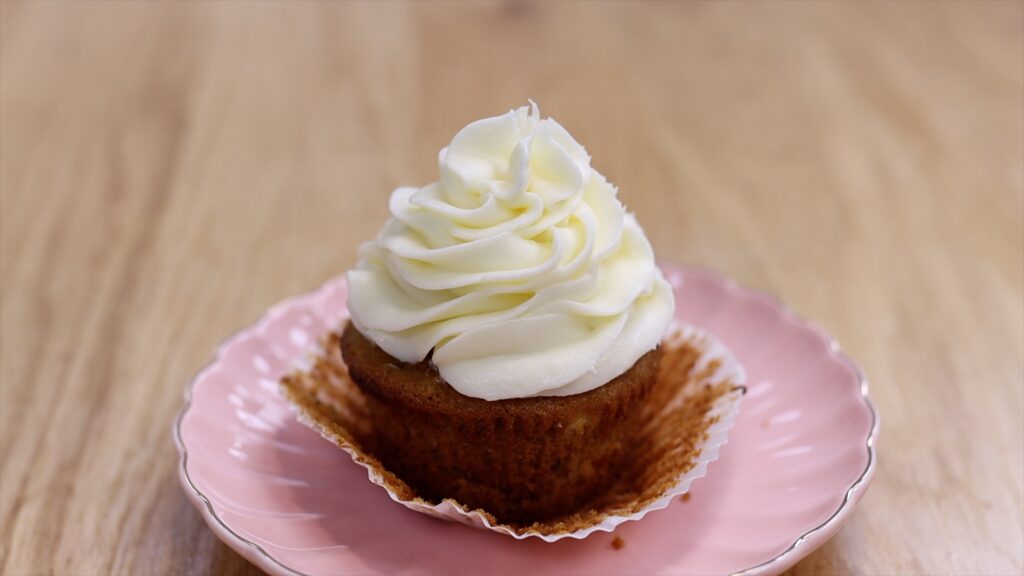
The quantity of sugar in this recipe is perfect for frosting a cake or to pipe a swirl on a cupcake. To adjust the stiffness of this cream cheese frosting just adjust the amount of sugar. If you want it to be less sweet you can use less sugar or use more sugar to make it sweeter. Be aware that with less sugar, the consistency will be runnier. The result will be much softer and less textured piping. With less sugar it will be difficult to frost a cake with smooth sides and sharp edges.
How to use cream cheese frosting to frost a cake
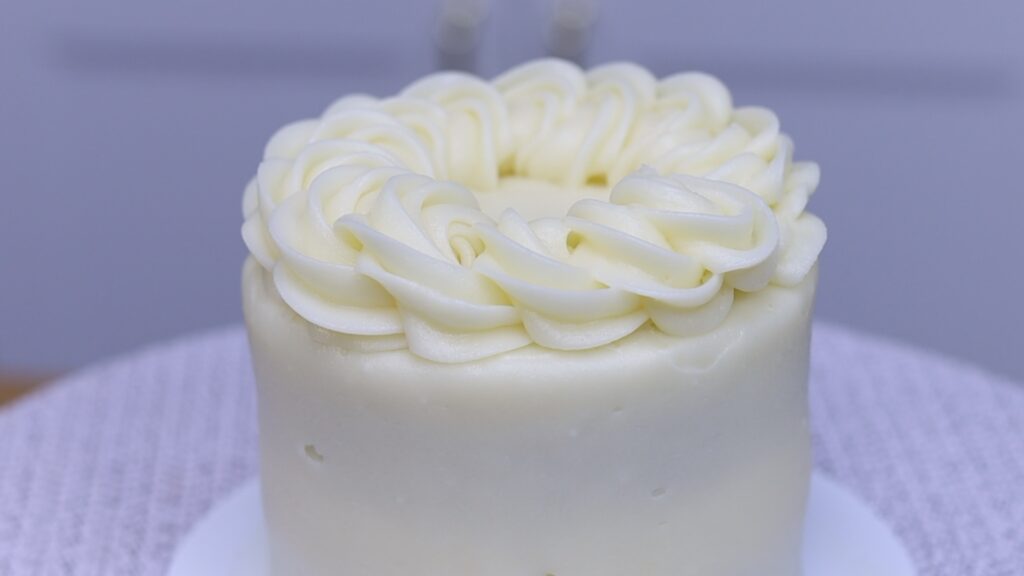
For really smooth frosting, follow the recipe as written to make your frosting. Then chill your cake in the freezer for 15 minutes before you frost it. Apply a crumb coat first, which is a very thin layer of frosting that catches and traps any crumbs that come off the cake so that they don’t get into your final coat of frosting. It’s especially important to use a crumb coat before your final coat of frosting if you’re using cream cheese frosting, which is more translucent or less opaque than regular buttercream frosting.
For the final coat, spread your frosting on generously. Push it up above the top edge of the cake and that will help you get sharp edges. Smooth the frosting with a cake comb, scraping around the cake several times. Touch up any indents by spreading more frosting over those and then smooth again until you’re happy with the sides. For the top, push sideways with an offset spatula. Don't push down because that will cause a bulge in the frosting around the top of the cake.
How to use cream cheese frosting for piping
You can pipe borders or swirls with this frosting and the texture will hold its shape. If the frosting gets softer as you pipe, it's from the warmth of your hands on the piping bag or the warmth of the room. Put the piping bag or bowl of frosting into the fridge for 5 minutes to chill it slightly. That will make the frosting stiffer so it will hold its shape better. You'll notice more texture and definition in your piping.
Cream cheese frosting isn’t as stiff as regular buttercream but it’s stable enough to support another layer of cake onto top. This means you can use it as filling for cakes, even for naked cakes!
How to colour cream cheese frosting
You can colour cream cheese frosting just like buttercream. I recommend gels over liquid colours because they’re much more concentrated so they’ll give you bright and bold colours without making the frosting too watery. As you tint cream cheese frosting, try to fold in the colour instead of stirring aggressively. As I mentioned before, if you over-mix cream cheese frosting you’ll break down the cream cheese and the frosting will become less stiff, or more runny. If that happens as you’re colouring it you can either put the bowl in the fridge for 5 minutes to chill it so that it firms up a bit or you can add more sugar, which will stiffen it. Cream cheese frosting pipes beautifully and has a gorgeous shine to it, too.
How to make a cream cheese glaze
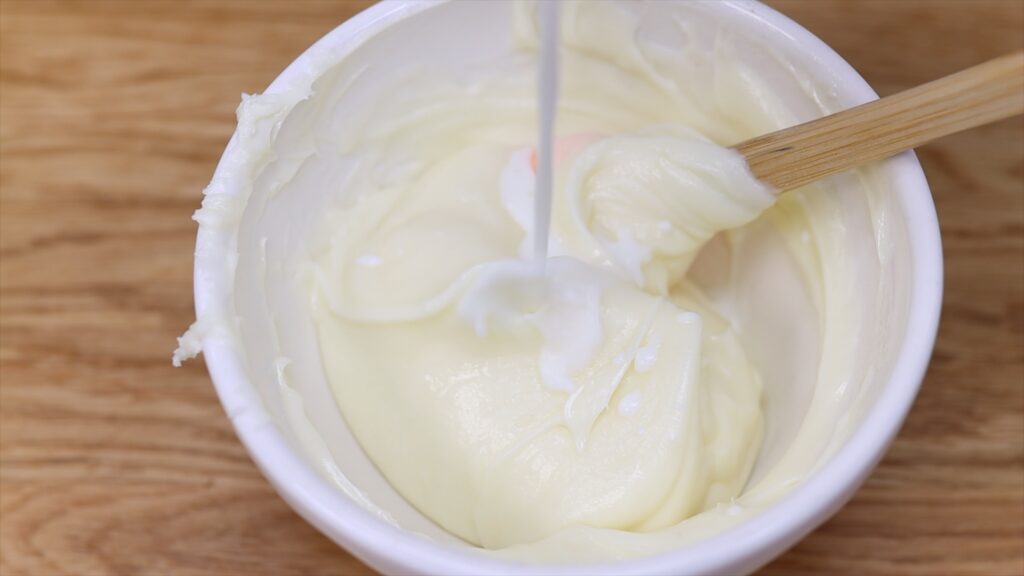
To use this cream cheese frosting as a glaze, microwave it for 30 seconds. Then add milk a spoonful at a time until you can drizzle it with a spoon. Spoon it onto your loaf or cake and it will run down the sides.
Although this will never set or crust to be firm, it’s thick enough that it won’t absorb into your cake and disappear! It’s just as tangy and rich and delicious as when it’s thicker and stiffer so it’s a very decadent topping for any dessert.
How to store cream cheese frosting
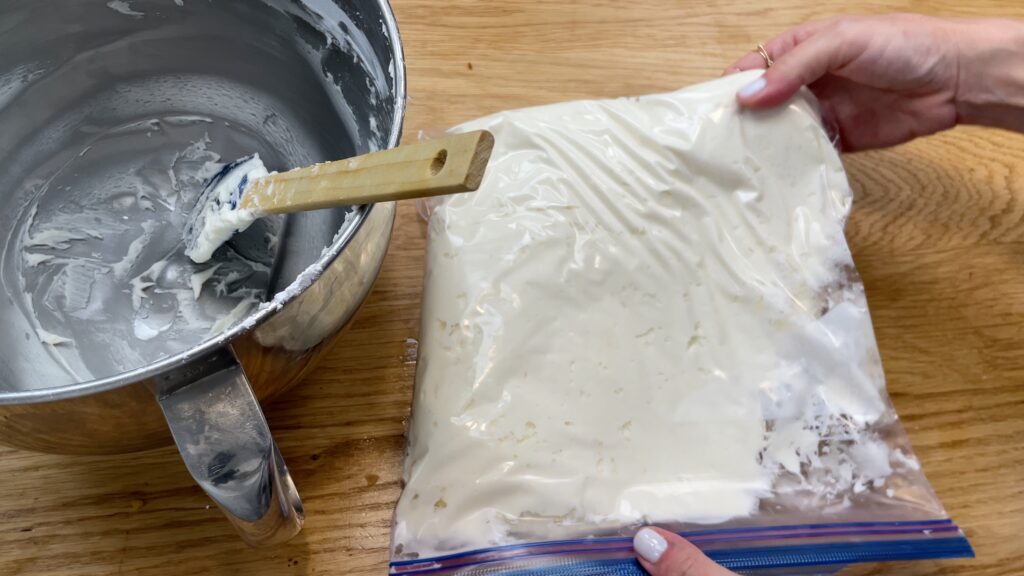
You can leave cream cheese frosting at room temperature for four hours. If you need to store it overnight, cover the bowl with plastic wrap and put it in the fridge. You can leave cream cheese frosting in the fridge for up two weeks or in the freezer for two months! I like to store cream cheese frosting in a ziplock bag so it doesn't take up much space.
When you take cream cheese frosting out of the fridge or freezer it will be very firm. Let it sit on the counter for about an hour before stirring it to knock out any air bubbles.
If you use cream cheese frosting on a cake, store that cake in the fridge. Take it out between two and four hours before serving to let it come to room temperature, when it will taste the best!
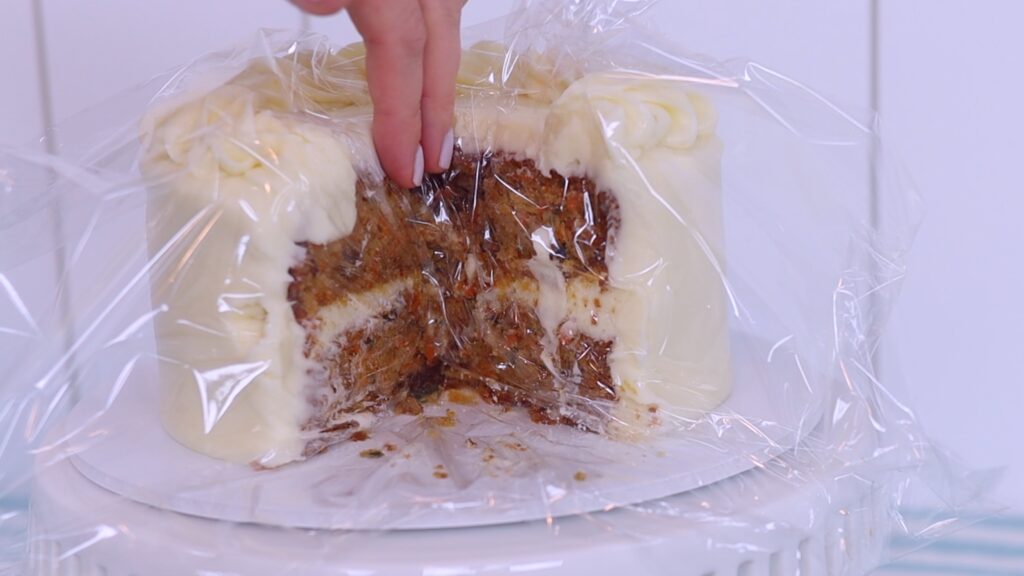
To save cake leftovers, cover any cut sides with plastic wrap to keep the cake moist. Put the cake in the fridge and take it out an hour before eating it.
Did I miss anything? Ask me in the comments below!
Here's the recipe for this cream cheese frosting for piping, frosting and glazes. You can adjust the quantities to use US (cups) or metric measurements. You can also scale the recipe up by using the buttons at the top of the recipe.
If you try this cream cheese frosting recipe, I’d love to hear what you think of it! Please leave a rating and comment below.
This is a cream cheese frosting for piping, frosting and glazes. It's not too sweet and it pairs perfectly with loads of cake and cupcake recipes.
Ingredients
UnitsScale
1cupbutter, room temperature
8ozcream cheese, room temperature
1lbpowdered sugar
1/4 teaspoon salt
1/2 teaspoon vanilla extract
Instructions
Put room temperature butter and cream cheese in a bowl and use an electric mixer to mix until smooth.
Sift powdered sugar and add to the bowl, mixing until incorporated.
Add vanilla and salt and mix to combine. The cream cheese frosting should be smooth and easy to stir. You mixer or spatula should leave soft peaks in it.
Notes
To fill and frost a three-layer 8" or 9" cake, double this recipe (click X2 at the top).
To make a glaze, microwave the cream cheese frosting for 30 seconds. Add milk a spoonful at a time until you can drizzle the cream cheese frosting as a glaze.
Store cream cheese frosting in an airtight container or a bowl covered with plastic wrap. You can leave it at room temperature for up to 4 hours or in an airtight container in the fridge for 2 weeks or in the freezer for 2 months.
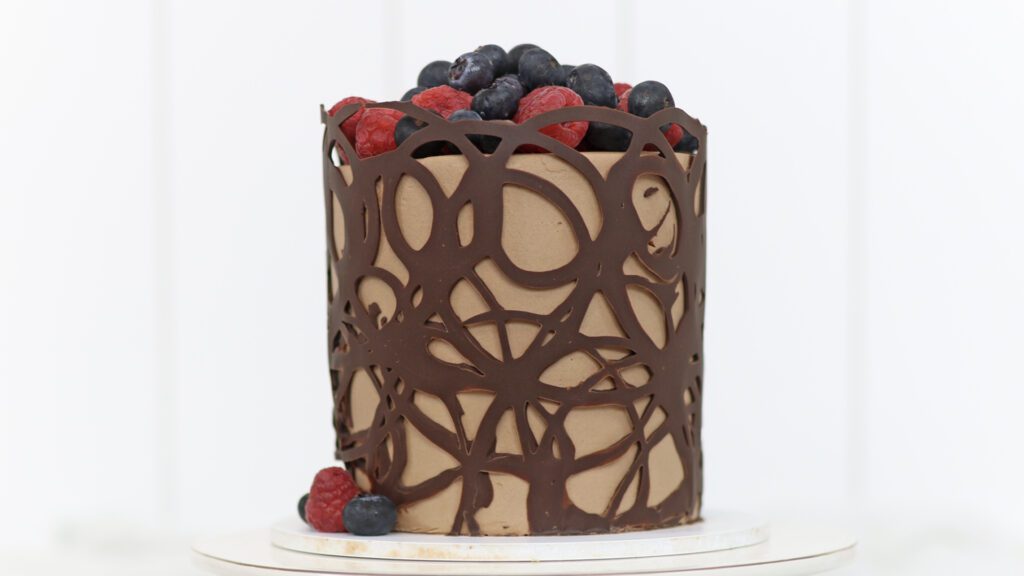
This chocolate collar cake design will make everyone ask how you did it and the secret is surprisingly simple, once you know a few tricks!
Let’s break the technique down into four steps.
STEP 1: Prepare the cake
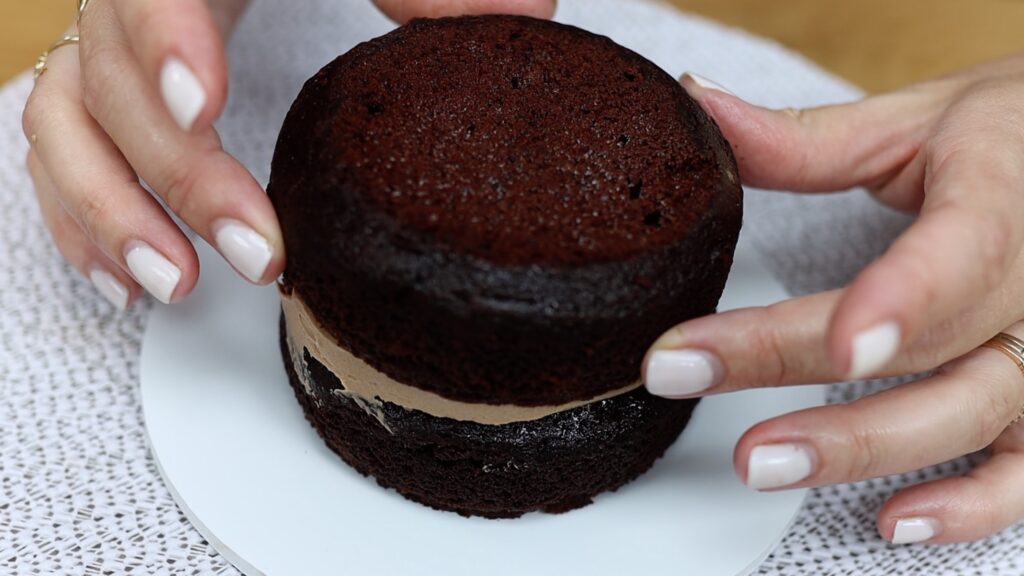
Starting with the basics, assembling a straight cake with give you the best results with this technique. Take your time to line each cake lay directly over the layer below so that the cake doesn't lean. Chilling the cake for fifteen minutes in the freezer or thirty minutes in the fridge will set the filling to hold the layers in place while you frost them. This way, they won’t slide or wobble around when you spread and smooth the frosting.
STEP 2: Prepare the collar
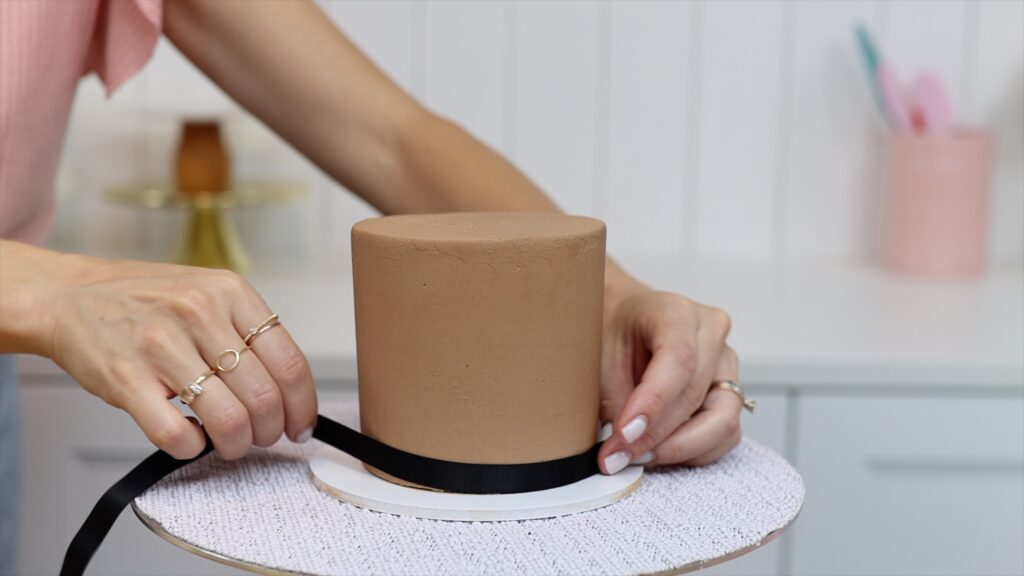
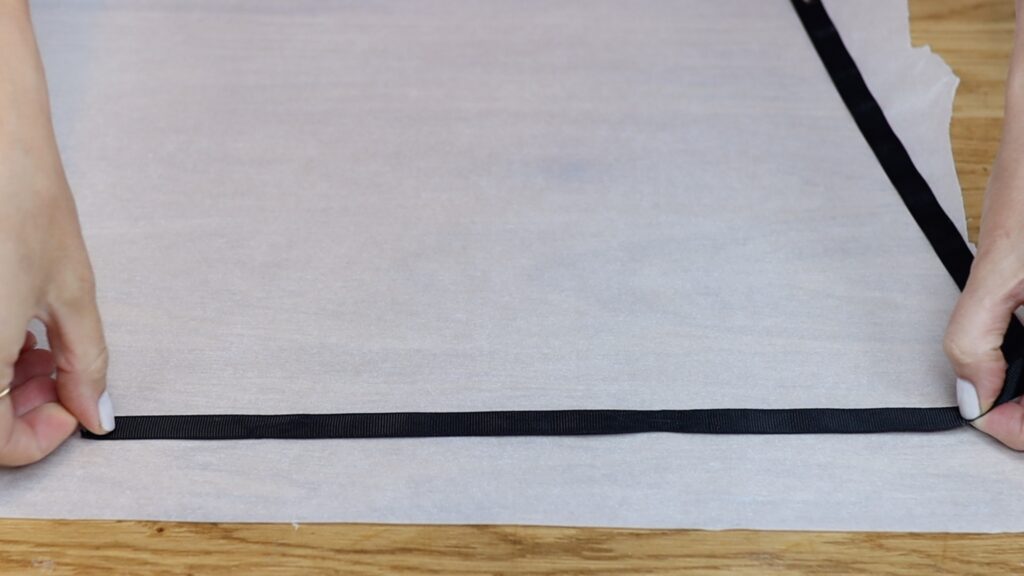
Chill the cake to set the frosting, which takes about an hour in the fridge. Wrap a ribbon or string around the cake to measure the circumference and also the height of the cake. Then place that on a piece of parchment or wax or baking paper and cut the paper so it’s the same length as the ribbon. For the height, about an inch taller than the cake is ideal. Now put the cake back in the fridge.
To make a design you’ll need melted chocolate. Melting chocolate is something people tend to struggle with but here are two tricks. First, only heat the chocolate for thirty seconds at a time in a microwave. Secondly, adjust the power to 80% to heat it gently so that it doesn’t burn or seize. When you take it out of the microwave, stir the chocolate to spread the heat since microwaves tend to create hot spots. Then heat for another thirty seconds, also at 80% power. Stir until the chocolate is smooth with no lumps.
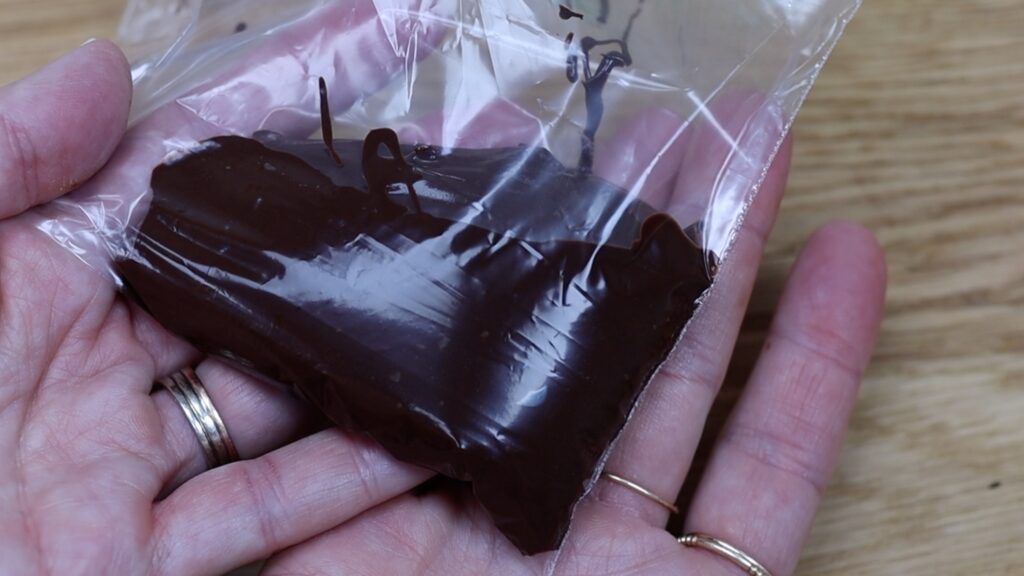
Pour it into a sandwich bag and cut a tiny piece off one of the bottom corners of the bag. You'll squeeze the chocolate through this hole. If the hole is too small your chocolate won’t pipe in smooth lines, like the chocolate on the right in the photo below. Also, the lines will be so thin that they’ll be very fragile. Look at the difference between that and the chocolate on the left. I cut a little bit more off the corner for those and the lines are thicker and smoother and neater.
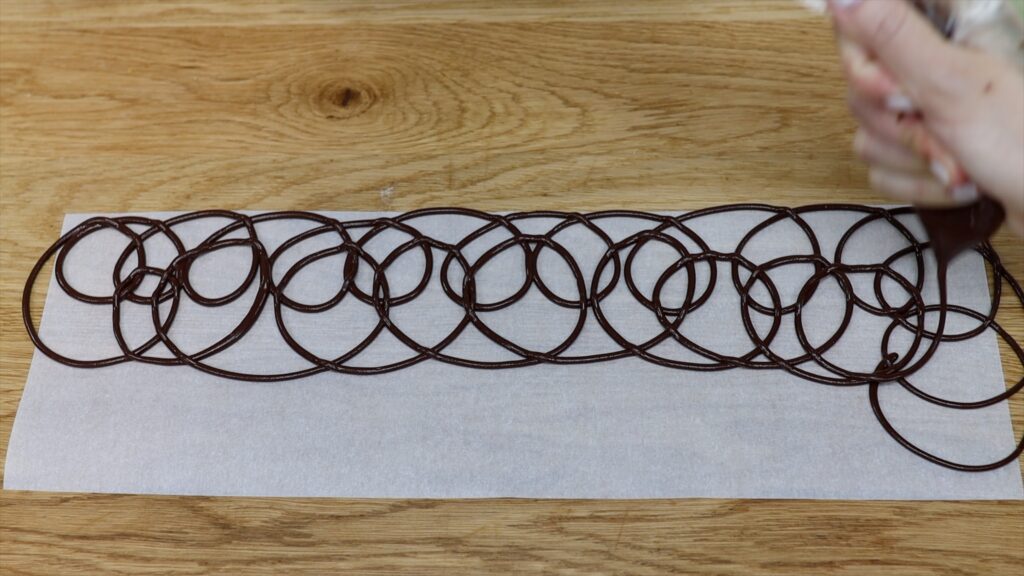
Cover your paper with loops or whatever design you want to create, keeping in mind that the closer the lines or loops or squiggles are to each other, the stronger the chocolate collar is going to be.
STEP 3: Wrap the cake
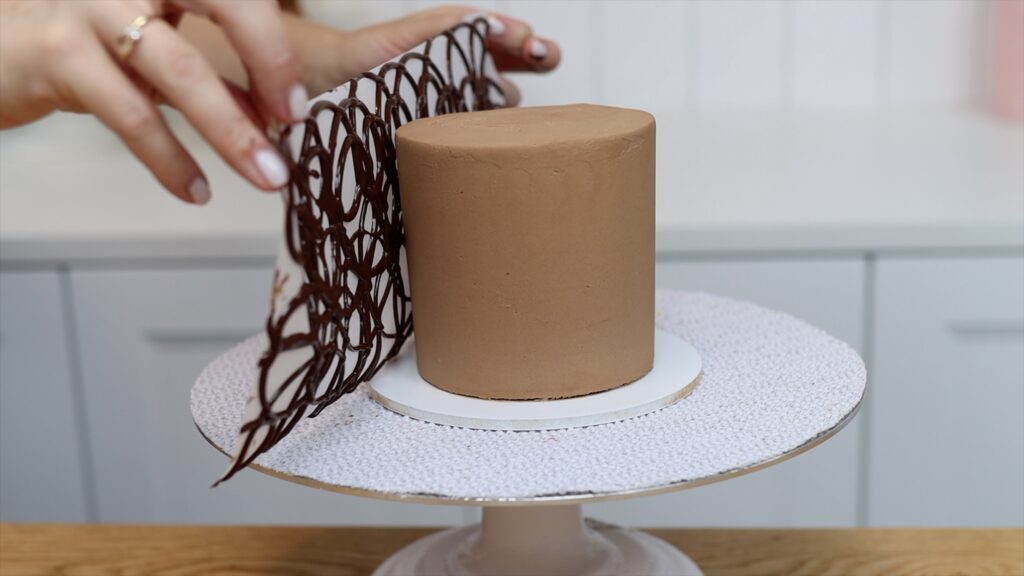
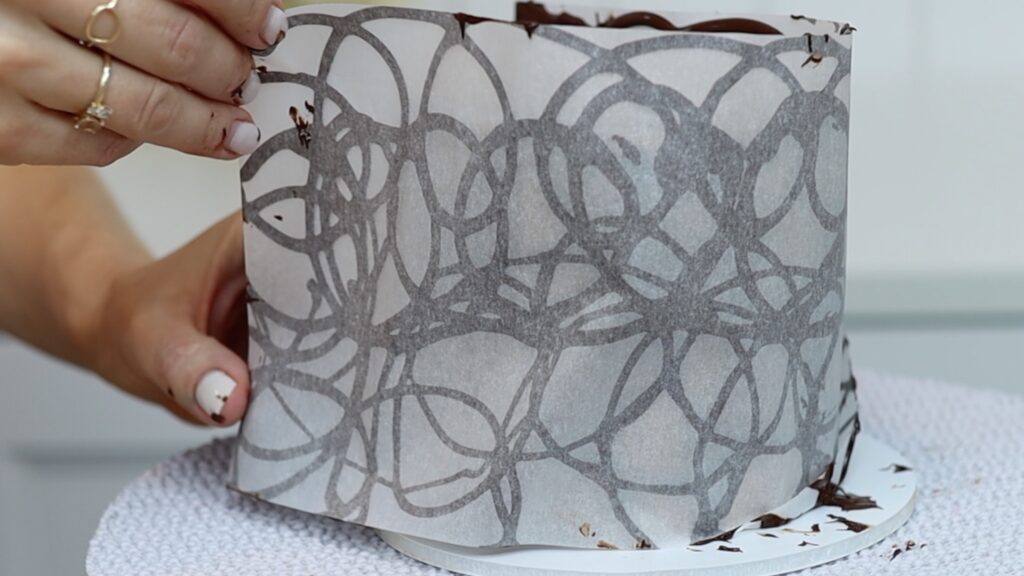
Take your cake out of the fridge and lift the chocolate design up straight away, before the chocolate sets. Lower it down to the cake, resting the bottom edge of the paper on the cake board so that the design goes all the way to the bottom of the cake, and wrap it around the cake to attach it to the frosting.
If you can do this without getting chocolate all over your hands, please tell me your secret in the comments! The paper will overlap itself where the beginning meets the end and that’s fine. Put the whole cake back in the fridge for an hour to set the chocolate.
STEP 4: Unwrap the chocolate collar cake
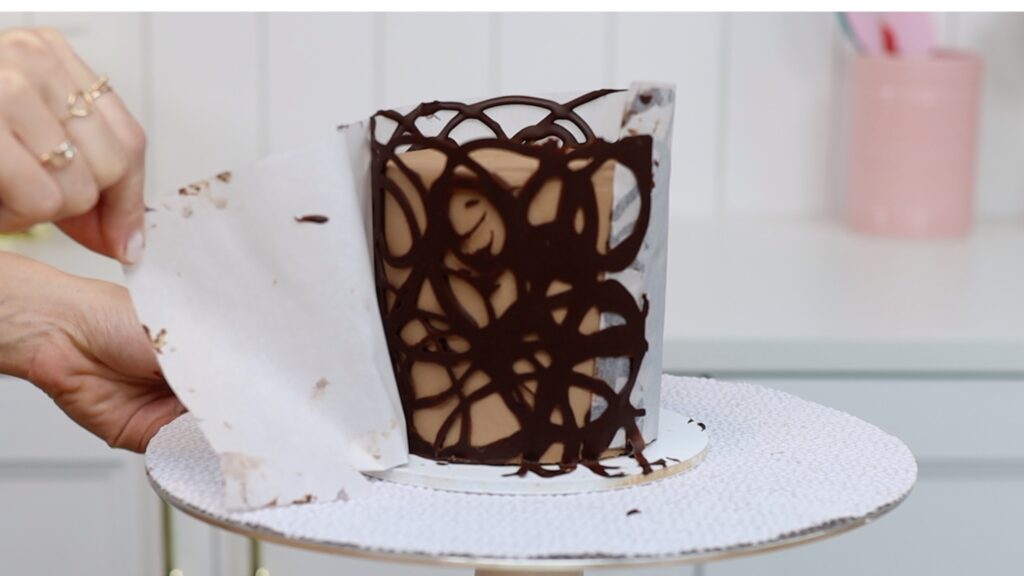
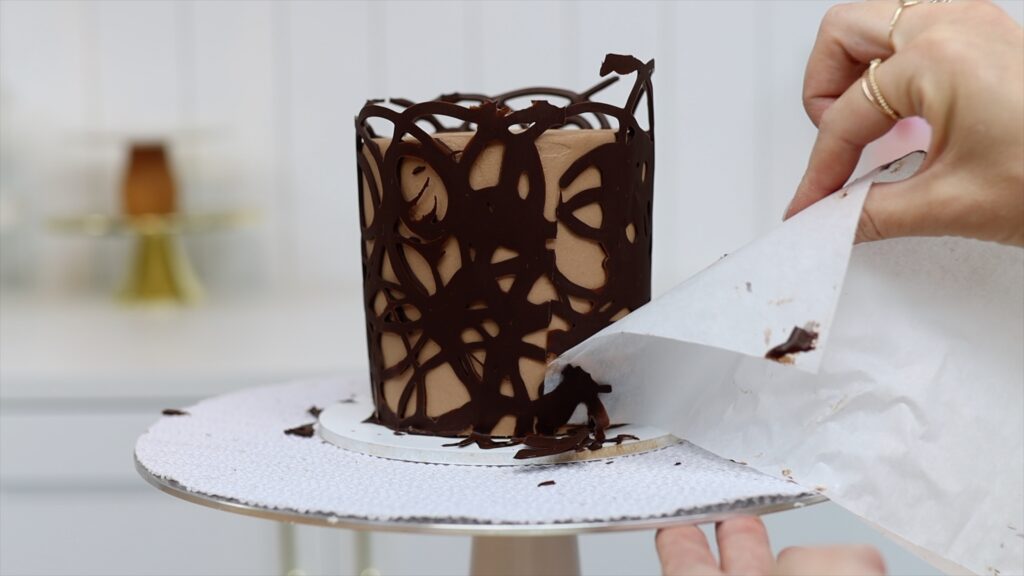
After the chocolate sets, pinch the top corner and slowly peel the paper away from the cake. I love unwrapping and exposing the chocolate collar cake underneath!
The paper will stick where the overlap was so for that, peel downwards to snap off the excess chocolate and leave a neat seam along the join of the design.
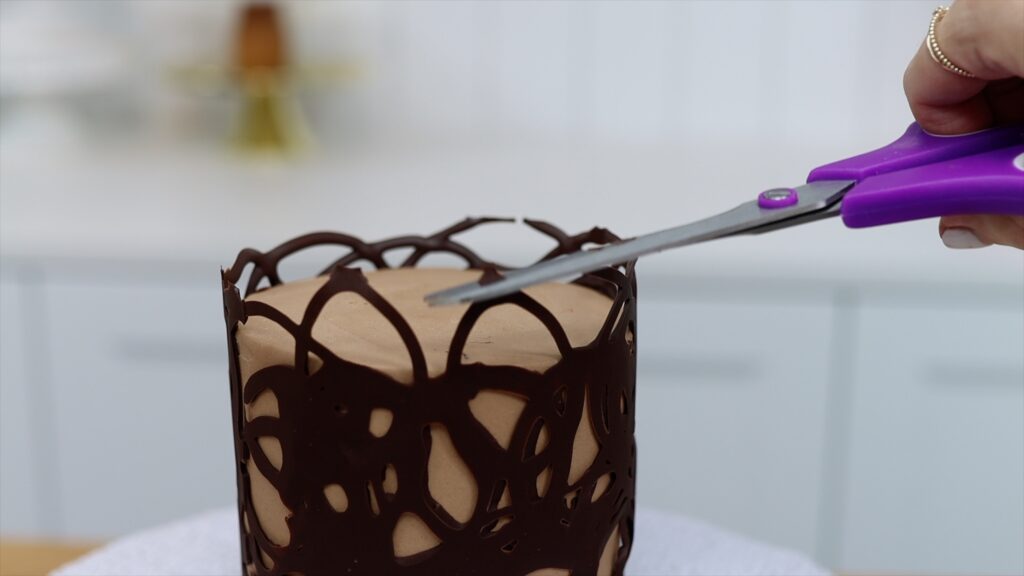
To tidy up the cake board, use a sharp knife or the edge of your offset spatula to scrape off any chocolate stuck to the board. You can wipe any smudges off the board with a paper towel wrapped around your finger. The chocolate will soften at room temperature so after a few minutes you can trim around the top edge of the design with scissors to tidy that up, too.
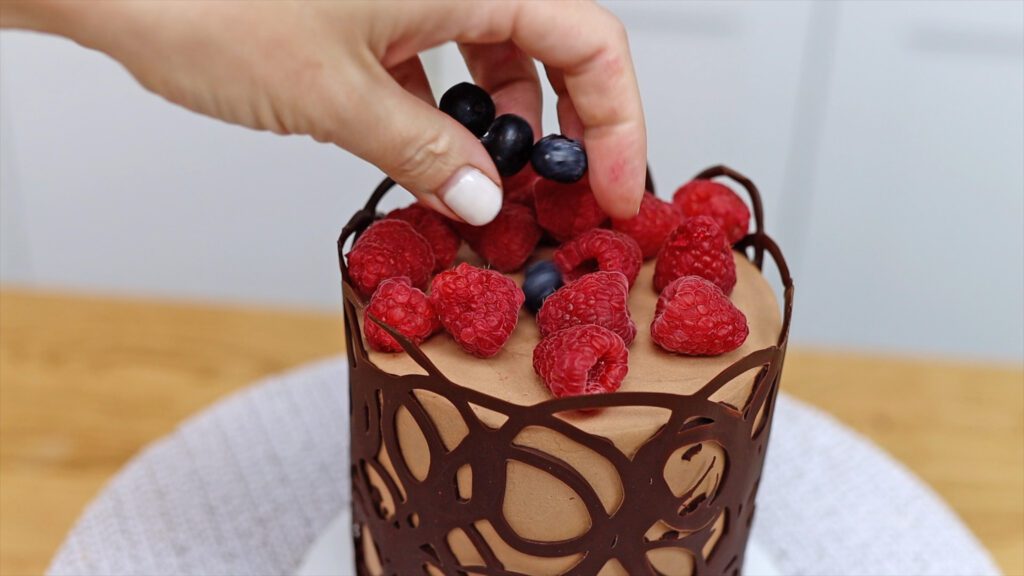
I don’t recommend wrapping a design any more than an inch above the top of the cake because the chocolate can droop at room temperature. The chocolate sticking up creates a wall which you can fill with fruit, chocolate truffles, flowers, or any other decorations you like!
If it’s hot, it’s best to store the cake in the fridge to keep the chocolate design stable.
How to serve a chocolate collar cake
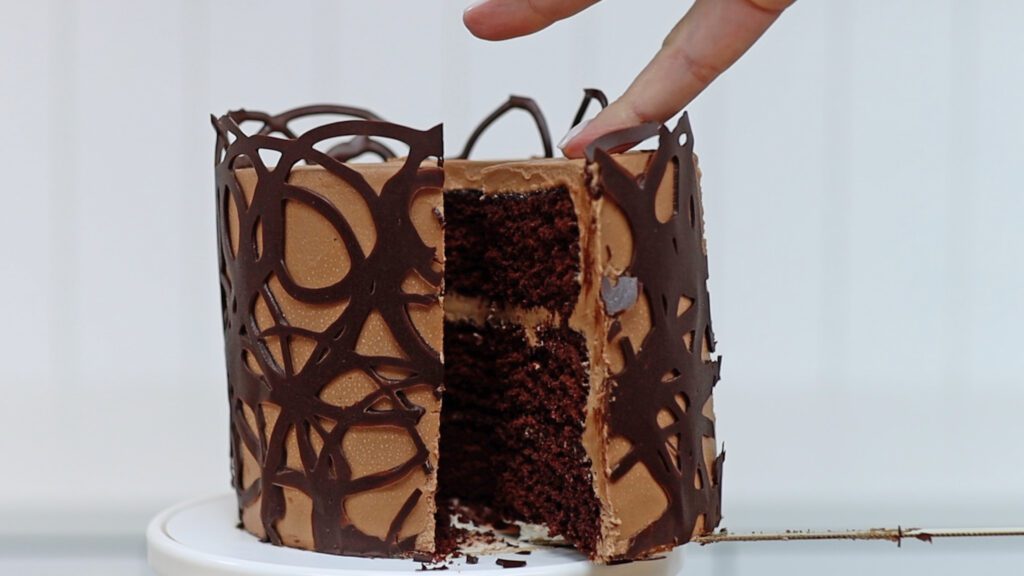
It's easiest to serve a chocolate collar cake when it's at room temperature. If the cake has been in the fridge, take it out an hour or two before you serve it so that the chocolate collar softens. The cake and frosting will taste better at room temperature, too. Run your knife under hot water before you cut into the cake for the neatest slices.
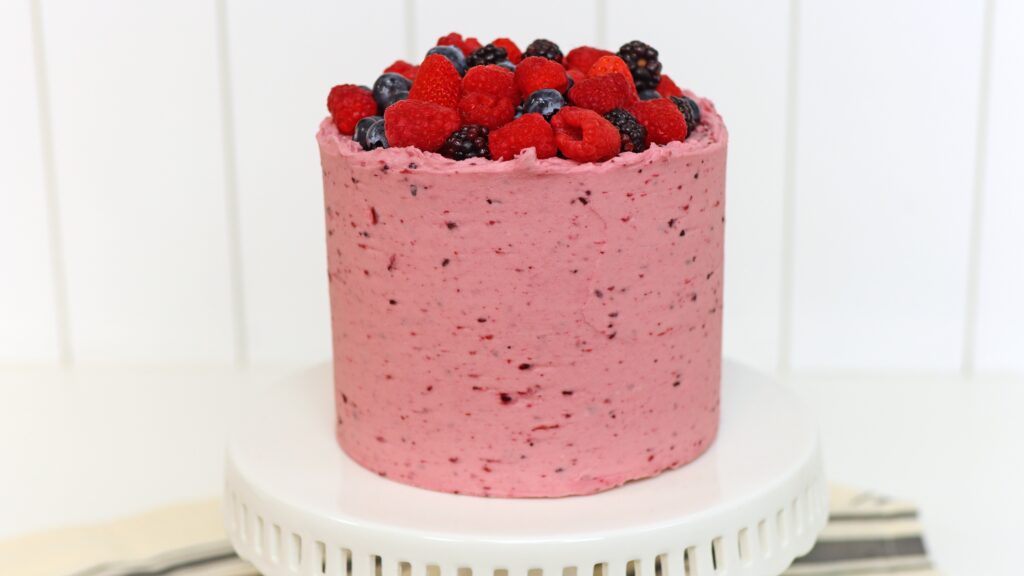
Here are nine ideas of ways to decorate a cake with berries, making it beautiful and delicious!
#1 Mix berries into frosting
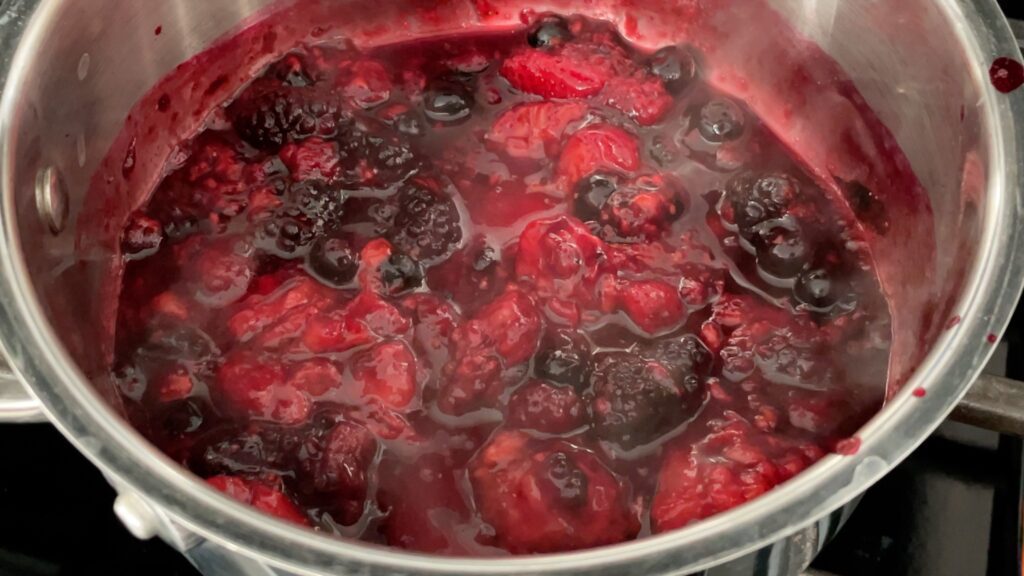
To mix berries into your frosting, simmer fresh or frozen berries with a bit of sugar. Use medium low heat to cook them gently until they soften and thicken.
Blitz the cooked berries in a food processor or blender unit smooth. You can strain them through a sieve if you want to remove the seeds. Let the mixture cool completely and then stir it into your frosting.
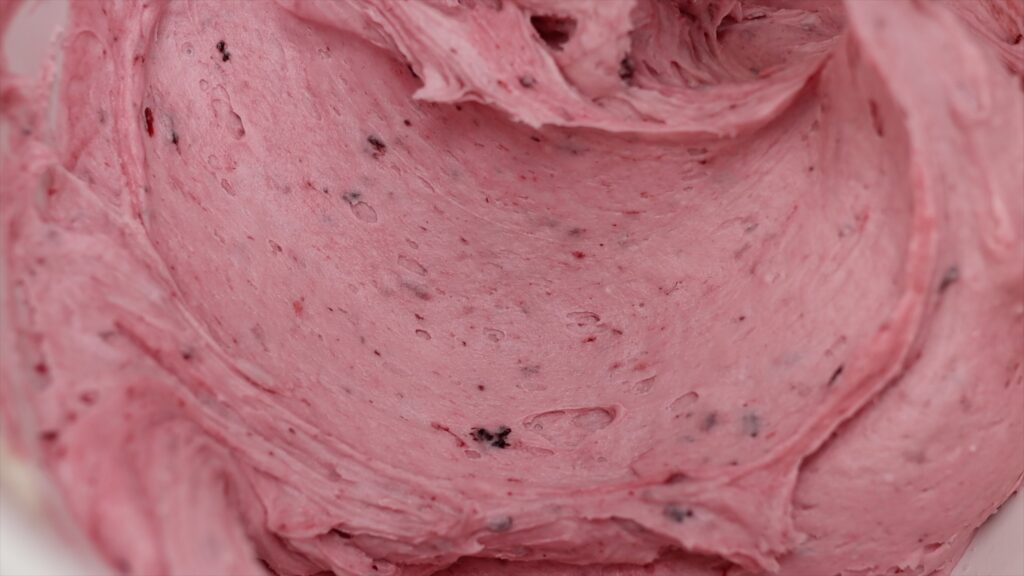
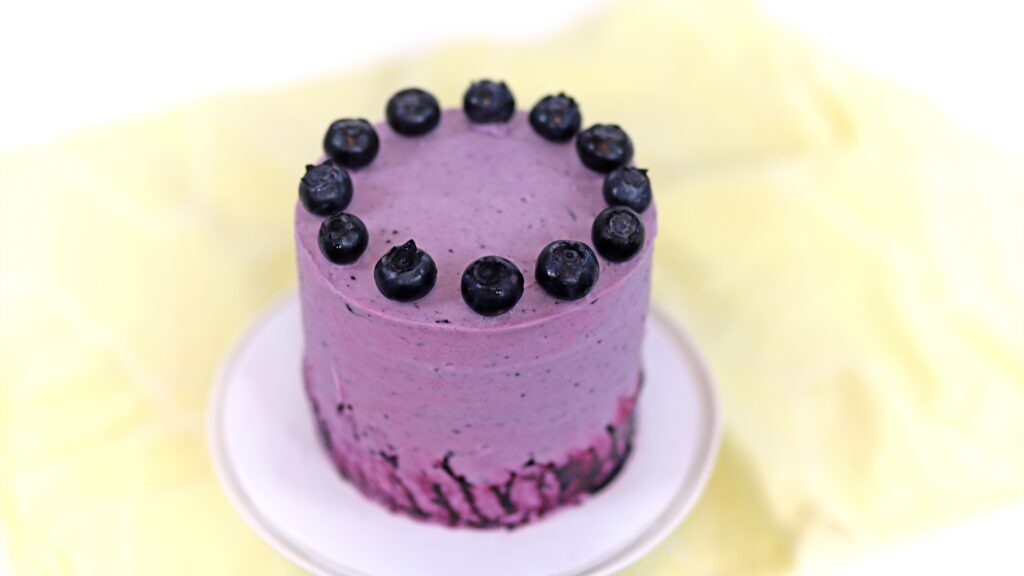
This is my 4 Minute Buttercream mixed with cooked berries. Add the cooked berries instead of the milk in the recipe to give the frosting amazing colour and flavour without making it too runny. I think the flecks of berry make it look delicious, too!
#2 Pile berries on top of a cake
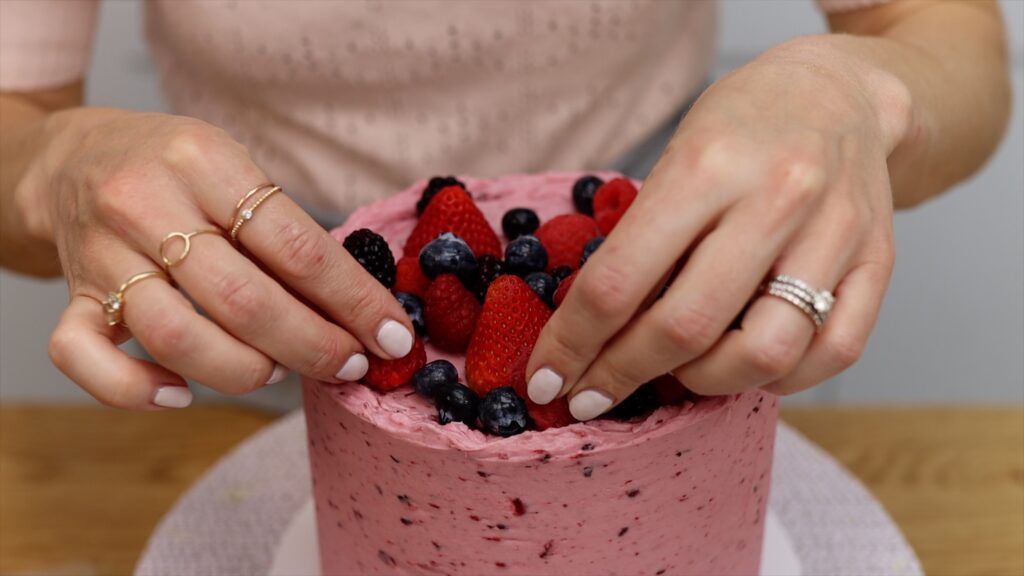
There are lots of ways to decorate a cake fresh berries. If you don’t smooth the top edge of the frosting you’ll leave a wall around the cake. This will hold a pile of berries in place.
If the frosting has set it won't be sticky anymore so the berries may move if you move the cake. To attach the berries, spread some fresh frosting onto the top of the cake to act as glue.
#3 Add berries to piping
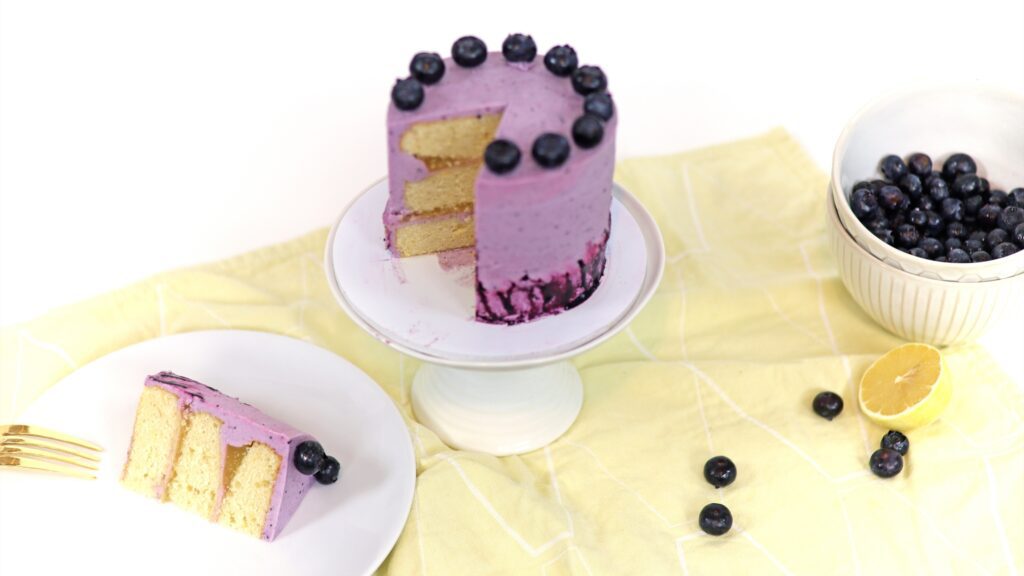
Add berries to piping for some extra height and colour. If you’re using buttercream, make sure you do this immediately after piping. If you wait too long and the buttercream sets, it will crack when you push the berries down. This is my Lemon and Blueberry Cake and it's heavenly!
#4 Place berries between frosting swirls
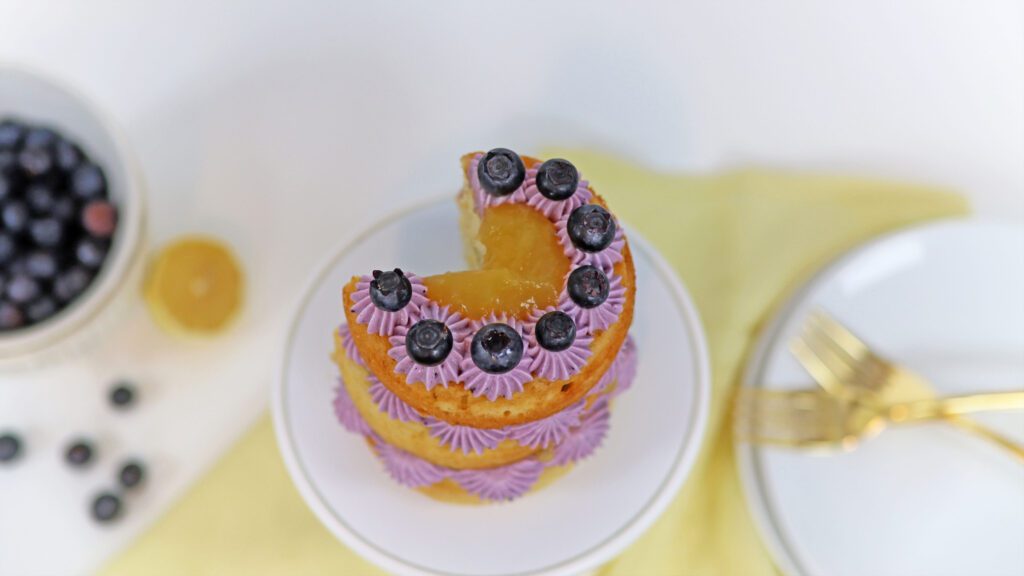
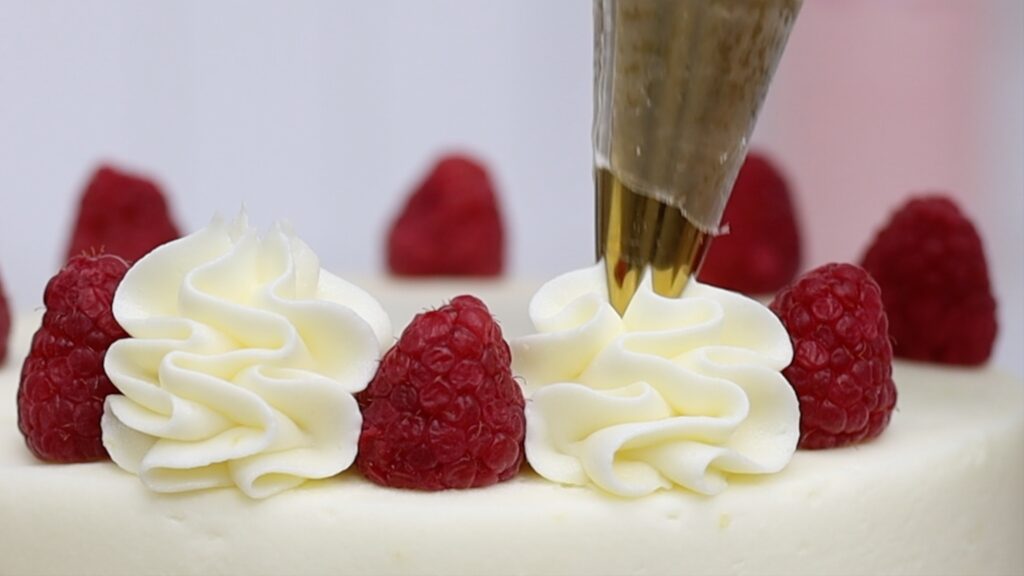
Another fun way to use berries on top of a cake is to place them between swirls of frosting. For even spacing around the cake, start by pushing the berries into the frosting on the top of the cake. Arrange them opposite each other to guide you so that there’s the same distance between each berry. Then pipe your swirls or ruffles or whatever in between the berries.
If you count as you pipe back and forth, all of your piping will be the same height. The berries add a burst of colour to this lemon cake.
#5 Make a border with berries
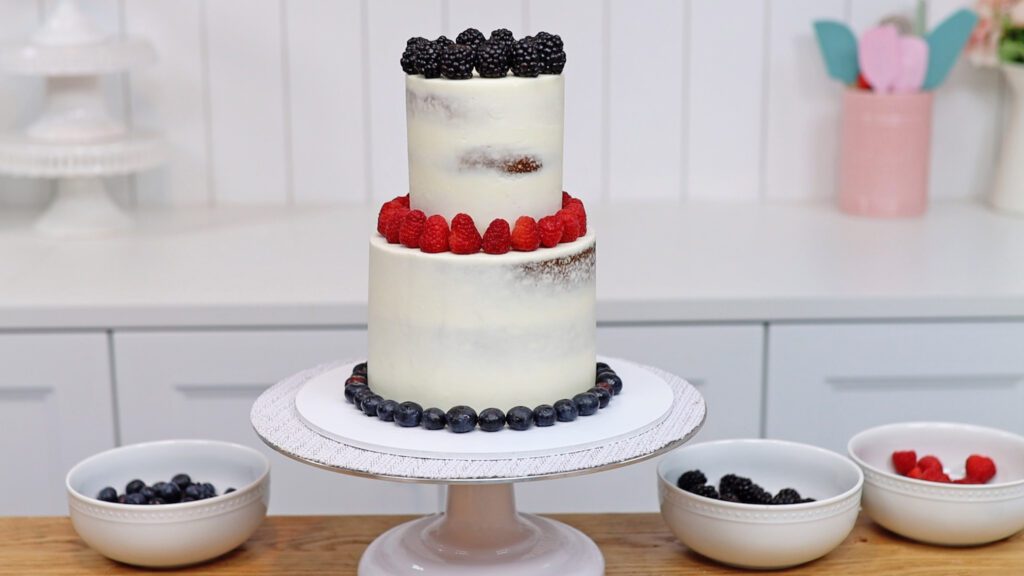
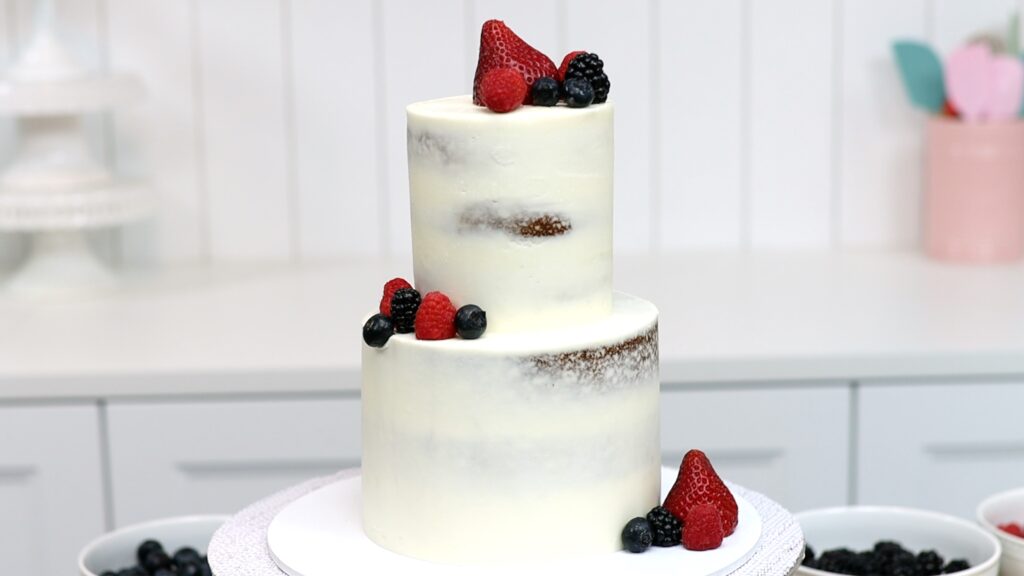
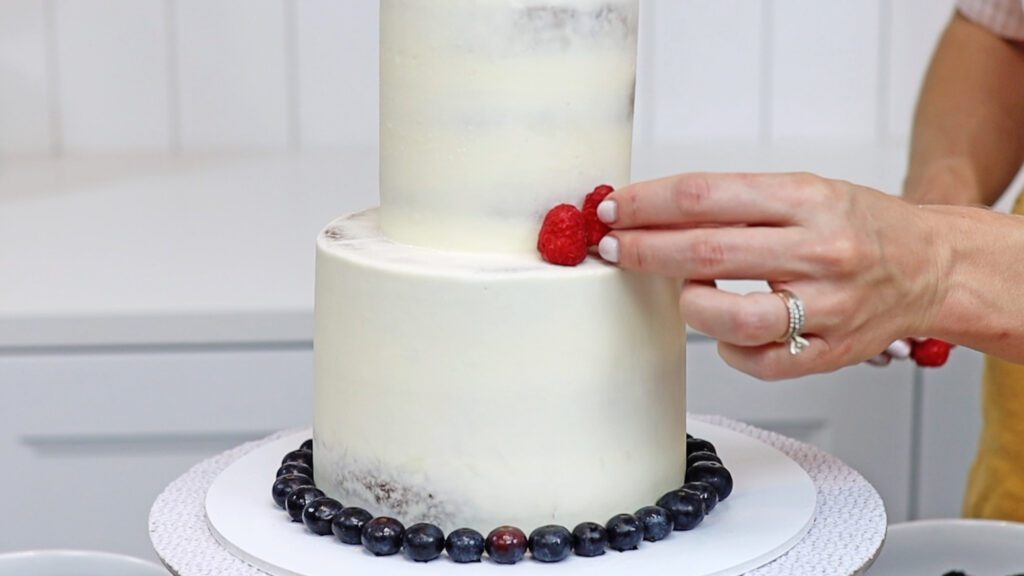
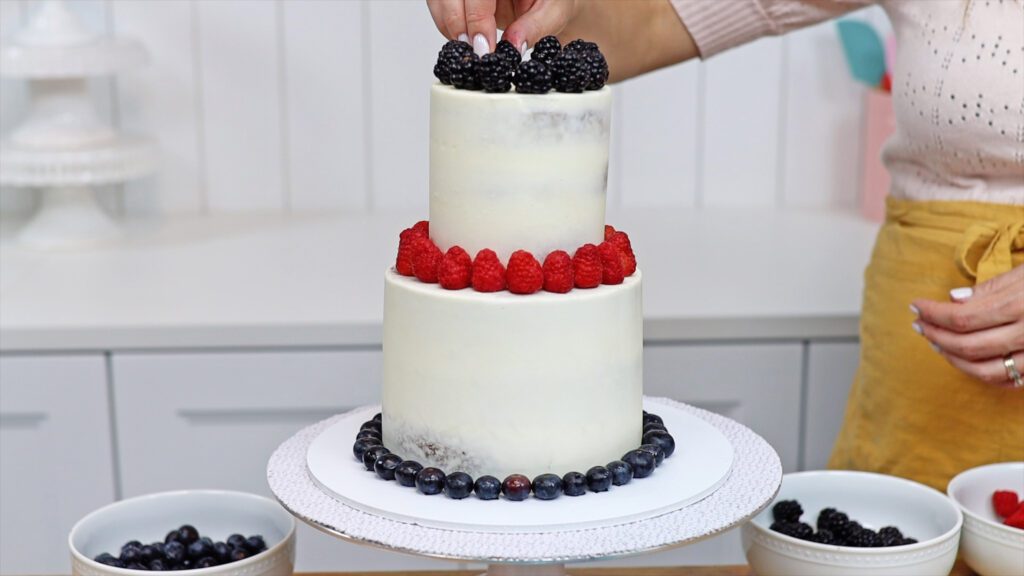
Berries make a nice border around the bottom of a cake. If your cake is a tier cake you can place berries around the bottom of each tier to decorate them.
I teach every step of preparing, assembling, frosting, decorating, storing and transporting tier cakes in a MiniCourse. If you join my Club you'll get access to every MiniCourse on my cake school!
#6 Use berries as cake toppers
Use berries as cake toppers instead, spacing them around the top of a cake. Using a bit of fresh frosting to attach each one if the frosting on the cake has already set.
You might choose to use the berries to mark slices, so that each slice has a berry on top!
#7 Cover a cake in berries
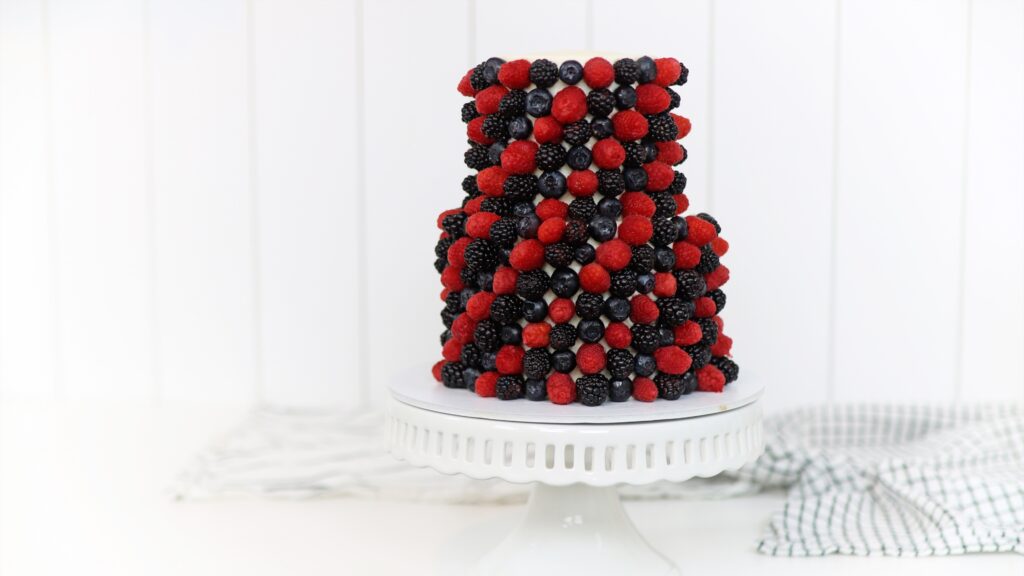
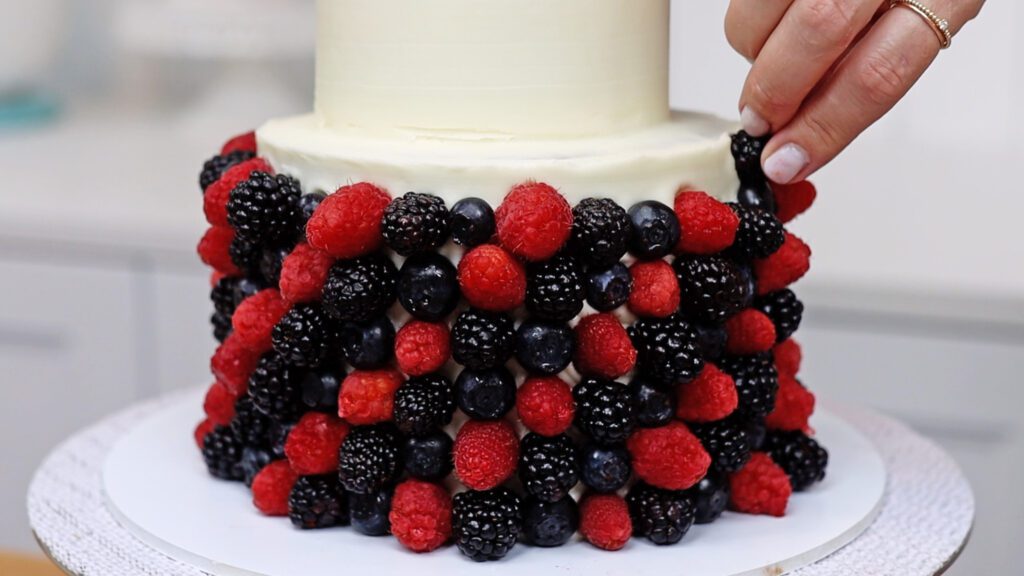
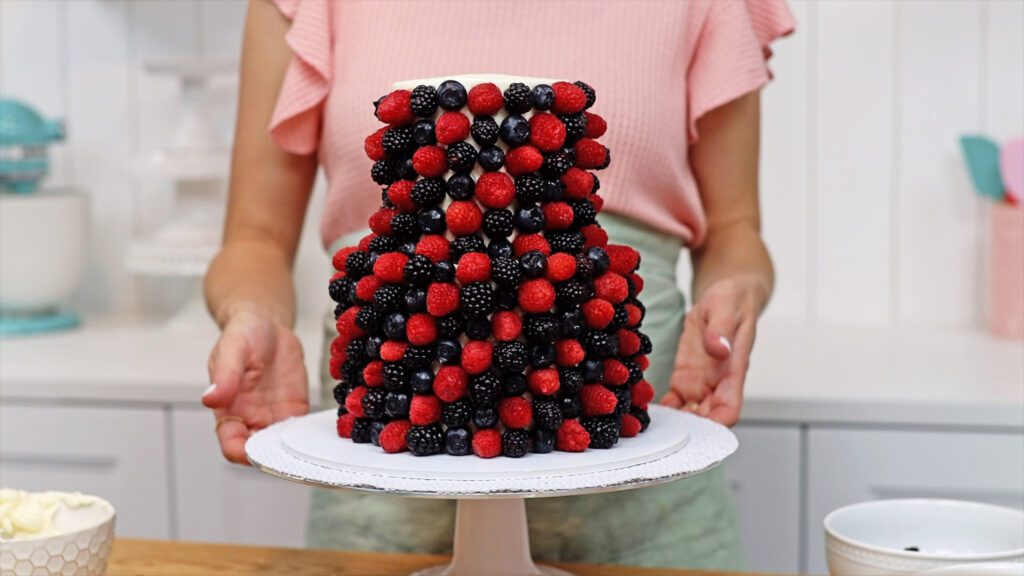
This one is the most time consuming but also the most dramatic! Press berries into the sides of the cake, starting at the very bottom and working your way up. Place the berries in the same order, for example: blueberry, blackberry, raspberry. Then offset each berry by one berry in the next row. You'll end up with diagonals going all the way up the cake.
#8 Add berry accents
If that last one seemed a bit over the top, try placing berries as accents on the cake. Make clusters or groups of different types of berries to create a variety of colours and shapes and sizes. You may need to pipe or spread fresh frosting to stick the berries to the cake.
#9 Spread cooked berries around the cake
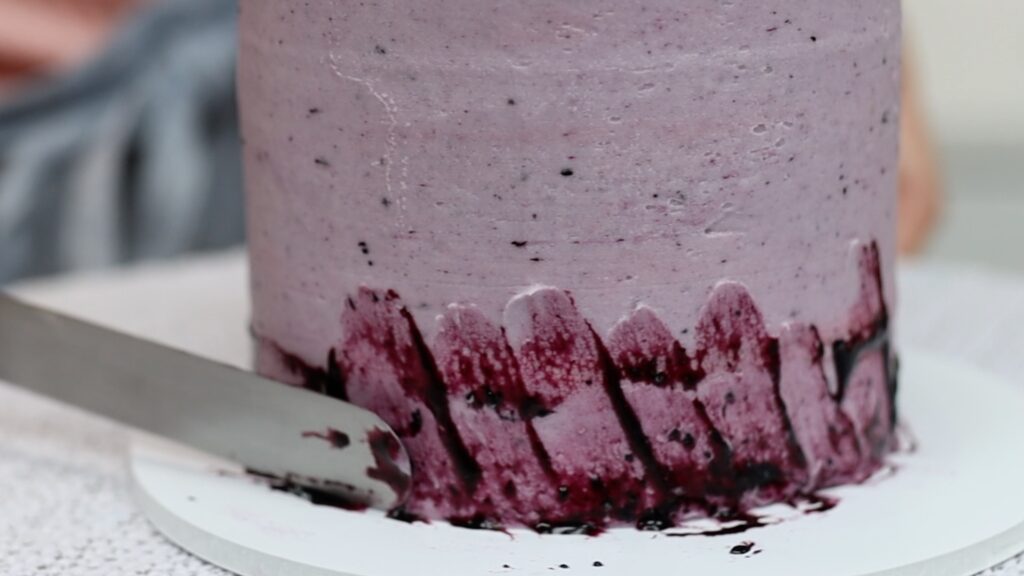
To create some bright texture on your cake, spread some jam or cooked berries around the bottom of your cake. I like to do this straight after frosting the cake, before the frosting sets. Use your offset spatula to spread the jam upwards in diagonal strokes around the cake. Overlap each stroke slightly so that there aren’t any gaps between them. You can use the back of a spoon for even more texture!
I hope you've seen some ideas you like! Tell me in the comments which is your favourite!
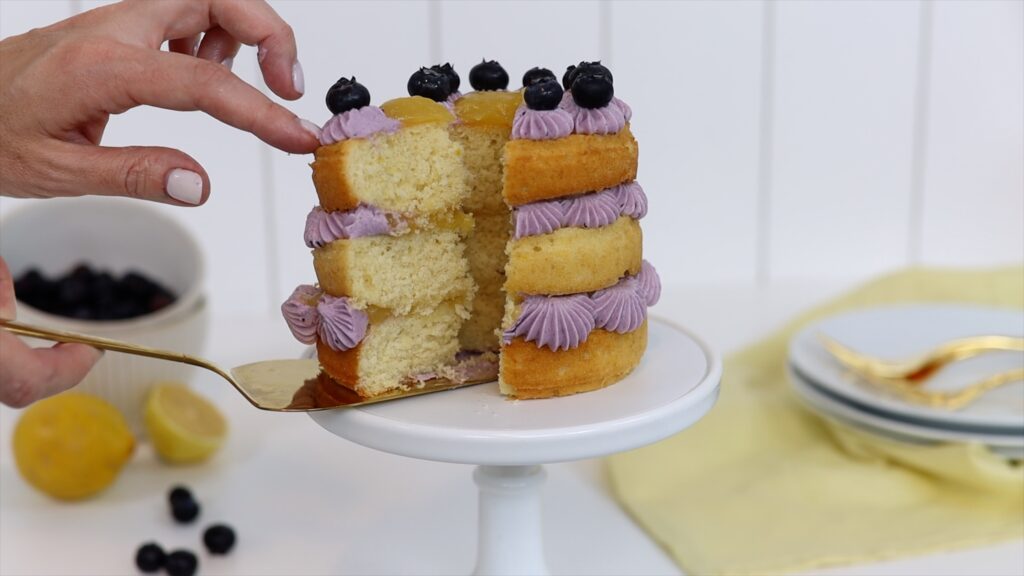
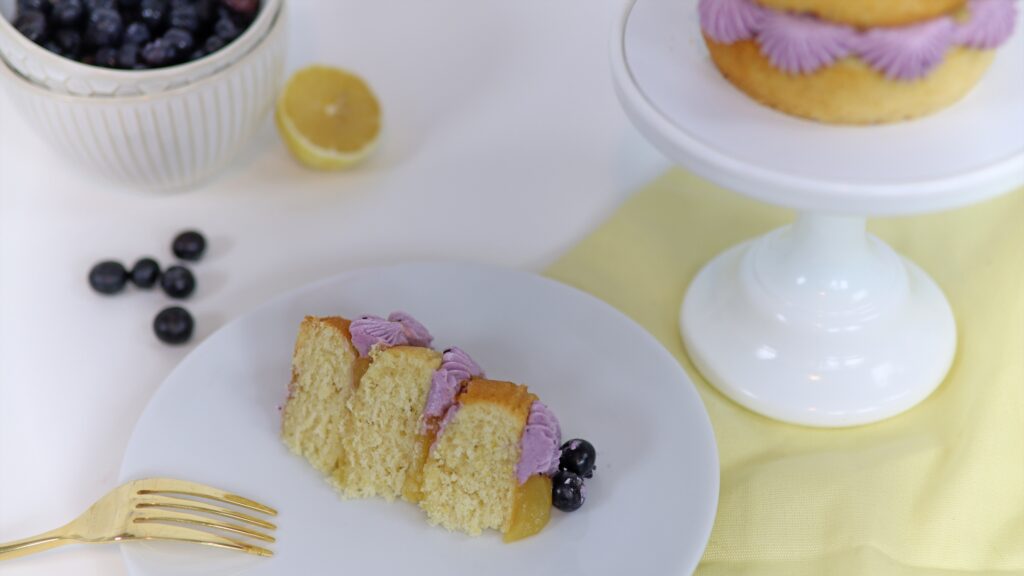
This lemon and blueberry cake has four mouthwatering elements:
zesty lemon cake
tangy lemon curd filling
sweet blueberry buttercream
juicy fresh blueberries
The combination is irresistible!
How to make this Lemon and Blueberry Cake
Make sure all of your refrigerated ingredients are at room temperature before you begin.
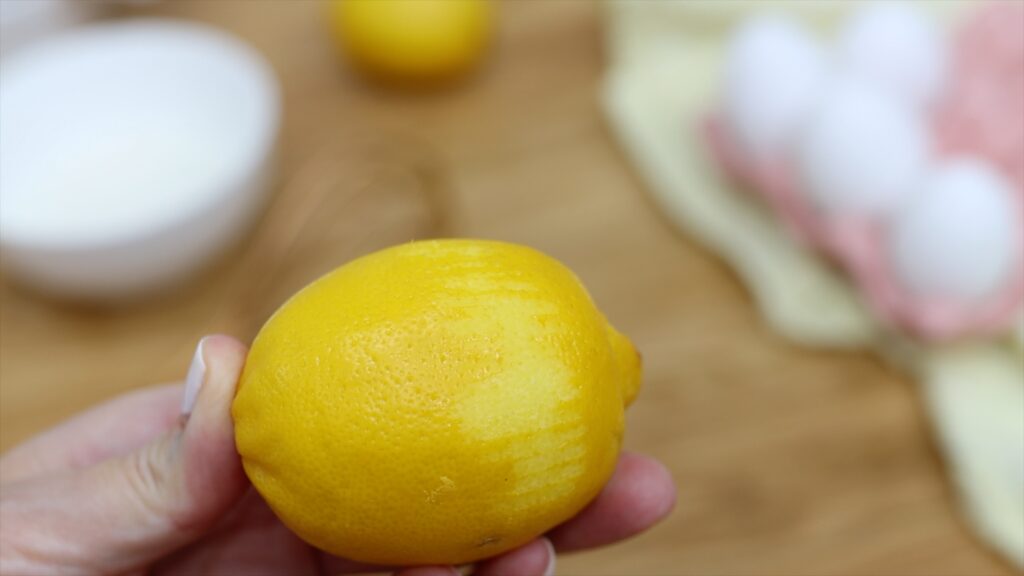
Start by creaming the butter and sugar together, which takes about three minutes. Meanwhile, zest your lemons. Using a lemon zester is ideal because it only takes off the fragrant outer peel instead of the bitter white pith underneath. If you don’t have a zester you can use the fine side of a grater.
By now the butter and sugar should be pale and creamy. Add the lemon zest and mix it in and then crack your eggs and add these one by one. Mix for about 30 seconds after each one so that they incorporate properly.
Now add the vanilla and mix that in. In a bowl, whisk together the flour and baking powder. Add half of this to the mixing bowl, mixing only until it’s just combined. As soon as you don't see any flour in the batter anymore, turn the mixer off. Avoiding over-mixing prevents a tough, dense cake. Then add the milk and sour cream and mix those in. If you need a substitute, instead of milk and sour cream you can use the same amount of buttermilk. Finally, mix in the rest of the flour mixture. Your batter should be quite runny and pale in colour with little flecks of yellow lemon zest.
Divide the lemon cake batter between three greased baking pans. Don't worry - we'll add the blueberry soon! Tap the pans to level them or spread the batter flat with a spatula. The recipe listed below makes a three-layer 6" cake or you can double it for a three-layer 8" cake. For mini cakes, use the 6" batter to make four 4" cakes. Or of course, you can divide the recipe by four to make just one 4" cake.
Bake the cake layers at 325F or 160C for 30 minutes. The cakes are baked when they don’t wiggle in the middle when you jiggle the pan. A toothpick poked into the middle of each cake will come out clean.
Run a spatula gently around the edges of each pan to loosen the cakes. Let the cakes cool completely before you assemble your cake.
A quick side note on substitutions. As I mentioned earlier you can use buttermilk instead of the milk and sour cream. For example, instead of 1/2 cup sour cream and 1/2 cup of milk, use 1 cup of buttermilk. Although I prefer the flavour and texture of this cake with sour cream, the buttermilk version is very similar! Both are soft and light but rich and buttery, too.
How to make lemon curd for this Lemon and Blueberry Cake
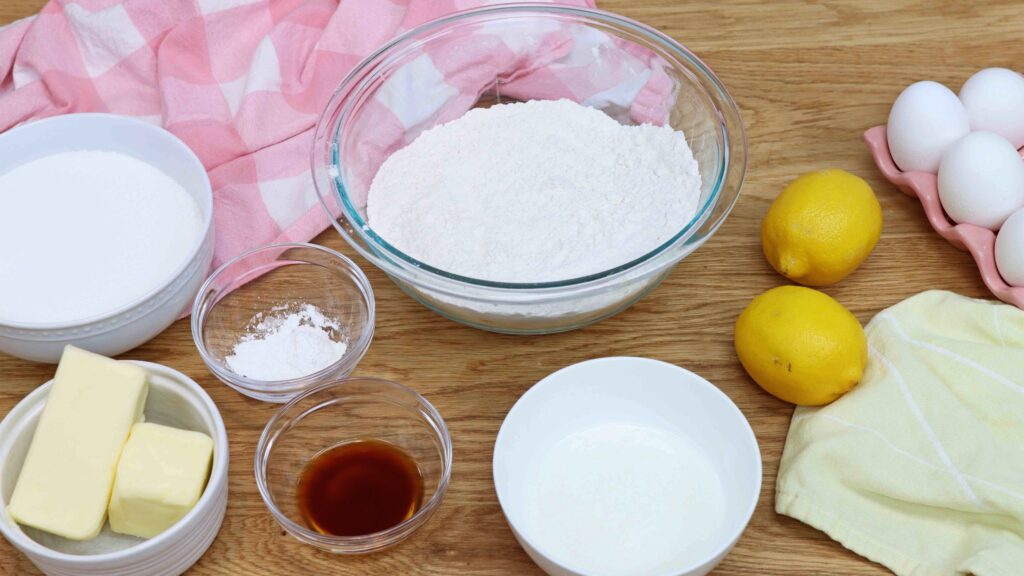
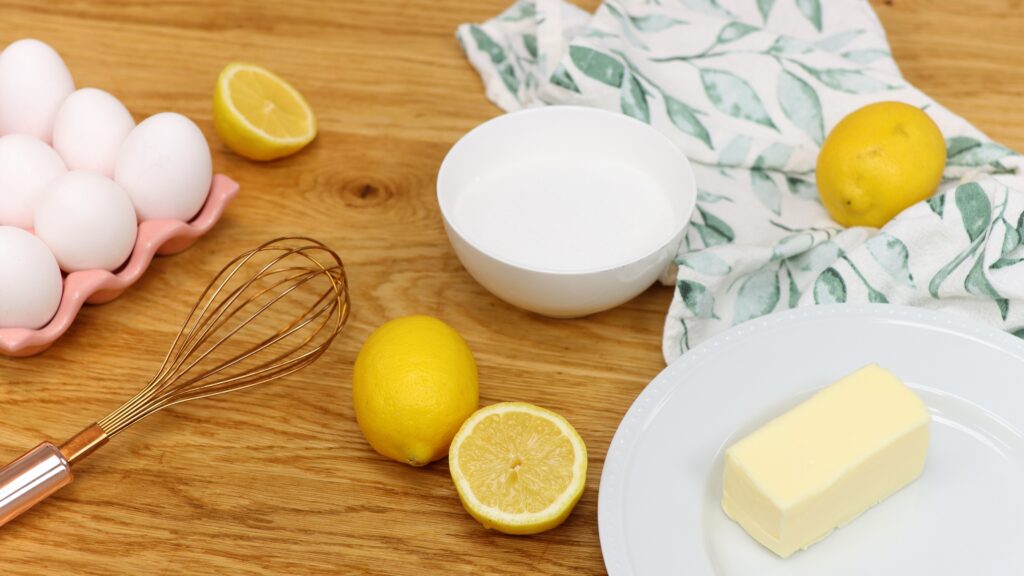
To make this cake even more lemony we’re going to make lemon curd. You’ll need lemon juice, lemon zest, butter, sugar, and eggs.
To prepare the ingredients, crack the eggs and cut your butter into small pieces so that it will melt easily. Zest your lemons and then squeeze them to measure out the lemon juice.
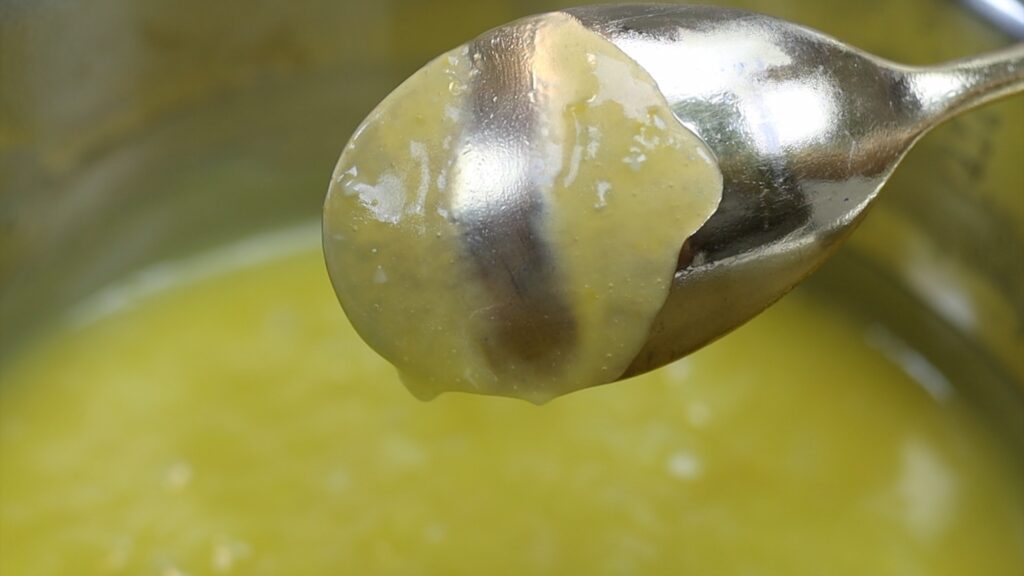
Put all of the ingredients into a small saucepan and heat over a low heat. The key to smooth lemon curd is to heat it very very gently so that the eggs don’t cook too fast and make the curd lumpy. It will take about 30 minutes to cook this and you need to whisk it as it cooks. Listen to a good playlist or podcast and don’t turn that heat up! You’ll notice the curd thicken as it cooks. To test if it's ready, dip a spoon into it and check the back of the spoon. It should be covered in a layer of curd that doesn't run off the spoon. If you wipe your finger through it, it will leave a clear trail.
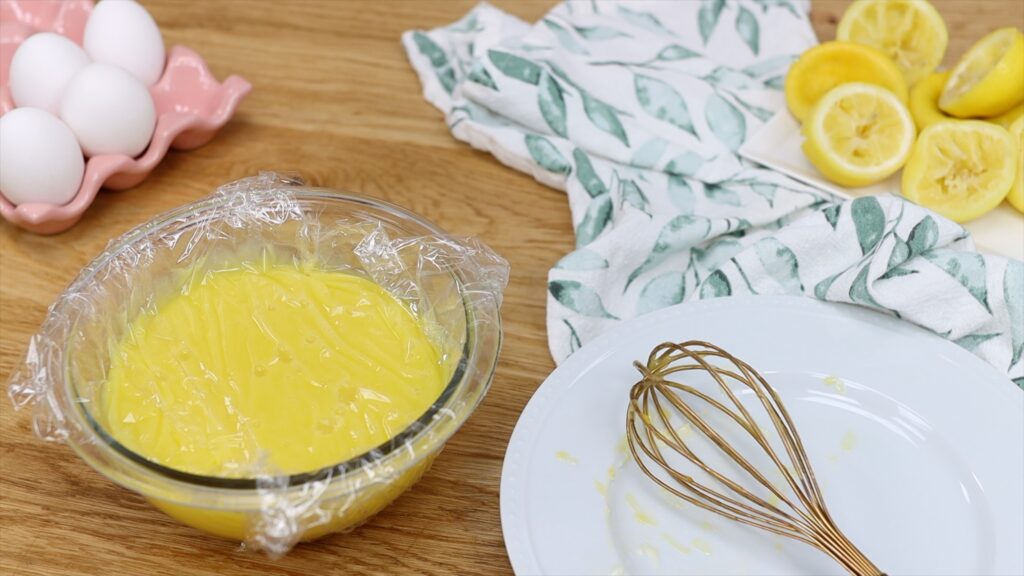
Pour the curd through a sieve and then cover it with plastic wrap. Push the plastic down onto the surface to prevent a skin forming on the curd.
Put it in the fridge and it will thicken as it cools.
How to make blueberry buttercream
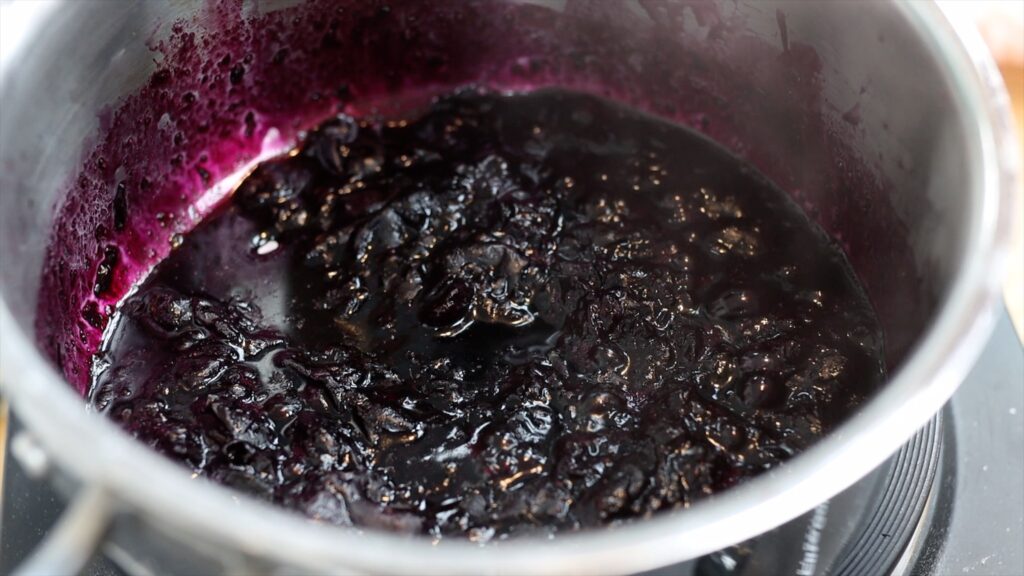
To make blueberry buttercream you can use fresh or frozen blueberries. Pour the blueberries in a saucepan with 1 tablespoon of water and 1 teaspoon of sugar. Simmer over medium heat, breaking down the berries with a potato masher or a fork. When the blueberry liquid starts to thicken, it’s ready.
Use a spatula or spoon to push the berry mixture through a sieve. You only want the liquid puree, not the blueberry skins. Leave the blueberry puree to cool and make your buttercream.
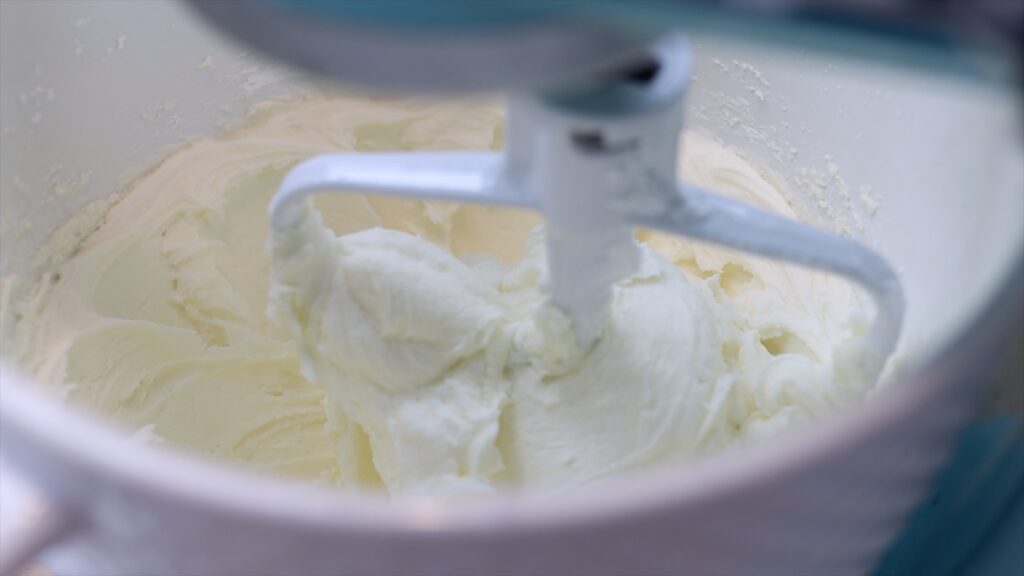
This recipe uses my 4 Minute Buttercream and it's very simple to make. Mix together room temperature butter and powdered sugar or icing sugar until it’s smooth and then add vanilla.
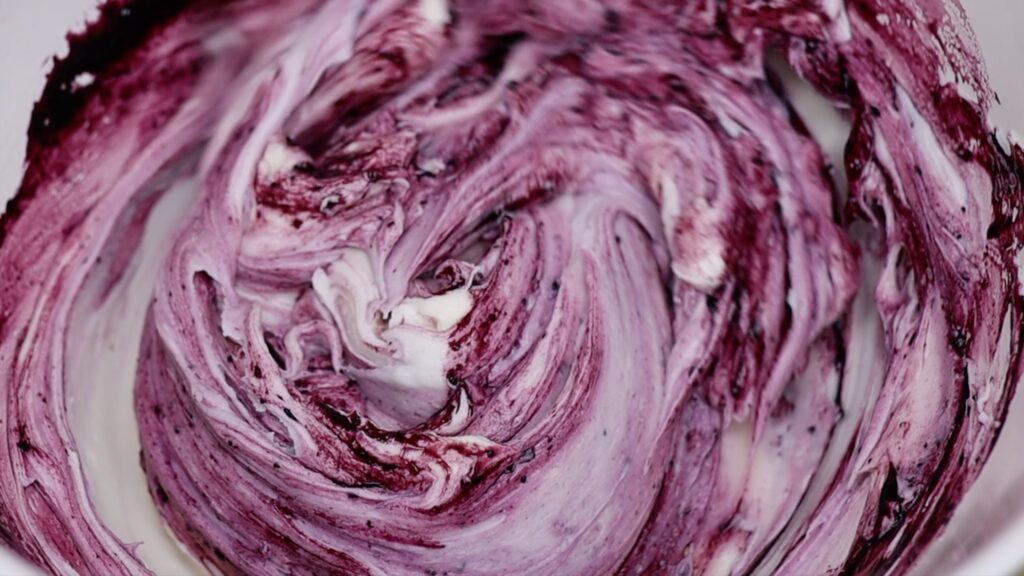
Normally you’d add milk or cream to thin it out but not for this recipe. Instead, add the cooled blueberry puree a teaspoon at a time to flavour and colour the buttercream. Stop adding it when the consistency is easy to stir and your spatula leaves smooth trails in it. If you add too much liquid you’ll make the buttercream runny and it won’t hold its shape. Look at this gorgeous colour!
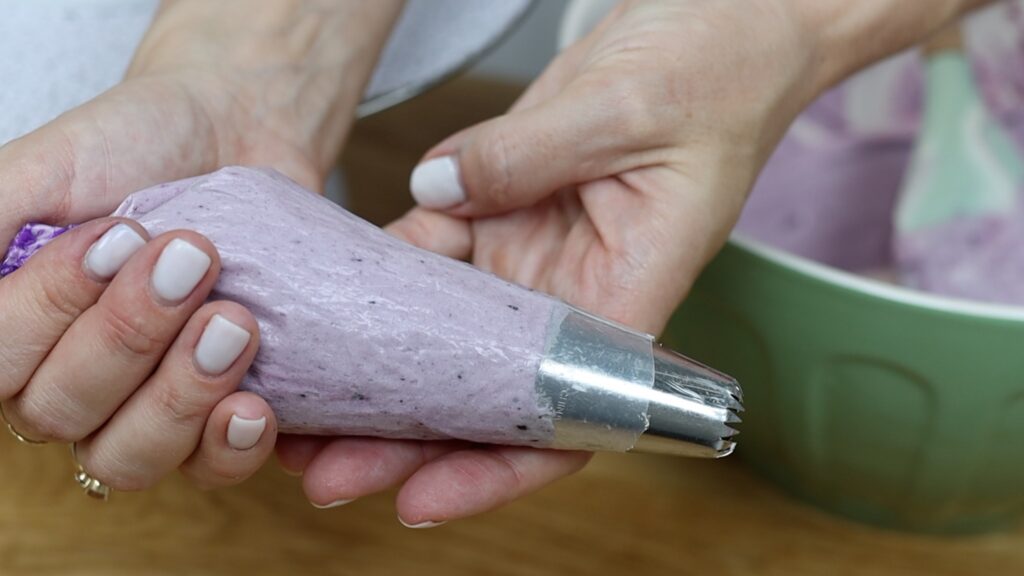
Put a large star tip like an 8B into a piping bag. Fill the bag about 3/4 full with the blueberry buttercream. I love the little flecks of berry in this! The reason for straining the puree to keep the skins out is that the skins will clog the piping tip.
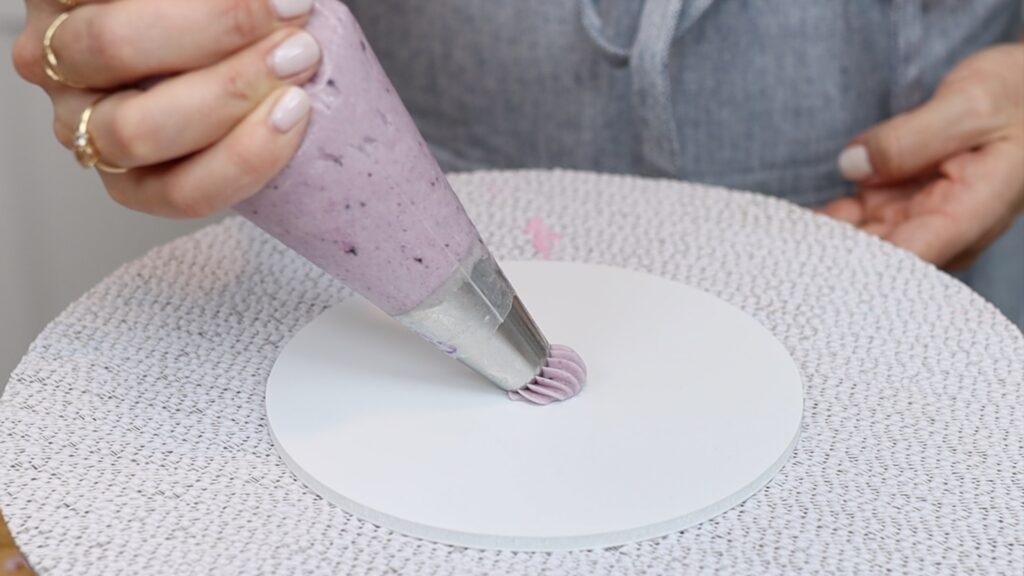
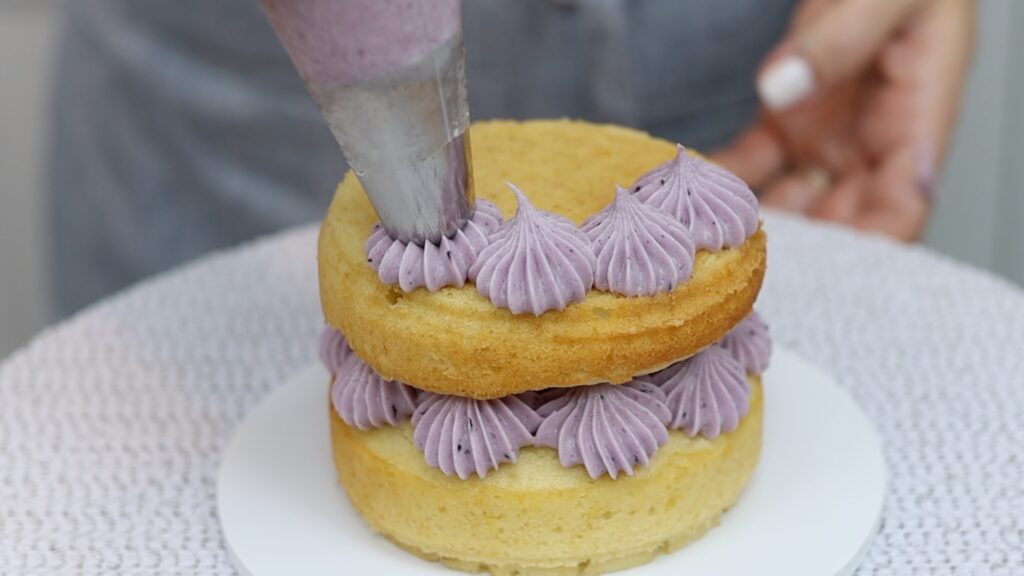
To assemble your lemon and blueberry cake, pipe a dot of blueberry buttercream on the middle of a plate or cake board. Press your first lemon cake layer into that. This will hold it in place. Note: a turntable is useful but not essential for this recipe!
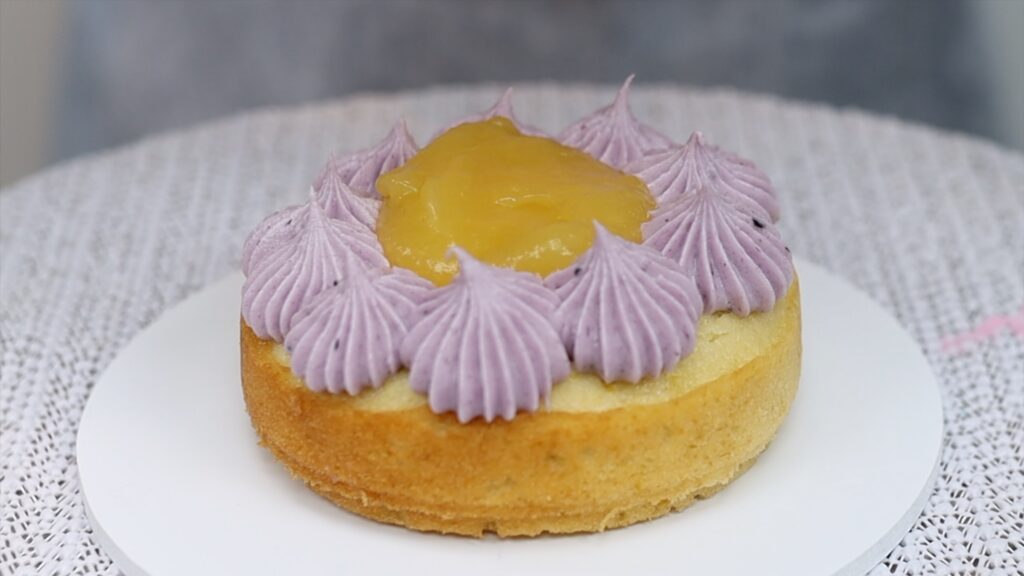
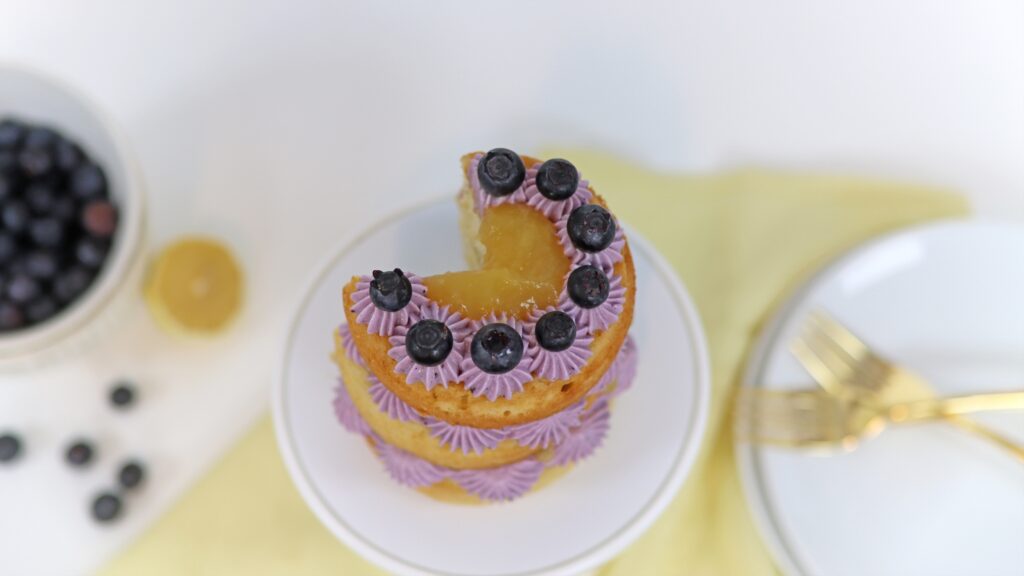
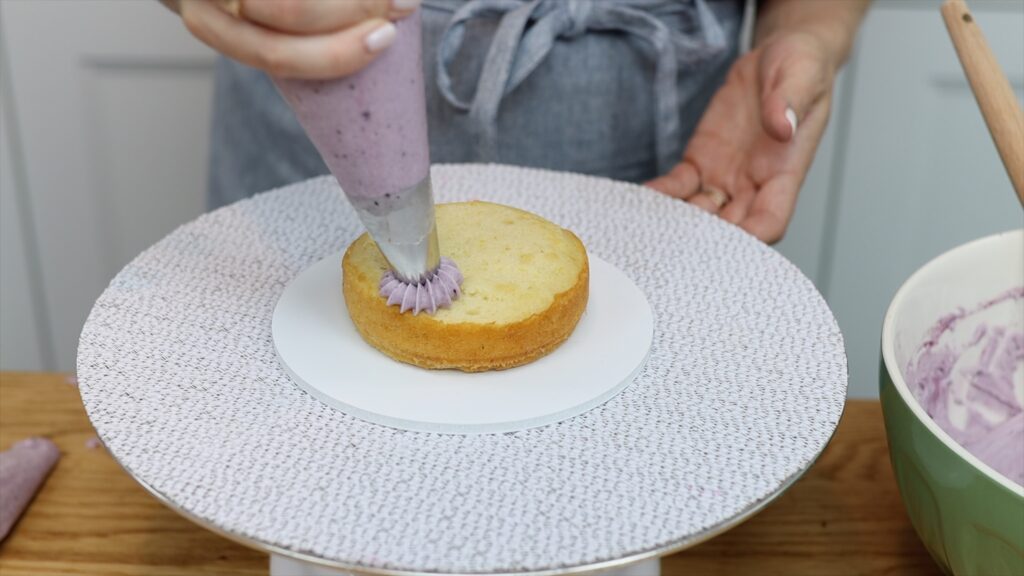
Pipe rosettes all around the outer edge of the cake, squeezing the piping bag to let the buttercream bulge out. Then pull up and away to make a peak on each rosette. Let the rosettes touch each other to form a wall around the edge of the cake and then spoon lemon curd into the middle.
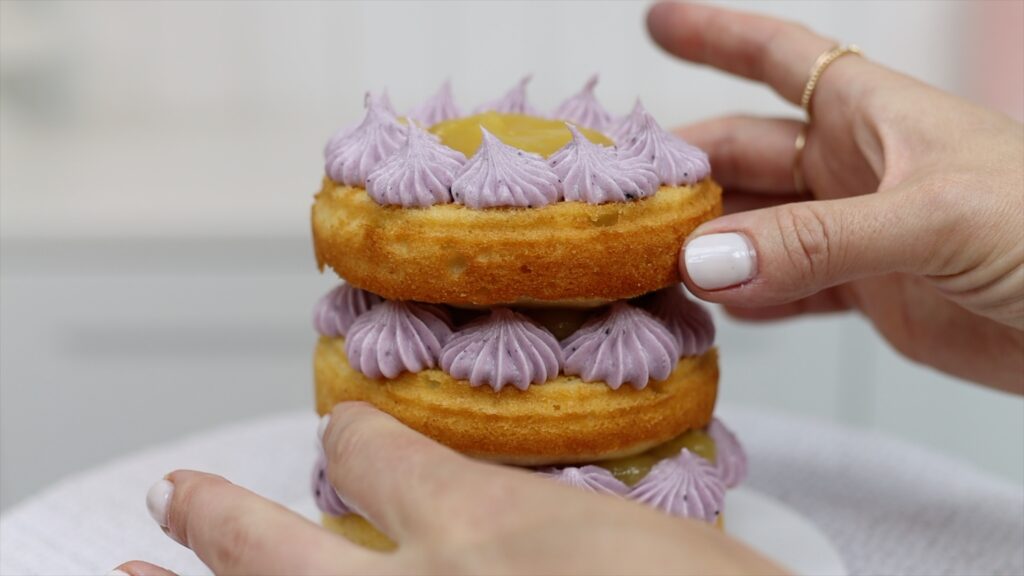
For naked cakes like this with piped filling, I like to leave a slight dome on each layer. Also, I flip the layers over for the second and third layer. That way, the middle of each cake layer rests on the filling below it but the edges are slightly raised. This leaves more of the pretty colour and texture of the piped filling visible.
Make sure each layer is centered so it’s directly above the precious layer. This ensures a straight cake that doesn't lean.
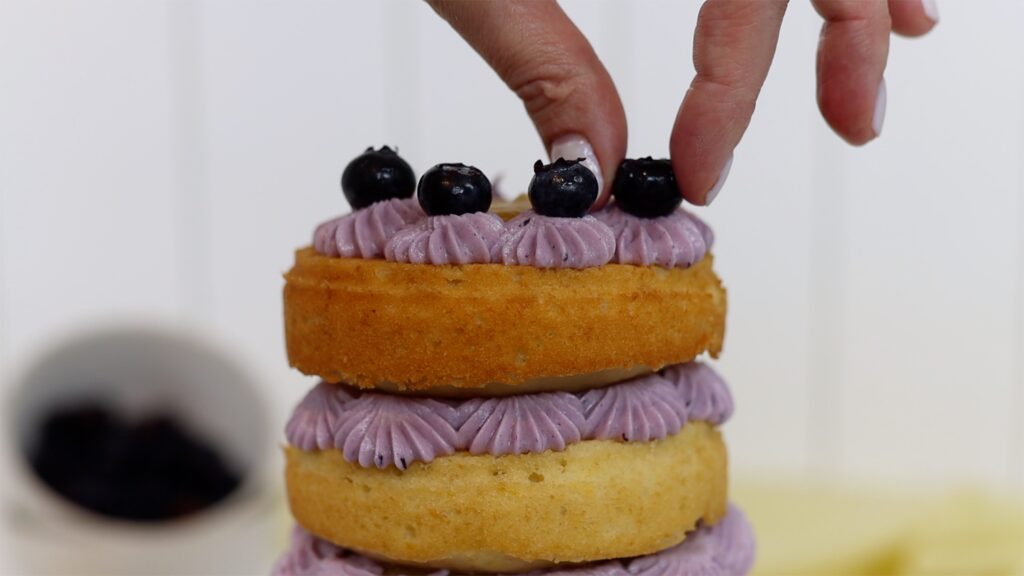
Top the cake with blueberries, which give you that burst of juice when you bite into fresh fruit. The piping and blueberries also help you cut your cake into equal portions by including one or two or three rosettes and blueberries in each slice.
Store the leftovers of this lemon and blueberry cake in an airtight container like a Tupperware in the fridge for a week. I’m confident it will all be eaten before then! The cake tastes best at room temperature so take it out of the fridge about two hours before you serve it.
Here's the recipe for a three-layer 6" Lemon Blueberry Cake. The same quantities will make four 4" cakes (also three layers each) or of course you can divide the recipe by 4 to make just one 4" cake. For a three-layer 8" cake you can double the recipe.
An irresistible combination of zesty lemon cake, tangy lemon curd filling, sweet blueberry buttercream and juicy fresh blueberries! Double this recipe to make a three-layer 8" cake.
Ingredients
UnitsScale
For the lemon cake layers:
1cupbutter
1 1/2cupswhite sugar
2 lemons
4 eggs
2 teaspoons vanilla
2cupsall-purpose (plain) flour
2 teaspoons baking powder
1/2cupsour cream
1/2cup whole milk (full fat)
For the lemon curd:
1 tablespoon lemon zest
1/3cup lemon juice (from about 4 lemons)
1/3cupgranulated white sugar
1/4cupunsalted butter, cut into small pieces
2 eggs
For the blueberry buttercream:
1/2cup fresh or frozen blueberries
1 tablespoon water
1 teaspoon white sugar
1cupbutter, room temperature
2 2/3cupspowdered sugar
1/2 teaspoon vanilla extract
For the garnish:
9-16 fresh blueberries
Instructions
To make the lemon cake layers:
In a mixer with a beater attachment, mix butter with sugar on medium speed until pale and creamy, about three minutes. Scrape down to the bottom of the bowl once during mixing to make sure no butter or sugar is stuck at the bottom.
Meanwhile, zest the lemons using a zester or the fine side of a grater. Add to the butter and sugar mixture and mix to combine. Add the eggs one at a time, mixing on the lowest speed after each egg until incorporated, about 30 seconds.
Add vanilla and mix on lowest speed for about 30 seconds to combine.
In a bowl sift and whisk together flour and baking powder. Add half of the mixture to the mixing bowl and mix on the lowest speed to incorporate.
Add milk and sour cream and mix into the batter. Add the rest of the flour mixture and mix only until just combined. The batter will be runny and pale in colour.
Grease three 6" pans and divide the batter between them. Tap the pans to flatten the batter or use a spatula to spread it flat.
Bake at 160ºC or 325ºF for 30 minutes or until a toothpick inserted into the middle of the cake comes out clean.
Let cakes cool in their pans for 5 minutes. Use a spatula to loosen cake from the edges of the cake pan and then turn onto a wire cooling rack. Leave to cool completely.
To make the lemon curd:
Put all of the lemon curd ingredients in a small saucepan over low or medium-low heat (depending on your stovetop). Bring to a simmer, whisking constantly until it thickens, which will take about 30 minutes. To test it, dip a spoon into it and it should coat the back of the spoon. Run your finger through that coating and you should leave a clear trail behind in the curd.
Pour the lemon curd through a sieve into a bowl, pushing through the sieve with a spoon if necessary.
Cover the bowl with plastic wrap, pushing it down to sit on the surface of the curd. Refrigerate for at least two hours and the curd will thicken more.
To make the blueberry buttercream:
Put the blueberries, water and white sugar in a small saucepan. Bring to a simmer over medium heat and mash the blueberries with a potato masher or fork. Simmer until the liquid thickens, about 5 minutes.
Pour the cooked blueberries into a sieve placed over a bowl and push the berries against the sieve using a spoon or spatula. Discard the blueberry skins and leave the blueberry puree in the bowl to cool.
Using an electric mixer, mix butter and powdered sugar on the lowest speed until smooth, about 4 minutes. Add vanilla and mix to combine.
Add the cooled blueberry puree a teaspoon at a time, mixing until the buttercream is easy to stir but still holds its shape.
Fit a piping bag with an open star piping tip like an 8B. Fill the bag no more than 3/4 full with blueberry buttercream.
To put it all together:
Pipe a dot of buttercream onto the middle of a plate or cake board and press your first layer of cake onto it. Pipe rosettes of the blueberry buttercream around the outer edge of the cake and spoon lemon curd into the middle.
Flip your next cake layer upside down and lower it onto the piping. Repeat the lemon and blueberry filling on this layer and then place the final layer on top, also upside down. Repeat the lemon and blueberry filling and gently press a fresh blueberry into the middle of each rosette.
Notes
If you don't have sour cream or milk you can omit both and substitute them with buttermilk.
You can refrigerate this cake for a week in an airtight container like a tupperware.
This cake is best served at room temperature! If you refrigerate it, take it out of the fridge two hours before serving it.
For a three-layer 8" cake, double this recipe (click "2X" at the top of the recipe).
Here are 14 useful time saving cake hacks to make you more efficient and productive, whether you’re making one cake or several at the same time. It doesn’t need to take all day to decorate a cake!
#1 Chill your cake
Before you frost a cake, put it in the freezer for 15 minutes. You can do this with the layers before you assemble the cake or with the entire cake after assembling it. Cold cake layers are firmer than when they're at room temperature. This means you’ll find it much easier and quicker to frost the cake when it’s cold than when it’s at room temperature. With this small time saving cake hacks you'll spend less time assembling, crumb coating and frosting your cakes. You’ll notice that when you spread frosting onto cold cake layers, the cake doesn’t wobble from side to side or slide around on the cake board. Also, fewer crumbs will come off the cake into the frosting than when the cake layers are at room temperature.
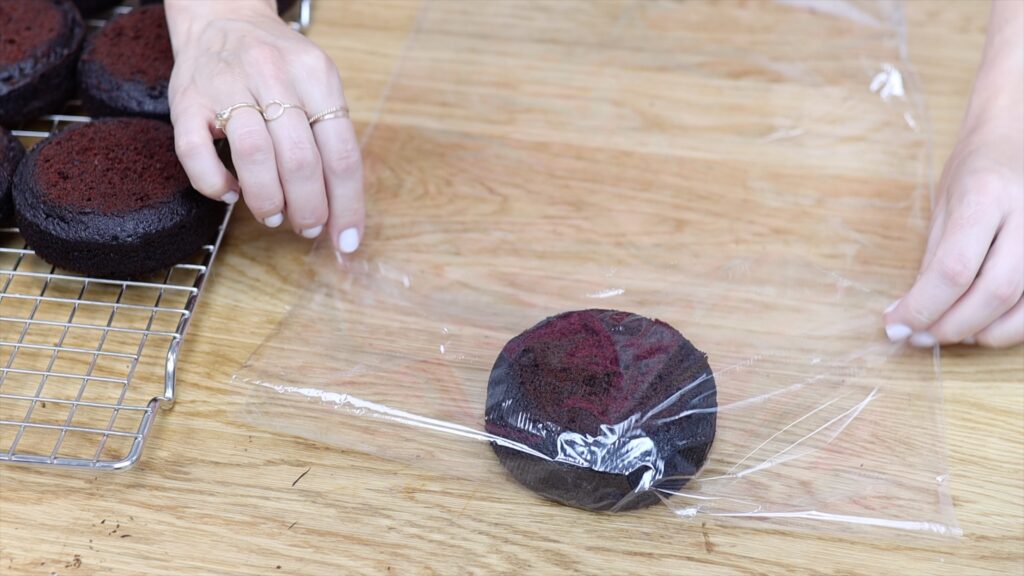
You can even put the cake in the fridge or freezer the day before, if you want to space out the cake making process. Wrap the layers in cling film or saran wrap before chilling so that they don’t dry out.
#2 Pipe your frosting
Instead of spreading filling and frosting onto a cake, try piping it on. Piping is much faster and will save you a few minutes for each cake you fill, crumb coat, and frost. You don’t even need any piping tips to do this! Just use the hole cut off the end of the piping bag to squeeze the frosting through straight onto the cake. I used my 4 Minute Buttercream for all of the cakes in this tutorial but piping works with any kind of frosting.
#3 Organize your tools
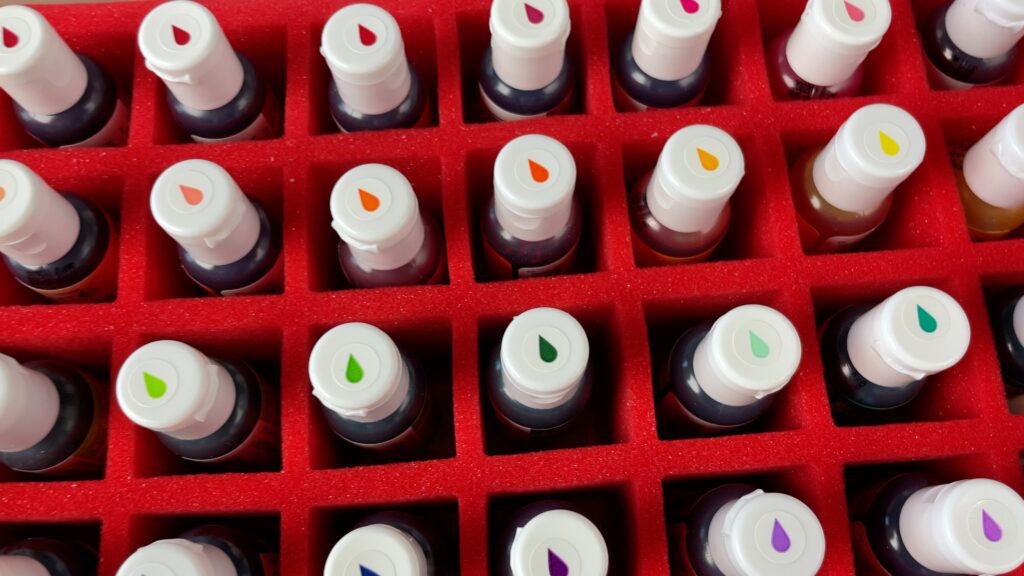
Organizing your tools will save you lots of time for every cake you decorate because you’ll know exactly where everything is. Try putting bottles of colour in a case with dividers that keep the bottles upright so that they don’t fall over and leak and then stain your hands. If you have lots of bottles, lining them up in rainbow order will make it even quicker to find the one you’re looking for.
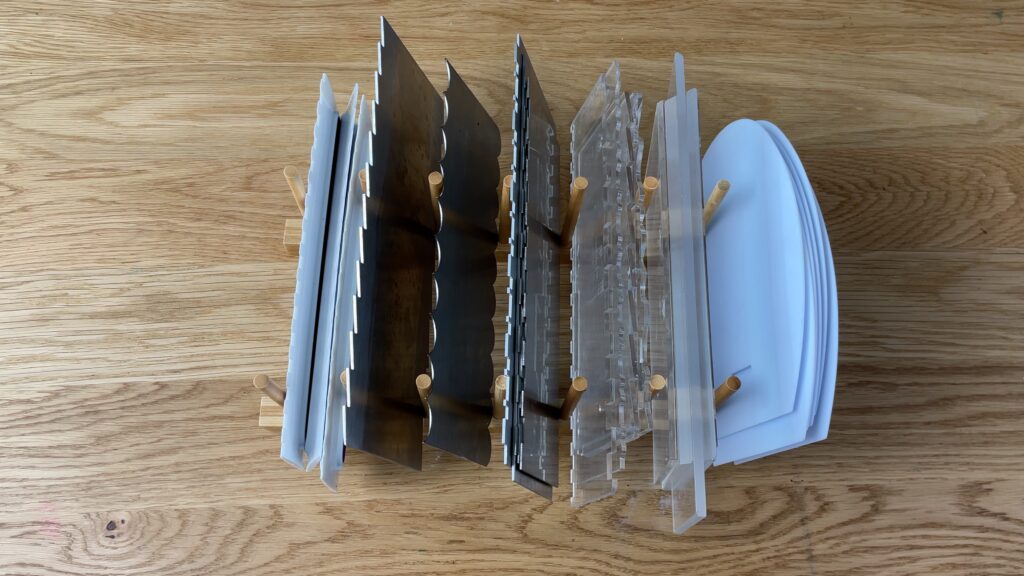
Stand your cake combs upright in a divider intended for lids of pots and pans or Tupperwares. This way you can see what you have and quickly pick up the one you want. Stencils are easy to find when they’re in a folder with clear plastic wallets, so you can flick through them effortlessly before choosing one. Piping tips are also easier to see and choose when they’re separated instead of tossed into a large box, so you don’t have to dig around to find the right one. I have a full tutorial with more hacks for storage and organization of cake decorating supplies.
#4 Re-tint leftover frosting
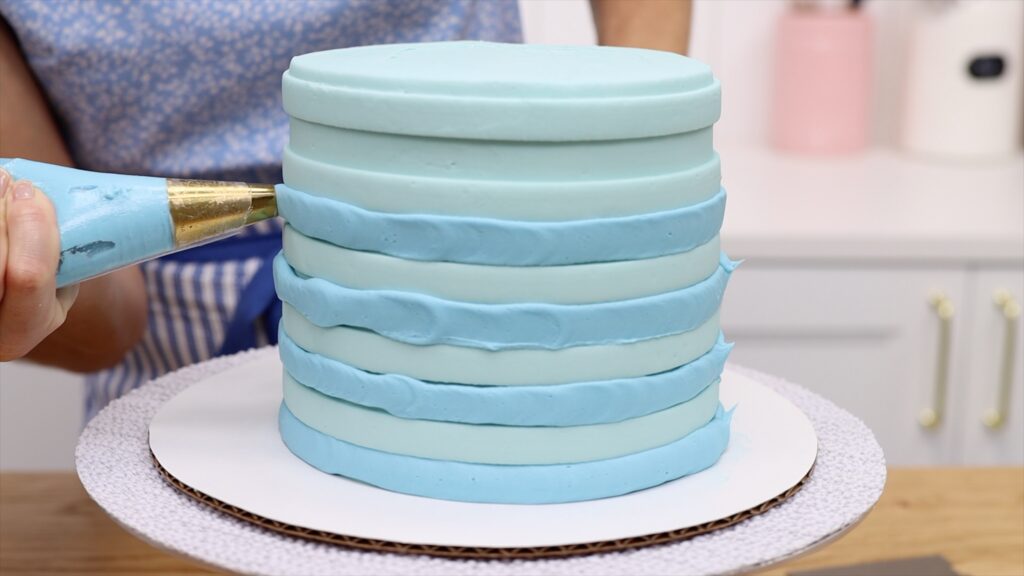
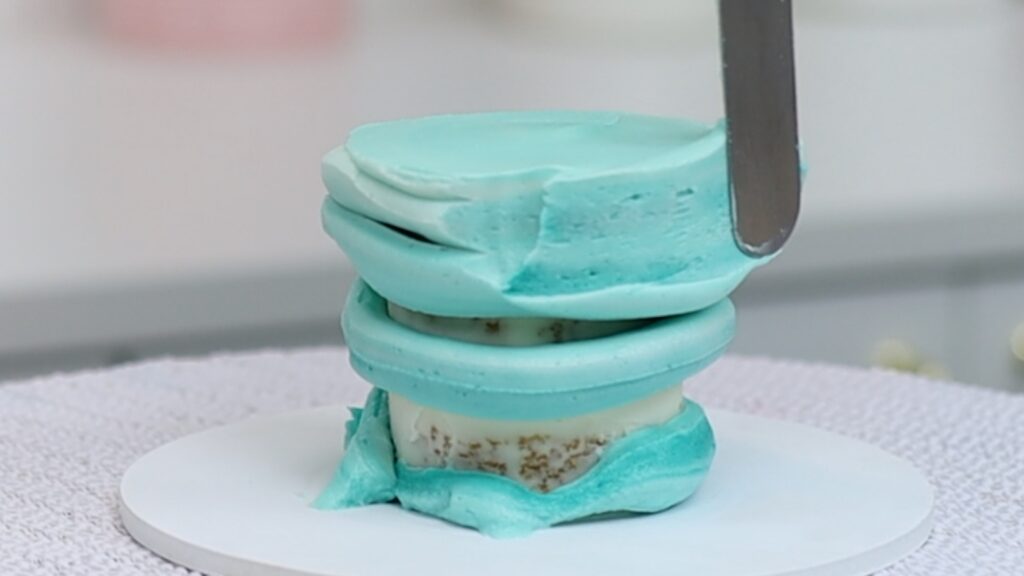
When you’ve finished using frosting for a cake, add more colour to tint to for the next frosting or decorative detail. For the cake above I used light blue buttercream to frost the cake and then added more blue gel to the leftovers to make the darker blue filling between the stripes. By using leftover frosting you’ll save time because you’ll need to make less frosting and also wash fewer bowls and spatulas!
#5 Make buttercream in advance
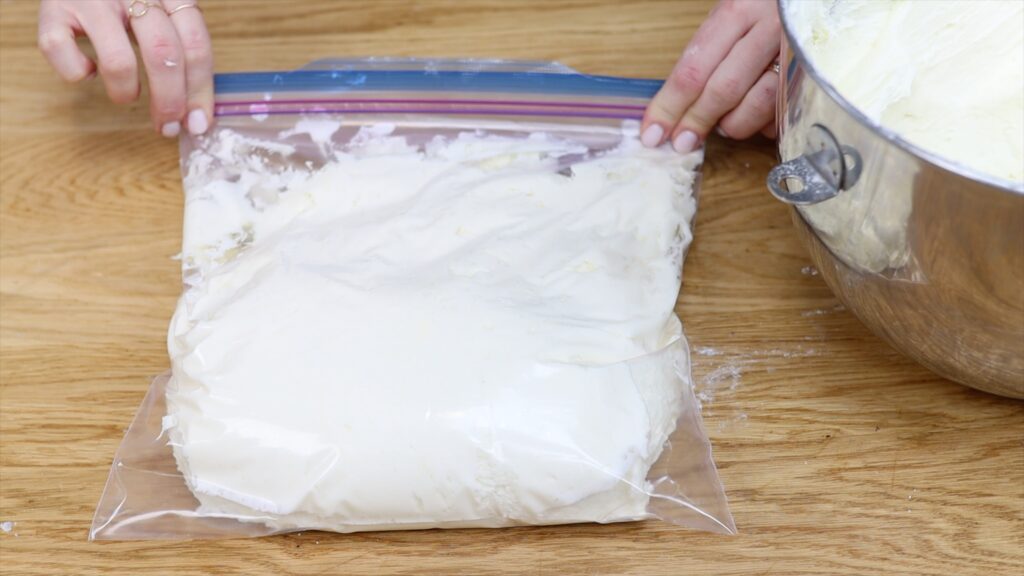
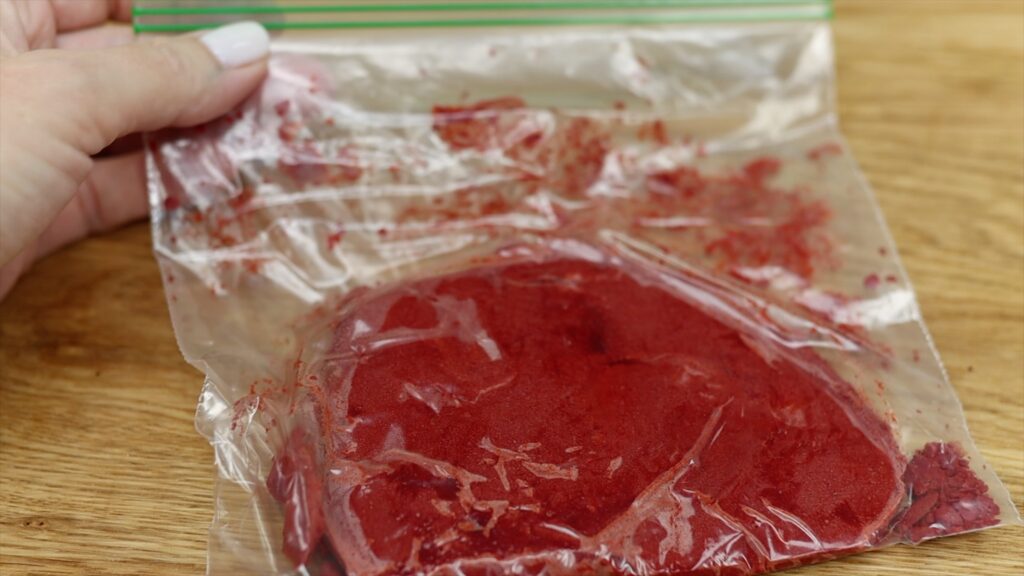
Did you know that you can freezebuttercream? That means you can make double or triple batches in advance and store them for up to two months! I like to use a large ziploc bag, which lies flat in the freezer and hardly takes up any space. Take it out of the freezer a few hours before you’re ready to use it to let it thaw and then stir it until it's smooth.
#6 Prepare piping bags ahead of time
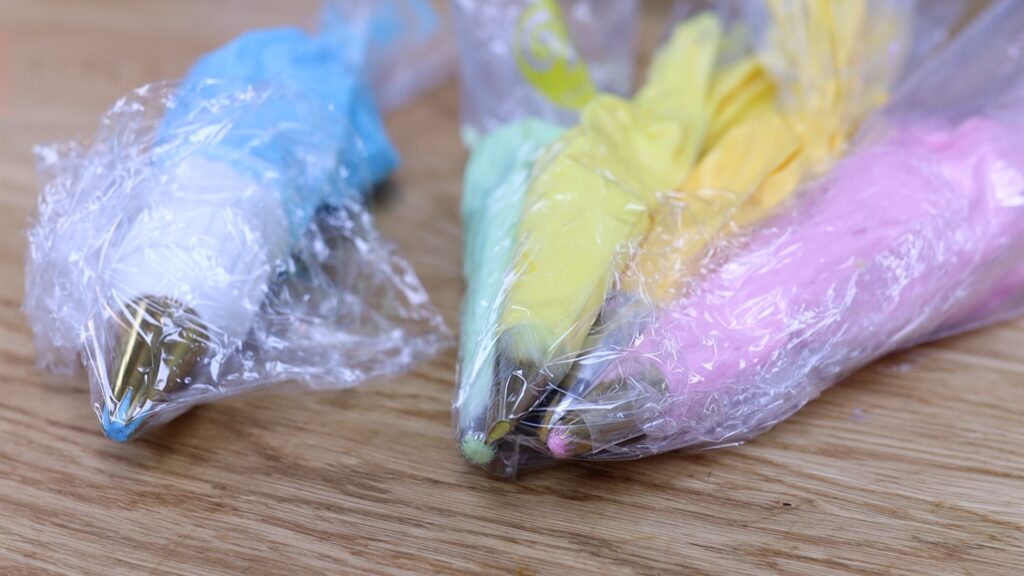
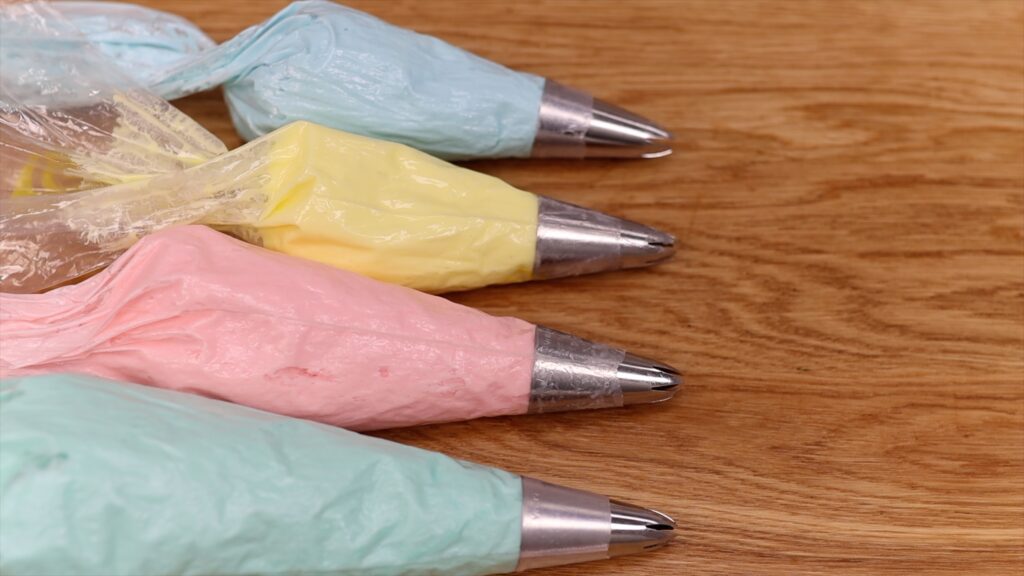
You can also prepare piping bags in advance if you’re using buttercream because buttercream can be stored at room temperature for two days. Twist the tops of the bags and cover the tips with cling film or Saran Wrap so that the buttercream doesn’t dry out and crust.
#7 Use couplers
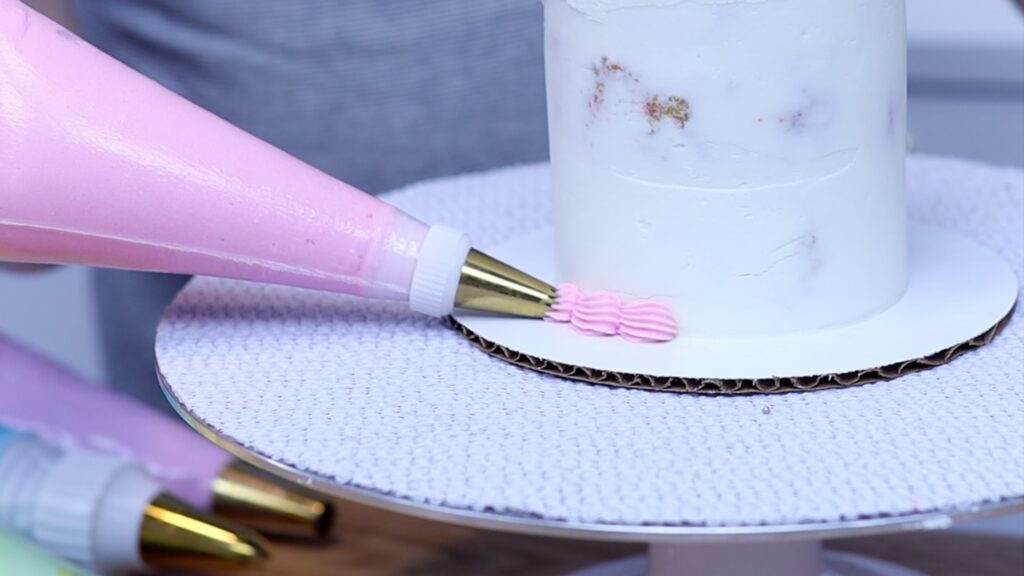
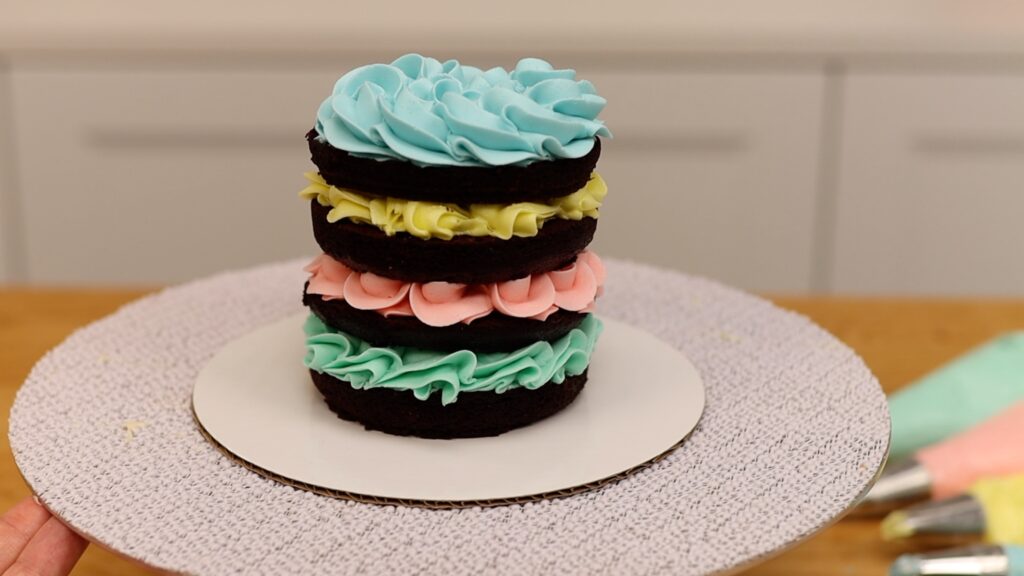
If you’re not using couplers in your piping bags, you’re wasting a lot of time! Drop a coupler into a piping bag and put a piping tip over the outside of the bag. Screw it on using the coupler ring. Fill the piping bag with frosting as normal and now you can switch easily between different piping tips and different colours! Just unscrew the piping tip instead of having to empty out the whole piping bag to get to it. Here’s a hack for super speedy switching of piping tips between piping bags: don’t bother cleaning the piping tip! Squeeze the new piping bag to push the old colour through the tip and when the new colour comes through the bag, it’s ready! Couplers make things much quicker for rainbow cakes and any designs with lots of colours or textures or both! For 4 reasons to use couplers, check out my tutorial on how to use couplers.
#8 Multiple tips
For any piping tips you use often, like the 1M star tip above, buy several of them. Now you can move onto the next colour or stage of your design or the next cake without having to wash and dry the piping tip first.
These tips are really cheap to buy so it’s not a big investment to buy several but it will save you a significant amount of time.
#9 One bag piping
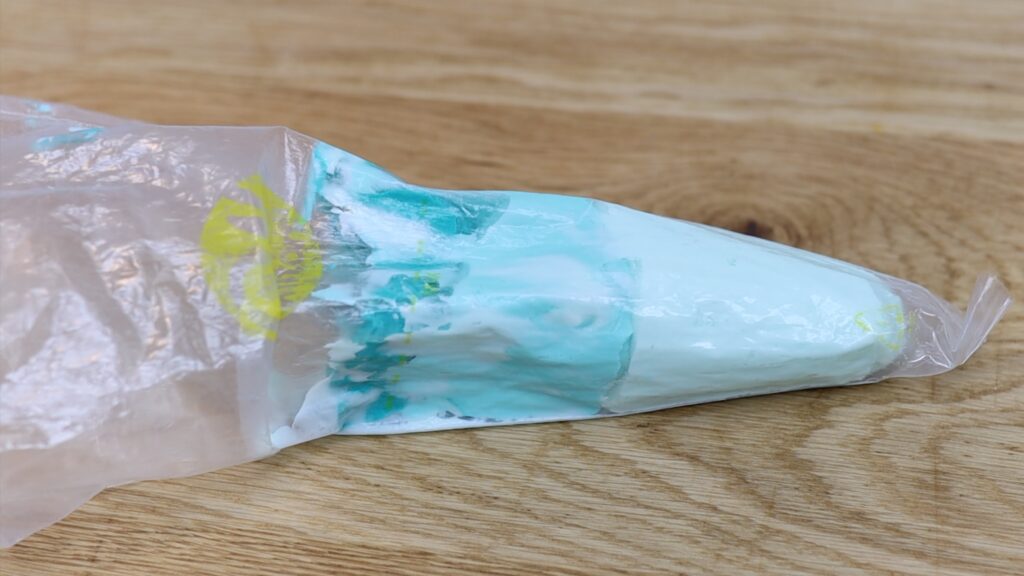
Have you heard of one bag piping? I made up the name so probably not but it’ll make sense in a moment. For ombre or watercolor frosting, where different colours or shades bend together, you can save time by putting all of those colour or shades into the same piping bag.
The layered look is pretty in the piping bag and also on a cake, creating effortless blended frosting that looks like it took much longer to achieve. Use the same technique for blending colours in swirls piped onto the top of a cake or for piping borders around the bottom of the cake. With this technique you'll add lots of detail in seconds.
#10 Prepare decorations
If you’re making more than one cake using the same technique or ingredients, make those ahead of time together. For example, measure and cut out all of your parchment paper stencils for upcoming cakes at the same time.
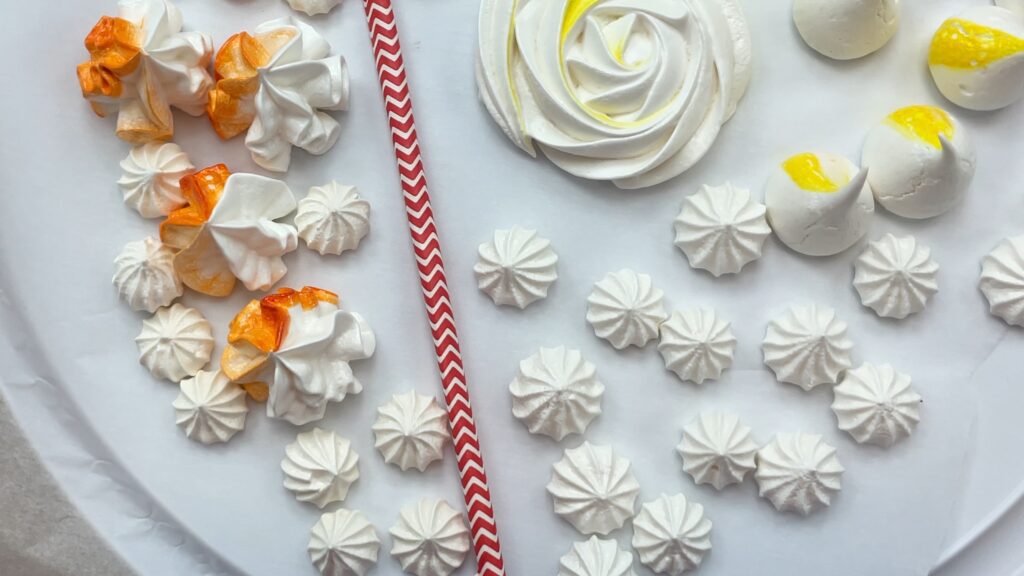
If you need to make meringues as cake toppers for several cakes, make them all together so that you only have to mix, pipe, and clean up once. Then freeze the meringues in an airtight container until you’re ready to decorate the next cake or cakes.
#11 Dirty tools
While you’re frosting and decorating, keep a container next to you where you can toss dirty tools when you’re finished with them. This keeps your workspace clear and makes cleaning up and washing up much quicker.
#12 Bulk baking and frosting
This is one of my favourite time saving cake hacks! Making cakes in bulk means you can mix and bake big batches of cake batter, which is more efficient than doing different batches on different days. Then wrap the layers in cling film or Saran Wrap and freeze them for up to two months.
If I’m decorating several cakes in a week, I like to divide my schedule so that I assemble and crumb coat cakes on one day. On a different day I frost and decorate cakes. This way, you’re using the same tools and materials for the same task and that makes everything much quicker. You'll also keep cleaning up to a minimum.
#13 Music for speed
Lastly, find something that works for you to make you more productive. I like to have fast music playing in the background to make me move faster!
#14 Challenge yourself with goals
I like to set a timer for each stage of my day as an incentive to finish the task within a deadline. This makes me work faster and I enjoy the challenge, too!
For hundreds more tips, cake designs and decorating techniques, check out my online cake school and join my ClubPLUS for access to every MiniCourse, MasterCourse and Live Workshop!
With just one batter to make, this easy marble cake is exactly that - easy! Chocolate and vanilla cake are marbled together and sandwiched between layers of vanilla buttercream. Then it's all covered up with chocolate buttercream. Yum!
How to mix this easy marble cake batter
Start by gathering your ingredients. Everything should be at room temperature which means taking your butter, eggs, and buttermilk out of the fridge at least two hours before you use them.
Mix the butter and sugar together on medium speed for about three minutes, until it gets much lighter in colour. It should look creamy and fluffy. Scrape down to the bottom of the mixing bowl to scoop up any sugar that the mixer hasn’t caught. Otherwise,you'll have lumps of gritty sugar in your batter.
Next add the room temperature eggs one by one, mixing for 30 seconds after each egg. Being at room temperature and adding them one at a time will help them incorporate easily into your batter. This makes the cake light and fluffy.
After the eggs comes the vanilla. Real vanilla instead of artificial vanilla will give you the richest flavour in your cake. Once that’s mixed in, you’ll need half of all of the dry ingredients. These are all-purpose flour, baking powder and baking soda. Pour this portion of the dry ingredients into the mixing bowl and mix at the lowest speed until you can’t see flour in the batter anymore. Scrape around the sides and bottom of the mixing bowl to mix in any flour clinging there. Then mix for a few more seconds, still using the lowest speed.
How to turn this batter into chocolate and vanilla
Now we’re going to divide the batter and there are three ways of doing this. You can weigh the batter, measure it with measuring cups, or guess/eyeball it! The most precise is to weigh the batterusing a scale until you get exactly half of the total amount. Set this batter aside to make the chocolate batter later, after you finish preparing the vanilla batter in the mixer.
Add buttermilk and oil to the vanilla batter in the mixer, mixing until everything’s incorporated. You really don’t want to overmix the batter after you’ve added any flour. Overmixing makes the cake dense and tough. Add a quarter of the dry ingredients, also mixing that only until it’s all incorporated. Now the vanilla batter is ready! Pour it into another bowl and then transfer the other half of the batter back into the mixer. This will be the chocolate batter.
To make the batter chocolatey we need cocoa powder, mixed with water to make quite a thick liquid. Whisk it together or use a fork to stir until the cocoa powder dissolves completely. The liquid should be smooth with no lumps.
It’s easiest for the cocoa powder to dissolve if the water is hot. If you do use hot water, wait for the mixture to cool before you add it to the batter.
Mix on the lowest speed until the cocoa mixture is incorporated. Then add the rest of the dry ingredients and mix on the lowest speed until those are incorporated. You’ll probably have to scrape down to the bottom of the bowl to gather up the flour stuck down there. Just like with the vanilla part of the batter, don't overmix after adding the flour. As soon as you don’t see any white specks of flour in the batter, turn the mixer off.
Marble the cake layers
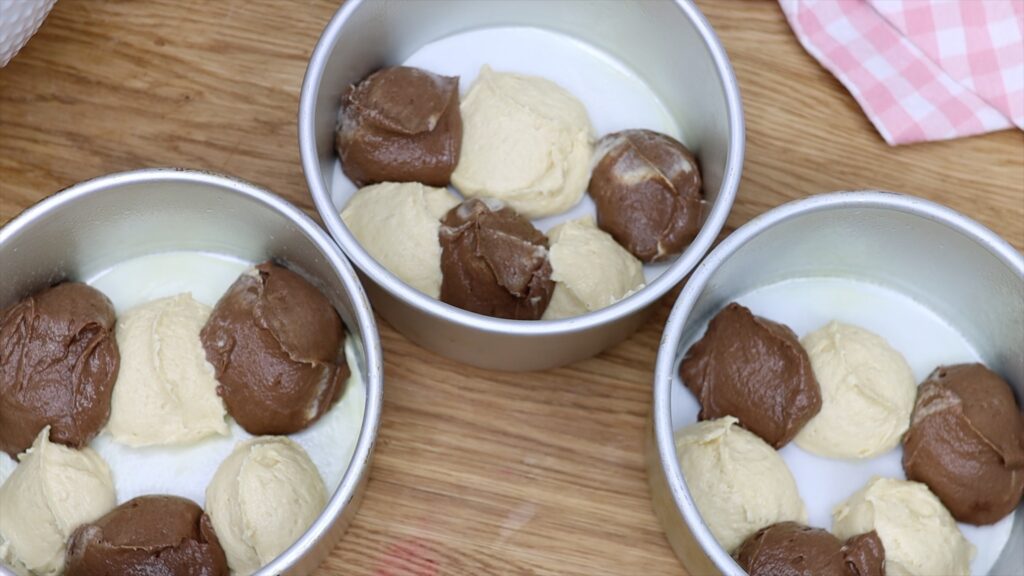
Now that we have the vanilla and chocolate batter, let’s get this party started! Divide the batter between three cake pans which you’ve greased with an oil spray or butter. Alternate between the vanilla and chocolate batter in each pan. I like to use an ice cream scoop for this part.
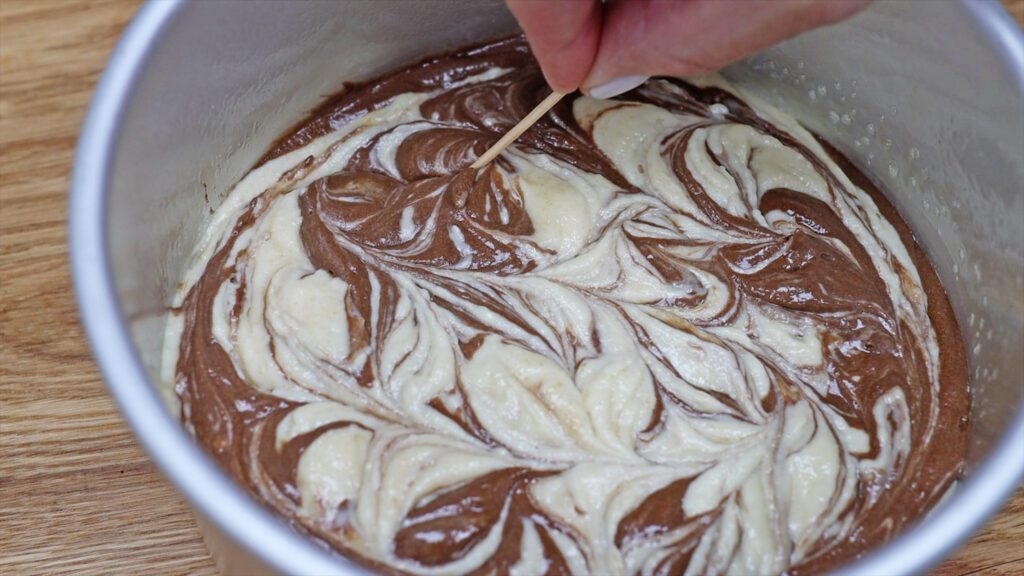
To marble the batter, drag a toothpick or the end of a spatula back and forth through the batter. Make sure you push down to the bottom of the pan so the marbling goes all the way through the cake layers. If you’re using a toothpick or anything else really thin you’ll need to go back and forth in several directions to get a good marble effect. This will look stunning when we cut into it!
Bake the easy marble cake layers
Bake the cakes at 350F or 175C until the middle doesn't wobble when you shake the pans. To double check, stick a toothpick into the middle of each layer. f it comes out clean, the cakes are baked. If there are smears of raw batter on the toothpick, bake them for two more minutes before checking again.
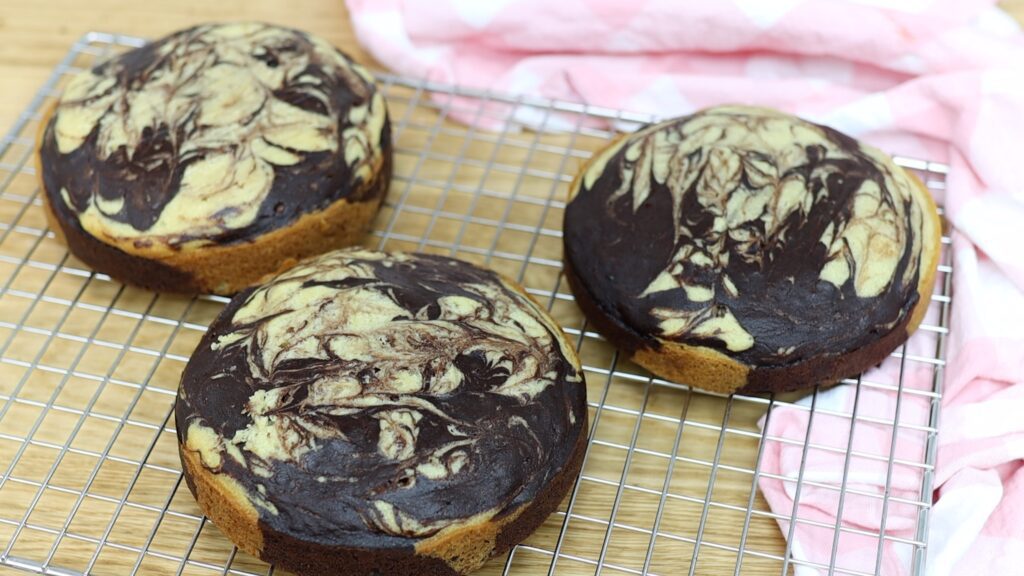
When you take the pans out of the oven, let them rest in the pans for five minutes. This way they'll firm up slightly and won't crack when you turn them out of the pans. Turn the pans over to flip the cakes onto a wire rack to cool. If you leave them in the pans for too long the cakes will continue to bake and might stick to the pans as they cool. By turning them onto a wire rack they’ll cool more quickly because the rack allows air to go underneath them.
How to assemble this easy marble cake
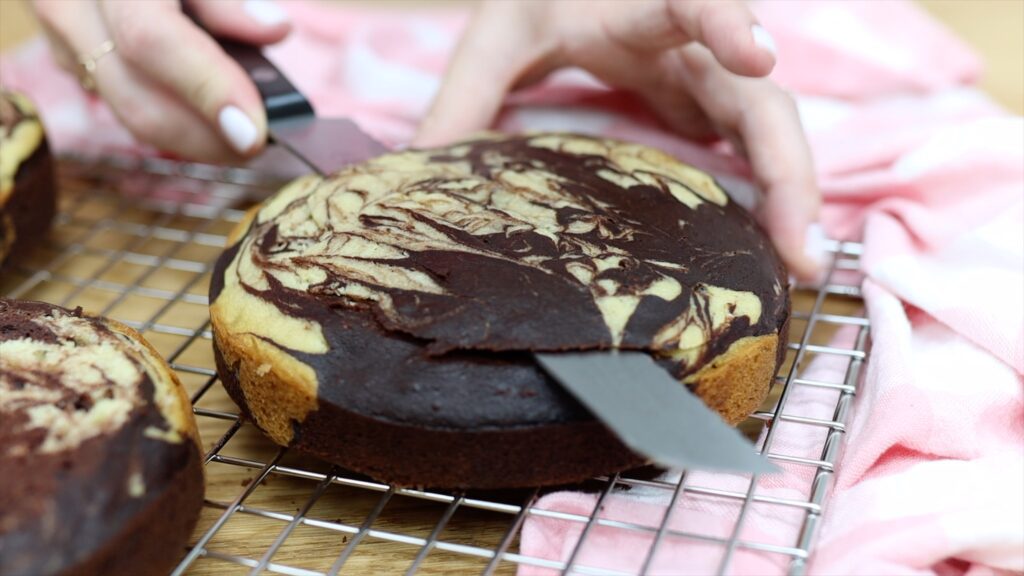
After the cake layers cool you can level them if you like. This will make them completely flat and that will make for a prettier slice when you cut into the cake. To level the cake layers, slice around the top with a serrated knife like a bread knife.
As long as you don't overbake this cake, it is incredibly moist. It's not very sweet so you can use any filling and frosting without making it overly sweet. My favourite combination is vanilla buttercream for the filling between the cake layers and chocolate buttercream as the frosting. To make the buttercream, mix butter and powdered sugar together until smooth. Then add vanilla to flavour it and milk to thin it out slightly. Use about a quarter of it to fill the cake, saving about half a cup for decorations at the end.
To assemble the cake, spread or pipe a dot of buttercream onto a cake board. Press your first layer of cake into the dot. Spread or pipe vanilla buttercream onto the cake layer and then place another layer of cake on top. Repeat with another layer of filling and the third cake layer.
How to frost this easy marble cake
To make chocolate buttercream to frost the cake, melt chocolate chips in the microwave. Use 80% power for 30 seconds at a time so that the chocolate doesn't overheat and seize. Stir the melted chocolate until it's smooth and then let it cool before adding it to the remaining buttercream. Keep stirring until there are no streaks of melted chocolate in the buttercream.
To prevent crumbs in your frosting you can chill your cake layers in the freezer for 15 minutes before frosting them. This makes them firmer and less crumbly. I always recommend applying a crumb coat, which is a really thin layer of frosting to trap any the crumbs that come off the cake. By doing this before applying your final layer of frosting, no crumbs will get into the visible outer layer of frosting on the cake.
How to decorate the cake
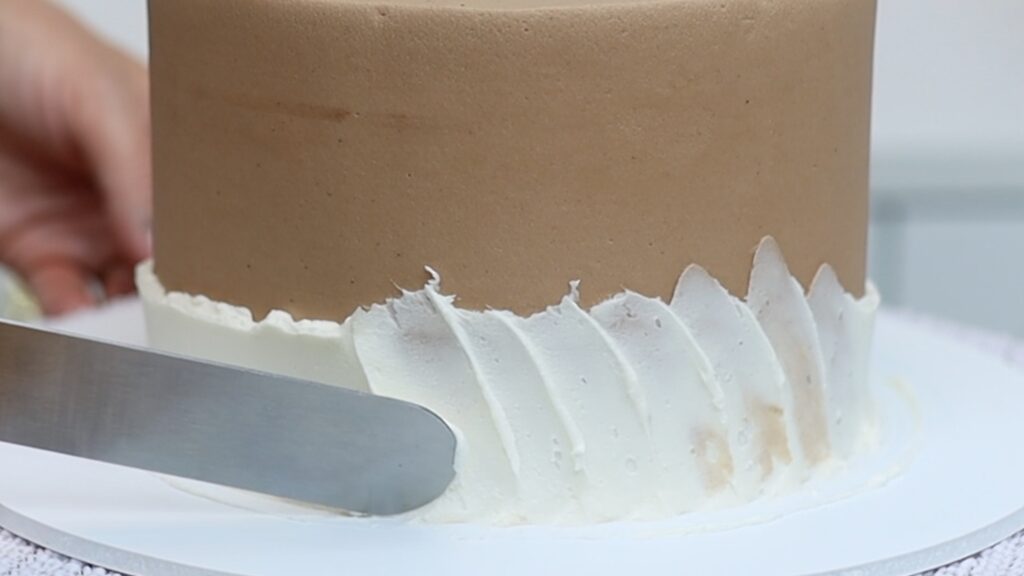
As a finishing touch, show that there is both vanilla and chocolate inside this cake. Using the vanilla buttercream you set aside earlier,spread or pipe a thin layer around the bottom of the cake. Use the tip of your offset spatula to swipe the vanilla buttercream upwards in a diagonal all around the cake.
When you notice the frosting building up on your offset spatula, scrape it off into a bowl before you continue. You only need light pressure for this.I f you push so hard that you expose the chocolate frosting through the vanilla, just go over that area again and any buttercream on your spatula will cover it up.
Storing and serving this Easy Marble Cake
You can store this cake for two days in the fridge but it tastes best at room temperature. If you refrigerate it, I recommend taking it out of the fridge 2-4 hours before serving.
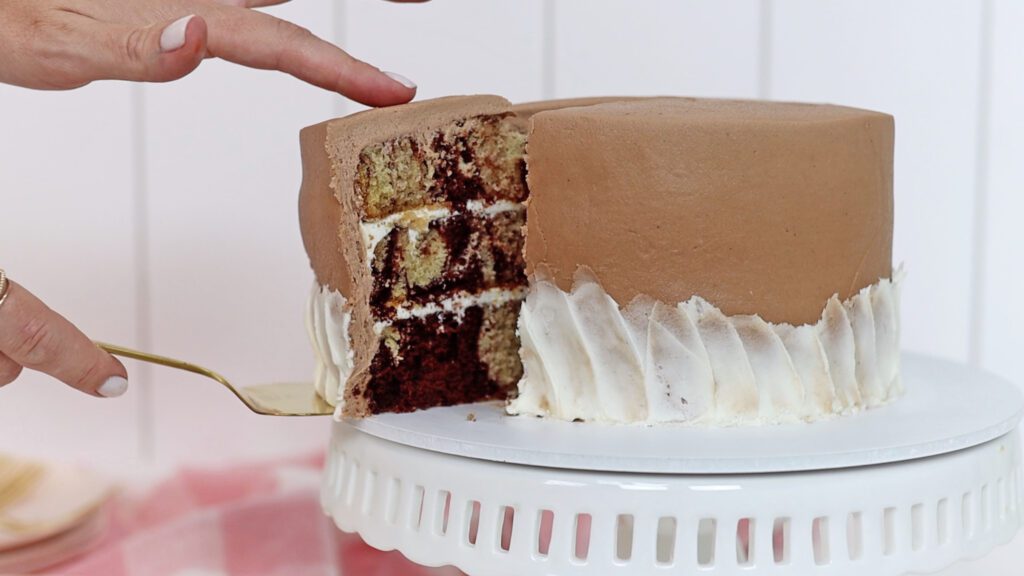
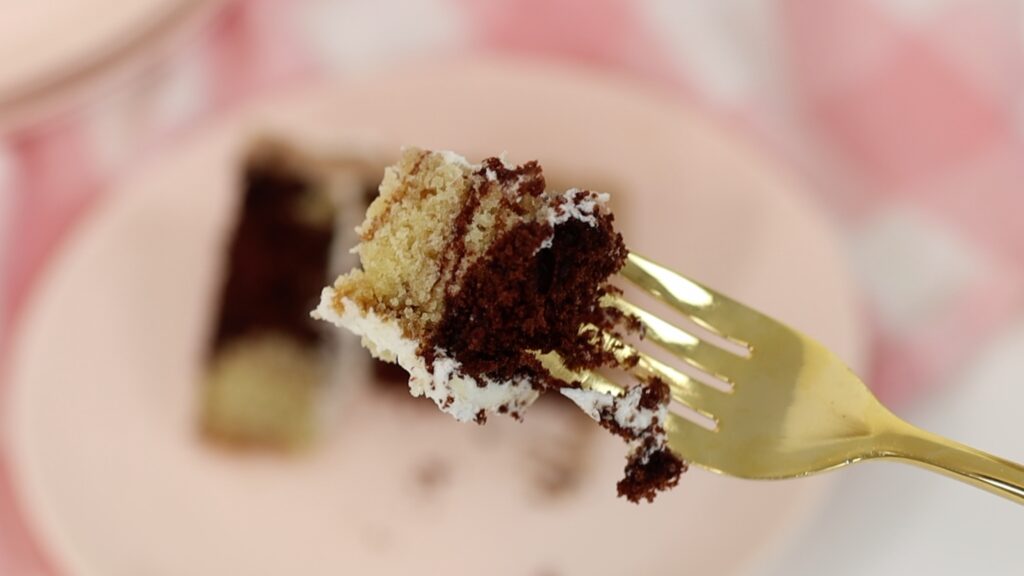
Now let’s cut into this beauty! Look at that beautiful marbling!
I hope you love this Easy Marble Cake as much as I do! If you make it, please leave a review and tell me what you think in the comments!
You'll find the recipe for this Easy Marble Cake below, with measurements for the ingredients in cups and also in grams. Switch between units of measurement by clicking the "US" (for cups) and "M" (for metric grams and ml) at the top of the recipe. You can adjust the recipe to make larger cakes by clicking the "1X" for a six inch cake or "2X" for an 8 inch cake.
In this one-batter recipe, chocolate and vanilla cake are marbled together and sandwiched between layers of vanilla buttercream, covered with chocolate buttercream. Yum!
Ingredients
UnitsScale
For the cake batter:
3/4cupbutter
1 1/2cupsgranulated sugar
3 eggs
1 tablespoon vanilla
1cupall-purpose flour
1 1/2 teaspoons baking soda
1/2 teaspoon baking powder
1/8 teaspoon salt
For the vanilla batter:
1/3cupbuttermilk
2 tablespoons vegetable oil
1/2cupall-purpose flour
For the chocolate batter:
1/3cupcocoa powder
3/4cup hot water
1/2cupall-purpose flour
For the filling and frosting:
1 1/2cupsunsalted butter at room temperature
4cupspowdered sugar
1 teaspoon vanilla extract
1/2 teaspoon salt
1-2 tablespoons milk or cream
1/3cupchocolate chips
Instructions
To make the marble cake layers:
In a bowl, whisk together hot water and cocoa powder until the cocoa powder has dissolved. Set aside to come to room temperature.
In a mixer with a beater attachment, mix butter with sugar on medium speed until pale and creamy, about three minutes. Scrape down to the bottom of the bowl once during mixing to make sure no butter or sugar is stuck at the bottom.
Add eggs one at a time, mixing on the lowest speed after each egg until incorporated, about 30 seconds.
Add vanilla and mix on lowest speed for about 30 seconds to combine.
In a bowl sift and whisk together 1 cup flour with baking soda, baking powder and salt. Add to the mixing bowl and mix on the lowest speed to incorporate.
Pour or scoop half of the batter into a separate bowl. You can pour it straight into a measuring jug (it will be be 1 1/3 cups batter) or into a bowl on a scale (it will weigh 325g). Set this aside to make the chocolate batter later.
Add the buttermilk and oil to the mixing bowl and mix on the lowest speed to combine. Add 1/2 cup flour and mix on the lowest speed until you can't see flour in the batter, about 30 seconds.
Grease three cake pans and divide the vanilla batter between them, using an ice cream scoop or spooning it into blobs spread out around each pan.
Pour the set-aside batter back into the mixing bowl and add the cocoa powder mixture. Mix on the lowest speed to combine. Add 1/2 cup flour and mix until batter is smooth, about 30 seconds.
Using a measuring cup or ice cream scoop, divide the chocolate batter between the pans by adding it in blobs in between the vanilla batter. Use the handle of your spatula or a toothpick to swirl the batter, going all the way down to the bottom of each pan. Tap each pan on the counter to knock any air bubbles out of the batter.
Bake at 175ºC or 350ºF for 26 minutes or until a toothpick inserted into the middle of the cake comes out clean.
Let cakes cool in their pans for 5 minutes. Use a spatula to loosen cake from the edges of the cake pan and then turn onto a wire cooling rack. Leave to cool completely.
To make the frosting:
Mix butter and powdered sugar on the lowest speed until smooth. Add vanilla, salt and milk and mix to combine.
Heat the chocolate chips in the microwave at 80% power for 30 seconds at a time, stirring after each time, until smooth. Set aside to cool.
To put it all together:
Spread a dot of buttercream onto the middle of a cake board and press your first layer of cake onto it. Spread vanilla buttercream onto the first layer of cake and place the next layer on top. Repeat with another layer of filling and the final cake layer.
Set aside 1/2 cup of vanilla buttercream. Add the cooled melted chocolate to the rest of the buttercream, stirring until there are no streaks of melted chocolate in the buttercream.
Frost the cake with chocolate buttercream, applying a thin layer first (a crumb coat) and letting it set at room temperature for 30 minutes or in the fridge for 15 minutes before applying a final layer.
As soon as you've finished frosting the cake, use the remaining vanilla buttercream to spread or pipe a thin layer around the bottom of the sides of the cake. Using gentle pressure, rest an offset spatula or the back of a spoon on the cake board and drag it diagonally upwards to create texture in the vanilla buttercream, repeating the motion all around the cake.
Notes
You can refrigerate this cake for two days after making it.
This cake is best served at room temperature! If you refrigerate it, take it out of the fridge 2-4 hours before serving it.
I’m going to share 6 ideas for patriotic red, white and blue cakes. I'll show you the techniques for each design and also give you tips on making your frosting bright blue and really red.
Textured red, white and blue cake
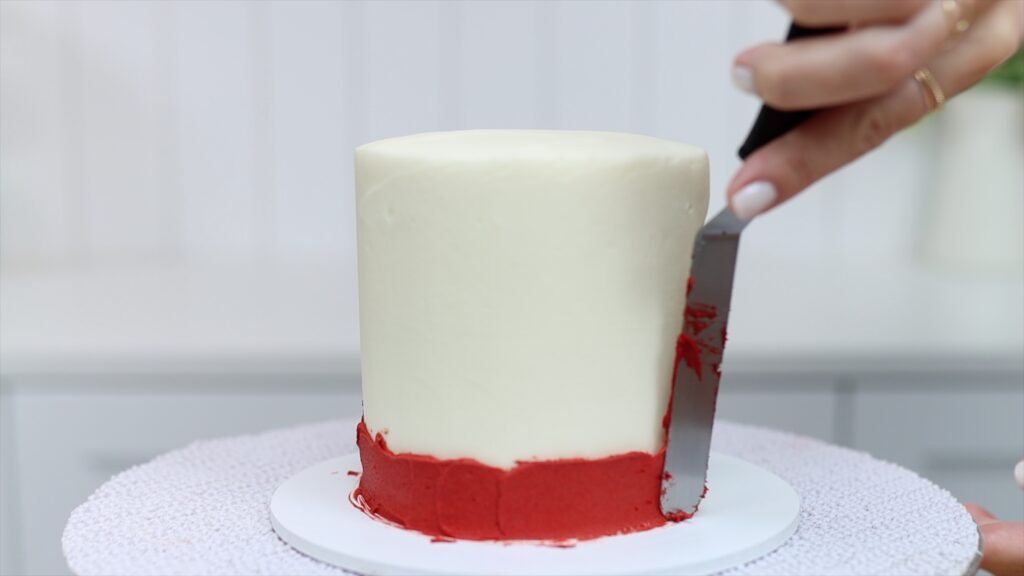
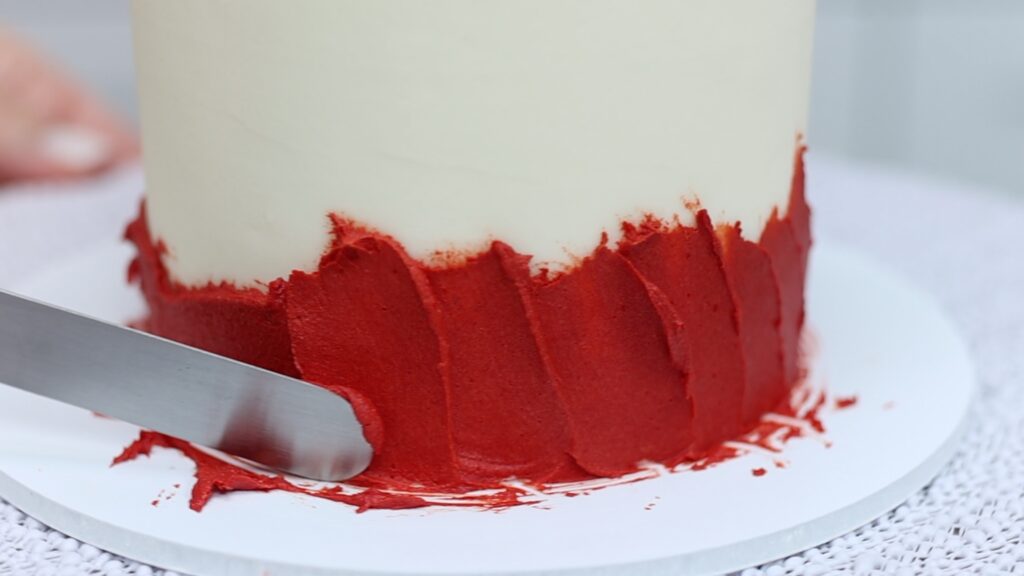
For this first cake, all you need is an offset spatula or a palette knife. Spread a thin layer of red or blue frosting around the bottom of a frosted cake. I'm using my 4 Minute Buttercream for all of these cakes but you can use any frosting you like.
Use the tip of your offset spatula or the back of a spoon to swipe the frosting upwards diagonally. You'll pull the frosting upwards around the cake to create this pretty, rustic texture.
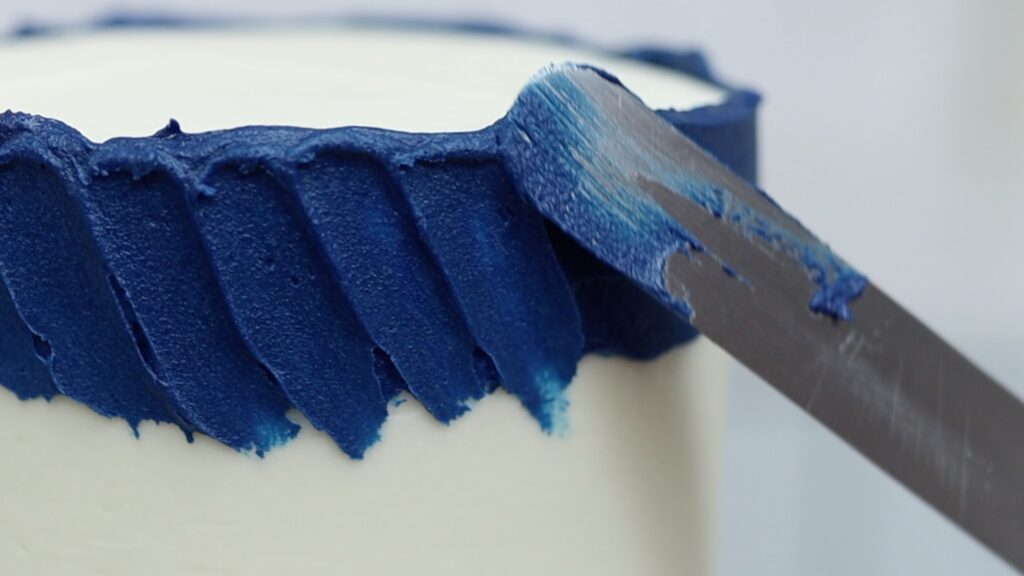
Spread a thin layer of frosting around the top of the cake and pull the tip of your offset spatula downwards diagonally. This will match the texture around the bottom of the cake.
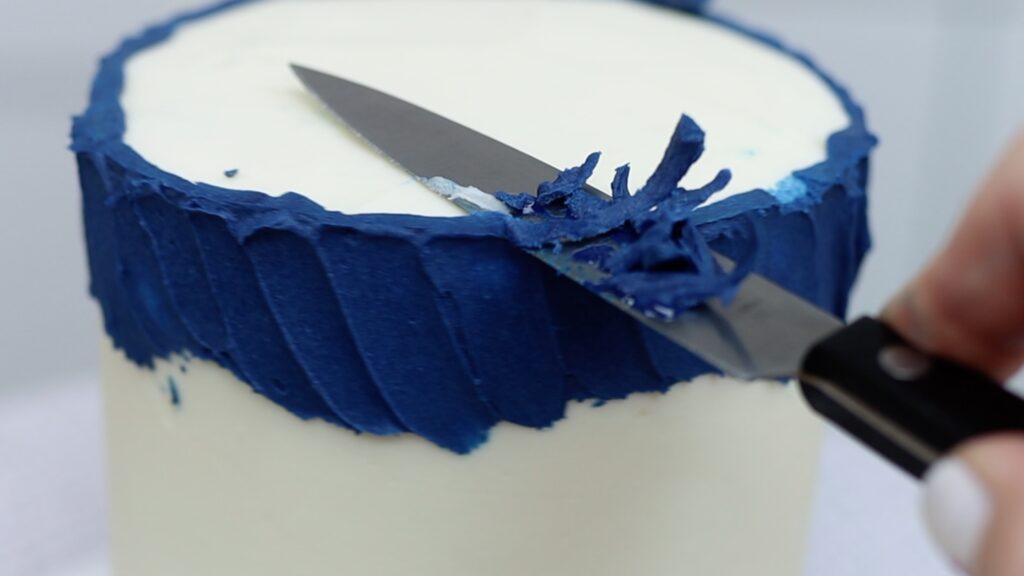
I love the uneven top edge of this frosting but if you want it to be straight, put the cake in the freezer for 15 minutes to set the frosting. Pour boiling water into a glass and dip a knife into it to heat the knife blade. Trim around the top edge of the cake, slicing off the uneven top edge of the frozen frosting and leaving a neat, straight edge behind.
Cake with a berry border
Berries are naturally red and blue and make pretty and delicious decorations. You can line them up around the bottom or top of a cake to add a colourful border.
If you’ve just frosted the cake and the frosting is still soft, the berries will stick to the frosting easily. If the frosting has set so it’s firm, you’ll need to spread or pipe a little bit of fresh frosting over the area where you want to put the berries. Then press the berries gently into that frosting to attach them. When that frosting sets, the berries will be held securely in place so you can move the cake or transport it worry-free.
Cake covered with berries
If you want to be more dramatic with your berry placement, arrange them in diagonal rows to completely cover the cake. The neatest way to do this is to choose an order, in this case raspberry, blueberry, blackberry, and press the berries one layer at a time into the frosting on the cake.
I’m not using strawberries because they're much bigger than the rest of my berries. If the berries are a similar size, like these raspberries, blackberries and blueberries, they’ll support each other as you layer them. Also, using similar sized berries will create the clearest diagonal lines on the cake. This design makes a red white and blue cake with so much fruit on it that it’s almost healthy!
Cake topped with berries
You can use berries to add red white and blue to any cake, like this chocolate cake, which is perfect is you want to make a cake look patriotic but still keep the focus on the flavour.
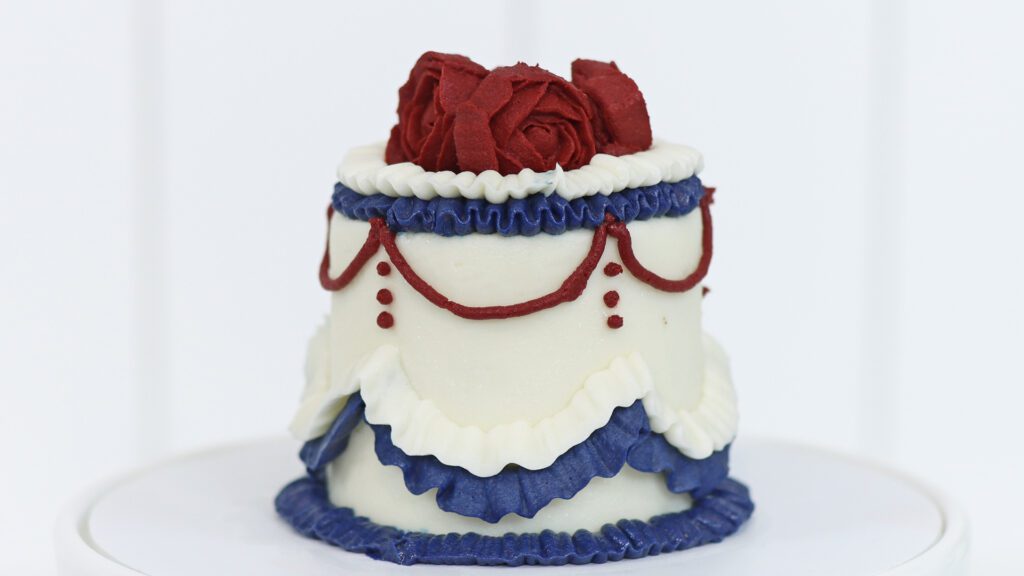
Vintage red, white and blue cake
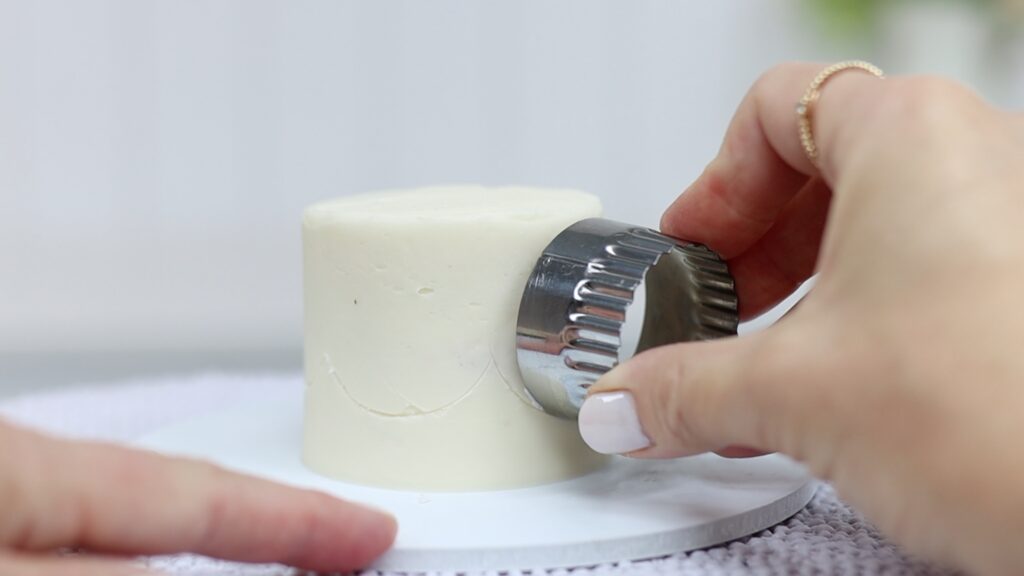
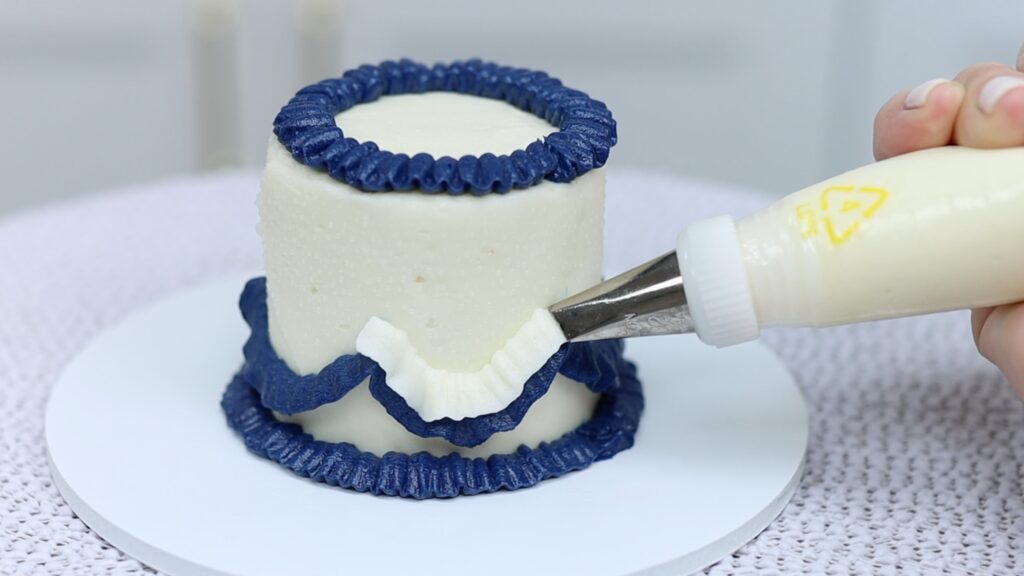
For a vintage look, use piping to add lots of texture and colour to a cake. Use a round cookie cutter to push the bottom half into the frosting to imprint semi-circles around the cake as a guideline before you start. For my design I want the top of the semicircles to be about halfway up the cake.
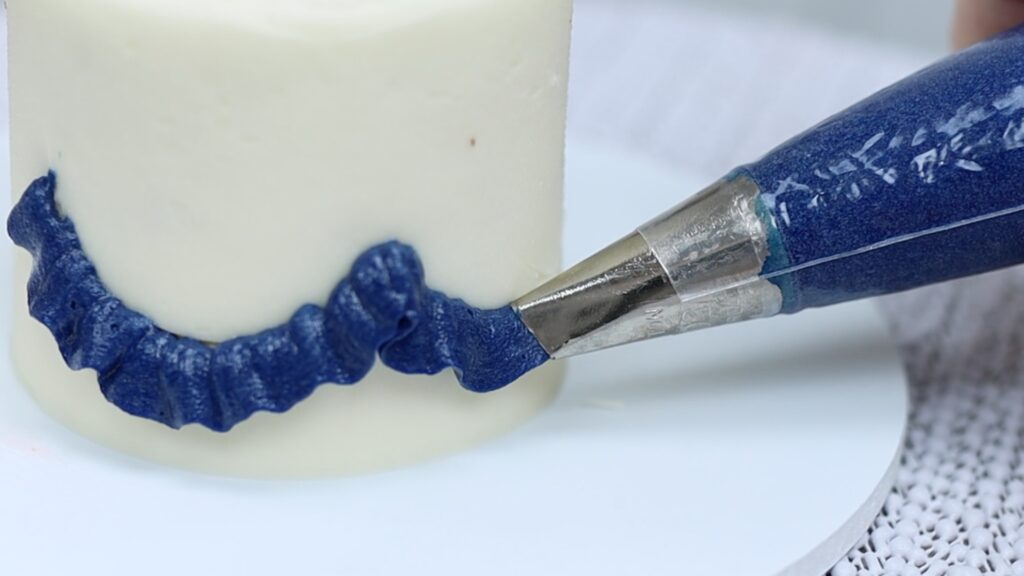
This is a #102 petal tip which is tiny because this is such a tiny cake! You’ll find a mini cake course and hundreds of other cake designs and decorating techniques on the British Girl Bakes cake school and if you join my ClubPLUS you’ll get access to them all!
The trick for these ruffles is to hold the wide end of the petal tip pressed against the cake and point the narrow end downwards. By wiggling your wrist slightly as you pull the piping bag you'll creates ruffles in the piping.
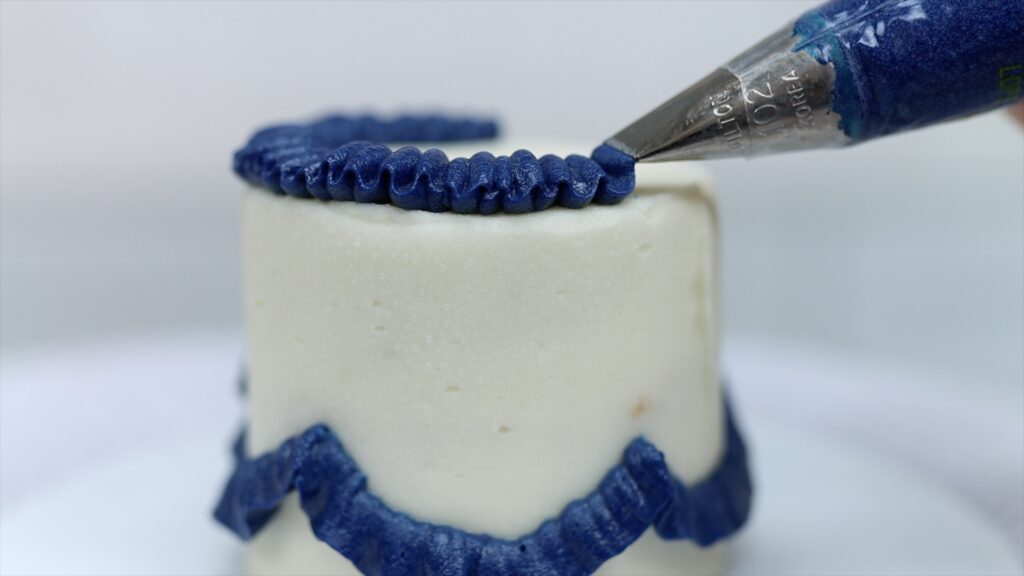
Another way to use a petal tip is to make these wavy ribbons. You’ll need the wide end of the piping tip to be pointing towards the middle of the cake with the narrow end pointing out to the edge of the cake. As you squeeze the piping bag and pull it around the cake, move it quickly up and down to make the waves. This looks pretty at the top of the cake and also around the bottom.
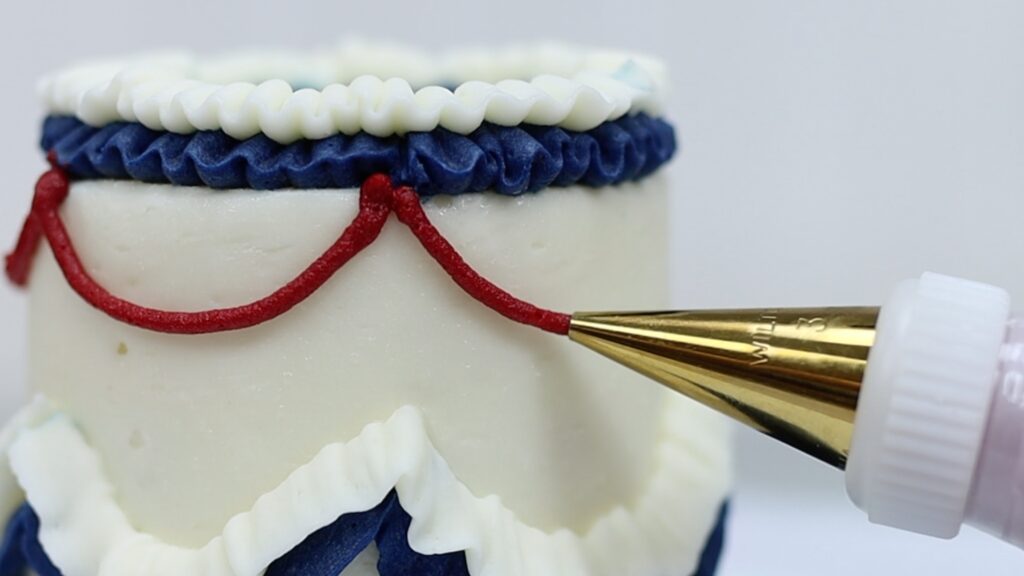
Pipe another ruffle using white over the top of the first ruffle, layering them around the cake. Keep the top of the piping tip, the wide end, pressed against the frosted cake to attach the top of the ruffle to the cake, so that it doesn’t droop. You can pipe these ruffles and this wavy ribbon onto the cake straight after piping the blue buttercream, or if you want to do it in stages you can do it after the first colour sets.
Now to add red I’m using a small round #3 piping tip to pipe strands of frosting around the cake. If the line breaks you can use a toothpick to touch it up. My hands are really shaky so if I can pipe these lines, you definitely can! Keep an eye on the ruffles below so that your lines mimic that curve and line up above them.
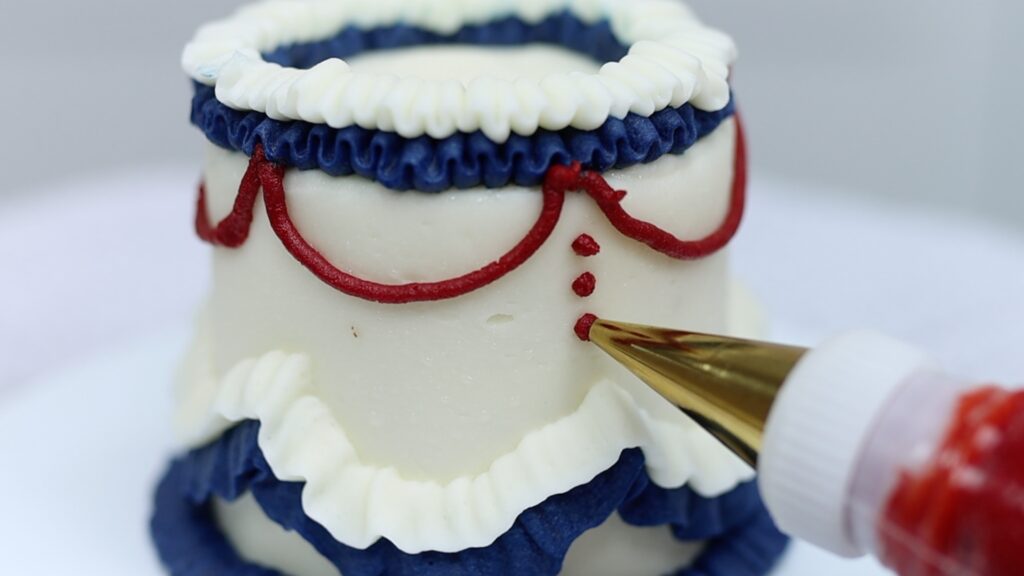
Then pipe three tiny dots down from the join of each of the curved lines. If your buttercream isn’t coming out of the piping bag easily it can be for one of two reasons. The first is that your buttercream is too stiff so you need to add more milk to thin out the consistency. The second is that you need to twist the top of the piping bag to put more pressure on the buttercream so that when you squeeze the bag it comes out effortlessly.
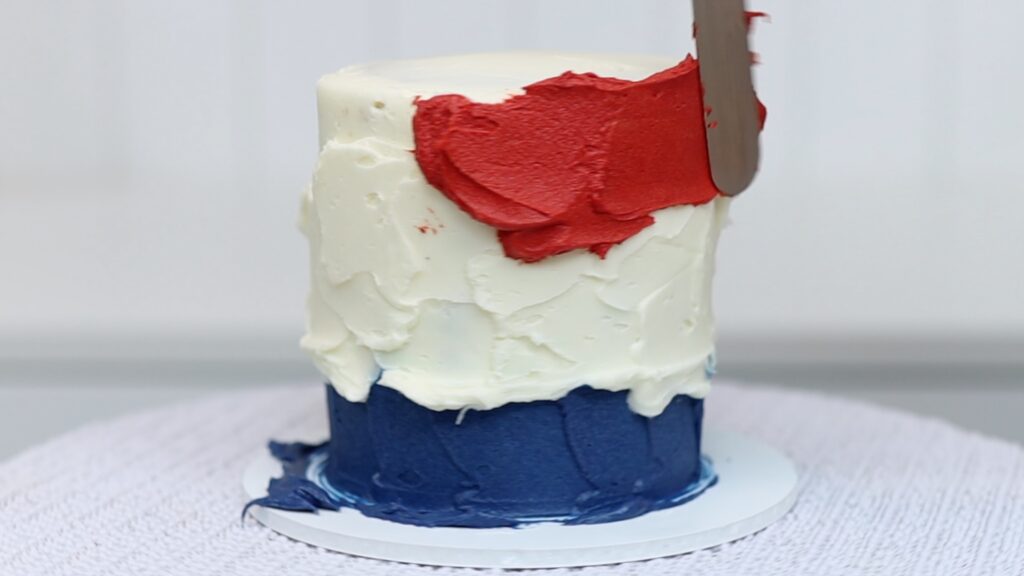
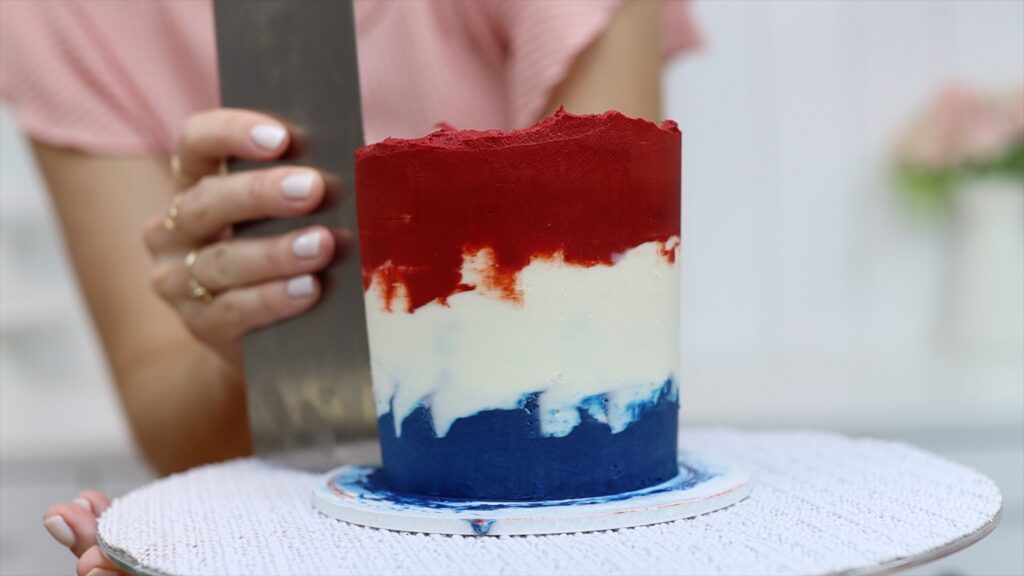
This cake design is the quickest because instead of frosting and then decorating the cake, the frosting is the decoration. After crumb coating a cake, spread red white and blue frosting in layers around the cake to completely cover it.
Use a cake comb to smooth the frosting. You can use a textured cake comb if you want to add texture instead. The colder the cake is, the less the colours will blend together so the bolder the separation will be. This cake has been in the freezer for a few minutes so the edges of each colour are quite dramatic.
How to colour buttercream red and blue
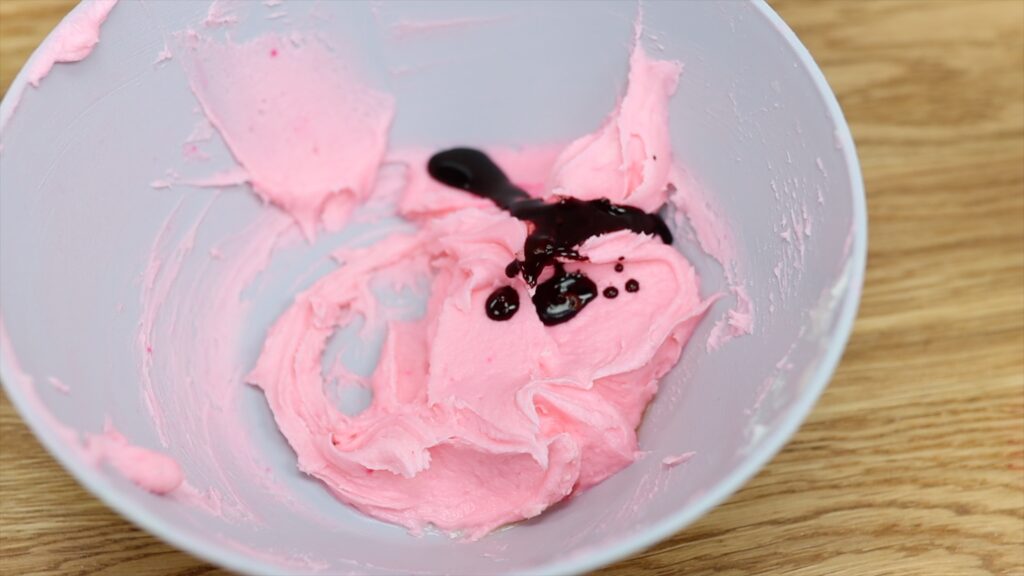
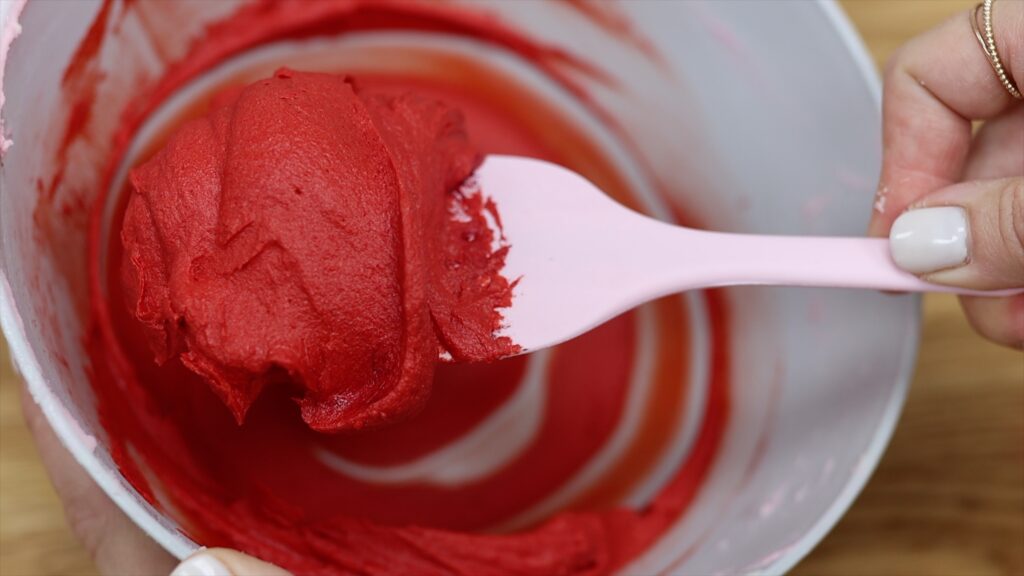
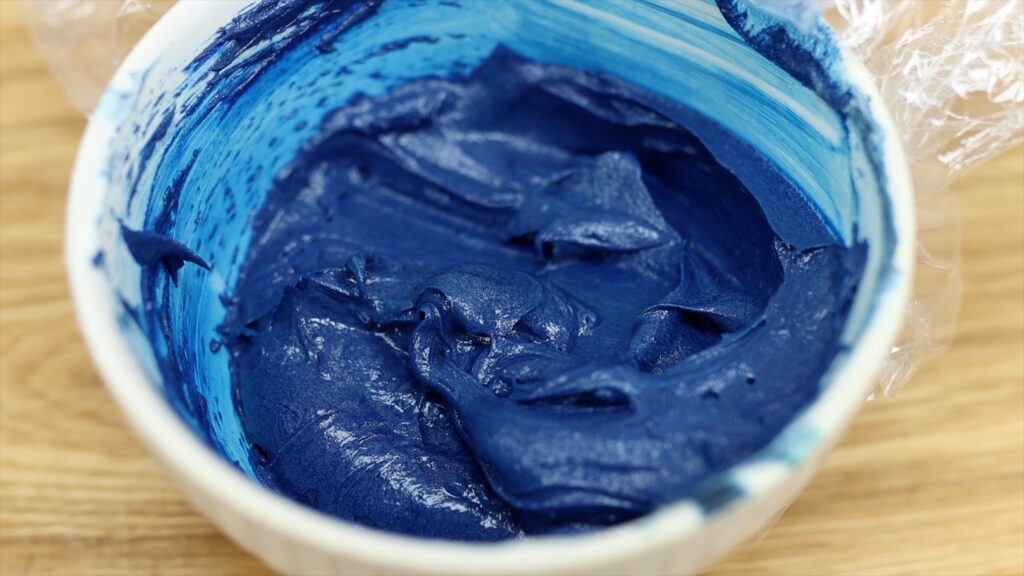
Here are a few tips for colouring buttercream. For a really bright red, start with white or pink buttercream and add a generous squirt of red gel colour. You need more than you think! I recommend using gel colours because they're much more concentrated than liquid colours so will make your buttercream bolder.
All gel colours will develop and darken with time so you can make the buttercream a bit lighter than you want it to be. Then cover it with cling film or Saran Wrap or a lid and wait about an hour and you’ll have an even bolder colour.
You can also put it in the fridge overnight, covered or in a ziplock bag, to allow the colour to develop.
Add flavour and moisture to your cupcakes with these 6 easy fillings! I'll show you how to fill cupcakes with two different methods and share lots of tips and tricks for filling, frosting and decorating cupcakes.
You can add filling to cupcakes using piping bags and also without them. I'll show you both methods and share my tips and tricks for both.
Method #1: How to fill cupcakes with piping tips
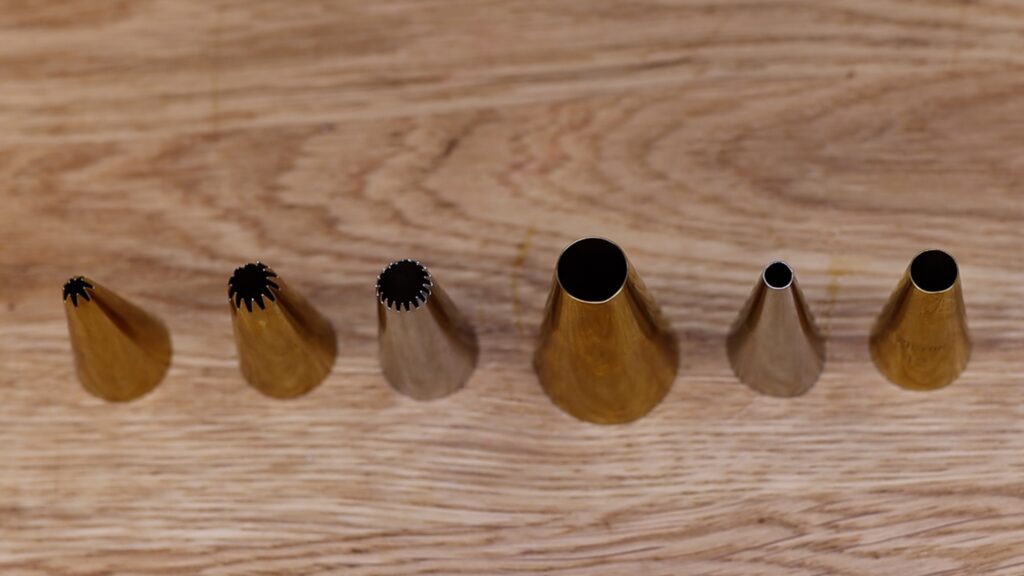
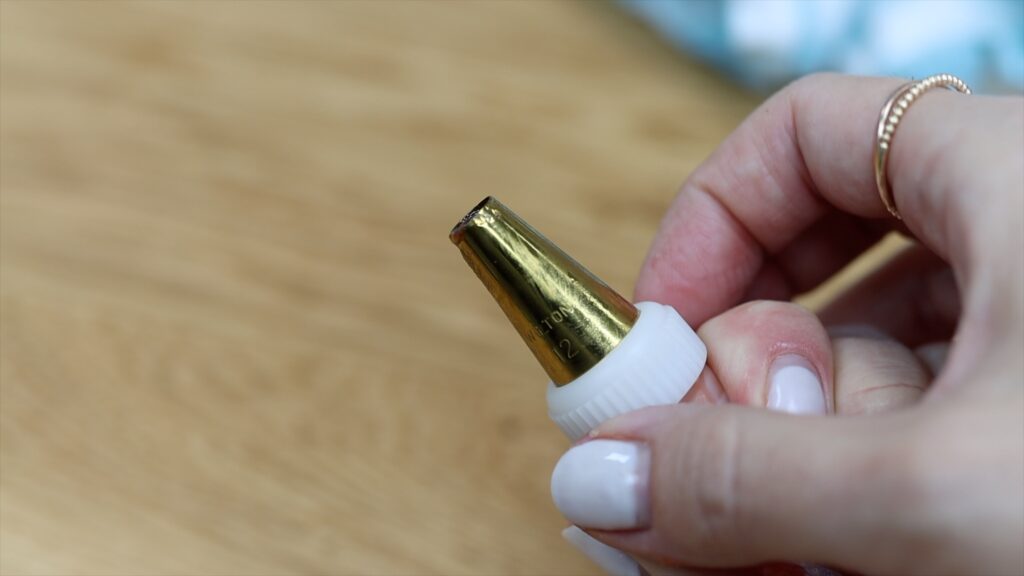
The quickest way to fill cupcakes is to use a piping tip. You don't have to buy a special piping tip to fill cupcakes - round tips or even a star shaped tip will work. When you choose the size of your piping tip, keep in mind the consistency of your filling. If it's runny, choose a tip with a small opening. If the filling is thick or stiff you can use a small or large piping tip.
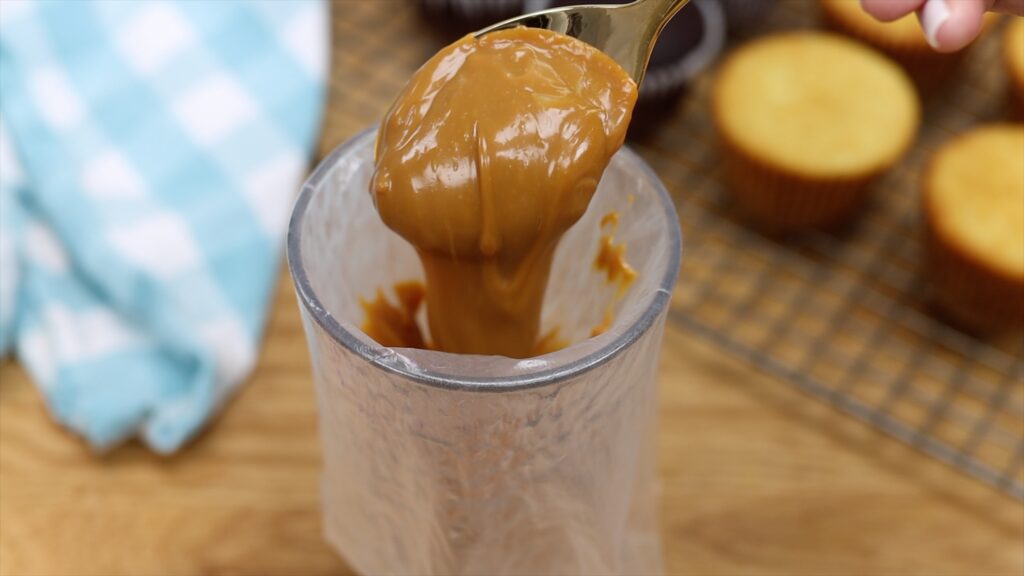
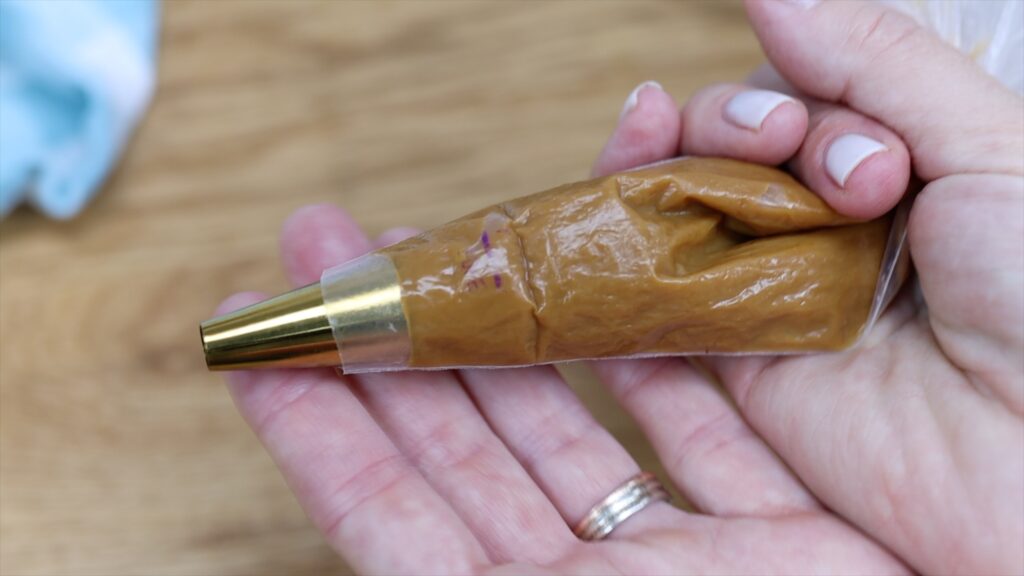
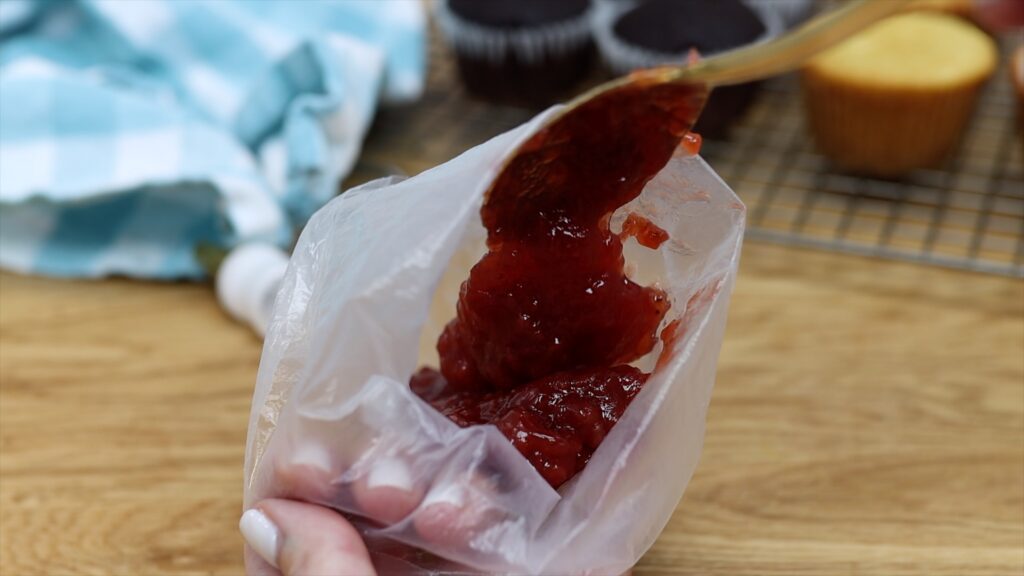
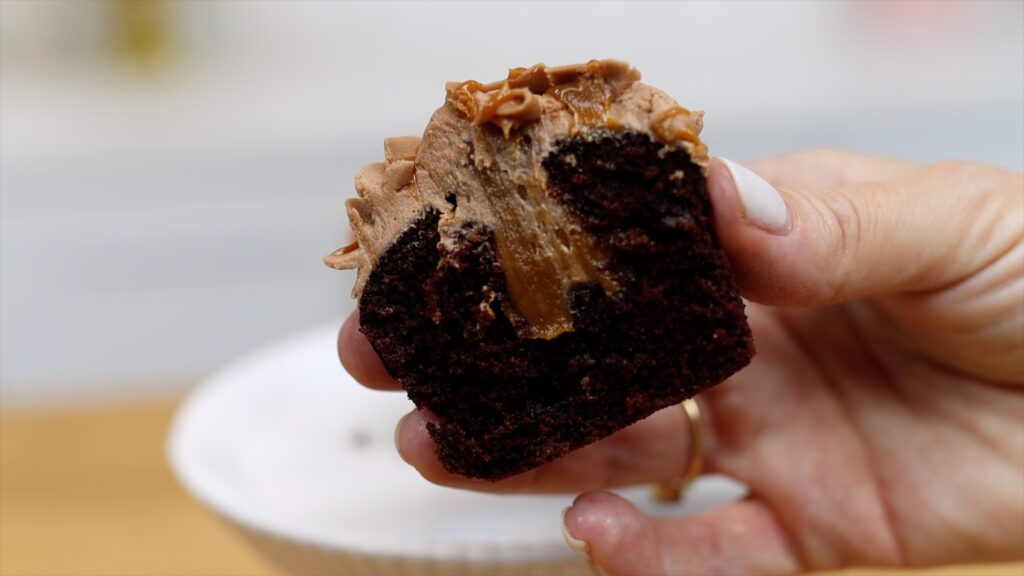
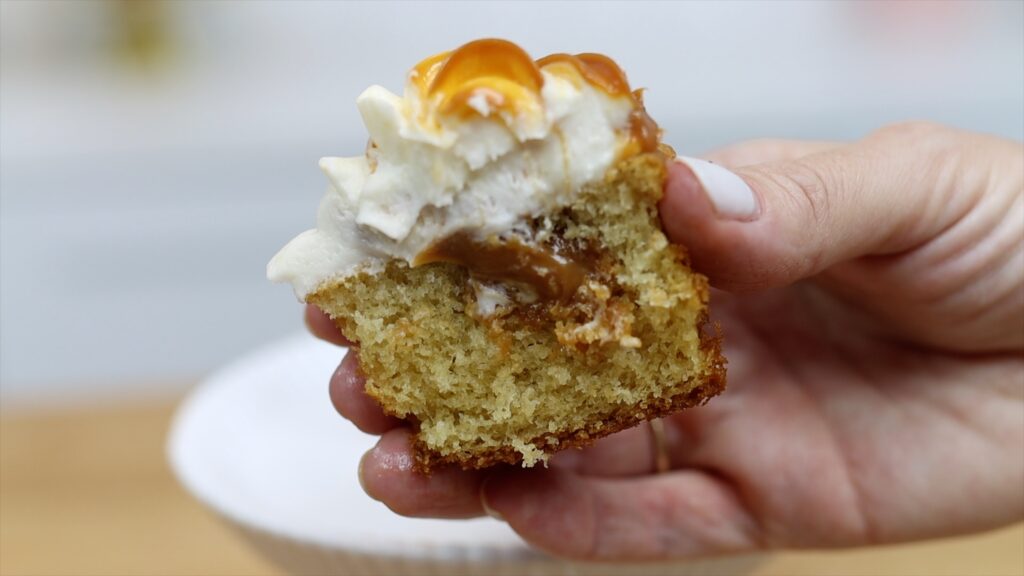
Drop your tip into a piping bag. The neatest way to fill piping bag is to fold it over a glass and then spoon the filling inside. This first filling is dulce de leche, which is a thick caramel that comes in a can. If you’re intimidated by homemade caramel, this is a great alternative!
You can make it runnier by stirring in some cream if you want to, which I’ve done here. You only need about a tablespoon for each cupcake. Unfold the piping bag and the top edge will be perfectly clean instead of covered with smears of your filling ingredient.
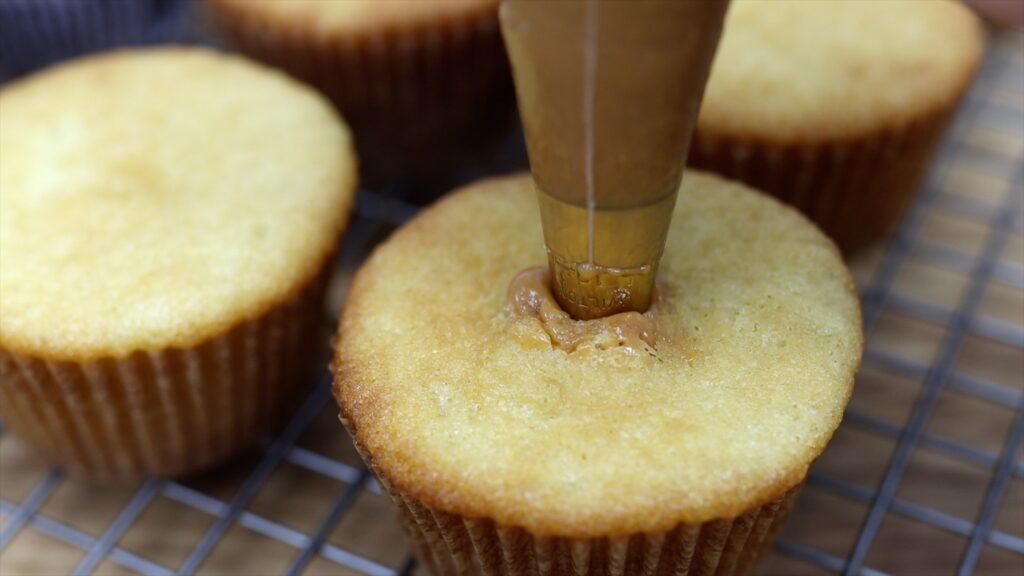
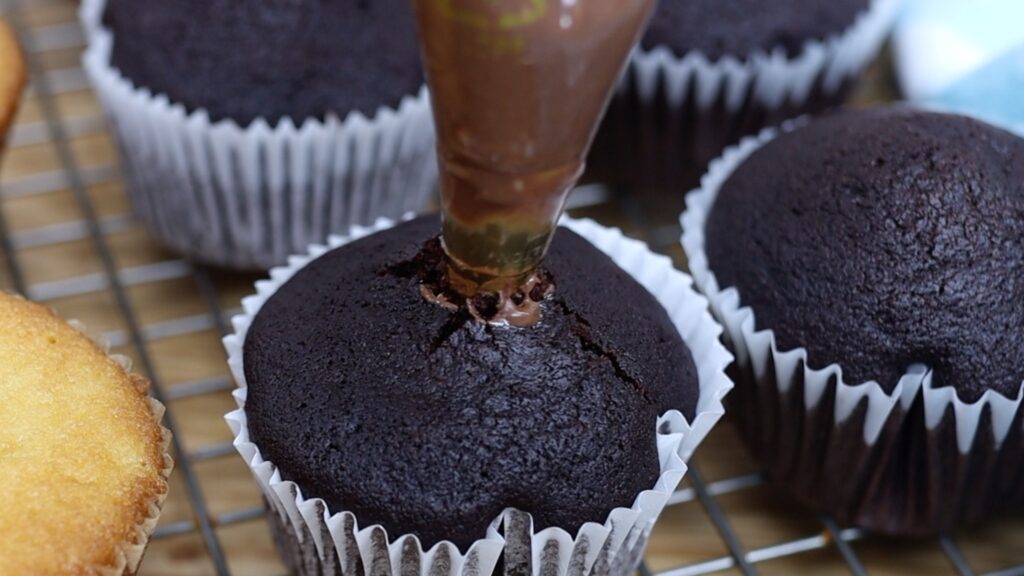
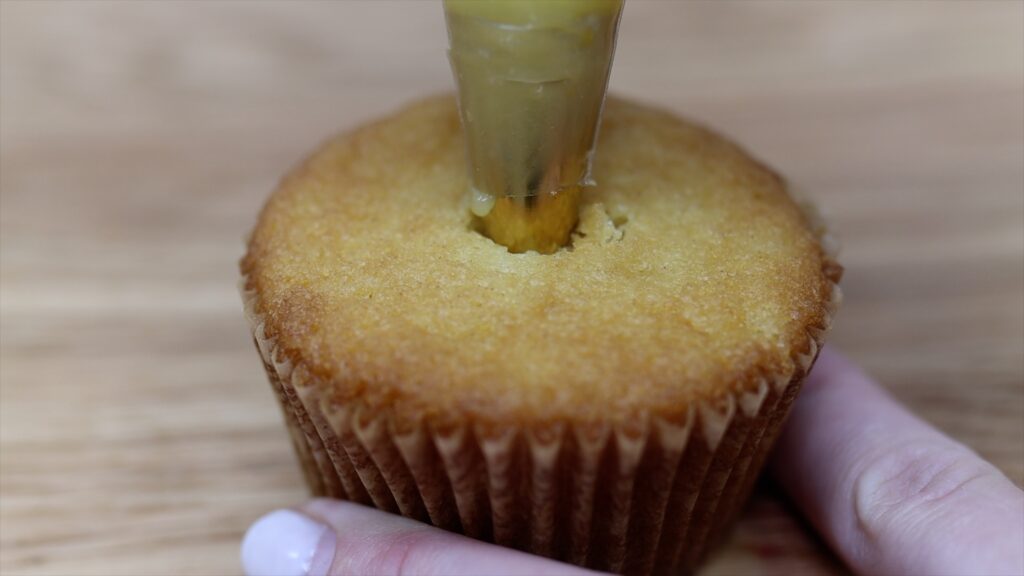
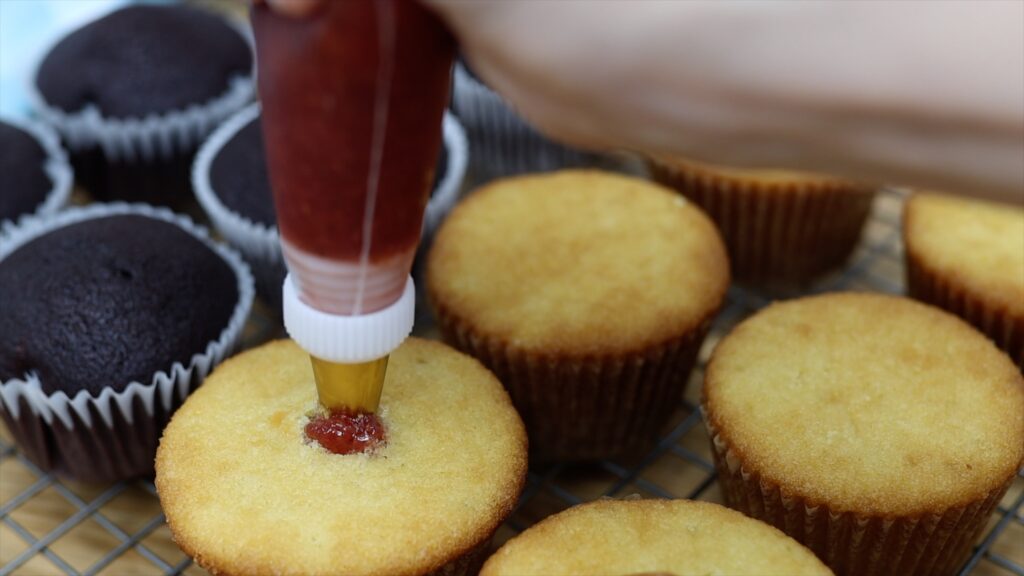
Squeeze the filling down to the end and then push your piping tip into the middle of a cupcake, going in maybe a third of the length of the tip, and squeeze the bag to fill the cupcake. When the cupcake bulges and the filling oozes out of the top, stop squeezing and lift the piping bag up.
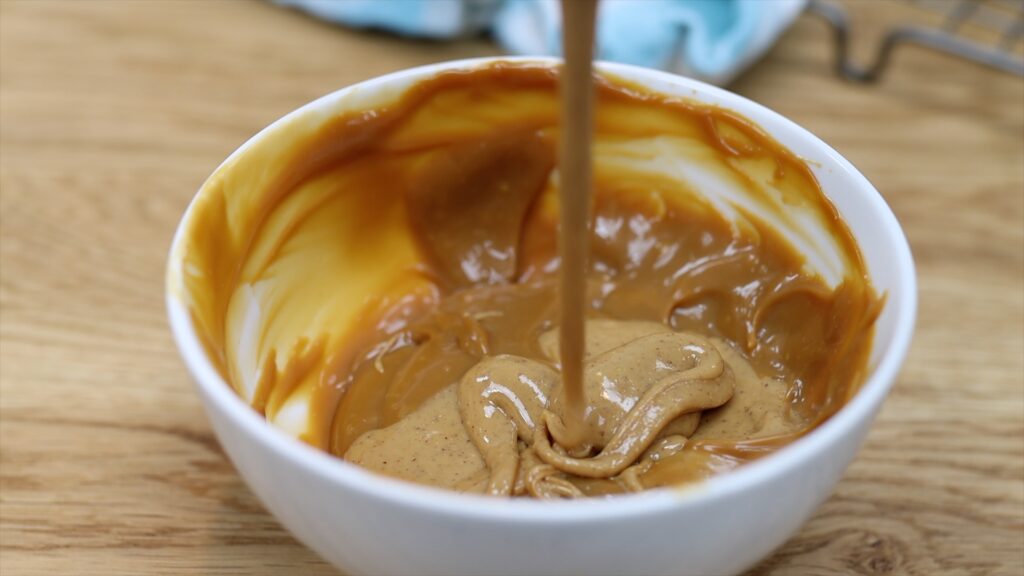
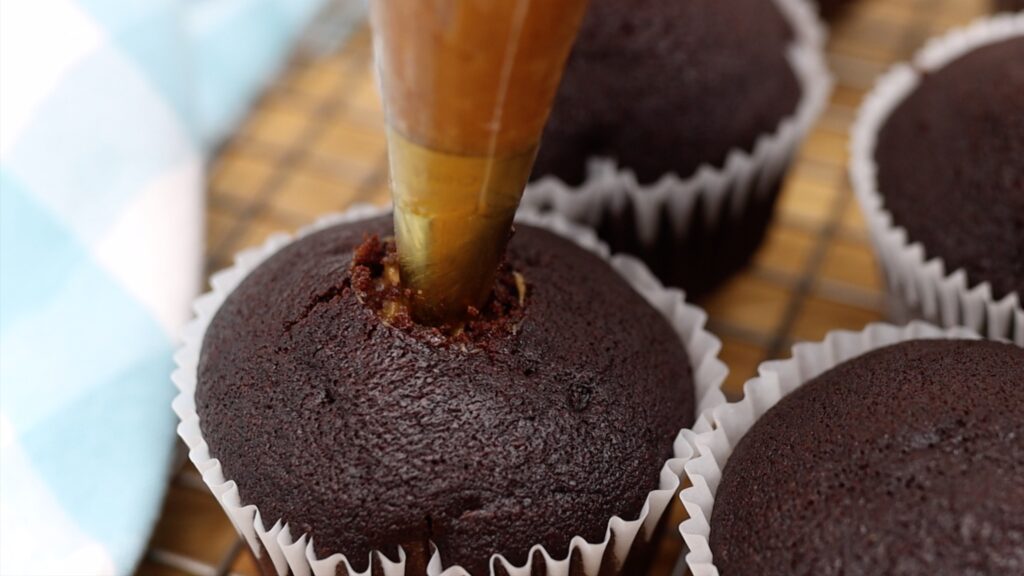
For another easy filling, mix dulces de leche or caramel with about half that amount of peanut butter. This peanut butter caramel is sweet and creamy and still a good consistency to pipe as filling into a cupcake.
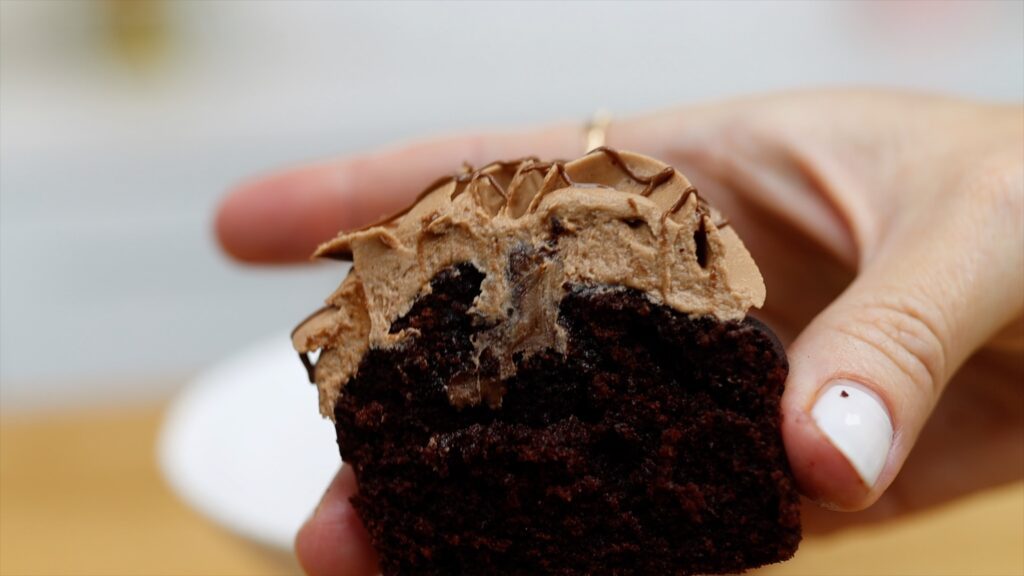
Ideally, filling ingredients won’t be very runny because those will absorb into the cupcake and you won’t notice them when you bite into the cupcake. Nutella is ideal! It’s best to push your piping tip with your fingers into the cupcake, otherwise the tip can be pushed by the cupcake back up into the piping bag. I’ll show you an easier option in a second. The cupcake cracking is a good sign that it’s bursting with the filling ingredient, for maximum flavour! You’ll cover up the cracks with frosting so don’t worry about them being ugly.
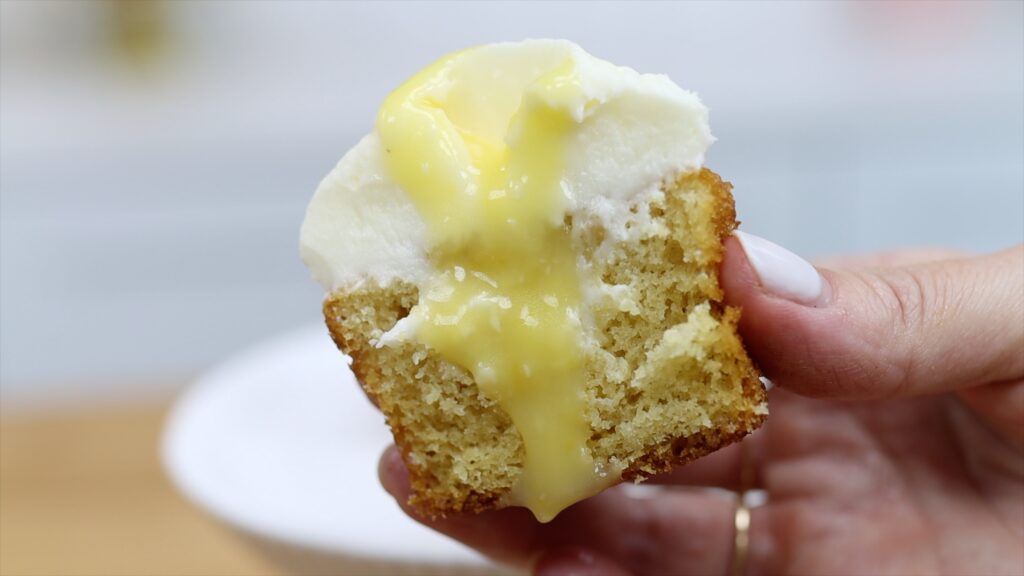
For the cupcake in the photo below I'm using lemon curd as the filling. You can buy it in a jar pre-made or make your own. Homemade tends to be runnier so using a smaller tip will prevent it oozing out of the bag while you’re moving the piping bag towards the cupcake!
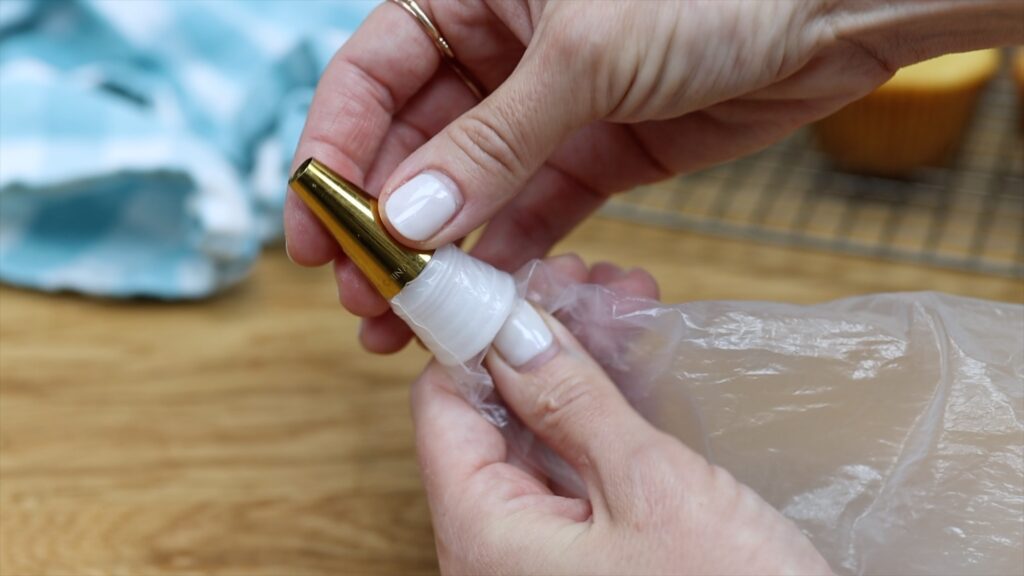
To make it easier to push the piping tip into a cupcake, use a coupler. These go on the inside of piping bags and then you attach the piping tip to the outside of the bag, screwing it on with the ring that comes with the coupler. This will hold the tip in place so it doesn’t push back up from the cupcake when you’re trying to fill the cupcake.
After using this filling just unscrew the ring on the coupler and take the piping tip off to wash and dry. Then you can use that some piping tip on another bag with a coupler, which makes it really quick to switch between different filling ingredients.
Method #2: How to fill cupcakes with a knife and spoon (the "cone method")
The second method for filling cupcakes is the knife and spoon method. It’s a bit more time consuming but it works best for really thick ingredients or really runny ingredients that are difficult to pipe. You don’t need a piping bag or piping tips for this method.
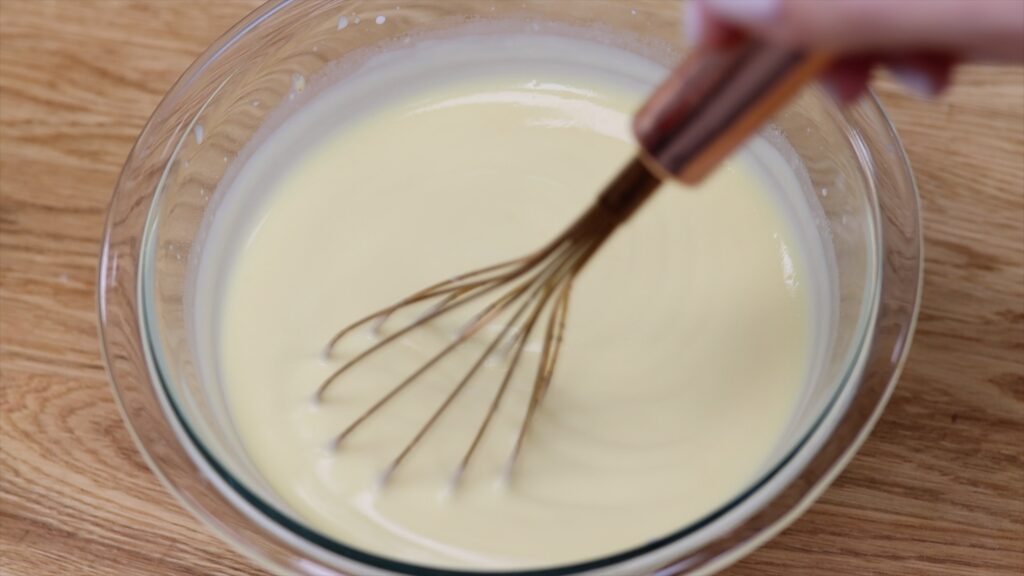
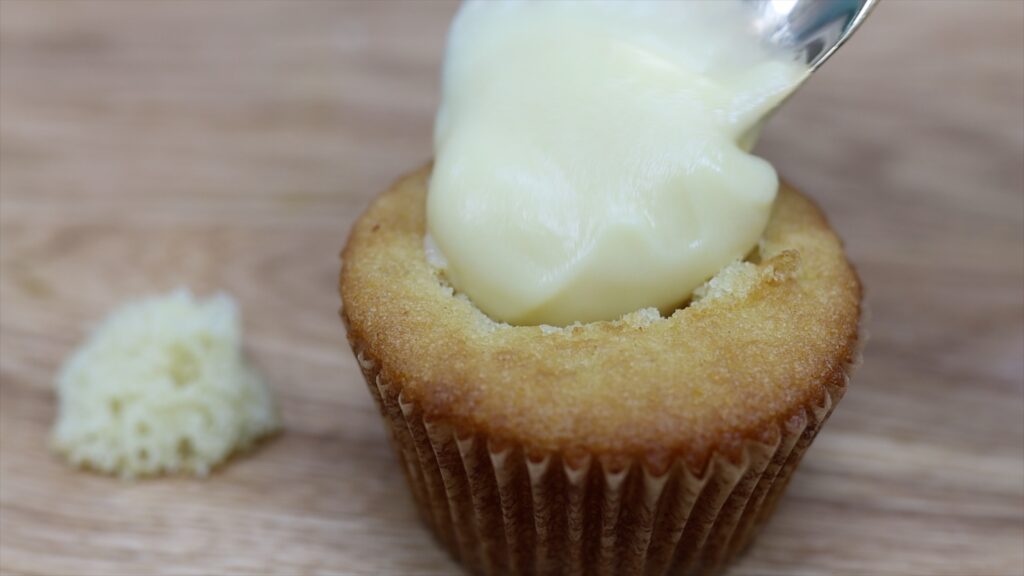
Start by choosing or preparing your cupcake filling. This is a package of vanilla pudding prepared according to the package directions. It makes cupcakes really moist and rich without making them overly sweet. Using a package of pudding means it only takes 5 minutes to set!
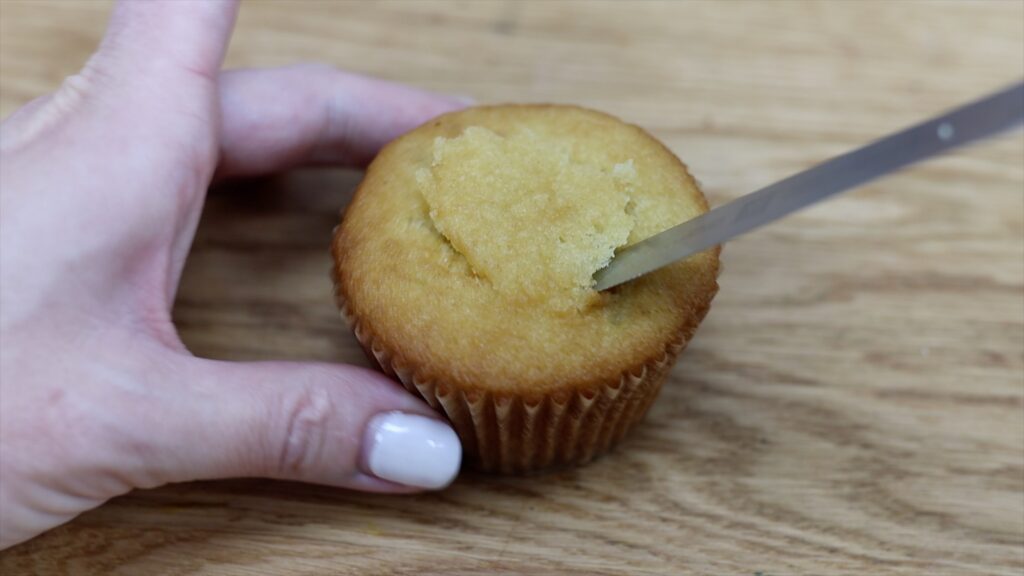
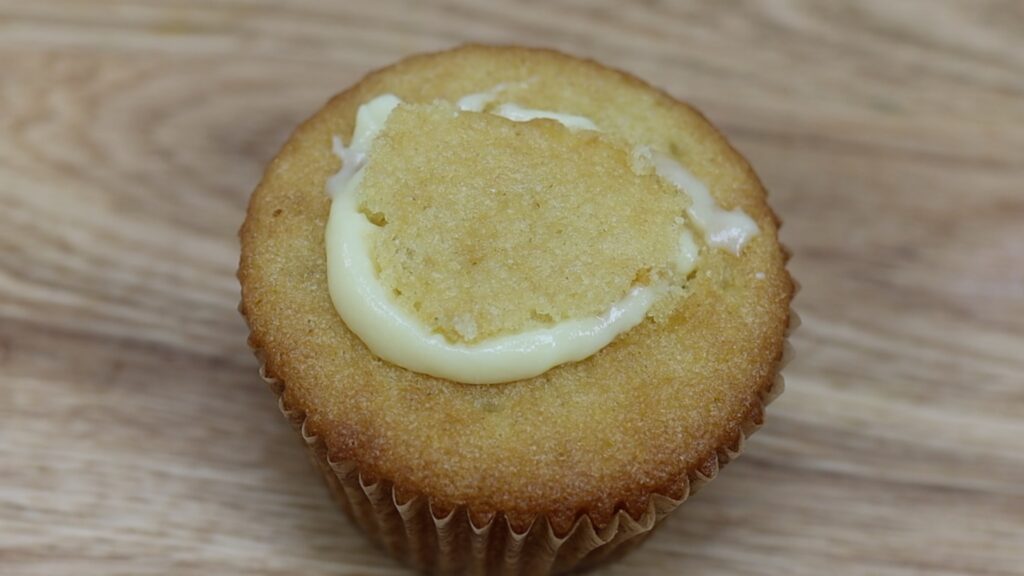
Hold a sharp knife at an angle to cut a cone shape out of the middle of the cupcake. Cut about halfway down the cupcake, not all the way down to the bottom of the cupcake. Save the piece of cupcake you cut out. Spoon your filling into the cupcake, letting the pudding or jam or any other ingredient fill the hole you've cut out. Then gently press the cupcake cone back over it.
How to frost and decorate filled cupcakes
Now it’s time to frost and decorate these cupcakes! I’ll show you options with and without piping tips.
How to decorate filled cupcakes with a drizzle
This is a 1M tip, which is a star shaped tip. After piping a swirl of my 4 Minute Buttercream or any other frosting onto the cupcake, to show what the filling is you can decorate the cupcake with it.
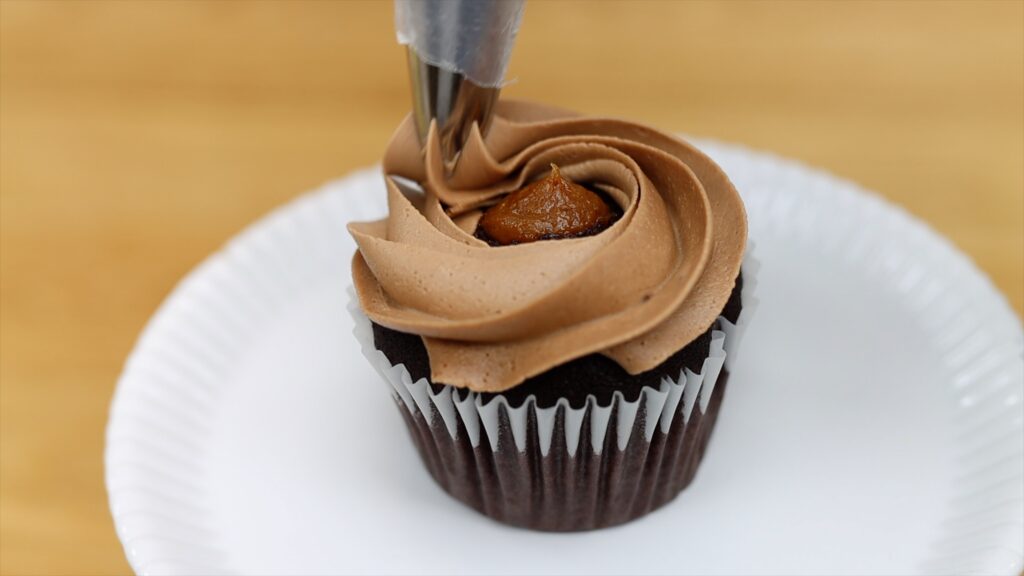
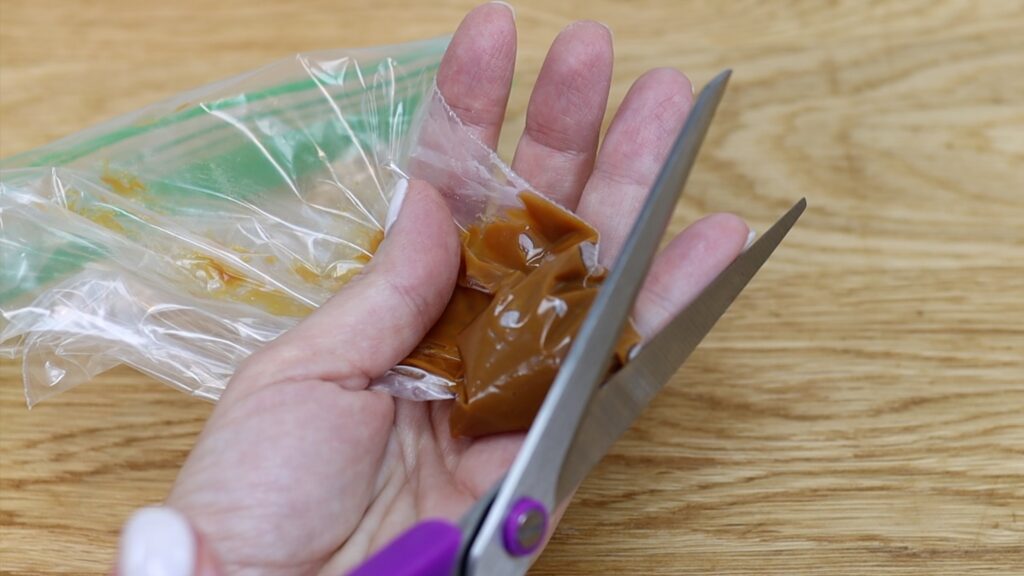
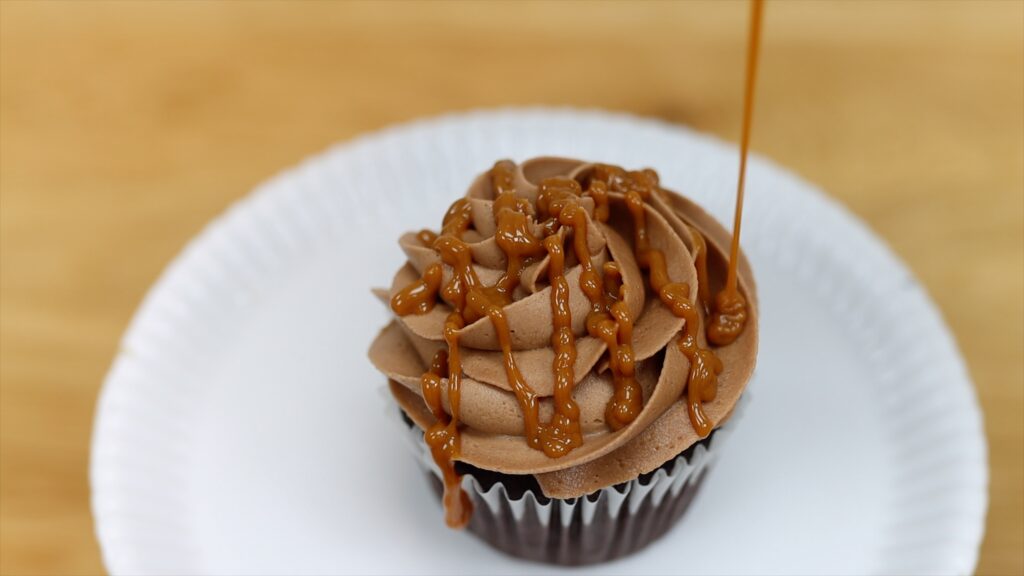
This cupcake is filled with dulce de leche so I’m going to use more dulce de leche to decorate it. Spoon some into a ziplock bag and microwave it for 10 seconds to thin it out a bit. Then cut a tiny piece off the corner of the ziplock bag to squeeze the dulce de leche through and drizzle over the cupcake. Yum!
You can do this with any filling, like Nutella or melted chocolate. The trick is to make sure it’s runny enough to drizzle so you might need to add cream or heat it for a few seconds in the microwave. Also, don’t cut off too much from the corner of the bag or you’ll have pipe globs instead of a nice thin drizzle.
How to decorate filled cupcakes with two-tone piping
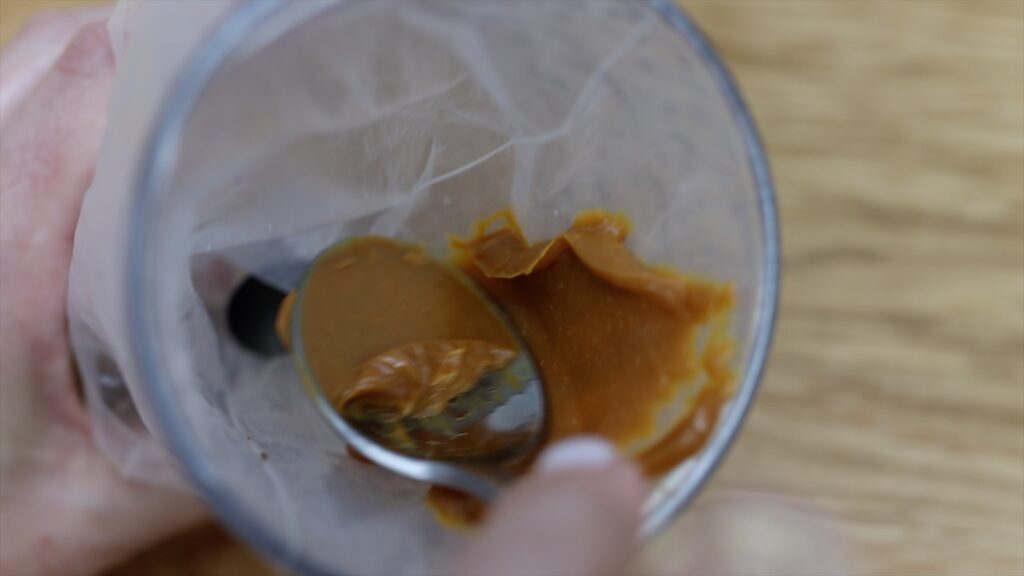
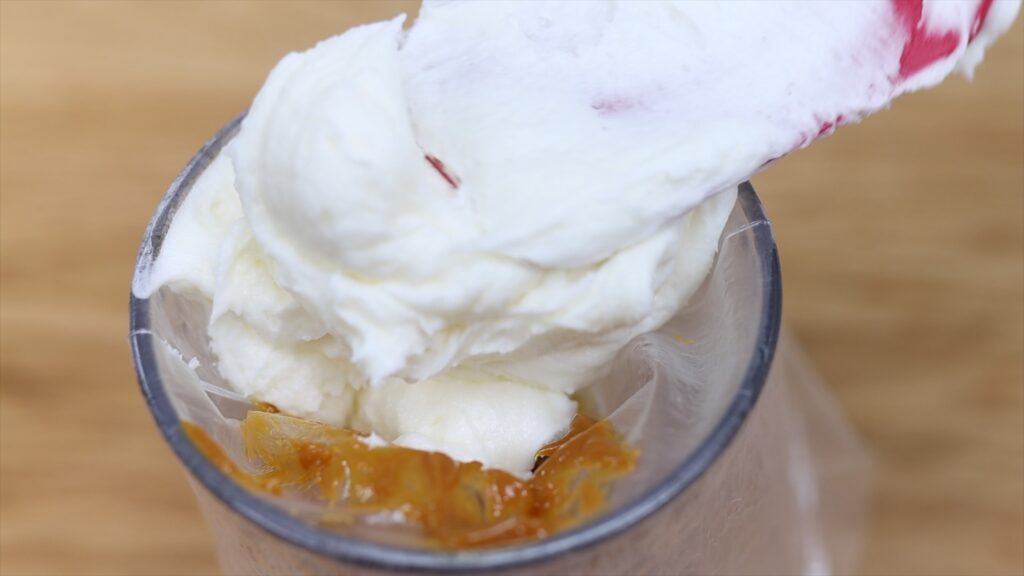
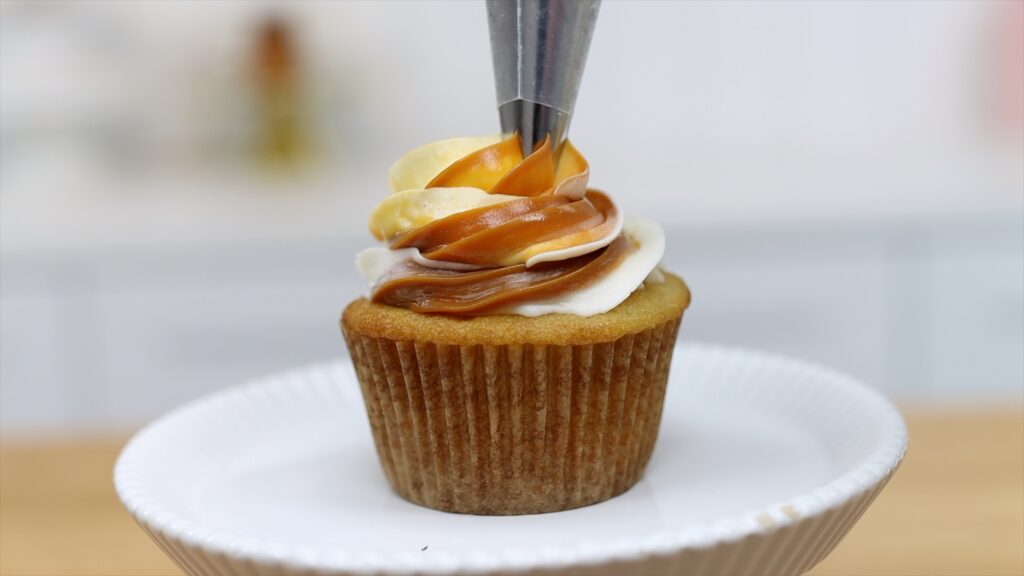
To incorporate the filling in the frosting you could stir the filling ingredient into your frosting or try two-tone frosting. It’s easiest to do this inside a glass so that the bag stays wide open while you’re filling it. Start by spooning the filling ingredient down one side of the piping bag and push it all the way down to the piping tip.
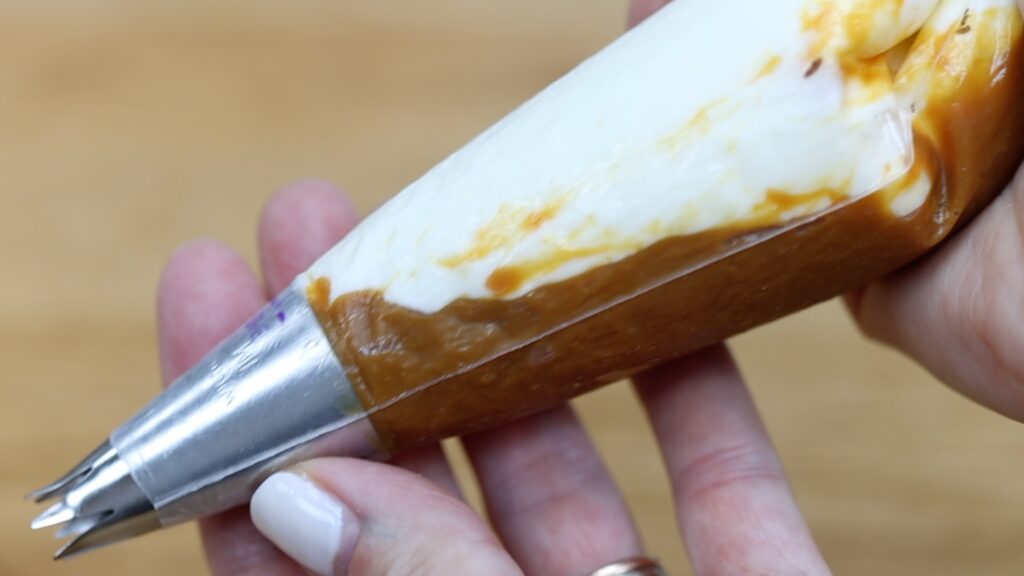
Then fill the other side of the piping bag with frosting. My favourite is my 4 minute buttercream! Lift the piping bag up and squeeze the filling and frosting down to the piping tip.
You should see both go all the way to the tip, meaning they’ll both pipe out through the tip together at the same time. Pipe a swirl onto your cupcake and you’ll see pretty two-tone frosting that tells everyone what flavour the cupcake filling is inside!
How to decorate cupcakes with filling ingredients
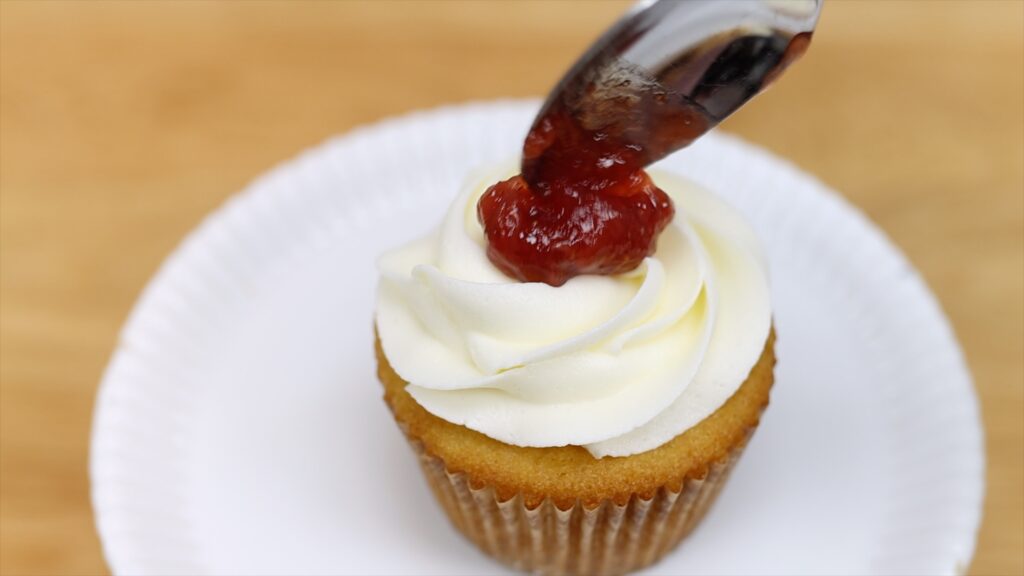
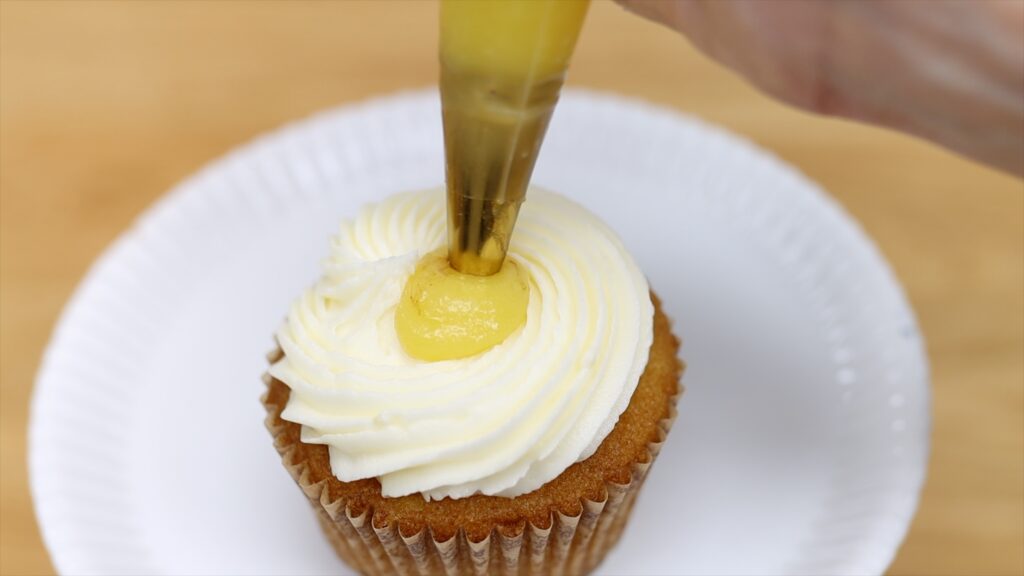
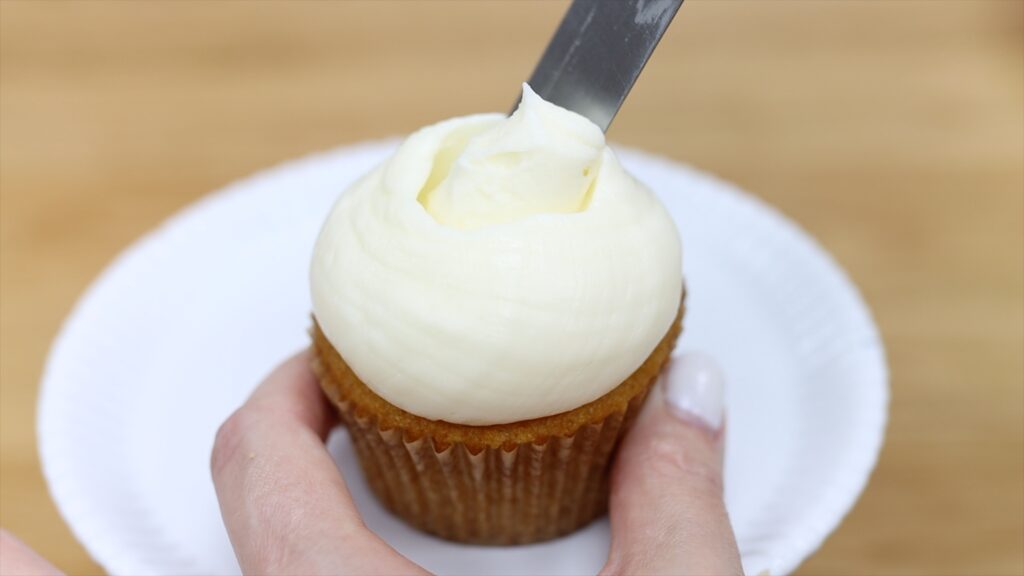
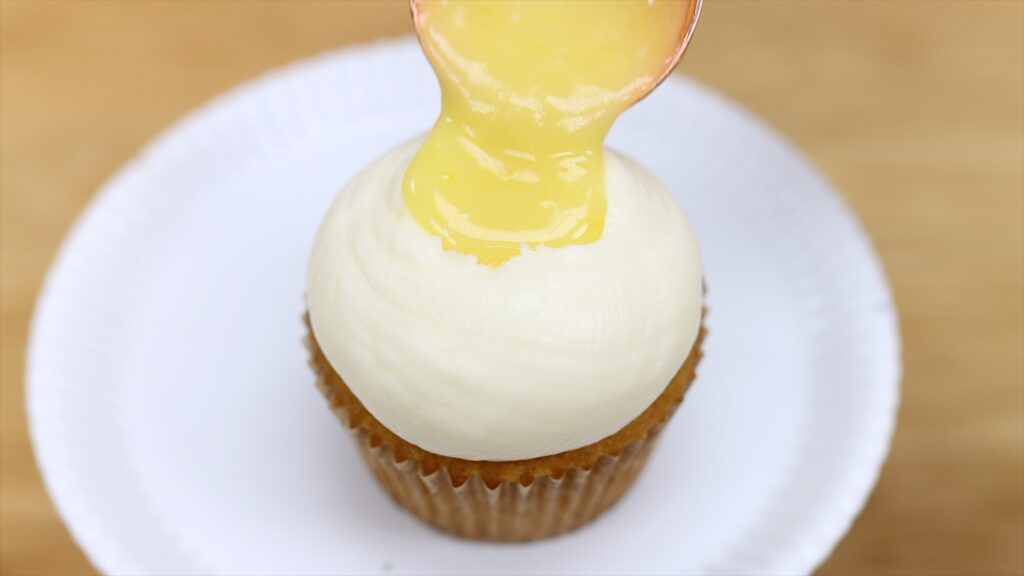
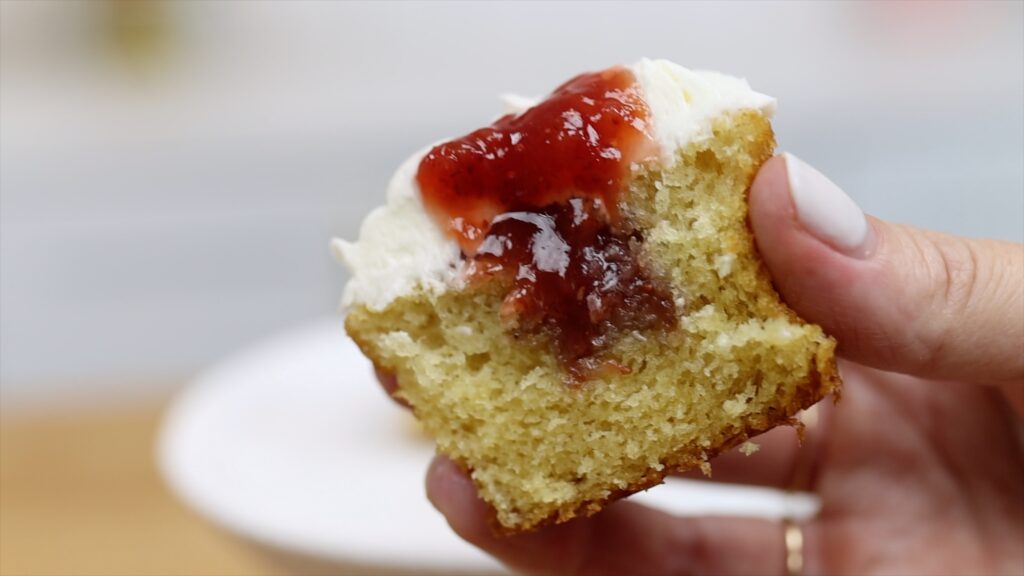
For another way to display your filling ingredient, pipe a swirl onto a cupcake with any piping tip but don’t finish the swirl. Leave a little gap at the top of the frosting and fill that with more of your filling ingredient. You can spoon the filling onto the top of the swirl, like this strawberry jam, or pipe it on, like the lemon curd below.
How to frost cupcakes without piping tips
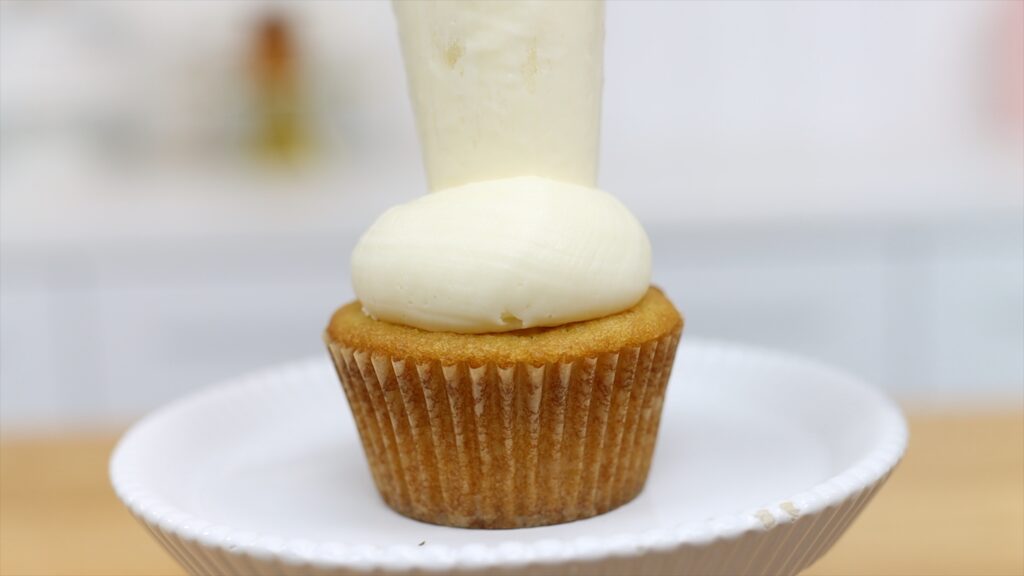
If you don’t have piping tips you can just use a piping bag with the end cut off. Hold the bag still as you squeeze it so that the frosting bulges out to cover the cupcake. Scoop out a bit from the middle with a spoon or an offset spatula and fill the hole with more of your filling!
Easy cupcake filling ideas
Now for the best part - biting into the cupcakes to discover what’s inside! Here are my favourite cupcake filling ideas that are easy as well as delicious:
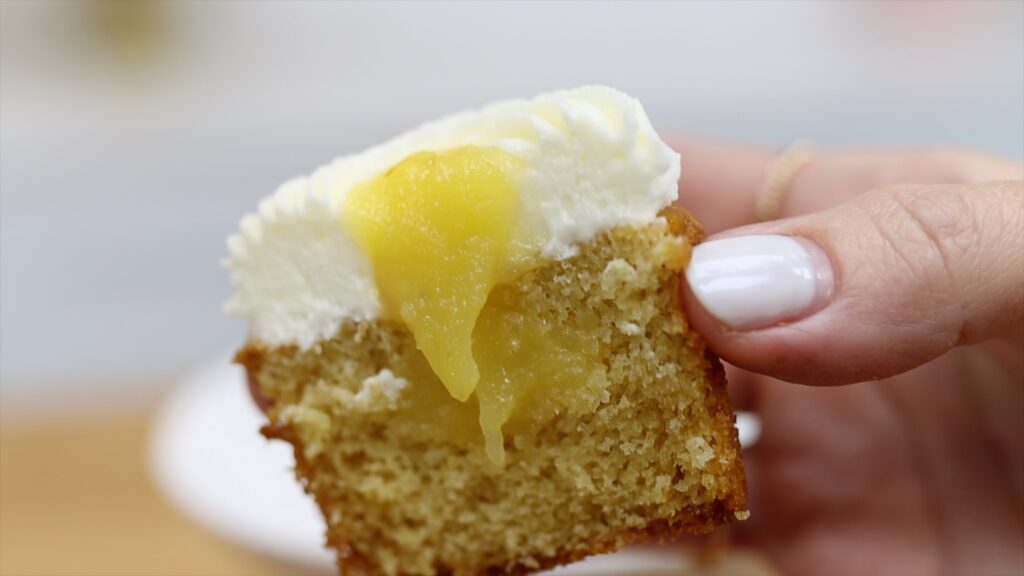
Lemon curd is deliciously tart, which balances out the sweetness of the frosting. You can use store-bought or homemade lemon curd but ideally it will be thick enough so that it doesn’t absorb into the cupcake.
Strawberry jam or any other flavour of jam will provide a refreshing burst of flavour in the middle of the cupcake.
Peanut butter caramel is easy to make by mixing dulce de leche with half the amount of peanut butter. It pairs perfectly with chocolate and isn’t too sweet.
Nutella is decadently chocolatey with a hint of hazelnut. It's a nice consistency to pipe or spoon into a cupcake as filling and also to drizzle over the frosting to decorate the cupcake.
Dulce de leche is a thick, creamy caramel that comes in a can so it's insanely easy to use. It looks beautiful in two-tone frosting and tastes incredible, too!
Vanilla pudding keeps the cupcake nice and moist without adding a lot of sweetness. If you're short on time, use a package to make it in just five minutes!
How to store filled cupcakes
Cupcakes will stay fresh for two days if they're stored in an airtight container at room temperature. If your filling needs to be refrigerated, for example lemon curd, you can put the cupcake in an airtight container in the fridge for two days. Cupcakes taste best at room temperature so take them out of the fridge a few hours before you serve them.
What's your favourite cupcake filling? Tell me in the comments!
I’m going to show you 12 tools that you already have in your kitchen that you can use to decorate cakes. Use these instead of buying fancy cake decorating tools and you’ll save money and space!
#1 Cupcake pan
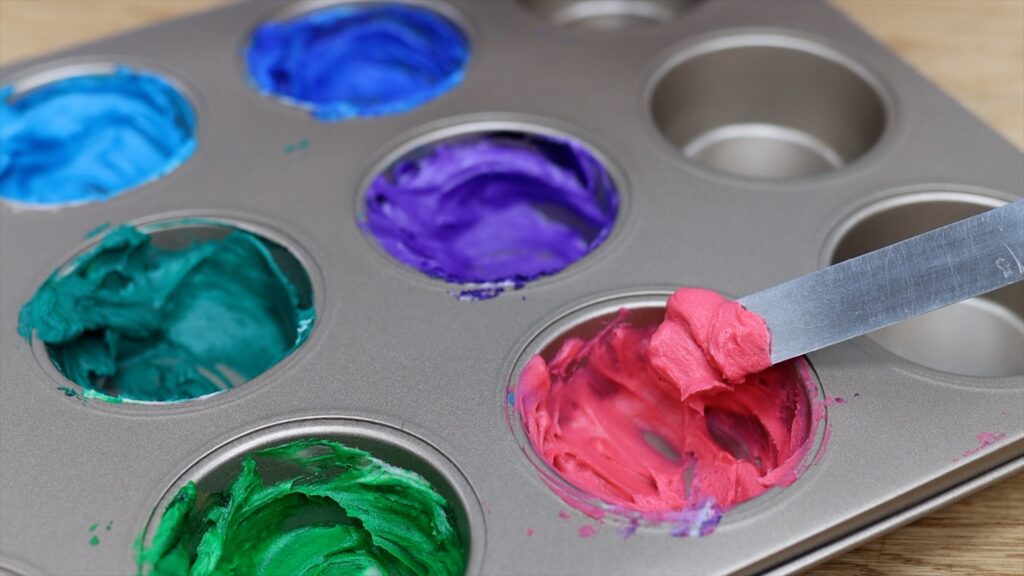
Cupcake pans aren’t just for baking cupcakes. Those little cups in the pan are perfect for tinting small amounts of frosting for cake designs, instead of using lots of little bowls with will take you forever to wash afterwards. Since you’ll only have a tiny amount of frosting in each cup, you’ll only need a tiny drop of gel to get reallybright colours.I love repurposing tools to get the most out of them and this is such a convenient hack!
#2 Casserole dish
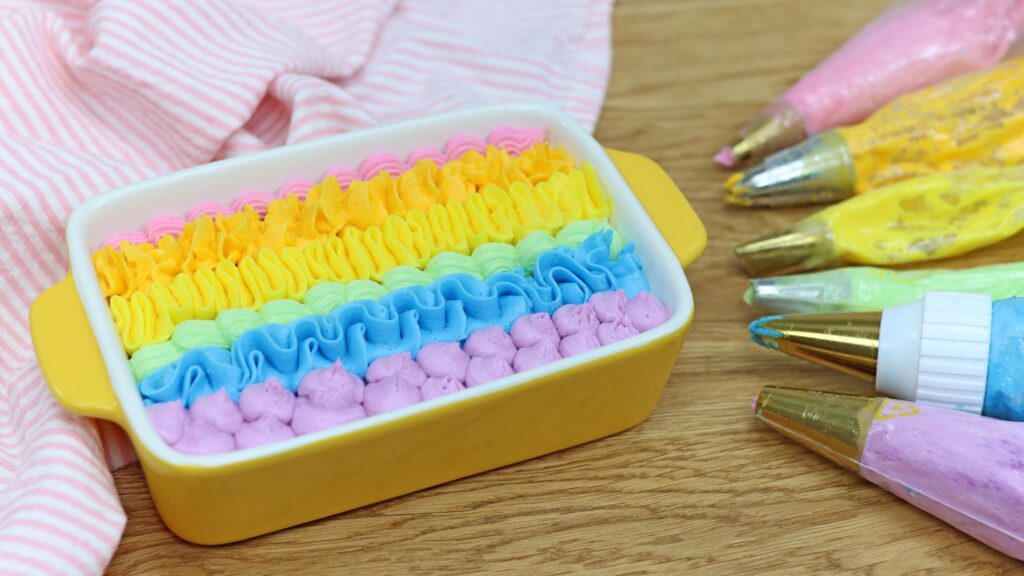
Casserole dishes or baking dishes can double up as cake pans. You’ll need to bake the cake for a few more minutes than normal since a glass or ceramic dish is thicker than a metal cake pan. This makes a cake that you decorate inside the dish so you don’t have to worry about covering up the sides.
Piping is a fun way to add lots of colour and texture or you can spread frosting to cover the top instead. Either way, these "tray bake" cakes are quick and easy to decorate. You’re not limited to cakes, either - try this with brownies or chocolate chip cookie dough! They’re easy to transport to an event and also easy to serve.
#3 Ziplock bags
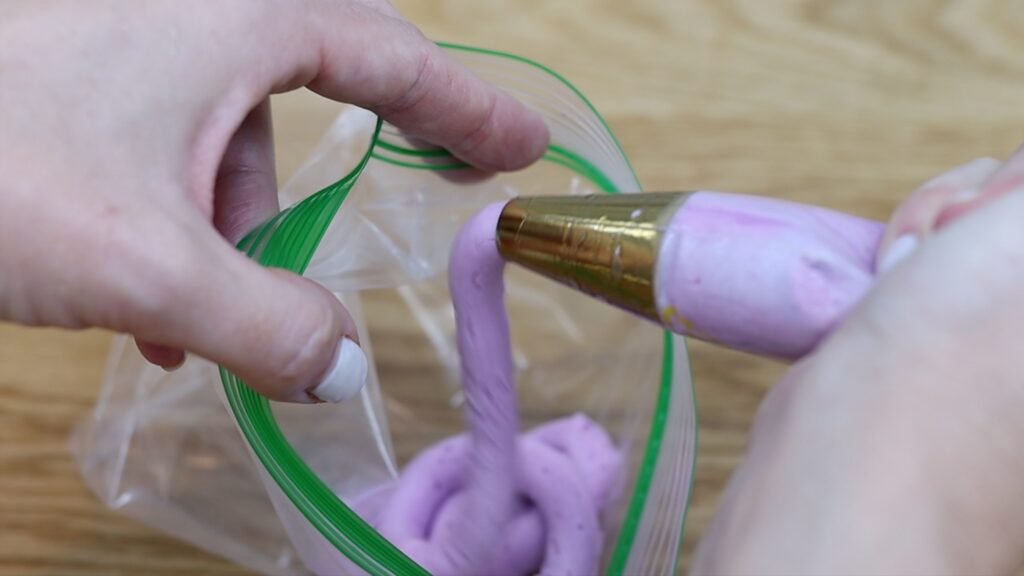
Leftover frosting? Don’t throw it away! Pipe or spoon it into a ziplock bag, which is airtight to keep the frosting fresh for 2 weeks in the fridge or 2 months in the freezer! After you push the air out it lies flat, taking up almost no space.
You can also use ziplock bags for piping beaded borders, dotted decorations or piped lines, if you run out of piping bags or want to use up buttercream from the freezer without dirtying a piping bag. You’d never guess this border was piped with ziplock bag!
#4 Parchment paper
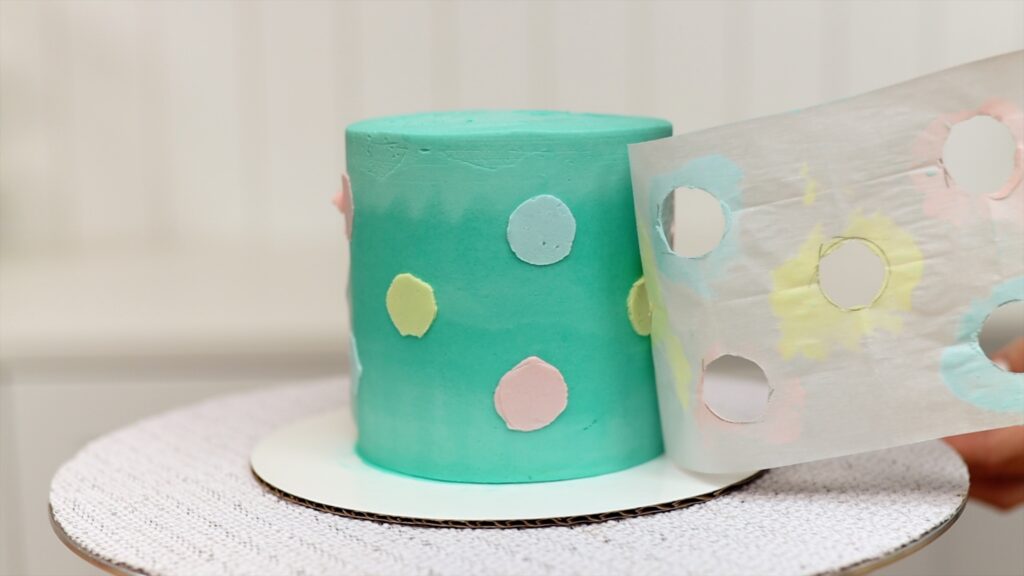
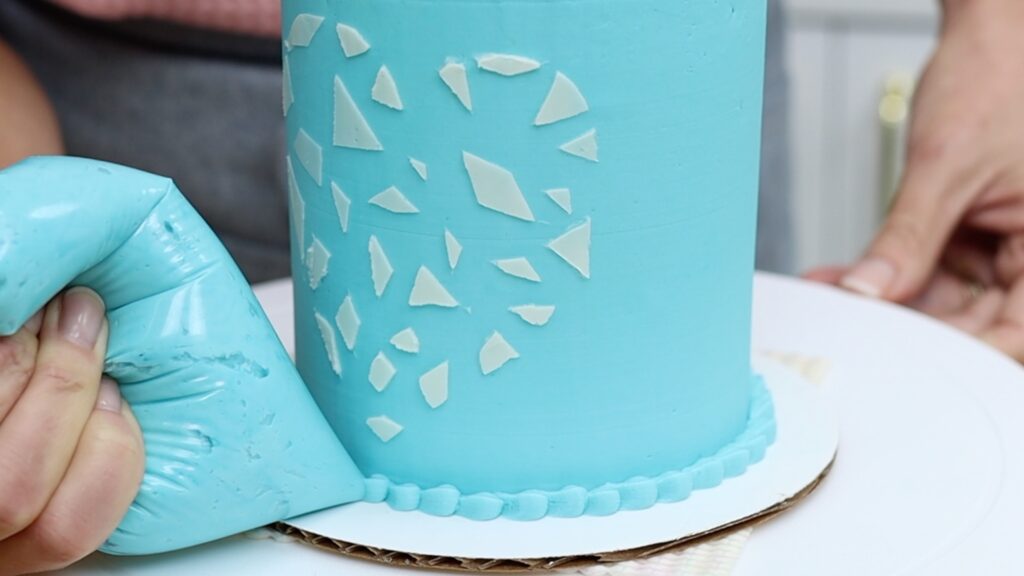
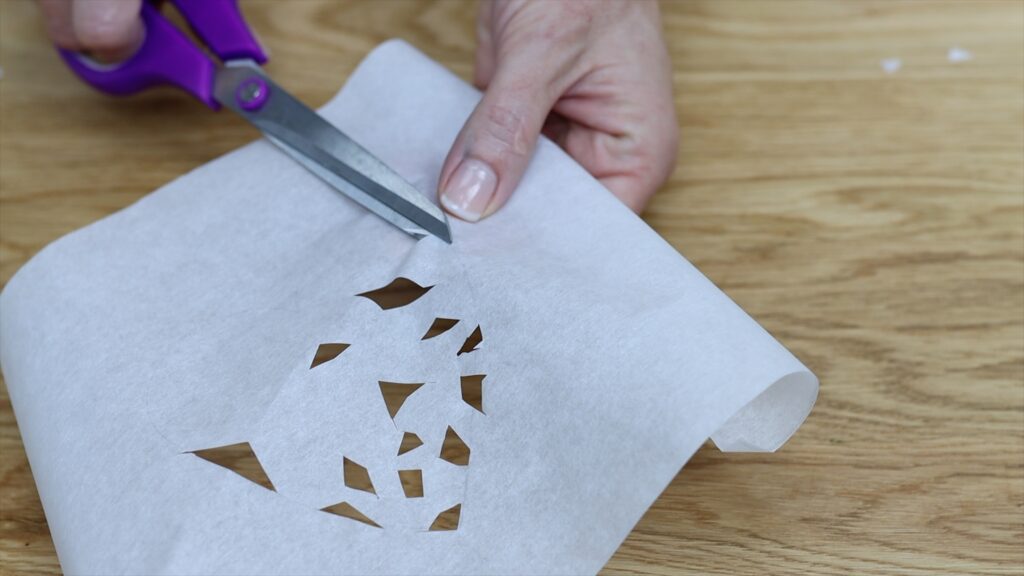
Let’s make a homemade stencil next. Parchment paper or wax paper is perfect for stencils because it’s easily available, cheap, lightweight and flexible. Draw your design or you can trace an image and then cut it out.
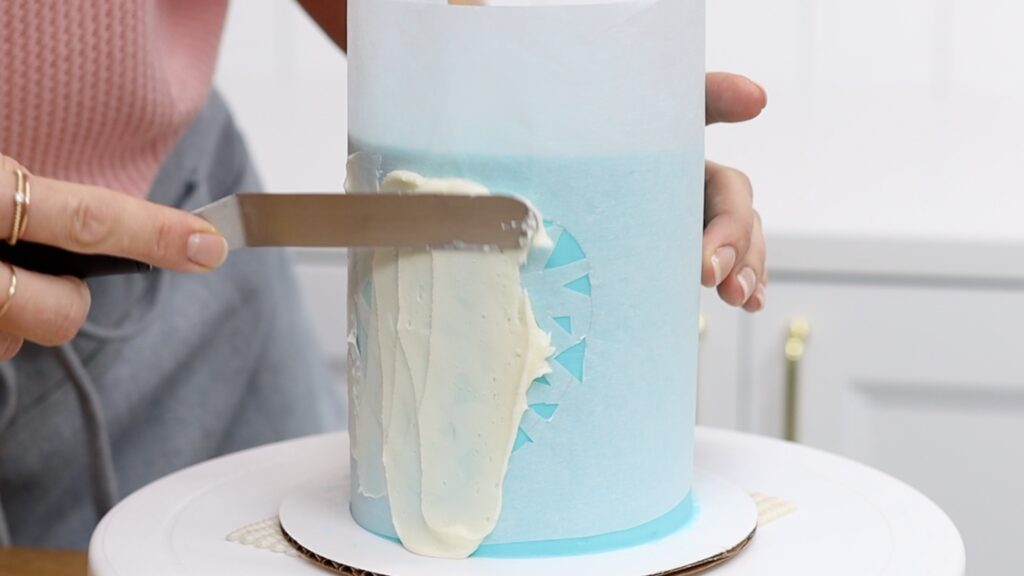
Wrap the stencil around a cake after chilling it. This is my 4 Minute Buttercream, which gets really firm when it’s cold so you won’t damage it with the stencil.
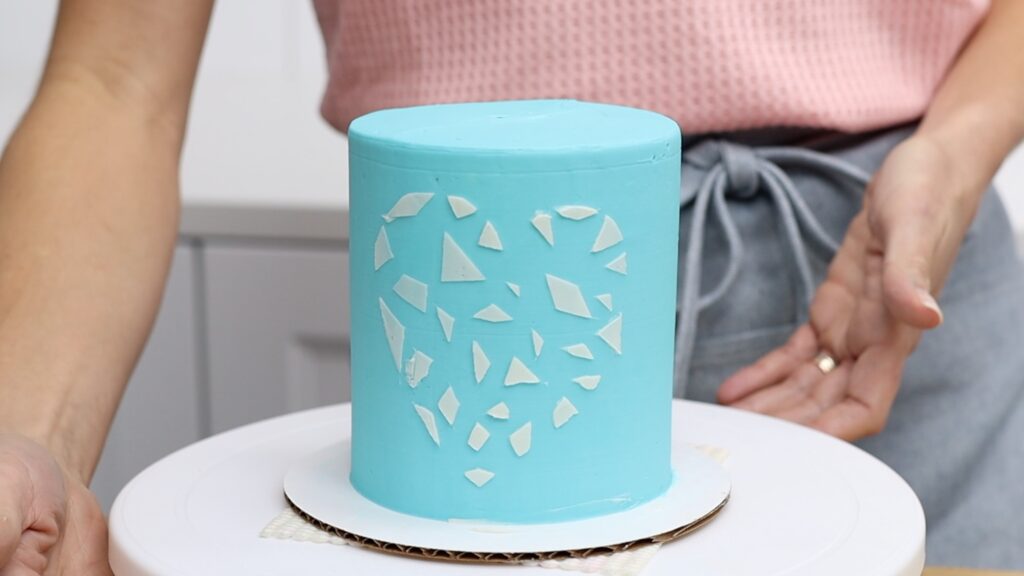
Spread buttercream all over the stencil and scrape off the excess to leave a thin, smooth layer. Then peel the stencil off to reveal an intricate homemade stencil design! Now you can create endless unique designs on a cake instead of buying expensive stencils.
#5 Drawer liners
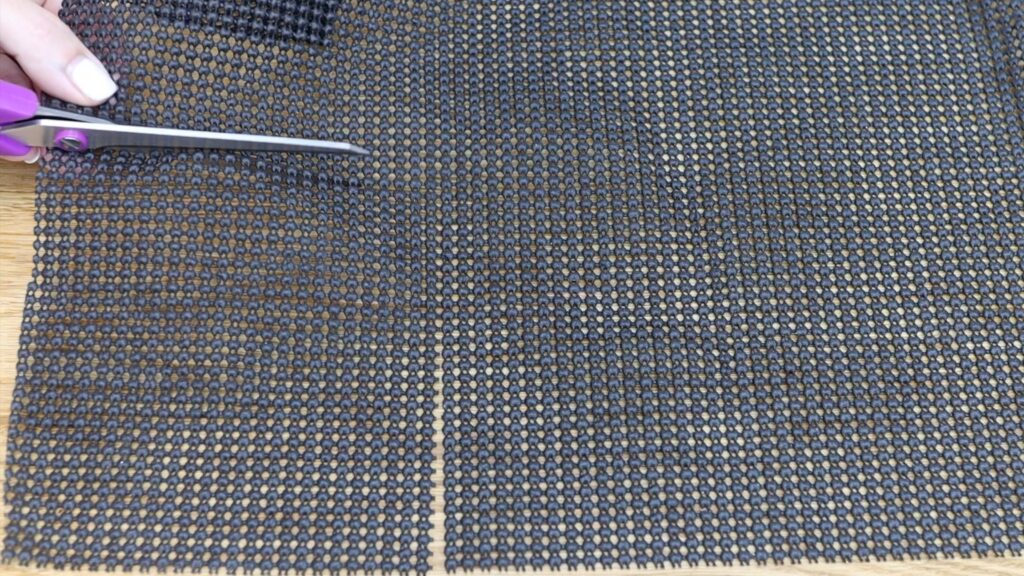
Non-slip mats are intended to line drawers and shelves but they're useful for cake decorating, too. Any mesh mat will act as a non-slip mat to stop your cakes sliding around on the turntable. You only need a small piece and this makes frosting cakes so much easier. You can also use it inside cake boxes if your cake board isn’t as big as the box, to stop the cake from moving within the box. You can wash and dry these and use them again and again!
#6 Toothpicks
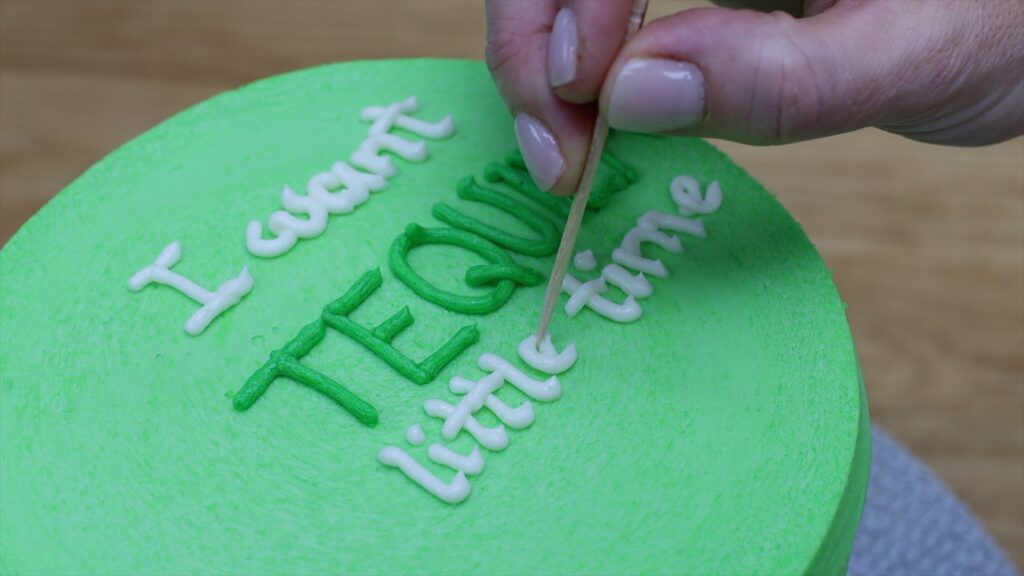
I always have a box of toothpicks handy for cake decorating. They’re great for outlining designs and they’re so tiny that they’re the perfect tool for manipulating frosting to tidy up lettering, stencil smudges, or borders on cakes. They work best on details that have just been piped or spread, so they are still soft and sticky.
#7 Baking tray
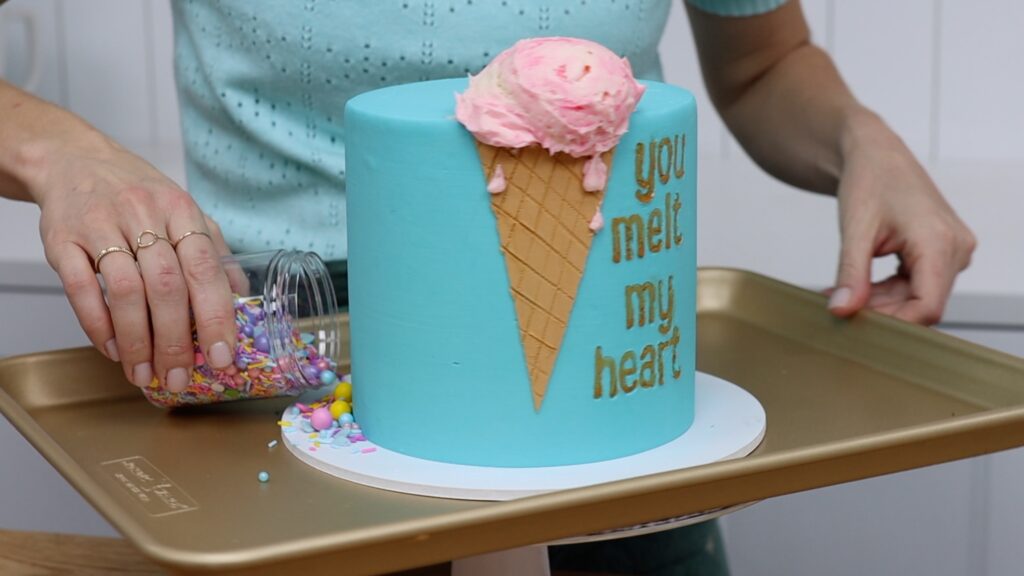
Cleaning up isn’t as fun as baking and decorating so to make that part as quick as possible, put your cake on a tray or baking sheet when you’re using sprinkles for cake decorating. The tray will catch any sprinkles that roll off the cake board, saving you from crunchy footsteps and finding stray sprinkles everywhere for days.
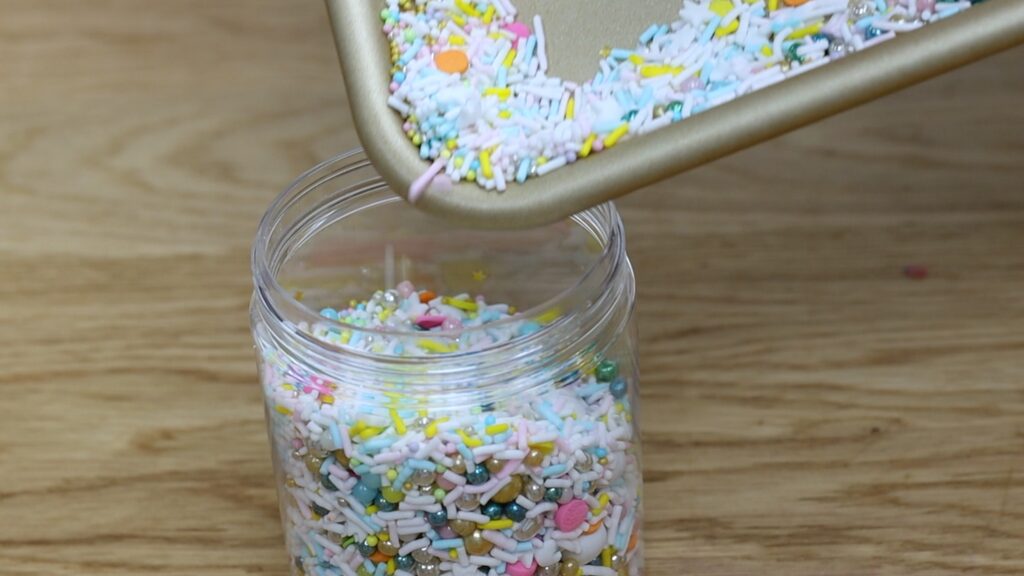
When you’ve finished, tilt the tray to pour the sprinkles down into one corner and into a bowl or jar to use for another project!
#8 Boba straws
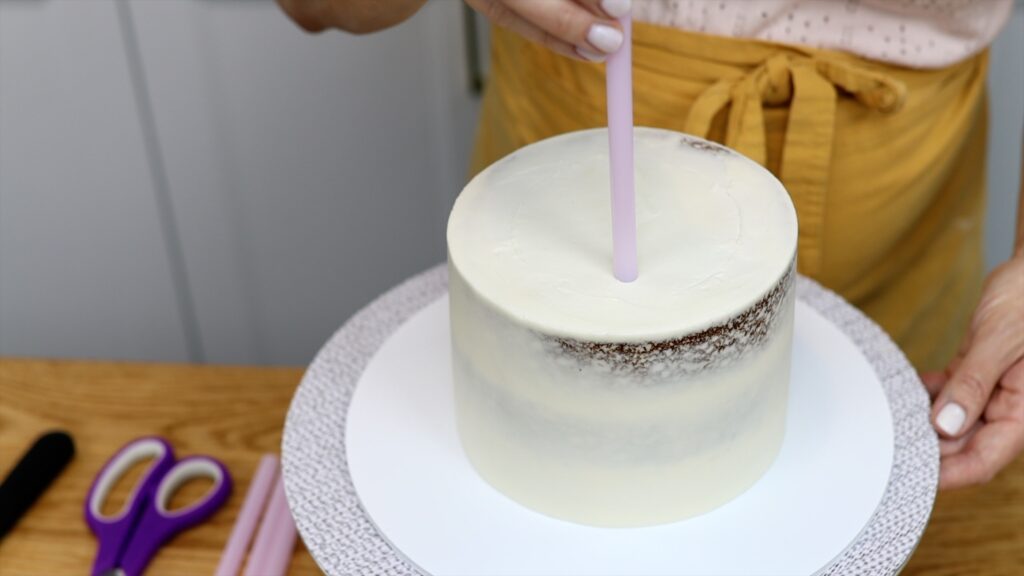
Boba straws are these wide straws and they’re stronger than normal straws, which makes them perfect for supporting tier cakes. Use one to measure the height of the cake by pushing it all the way to the bottom of the cake, pinching the straw where it sticks out above the cake, and pulling it out.
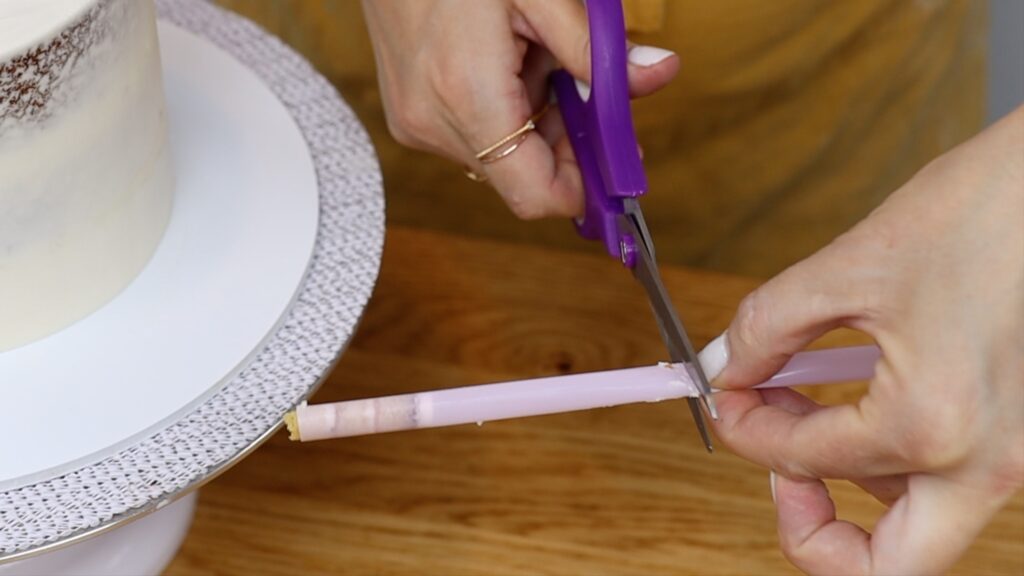
Cut it where you pinched it and then measure the rest of the straws against that straw, so that they’re all the same length.
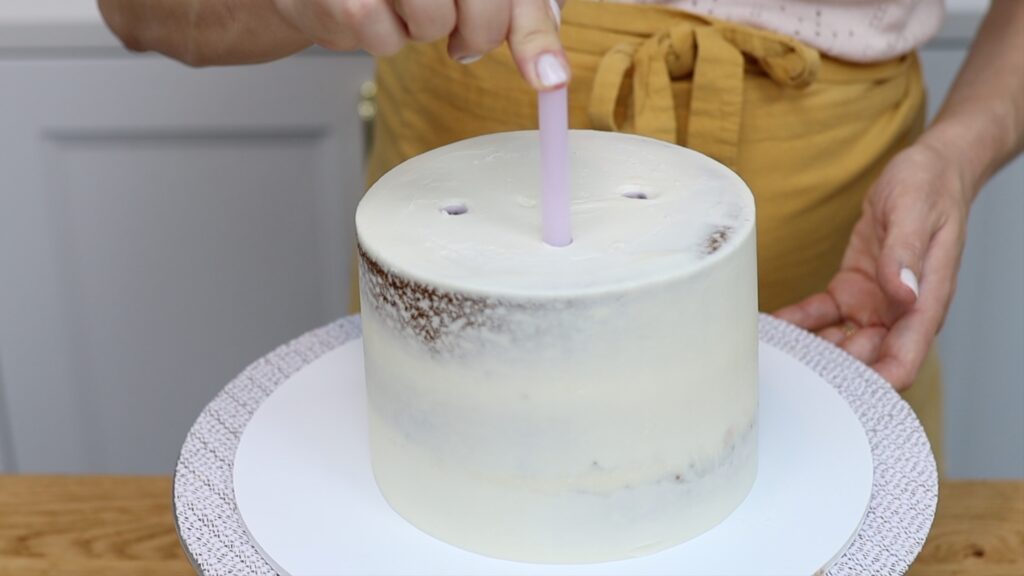
Push them into the cake and these will hold up the next cake, on its own cake board, so it doesn’t sink into the bottom tier.
#9 Paper straws
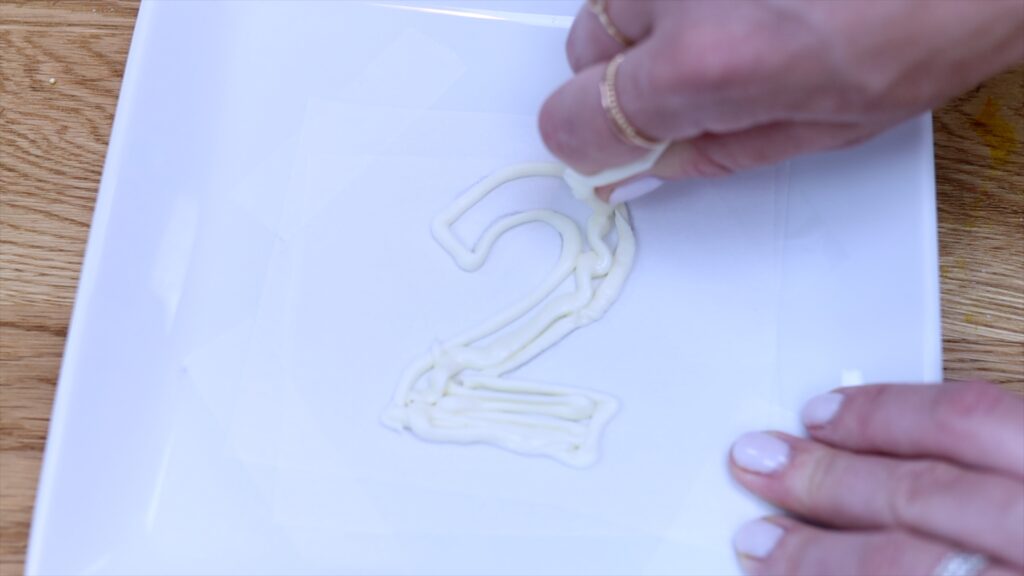
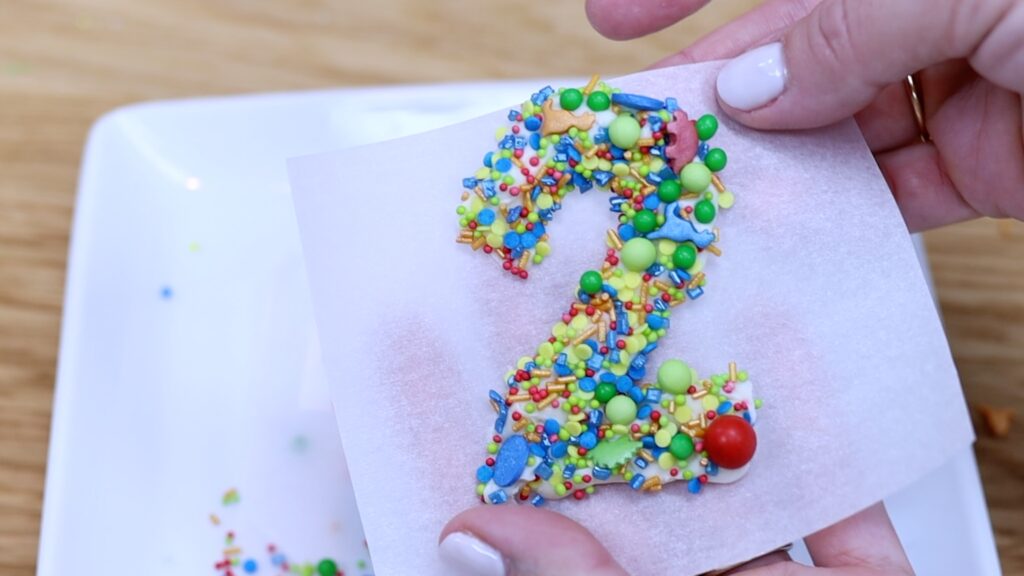
Use paper straws to make your own cake toppers of any shape and size. Draw or trace your shape and put it on a plate or tray or cutting board. Choose something flat and small enough to put in the freezer. Tape a piece of parchment or wax paper on top so you can see the shape through it. Melt chocolate chips, spoon them into a ziplock bag and cut off a corner. Squeeze the melted chocolate through the hole to outline the shape and then fill it in.
Use a toothpick or a spoon or a small offset spatula to spread the chocolate flat and then pour sprinkles on top straight away, while the chocolate is still soft and sticky. Press the sprinkles gently into the chocolate and then put the plate into the freezer for 5 minutes to set the chocolate.
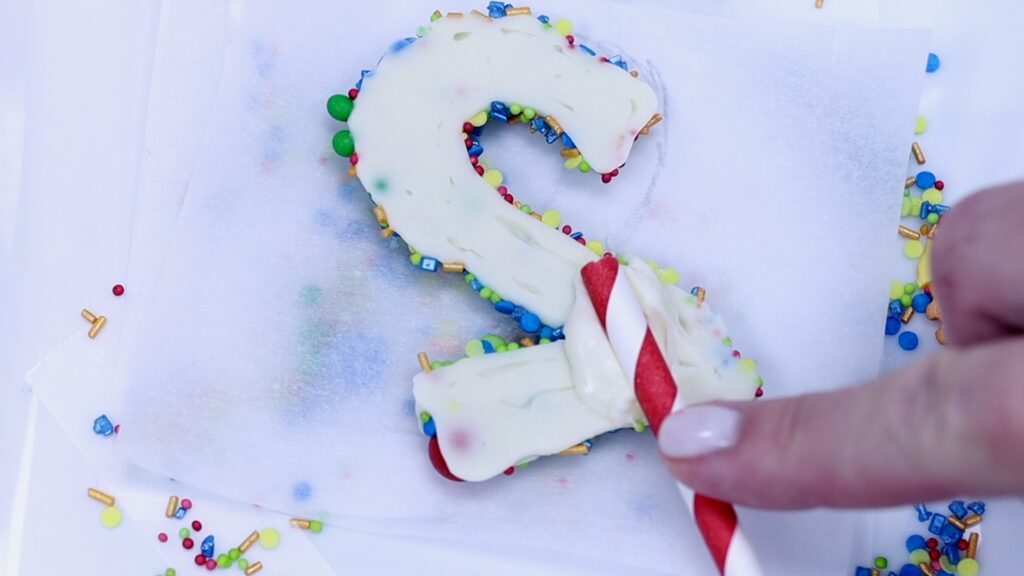
Lift the shape off the parchment paper and flip it over and make a little line of melted chocolate towards the bottom of the shape, which will act as glue.
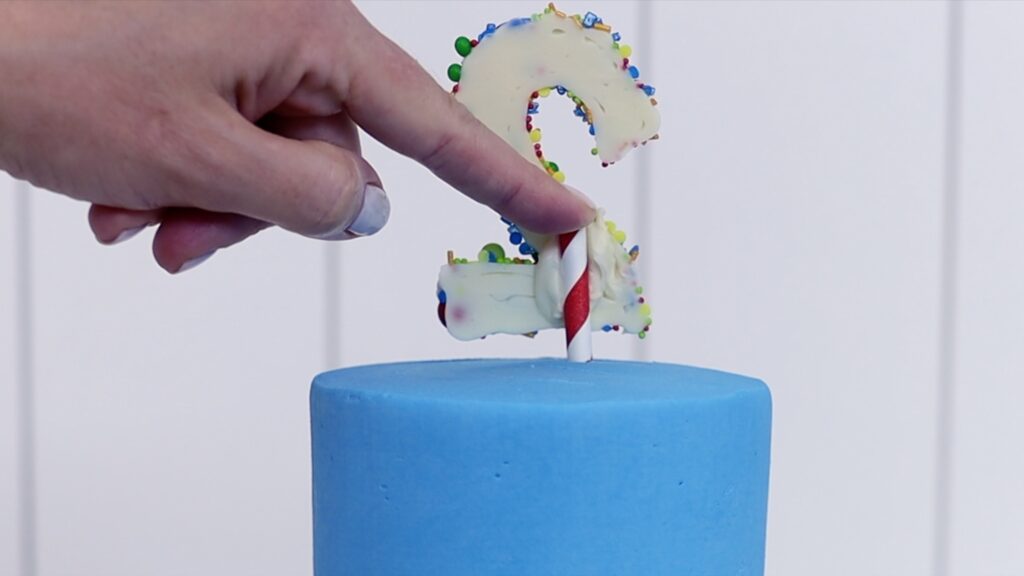
Push a paper straw into the melted chocolate, leave it to set, and then push the straw into a cake to make a fun, colourful, cake topper!
#10 Ice cream scoop
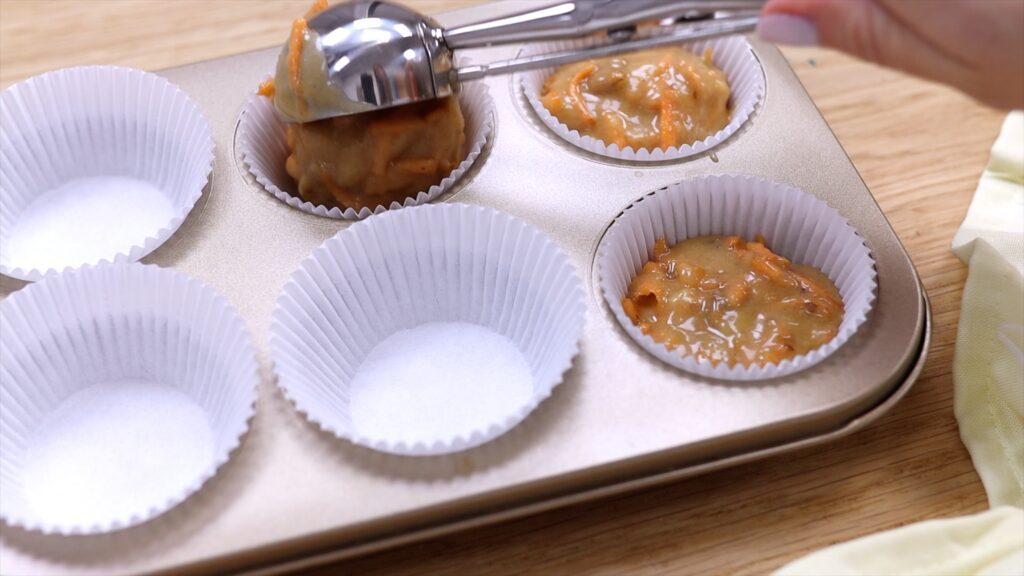
Ice cream scoops can be used to divide batter between cupcake wrappers without spilling onto the top edge of the wrappers or onto the cupcake pan, and if you fill the scoop with the same amount of batter each time, all of your cupcakes will be the same size!
You can do this for cake batter too, which will make sure you have the same amount of batter in each pan so each cake layer is the same height. [It’s also great for marble cakes, so you can alternate between different flavours of batter and then swirls them together to marble them at the end.
#11 Fork
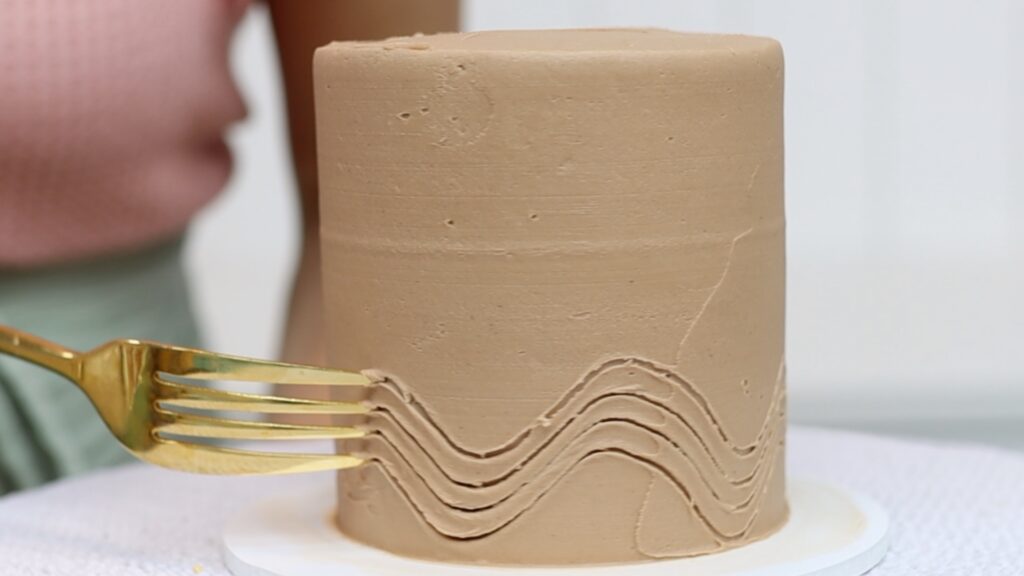
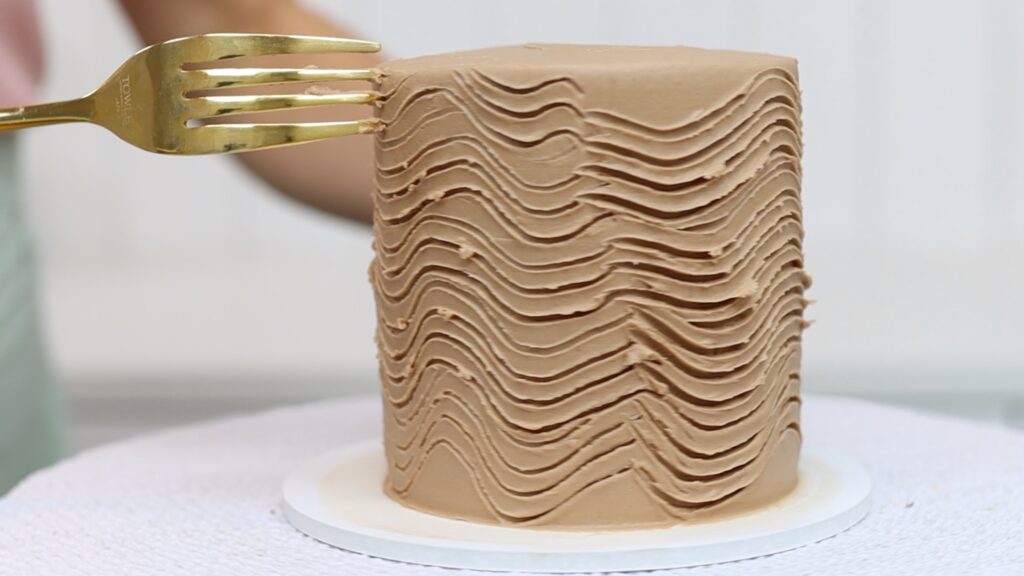
Another multipurpose utensil is a basic fork. When you frost a cake the frosting will be soft and sticky. Straight away, before the frosting sets, press the prongs of a fork gently into the frosting and spin the cake, moving the fork to imprint whatever pattern you like.
This is an easy way to add lots of texture and detail without needing to buy a cake comb. Also, the process with a fork is much quicker than with a cake comb!
#12 A tall glass
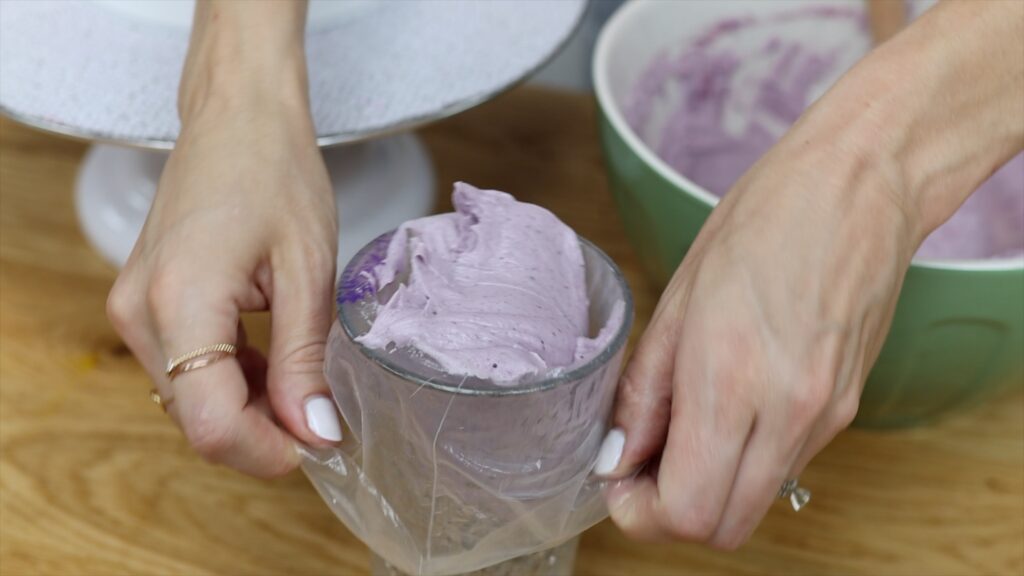
Finally, a tall glass will be your best friend when you’re using piping bags. Drop the piping bag in so that the piping tip is at the bottom of the glass and fold the top edge of the bag over the rim of the glass. Spoon your frosting into the bag and this way, you’ll keep the top edges of the piping bag clean so you don’t get frosting all over your hands when you pipe.
Unfold the bag, squeeze the frosting down to the bottom, twist and bag and you’re ready to pipe!
I hope these tips have been useful! For more ideas for easy cake decorating visit my online cake school for hundreds of cake designs and techniques - join my Club PLUS for access to every MiniCourse, MasterCourse and Live Workshop!