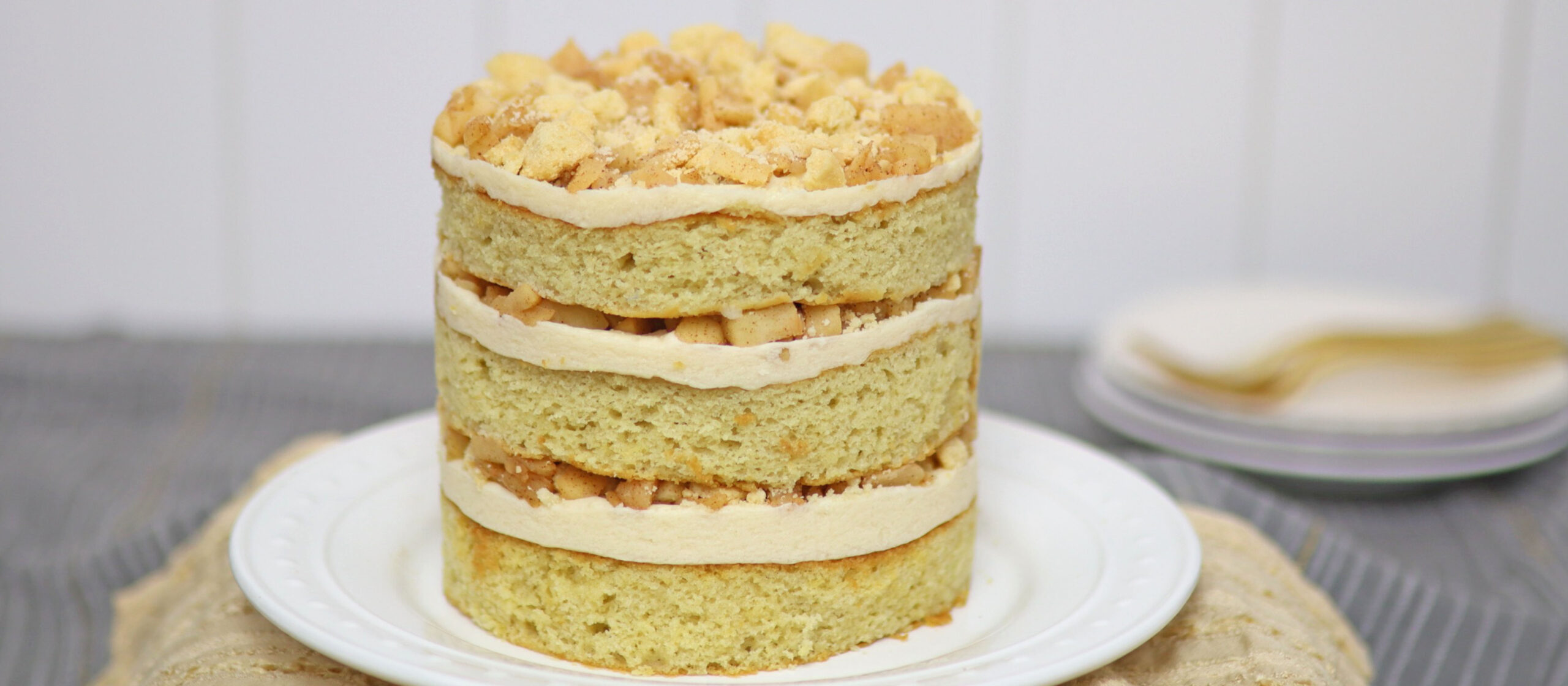
This apple pie cake has all of the flavours of apple pie layered into a cake: soft vanilla cake, cinnamon apple filling, brown sugar buttercream and buttery shortbread crumbs.
It’s surprisingly quick to make, too! Instead of baking three separate cake layers, you’ll bake just one sheet cake and cut it into three 6 inch layers. And because the cake is assembled inside acetate with the layers left exposed, there’s no need to frost the sides. Just stack, chill, peel off the acetate, and it’s ready!
Make the Vanilla Cake
This apple pie cake starts with a scaled down version of my Very Vanilla Cake recipe. This is a rich, buttery cake that complents the fillings and and frosting perfectly!
Spread the batter evenly into a greased and lined 9 x 12-inch quarter sheet pan and bake until the cake is golden and springs back when pressed gently in the middle. Another method to check it's baked is to poke a toothpick into the center and checking that it comes out clean.
Leave the cake to cool completely before turning it into round cake layers later.
Make the Apple Pie Filling
Peel and chop the apples into small pieces. Keeping the pieces fairly small makes the finished cake much easier to slice.
Put the apples into a saucepan with the butter, water and cinnamon. This filling doesn't have sugar because the brown sugar buttercream provides (I think!) the perfect amount of sweetness but feel free to add sugar at this point if you like.
Cook over medium heat, stirring occasionally, until the apples have softened and the liquid has reduced. You want the apples to be tender but not completely broken down into applesauce.
Take the filling off the heat and leave it to cool completely before assembling the cake. Warm apple filling will melt the buttercream.
Make the Brown Sugar Buttercream
Brown sugar adds a delicious caramel-like flavour to this buttercream, but adding it directly to buttercream can leave noticeable sugar crystals in the frosting. Instead, put the brown sugar and milk into a small saucepan. Warm it over medium low heat, stirring until the brown sugar has completely dissolved. Pinch the mixture and rub it between your fingers to check that you can't feel any sugar crystals.
Take the mixture off the heat and leave it to cool completely to room temperature.
Beat the butter until smooth. Gradually add the powdered sugar, mixing until incorporated. Add the cooled brown sugar mixture and vanilla and mix until the buttercream is smooth and creamy. Lastly, mix in the cream cheese.
The buttercream should be easy to stir and although your spatula will leave trails in the buttercream, those trails should look soft and smooth. If your buttercream feels stiff, add a spoonful of milk to thin it out.
It's easiest to use this buttercream in a piping bag. Cut the end off to leave a hole a bit bigger than your thumbnail and set aside for later. If you don't have a piping bag, you can use a spoon instead but cover the bowl with a lid or plastic wrap for now to prevent the buttercream from drying out and crusting.
Prepare the Shortbread Crumbs
Crush the shortbread cookies into coarse crumbs. I snapped them apart with my hands but it would be easier to put them into a sandwich bag and bang them with a rolling pin, hammer, or heavy cup.
Don't crush them all the way into a fine powder. Leaving some larger pieces gives the cake more texture and helps create a buttery pie crust effect.
Cut the Cake Layers
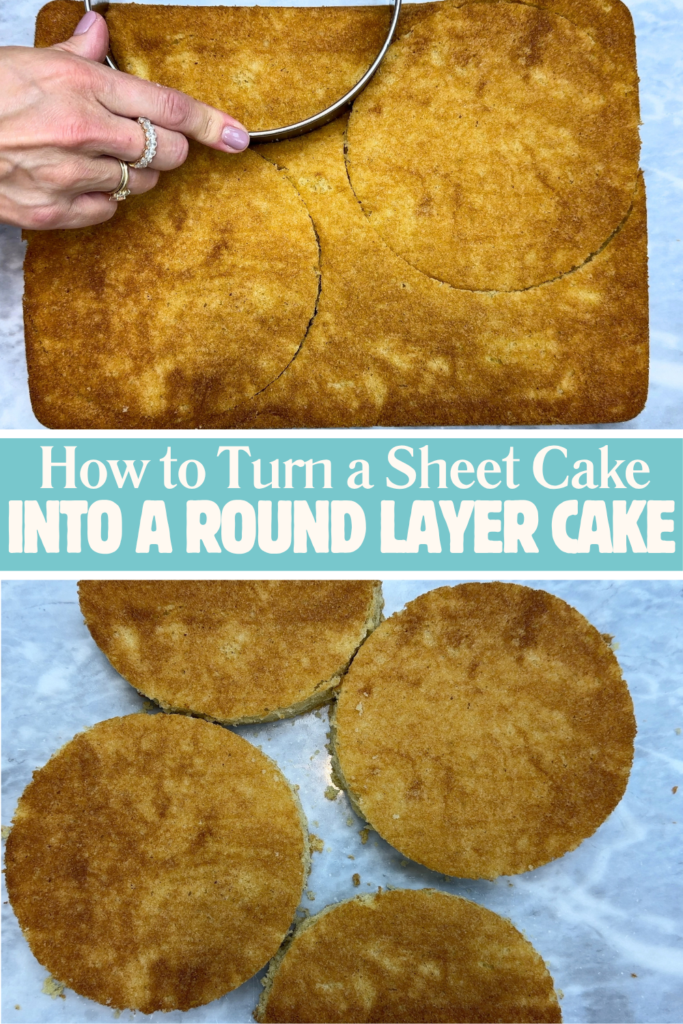
Use a 6 inch cake ring or cookie cutter to cut two complete circles out of the sheet cake. If you don't have one, position a 6 inch cake pan or cake board as a guide and cut around it.
Use the remaining cake to cut two semicircles. These can be fitted together inside the acetate to create the third layer.
This is one of my favourite things about assembling cakes with acetate: you can make a tall layer cake from a single sheet cake. This is such a time-saver if you only have one or two round cake pans (or none!).
Assemble the Apple Pie Cake
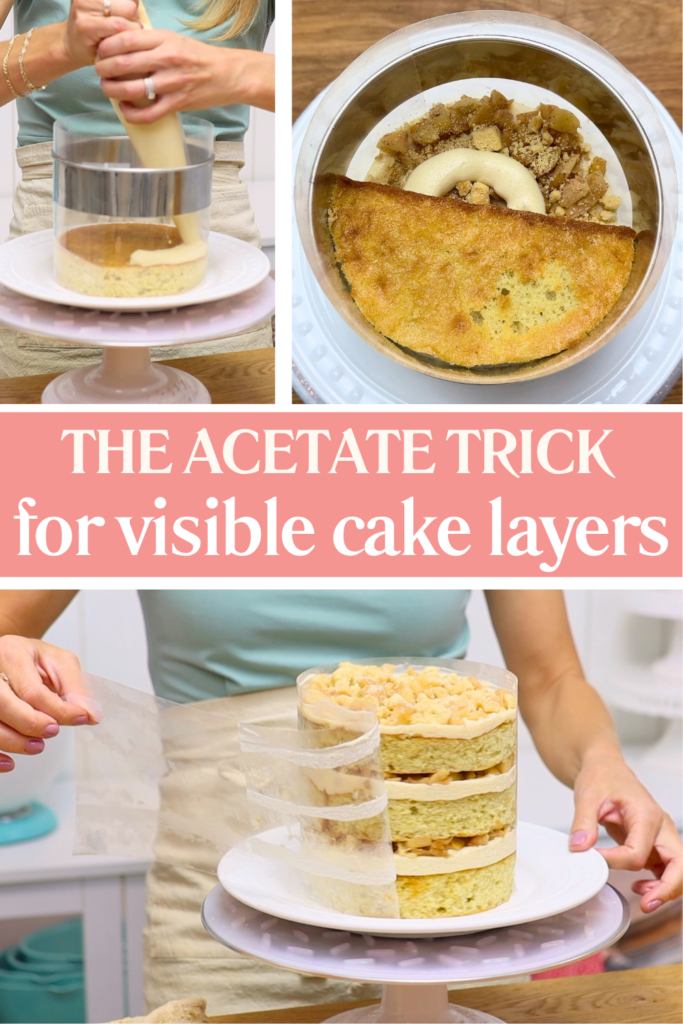
Using acetate to assemble this apple pie cake makes it possible to leave the neat layers of cake and filling exposed when the acetate is later peeled away.
Pipe a spread some buttercream onto the middle of a cake board or plate and press one of the round cake layers onto it. Wrap acetate tightly around the cake layer, cutting it so that there's a small overlap where the beginning and end of the acetate meet. If you have one, lower your 6 inch cake circle or cookie cutter over the acetate to hold it in place. If you don't have one, use a piece of tape to keep the acetate wrapped snugly around the cake.
Pipe or spread a layer of brown sugar buttercream over the cake, using about a third of the buttercream. Add a third of the cinnamon apple filling, pushing some up to the edges of the cake so that it's visible when you peel the acetate away later.
Sprinkle with a third of the shortbread crumbs.
For the next cake layer, fit the two semicircles together inside the acetate. Once the cake is assembled, you won't be able to tell that this layer was made from two pieces. I didn't trim the straight edge of my semicircles, which was the edge of the sheet cake that touched the pan so was darker than the inside of the cake. When I sliced into the cake, the darker edge was visible. Next time I'll trim that edge off so it looks prettier when slicing!
Spoon another third of the brown sugar buttercream, apple filling and shortbread crumbs onto this layer of cake. Then add the final complete cake layer and finish the top with brown sugar buttercream, apple filling and the remaining shortbread crumbs.
Chill and Unwrap the Cake
Chill the assembled cake until the buttercream is firm and the layers are stable. This takes about one hour in the fridge. Since the top of the cake is covered with buttercream and the sides are covered with acetate, the cake won't dry out while it's in the fridge.
Slide the cake ring up the acetate to remove it and peel off the acetate.
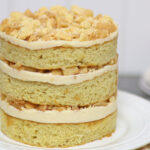
Instead of covering the outside with frosting, the acetate leaves the sides exposed so you can see every layer of vanilla cake, brown sugar buttercream, cinnamon apples and shortbread crumbs.
Tips for the Best Apple Pie Cake
Make sure both the apple filling and brown sugar mixture are completely cool before they touch the buttercream.
Don't skip dissolving the brown sugar. Mixing brown sugar straight into buttercream can leave it noticeably grainy because the sugar crystals don't dissolve in the buttercream.
Keep the apple pieces fairly small so the cake is easier to assemble and slice. The pieces will cook evenly if they're all about the same size.
For the shortbread, aim for a mixture of crumbs and small chunks rather than a completely fine crumb.
And don't worry about using cake scraps to create one of the layers. The acetate holds everything tightly together while the cake chills and the buttercream above and below that layer will secure the piece. I do recommend trimming off any browned edges of the semi-circles of cake so that once it's sliced, you'd never know they were separate pieces.
This apple pie cake is a gorgeous and quicker alternative to a traditional frosted layer cake, with the flavours of apple pie in every slice: vanilla cake, cinnamon apples, caramel-like brown sugar buttercream and buttery shortbread crumbs.
Using a mixer with a beater/paddle attachment (not a whisk), beat room temperature butter and sugar on medium speed until pale and creamy, about 2 minutes. Scrape down to the bottom of the bowl once during mixing to make sure no butter or sugar is stuck at the bottom.
Add eggs one at a time, mixing on the lowest speed after each addition for 30 seconds. Scrape down to the bottom of the bowl to make sure everything is incorporated before adding the next egg.
Add vanilla and mix for about 30 seconds to combine.
In a small bowl or measuring jug, mix room temperature buttermilk and oil. Add half to the butter mixture and mix on lowest speed to incorporate.
In a bowl, sift flour, baking soda, baking powder and salt. Add half of the flour mixture to the mixing bowl and mix on lowest speed to incorporate, scraping down to the bottom of the mixing bowl to check that batter is evenly mixed. Repeat with the remaining buttermilk mixture and then finish with the remaining flour mixture.
Grease a 9x12" sheet pan with non-stick oil spray or butter. Pour the batter into the pan and spread it into the corners. Batter will be thick!
Bake at 160ºC or 325ºF for 23 minutes, or until a toothpick inserted into the middle of the cake comes out clean.
Leave cake to cool in the pan for 10 minutes. Use a spatula to loosen the cakes from the edges of the pans and then turn onto a wire cooling rack. Leave to cool completely.
Cut two circles and two semi-circles out of the cake using a 6 inch cookie cutter (sometimes called a cake circle) or use a 6 inch pan to cut around.
To make the filling:
In a pan over medium heat, mix apples with butter, water, and cinnamon and and simmer, stirring occasionally, until soft, about 15 minutes. Leave to cool.
To make the brown sugar buttercream:
In a pan over medium low heat, whisk together milk and brown sugar until you can't see any grains of sugar in the mixture. Leave to cool completely.
Sift the sugar to remove any lumps and check that the butter is at room temperature - you should be able to slice through it easily with a spatula.
In a mixer with a beater (paddle) attachment, mix butter for a few seconds until smooth. Add the cooled brown sugar and milk mixture and mix to combine.
Add the powdered sugar and mix for about a minute on low.
Scrape down to the bottom of the bowl to loosen any ingredients stuck there. Add the salt, cream cheese, and vanilla and mix to combine.
To put the cake together:
Spread some buttercream onto the middle of a plate or cake board and press the first layer of cake onto it to attach it.
Wrap a piece of acetate tightly around the cake and secure it with tape and optionally, lower a 6 inch cookie cutter or cake circle down around the outside of the acetate to hold it in place.
Spread or pipe a third of the brown sugar frosting onto the first layer of cake and then spoon a third of the apple pie filling on top. Sprinkle a third of the crushed shortbread cookies on top.
Place the two semi-circles of cake on top to form a circle of cake. Repeat layering another third of each of the fillings and then place the final cake layer on top, finishing with the final third of the fillings on top.
Refrigerate the cake for an hour and then remove the cake circle and peel off the acetate.
Let the cake come to room temperature before serving. Store leftovers in the fridge in an airtight container like a Tupperware.
Notes
*If you use salted butter, skip the salt in the recipe.
Store this cake in an airtight container in the fridge for up to 3 days. Take it out 2-4 hours before serving to allow the cake and fillings to come to room temperature before enjoying.
I'm so glad you're signing up for my newsletter! You're sure to find loads of caking inspiration and learn from the tips and tricks I've discovered throughout my career!
Want to learn more?
Get immediate access to my FREE course on 10 Frosting Techniques and my newsletter with loads of caking inspiration, tips and tricks!