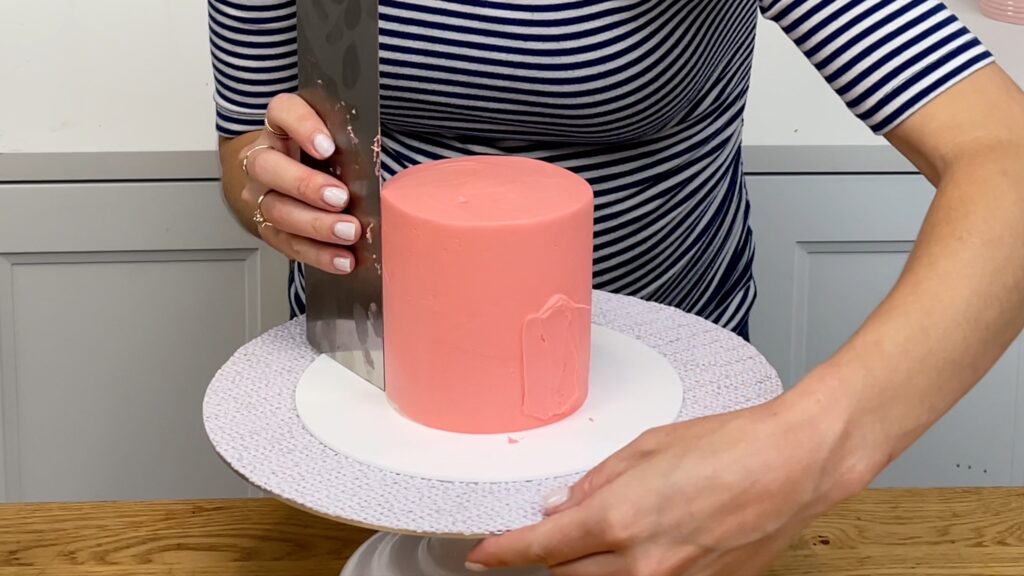
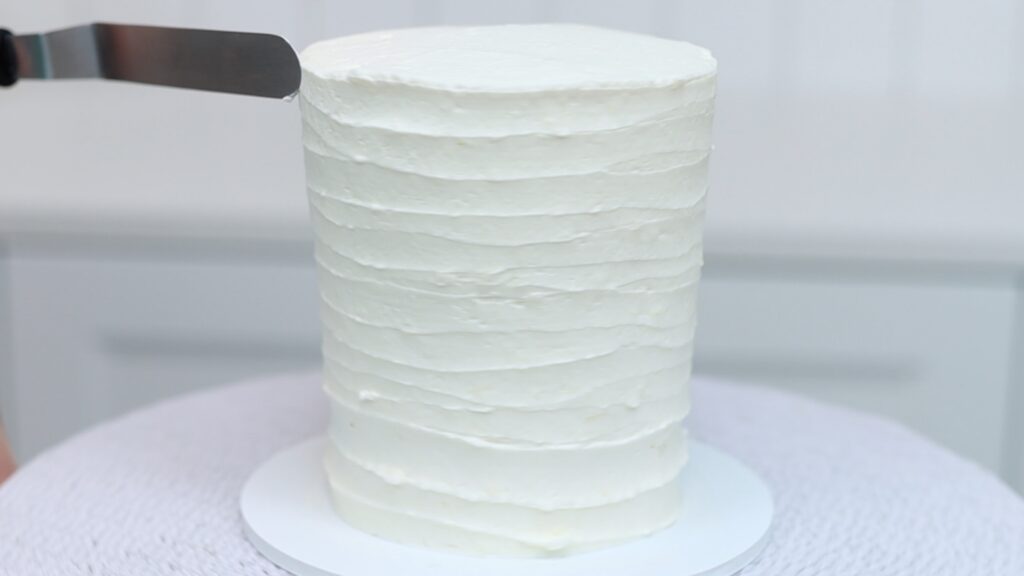
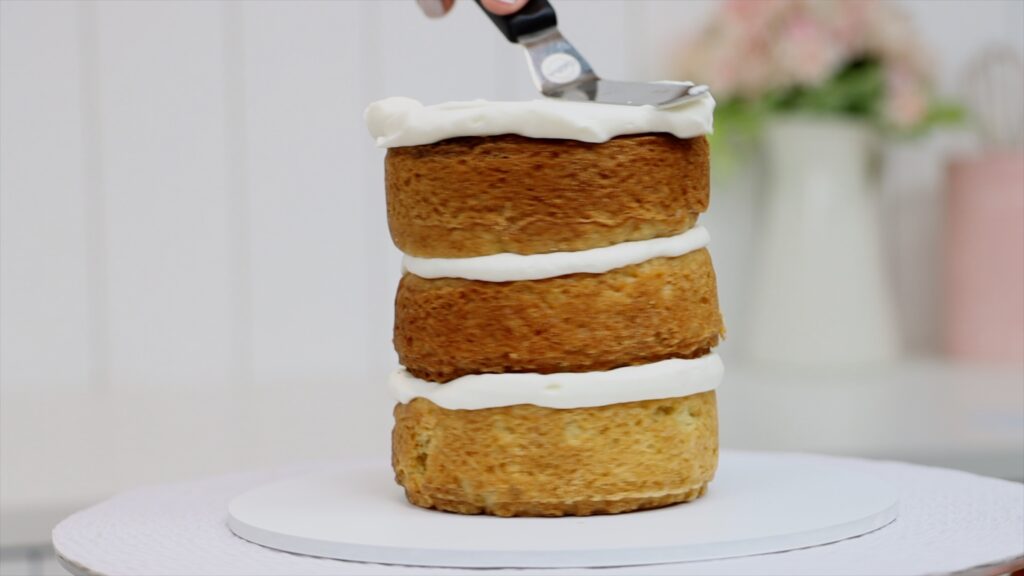
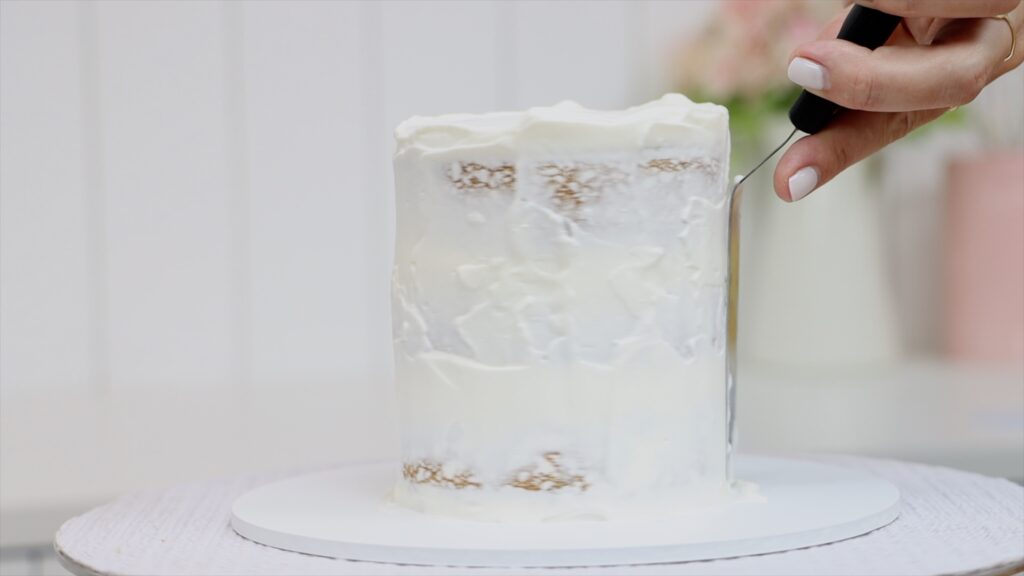
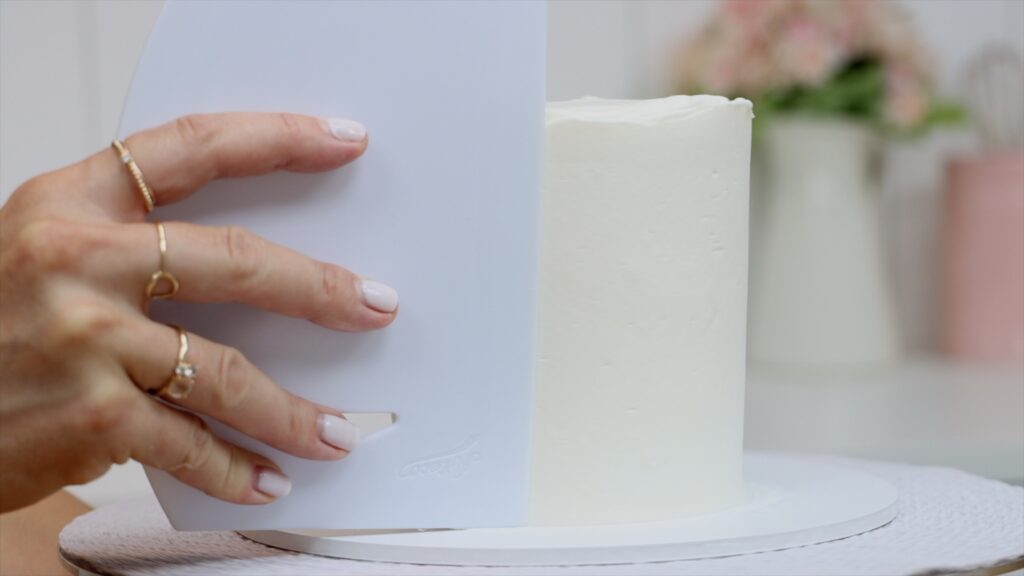
With a half and half cake you can offer two completely different flavours in just one cake! They’re great for joint birthday celebrations or just to give people two different options.
How to prepare layers for a half and half cake
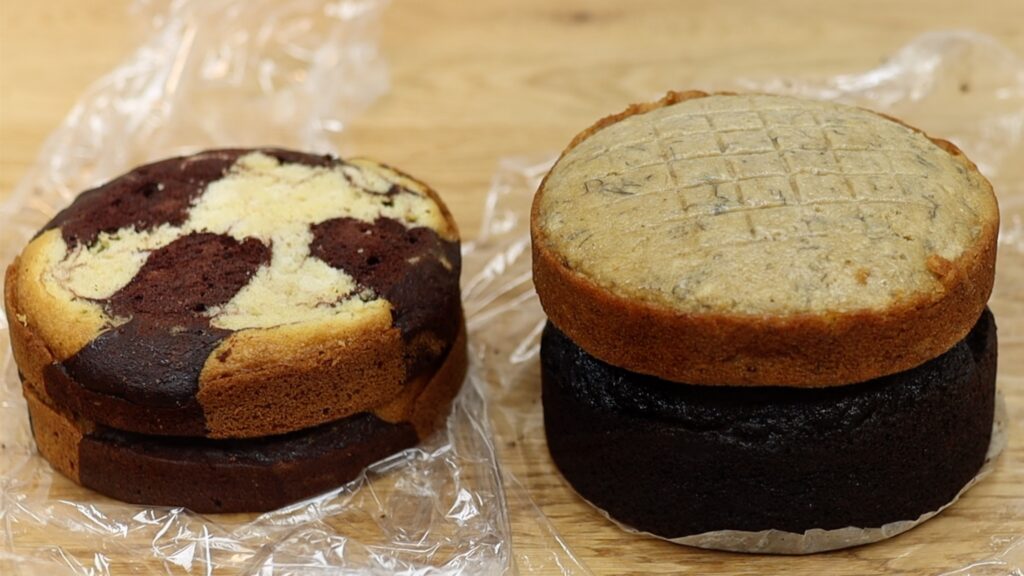
You’ll need two or four layers. Any even number will work, depending on how tall you want your cake to be. I’m using two marble layers for one half and for the other half, chocolate and banana layers.
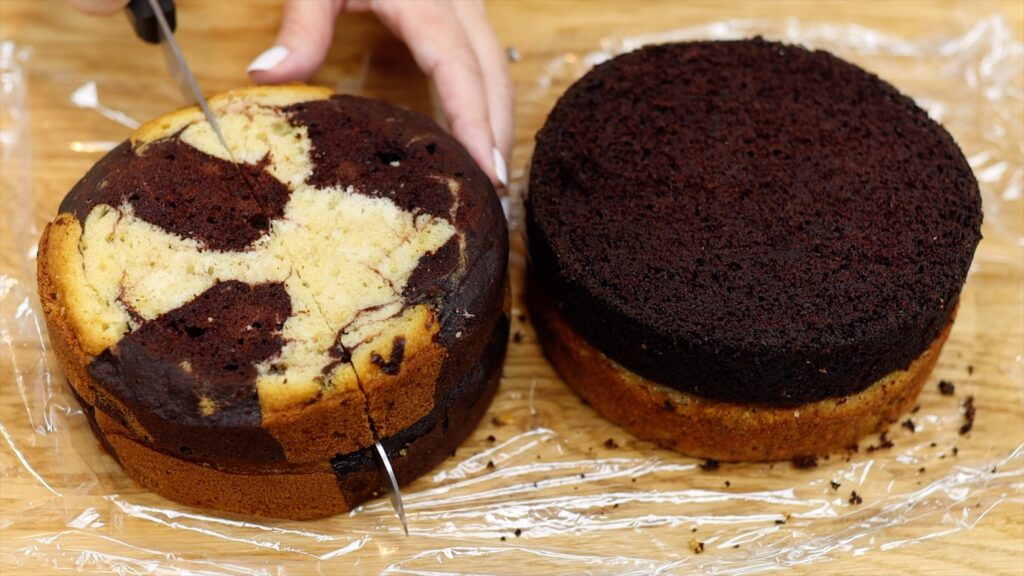
Both halves of the cake need to be the same height to make a level cake. Before assembling, stack the layers to see if one side of the cake would be taller than the other. Use a serrated knife like a bread knife to trim any taller layers. Now cut all of the layers in half down the middle.
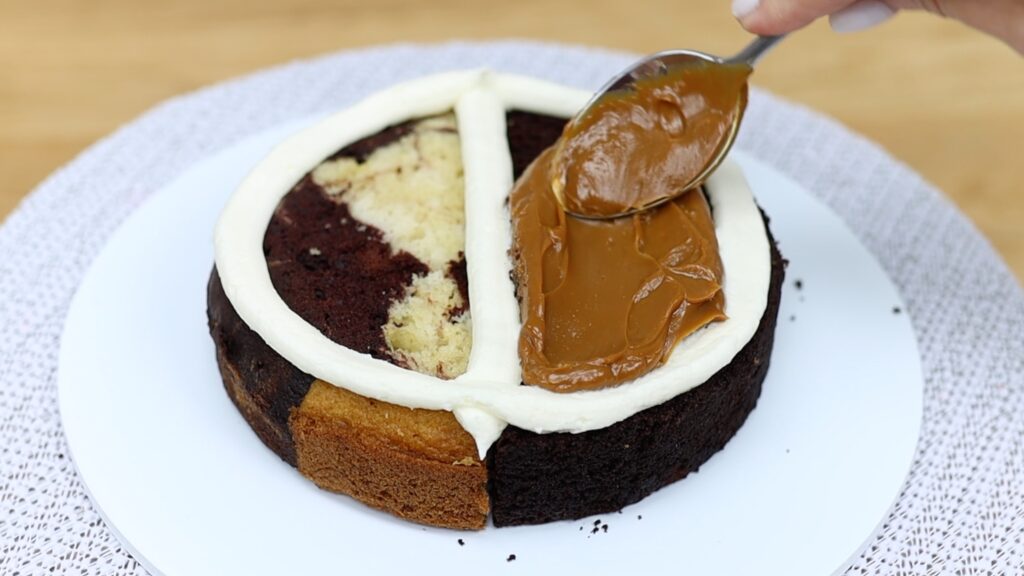
Prepare your filling and frosting for each half of the cake. I’m using Nutella and dulce de leche for fillings and also mixing them into my 4 Minute Buttercream for the frostings.
How to assemble a half and half cake
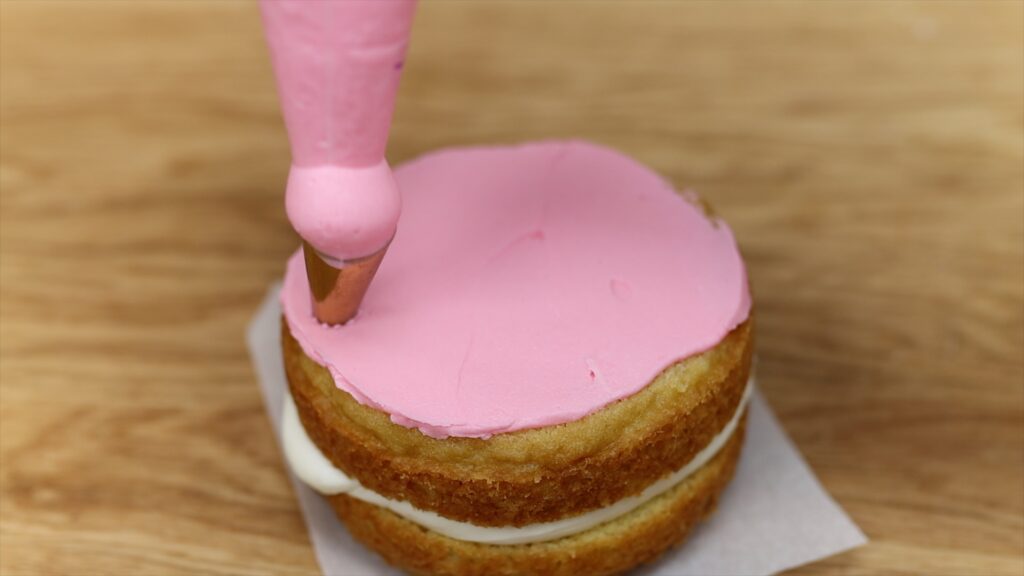
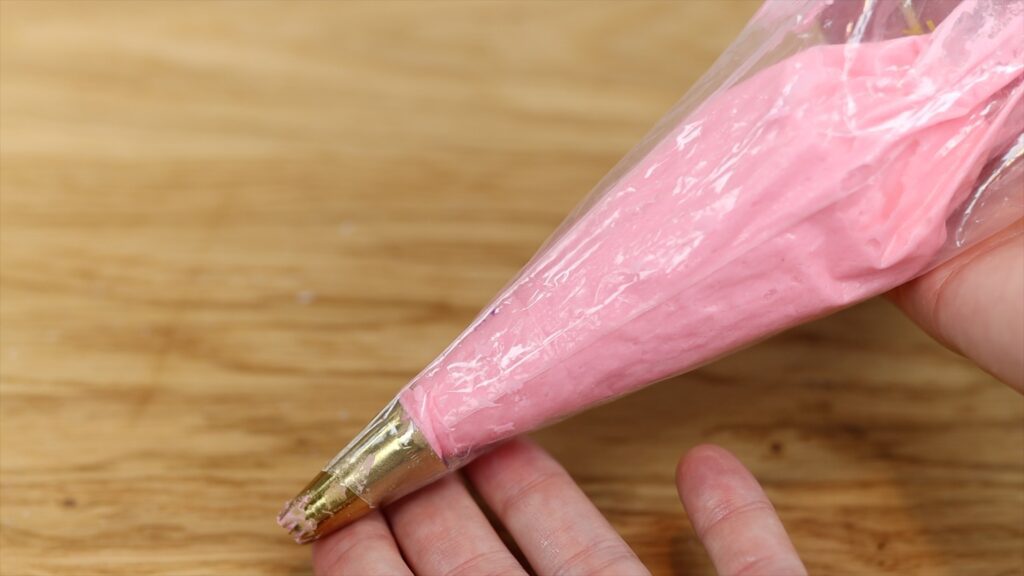
The easiest way to assemble your cake is to put some frosting into a piping bag with the tip cut off. If you don’t have a piping bag you can spread it on instead.
Spread or pipe two dots of frosting onto a cake board. Push half a cake layer into one dot to attach it to the board. Then spread or pipe frosting along the cut edge and press another half of cake into it. It will attach to the cake and to the other dot of frosting on the cake board.
If your fillings are runnier than buttercream you'll need what’s called a buttercream dam. This is a wall around each cake layer to hold in the filling. It prevents the filling from oozing out from between the cake layers. On the chocolate and banana layers I spooned dulce de leche into the dam. Nutella made the perfect filling on the Easy Marble Cake half.
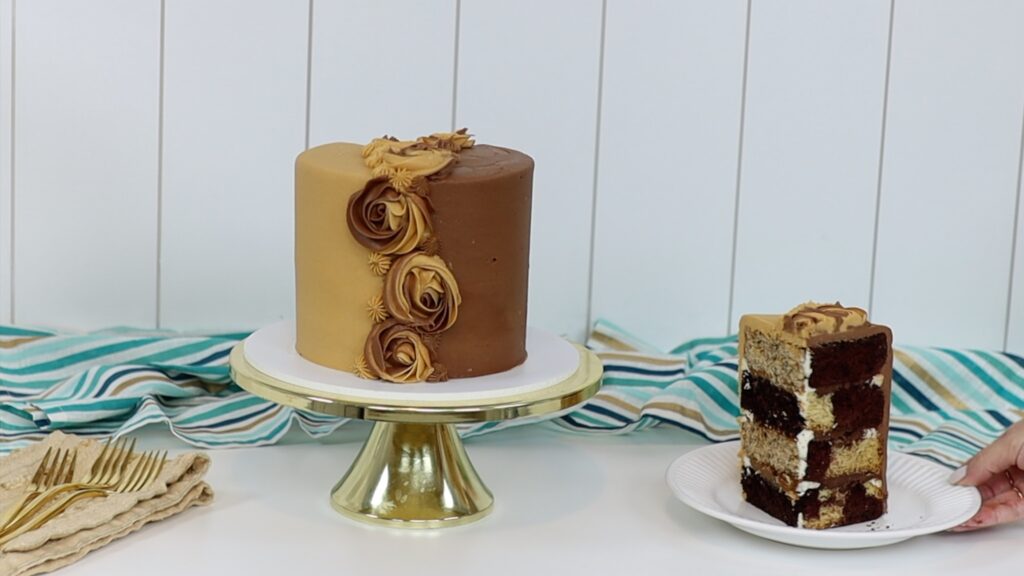
In hindsight I wish I’d chosen flavours that looked more obviously different than these! The chocolate and banana layers are almost the same colours as the chocolate and vanilla marble.
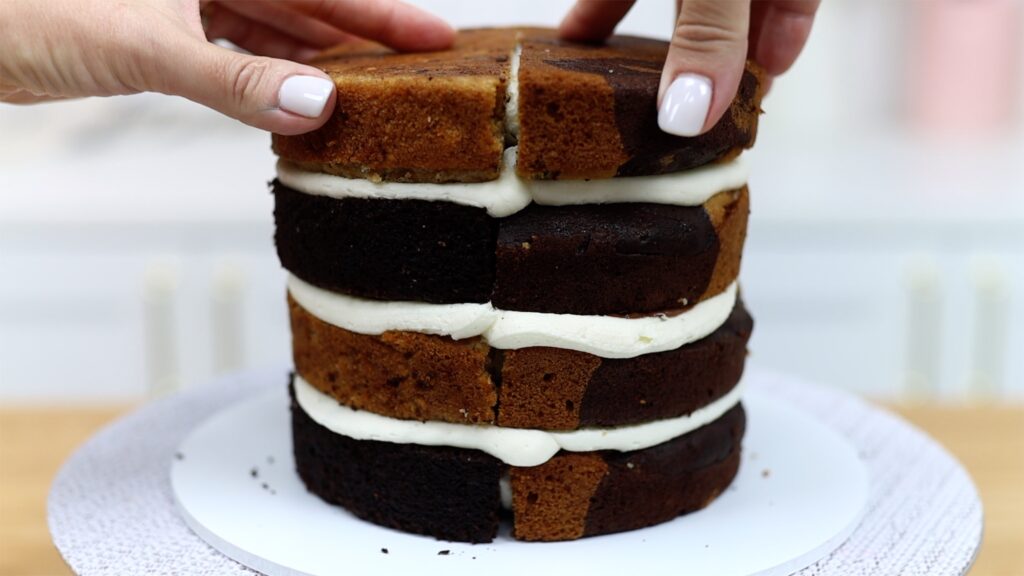
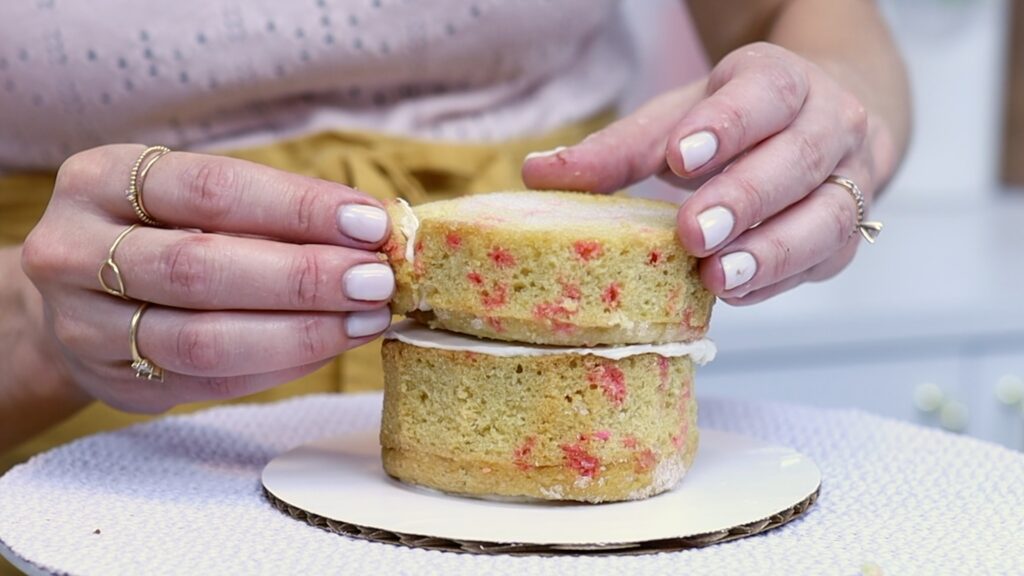
Place the next layers on top to continue assembling your cake. The frosting along the cut edge of each layers is really important. It attaches the two sides of each layer together, otherwise the cake can split down the middle and fall apart. This frosting acts as glue to hold them tightly together.
Push the two halves of the cake to stick them firmly together and also push down to level the cake.
How to frost a half and half cake
Divide the rest of your frosting into two bowls and add any frosting left in your piping bag, too. Tint each half with a different colour or use different flavour ingredients for each bowl.
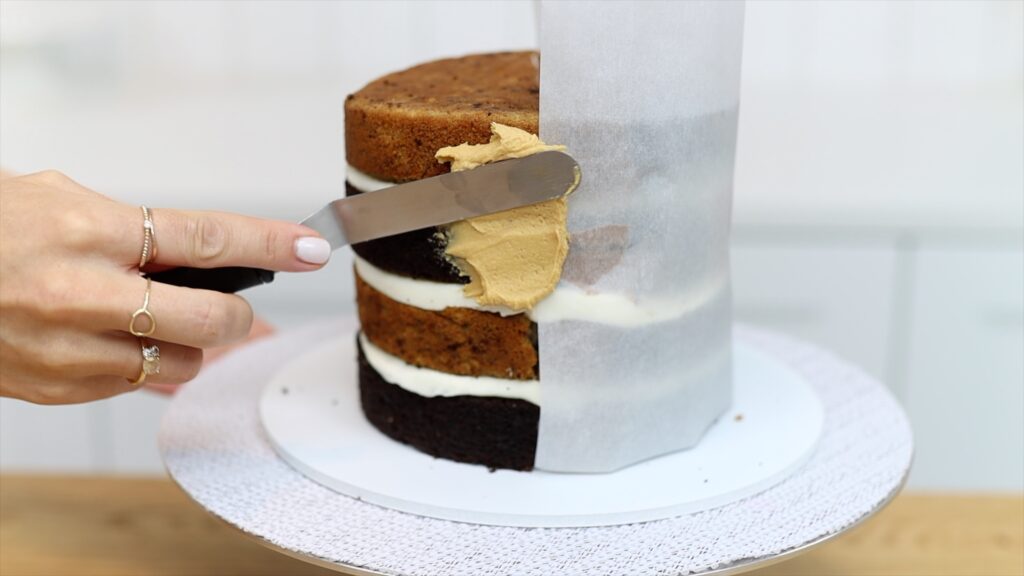
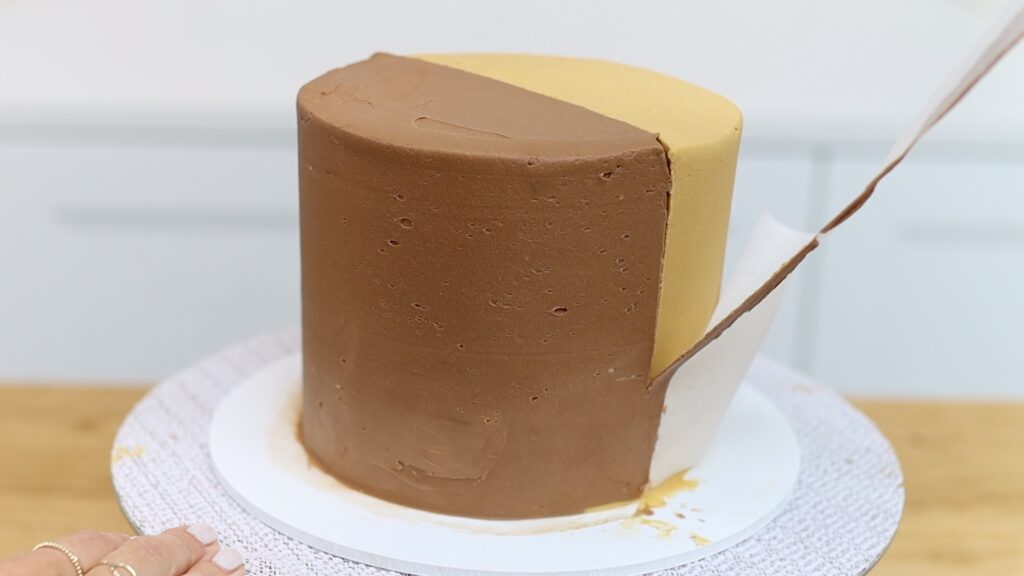
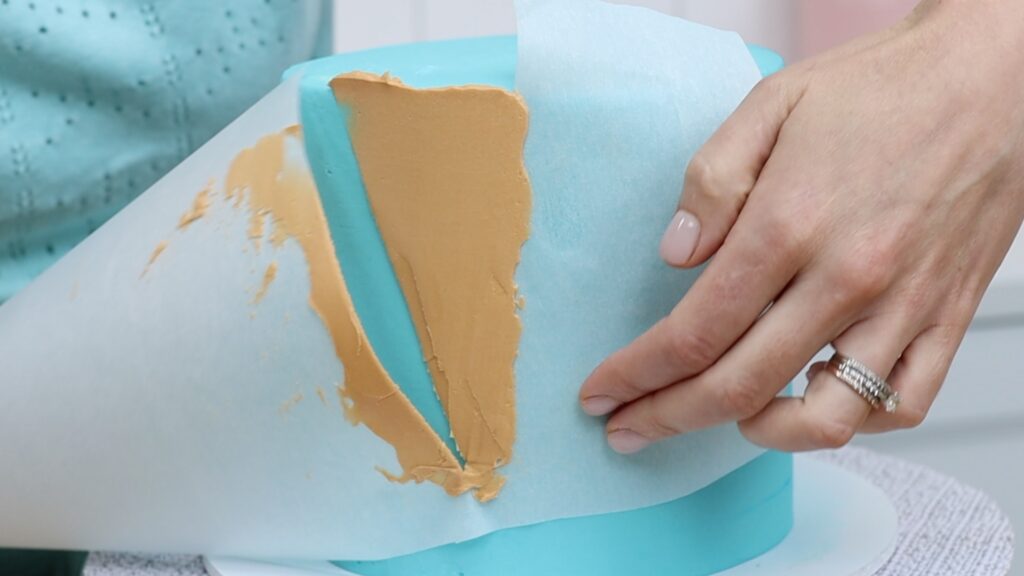
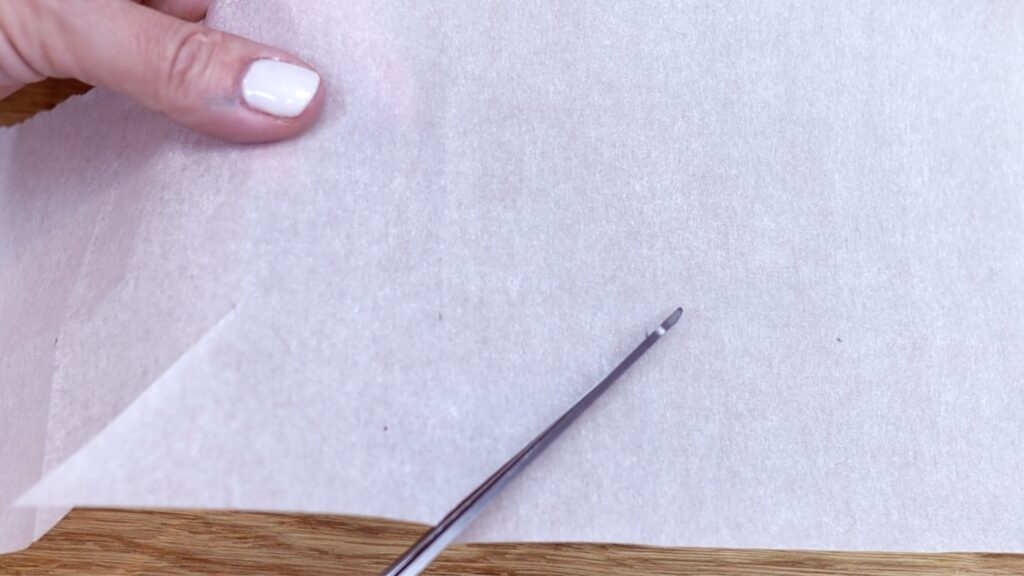
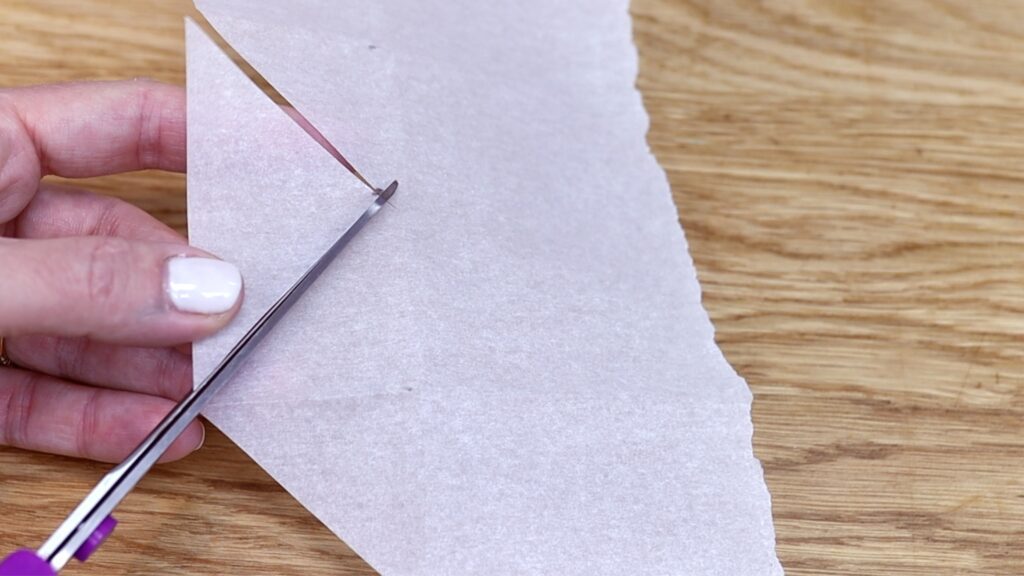
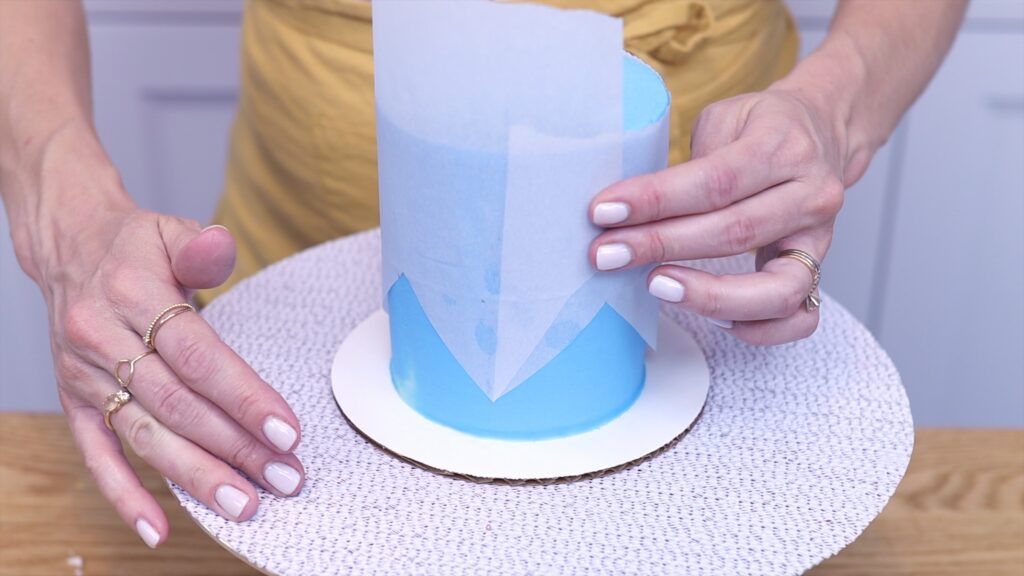
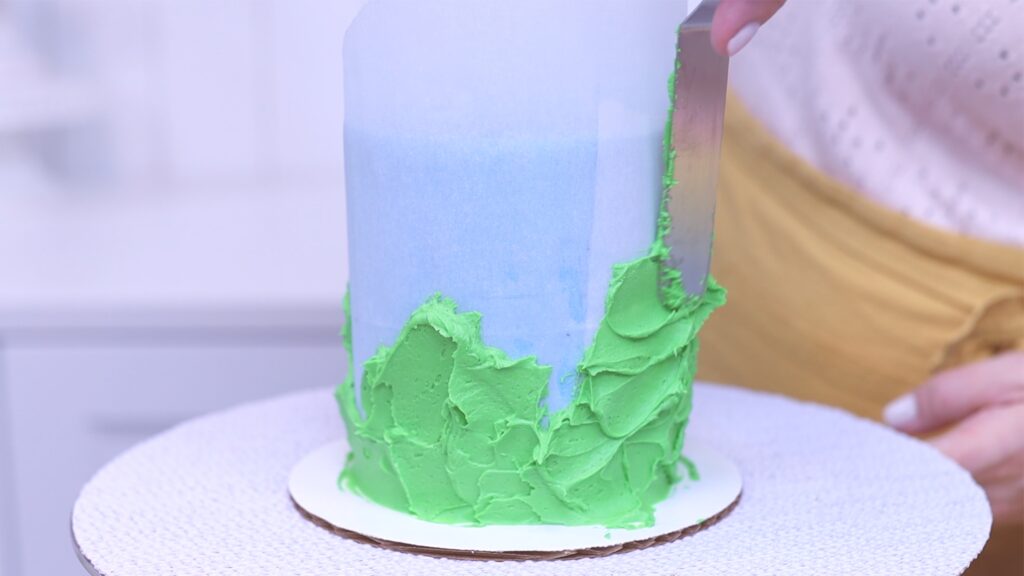
Spread a few dots of frosting onto one half and wrap that half with parchment paper. The parchment will stick to the dots. Trim the parchment so it covers only that one half of the cake. Then use the other flavour of frosting to frost the exposed side of the cake. The parchment will prevent that frosting from getting onto the covered half.
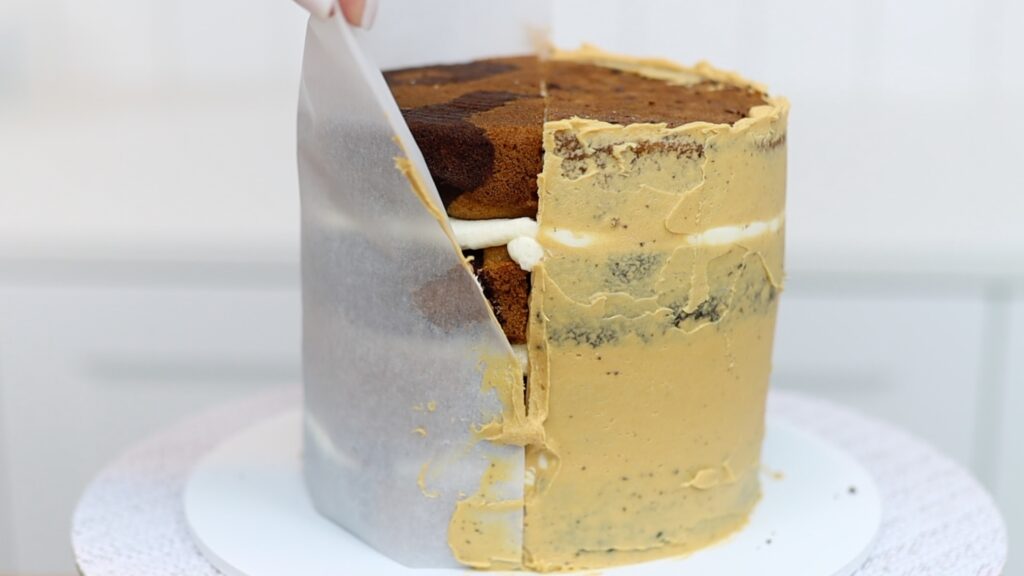
It's always a good idea to apply a crumb coat of frosting first. This will trap any crumbs that come off the cake so they don't get into your final layer of frosting. It’s messy but that’s fine because it will be covered up in a minute.
When you peel the parchment off, the frosting will stop exactly in between the two halves of the cake!
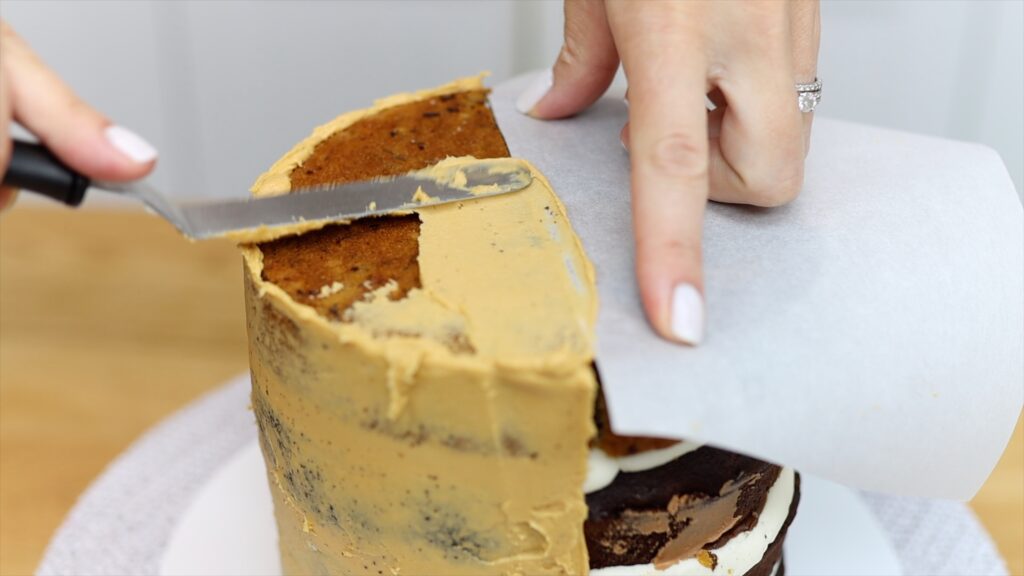
Do the same for the top, covering up the other half of the cake with parchment before spreading frosting onto this half.
Then cover up the frosted side of the cake with parchment paper. Spread frosting onto the other half of the cake. Optionally, you can chill the cake before you do this. If you don't, when you peel the parchment off you’ll leave some texture behind on the frosting. Since it’s just the crumb coat (which will be covered up) it doesn’t matter.
Put the whole cake into the freezer for 15 minutes until the frosting has set. To test it, touch it and check that you don't leave any texture in the frosting. Some tiny condensation drops will form on the frosting, which will help parchment stick as you cover up one half.
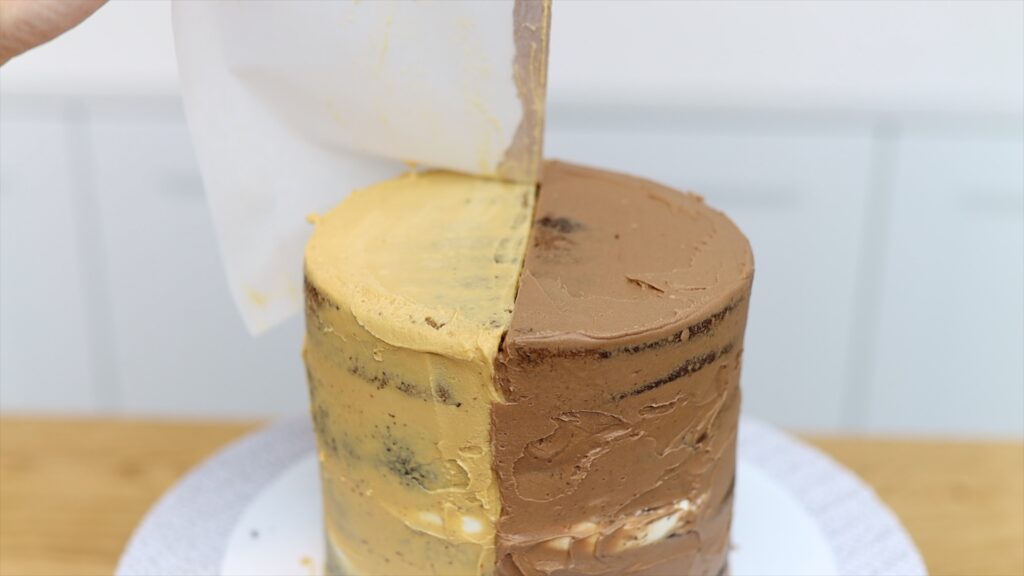
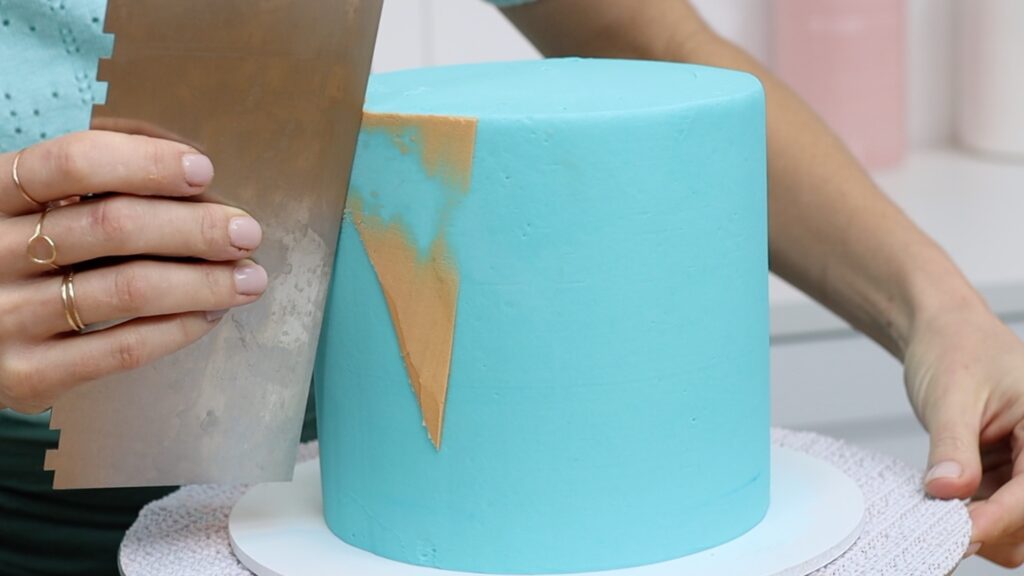
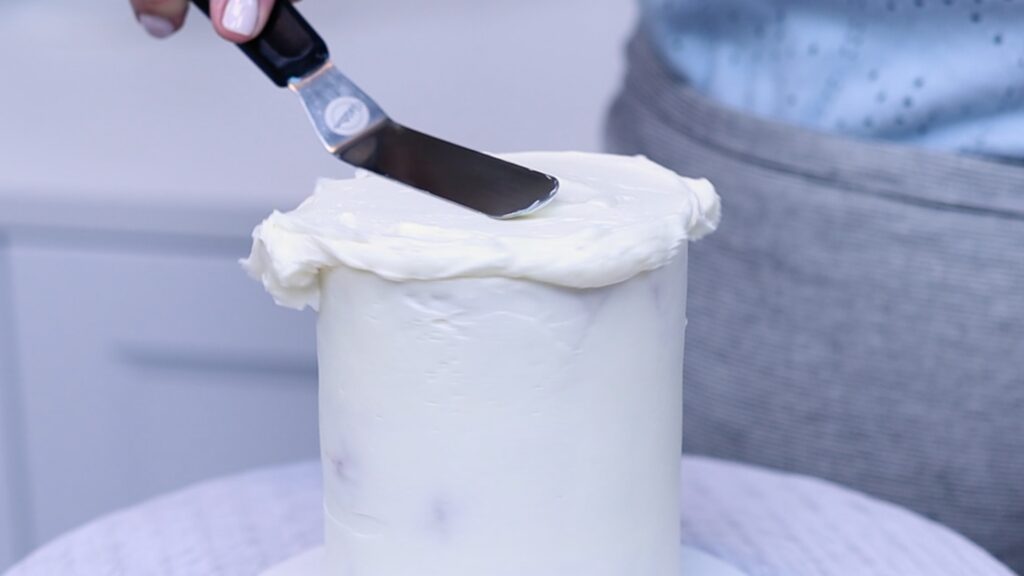
Spread frosting onto the other half. Apply the frosting more thickly now because this is the final layer of frosting so you want it to be much neater than the crumb coat. Scrape around this half of the cake with a frosting comb to smooth the frosting. Then tidy up the top edge of the cake by swiping the frosting sideways with your offset spatula. Peel the parchment off to reveal a neatly half-frosted cake!
Put the cake back in the freezer for another 15 minutes to set this frosting. Then repeat the process for the other half of the cake, covering this side with parchment and then spreading another flavour of frosting onto the other side. Because the first flavour has set, pressing parchment against it won’t imprint any texture into the frosting. When you peel it off the frosting underneath will look perfect!
Half and half cake decoration ideas
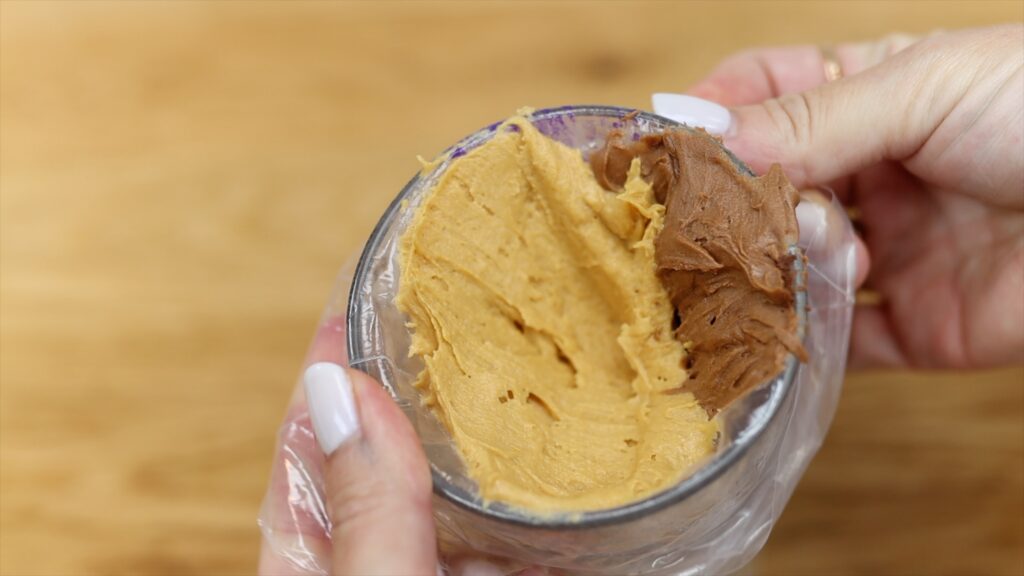
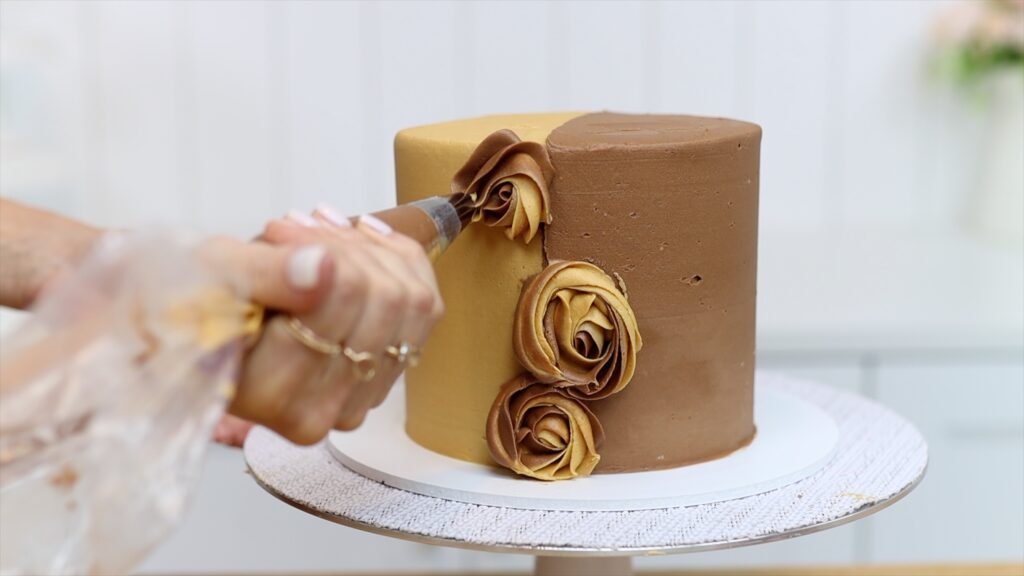
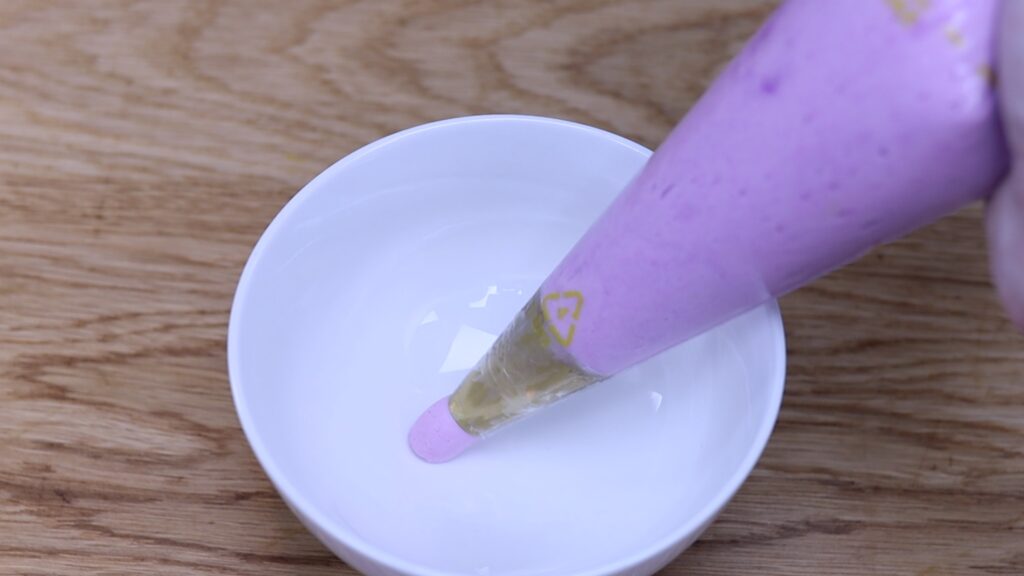
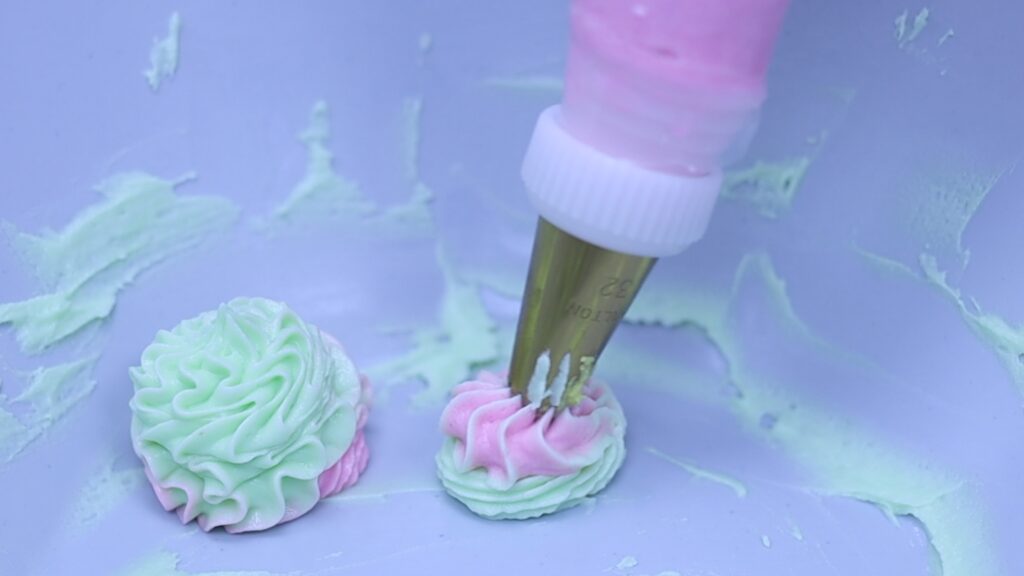
The joins between the flavours are fairly neat but I always like to cover mine with something. For this cake I’m piping some details with two tone frosting, which is easy to make! Fill a piping bag with one flavour on one side and another flavour on the other side. I like to put the piping bag into a glass to hold it open for this.
Then push both flavours down to the piping tip. This is a 1M star tip. These swirls or rosettes hide the join of the two flavours of frosting, and also add some pretty details. If you don’t want to blend the flavours of the two halves, pipe with plain vanilla buttercream in different colours.
Why make a half and half cake?
A half and half cake is a great way to use up extra layers. You might be wondering, "why would I have extra cake layers?" Maybe your batter didn’t make enough to make the size of cake you were planning on. Maybe it made too much so you have one too many cake layers for your cake. In my case, I bake in bulk so I have loads of layers in the freezer to pull out whenever I want to make a cake. Sometimes I’ll end up with one lonely banana or chocolate layer, like these. They're perfect for a half and half cake!
People are always blown away by half and half cakes and excited to see the inside. Although I wouldn’t serve anyone a piece this big, it’s fun to show off the two flavours within one slice!
The possibilities for this are endless - wouldn't it be a fun idea for a wedding cake?! For birthday cake ideas and designs for every occasion visit my online cake school.
Wondering what to do with leftover frosting? In this tutorial I'll show you nine ways to use it and how to store it for later cakes!
#1 Add a border to your cakes
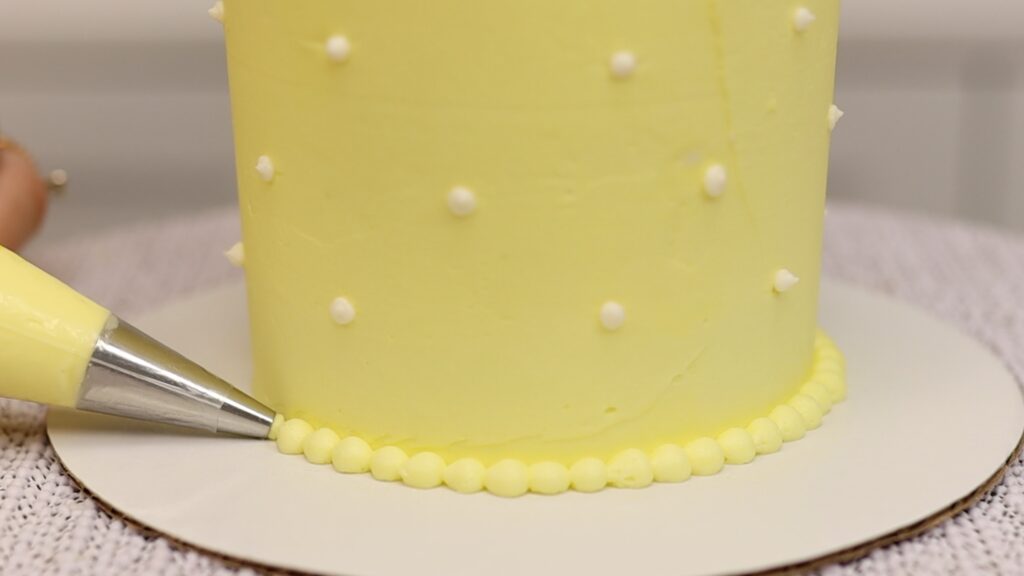
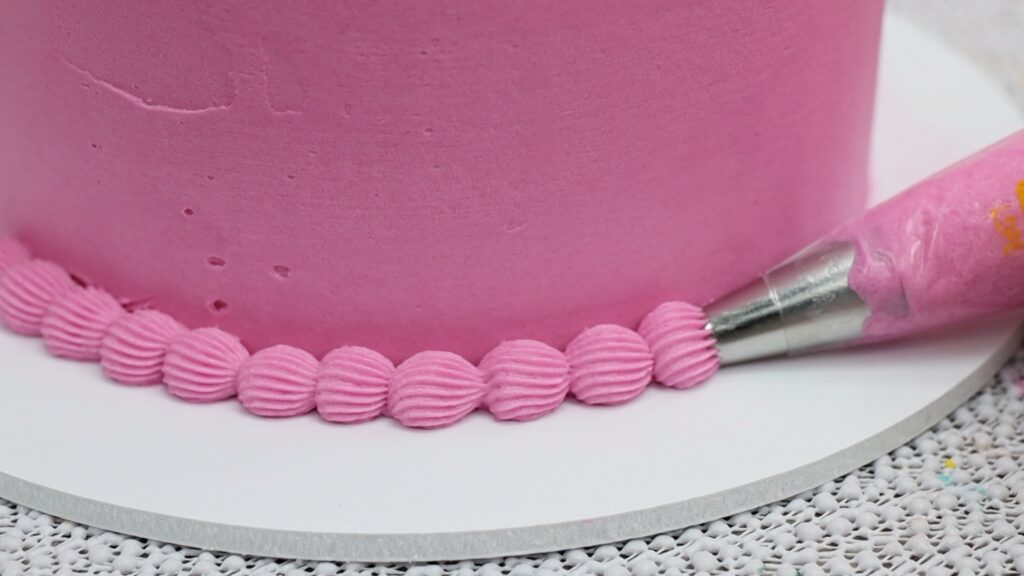
With just a few spoonfuls of leftover frosting you can pipe a beautiful border. Scoop it up and spoon it into a piping bag fitted with any star shaped tip. Now you can add pretty textured detail to the bottom or the top of the cake.
The smaller the piping tip and the smaller the cake, the less frosting you’ll need. At the bottom of the cake you’ll cover up any air gaps or imperfections between the cake and the cake board or if you pipe a border onto the top of the cake, you’ll give the cake some height and make it look more elegant!
#2 Re-tint frosting
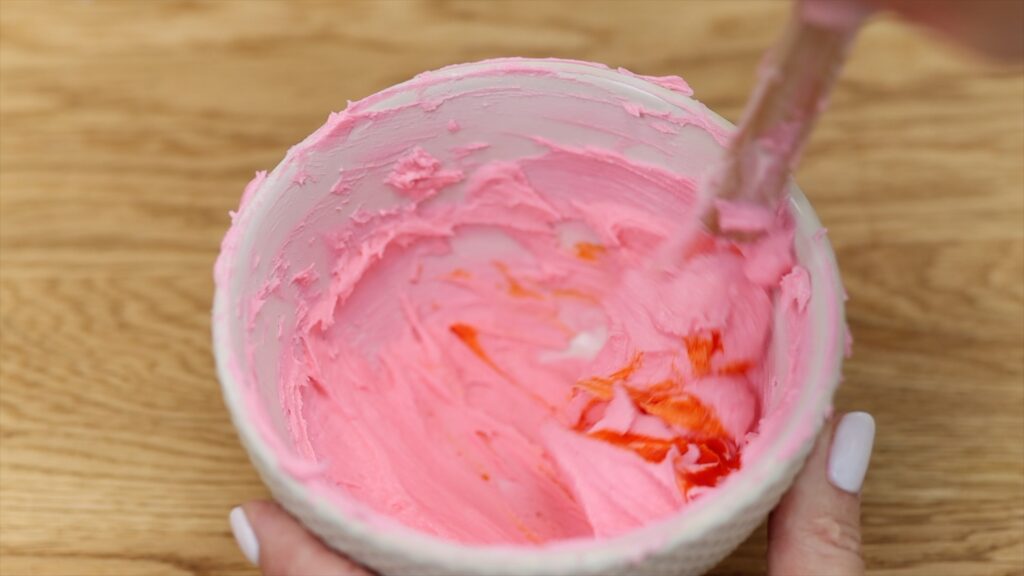
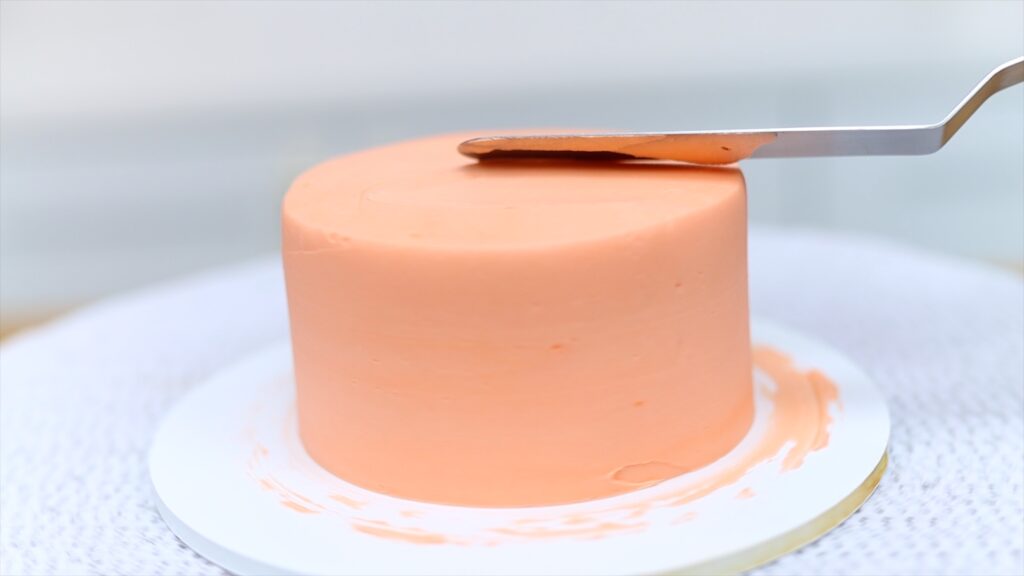
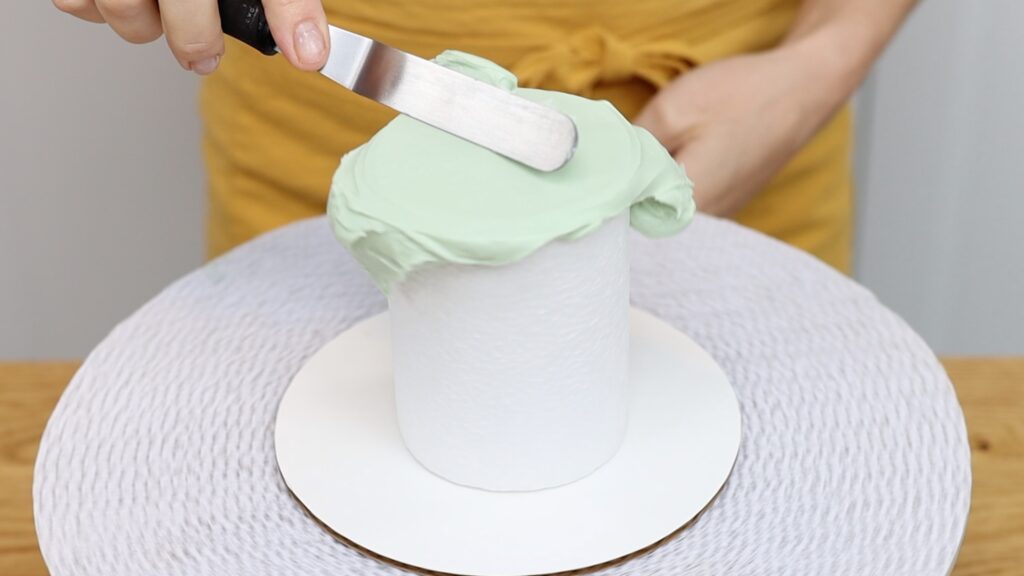
You can re-purpose leftover buttercream by tinting it another colour. I recommend gel colours because they’re much more concentrated than liquid colours so you’ll make much brighter, bolder colours. Add them a drop at a time to make the colour you want.
Now you can use this leftover frosting to frost or decorate another cake. This teeny tiny cake is a lunchbox cake!
I should mention that for any of these ideas, you can do them straight away or store the frosting for up to two months, which I’ll show you how to do later in this tutorial.
#3 Pipe flowers
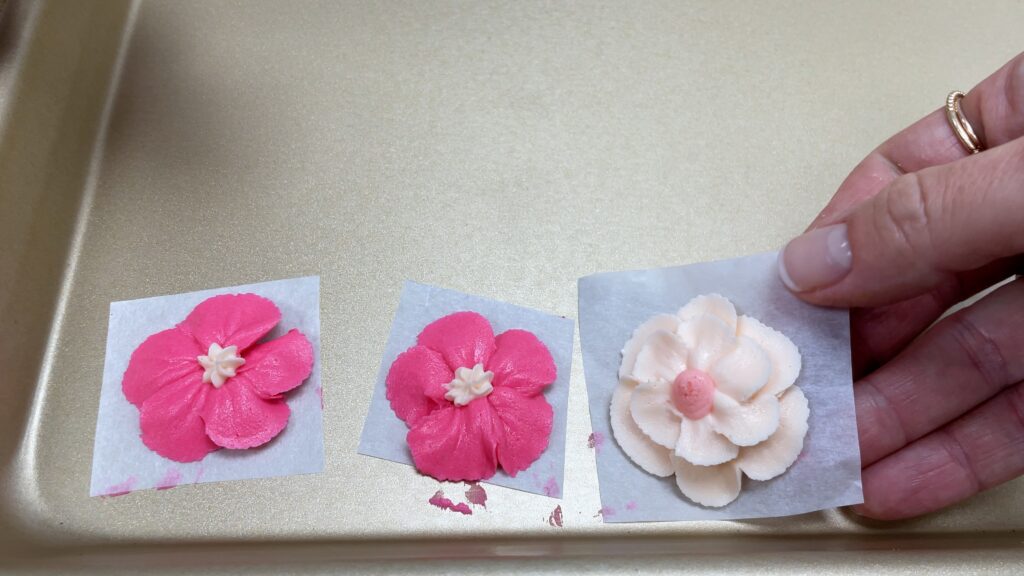
Piped flowers can be frozen for a month. All you need is a flower nail, a little piece of parchment paper and a petal tip. I show how to pipe these flowers in this tutorial.
Slide the piped flowers on their parchment paper onto a tray and put them in the freezer until you’re ready to use them to decorate a cake!
#4 Use leftover frosting for a stencil
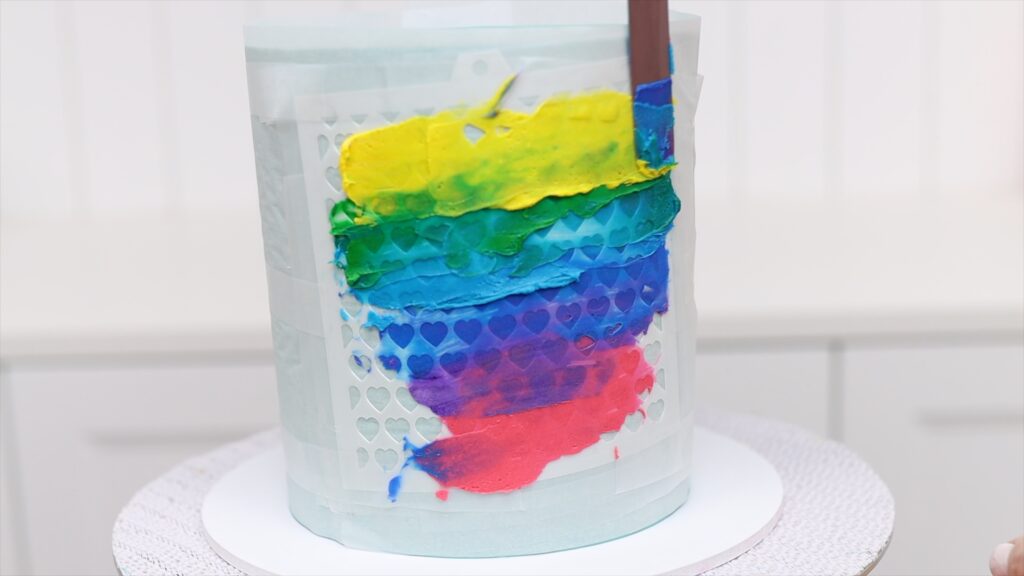
Some decorative details only need a tiny amount of frosting, like stencils. This is a great way to use up that last little bit of buttercream!
I teach all sorts of unique cake decorating techniques in my online course, The Basics of Buttercream. Join my ClubPLUS for access to every MasterCourse, MiniCourse and Live Workshop!
#5 Make a mini cake
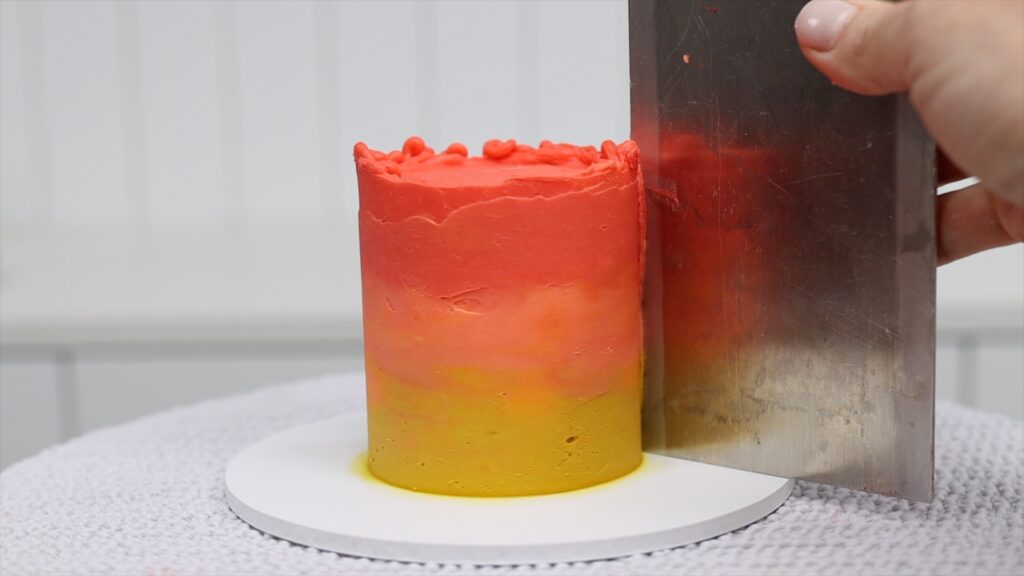
Mini cakes are a great way to use up teeny tiny amounts of leftover frosting. You can make a cake using cupcakes as the layers like I did for this one! Use mini cakes to practice new cake decorating techniques or make someone a thoughtful gift.
#6 Decorate a cake dummy
If you don’t want to bake anything, use a cake dummy to practice smooth frosting or any decorating techniques!
Cake dummies are styrofoam rounds that come in different sizes. After you finish practicing you can wash the frosting off and re-use the dummy to practice another technique!
#7 Make a dessert
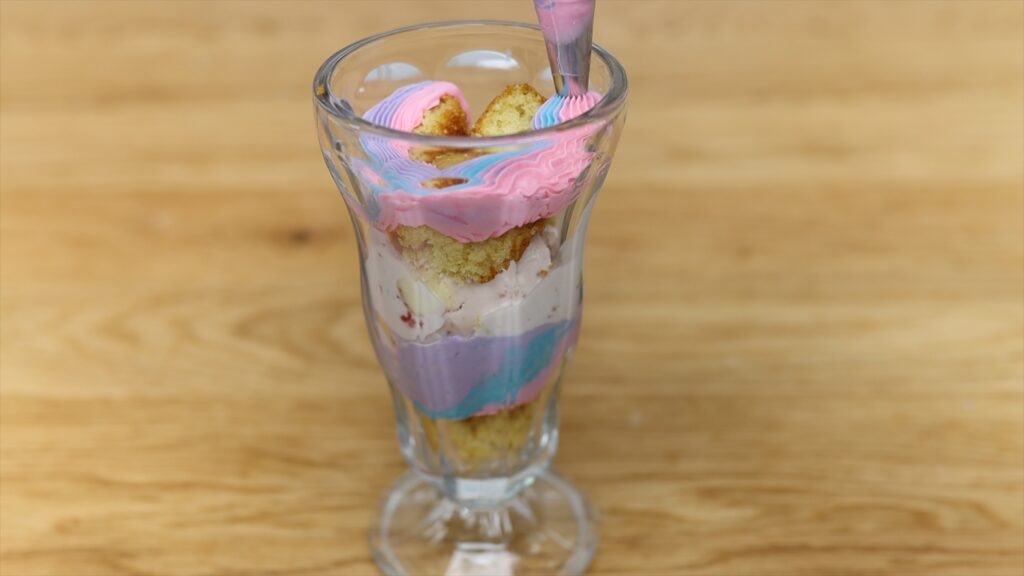
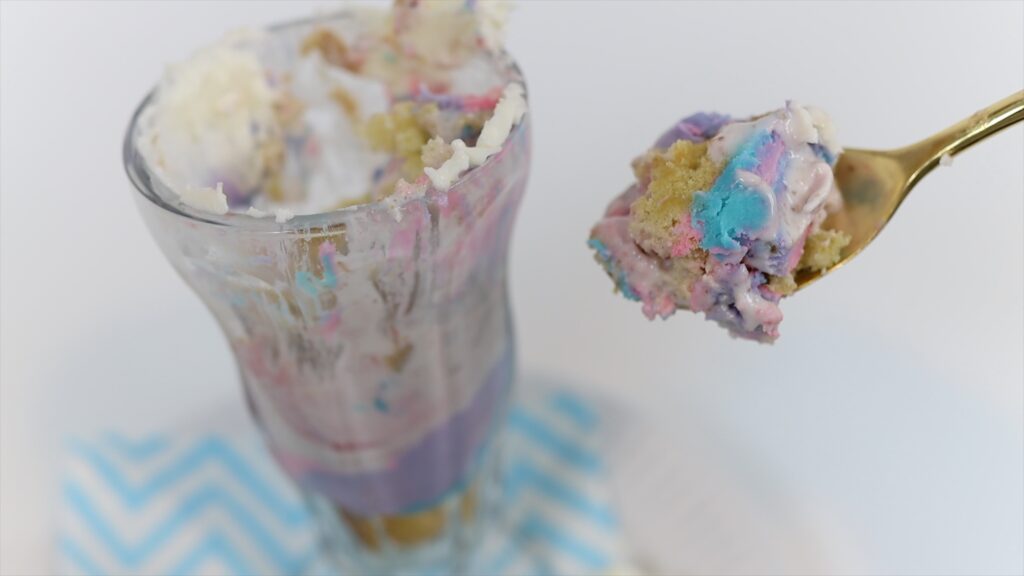
Make a dessert with your leftover frosting like a cake sundae. This is also a great way to use domed cake layers you’ve trimmed or offcuts from sheet cakes.
Alternate cake scraps with leftover frosting and add ice cream to make it really decadent! These make a romantic dessert for two or an indulgent treat for yourself.
#8 Decorate cookies
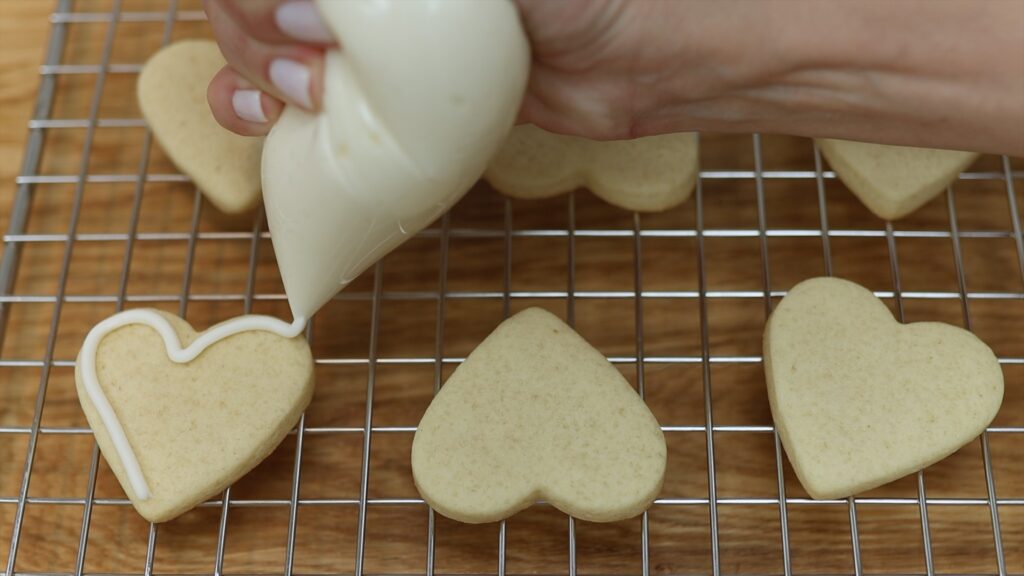
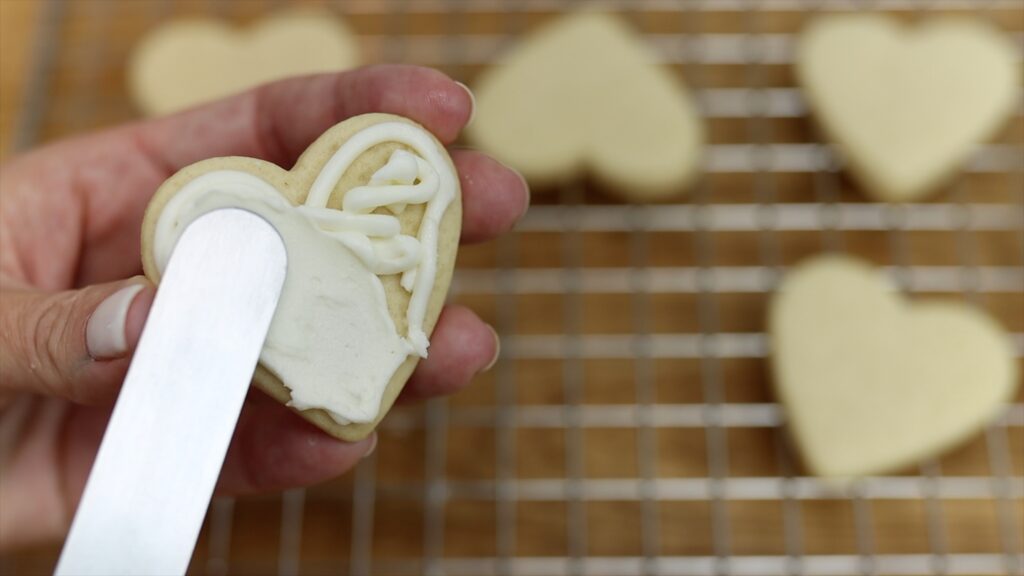
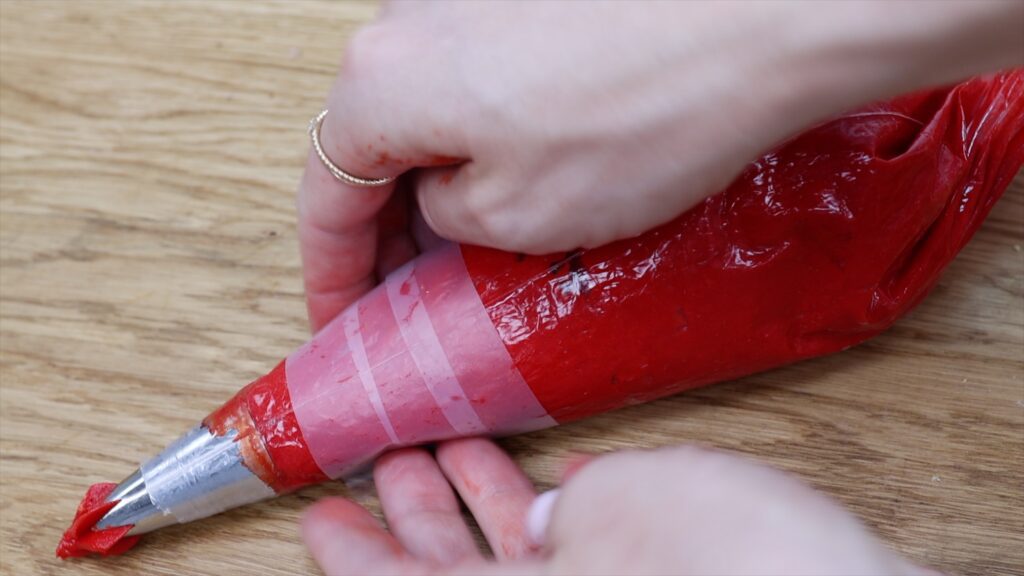
Did you know that you can decorate cookies with buttercream? Buttercream is much less temperamental than royal icing and it’s very easy to pipe. Put the buttercream in a ziploc bag, cut off a corner and then squeeze it to decorate the cookie.
I like to start with an outline and then fill it in with zig zags. You can smooth the buttercream with an offset spatula.
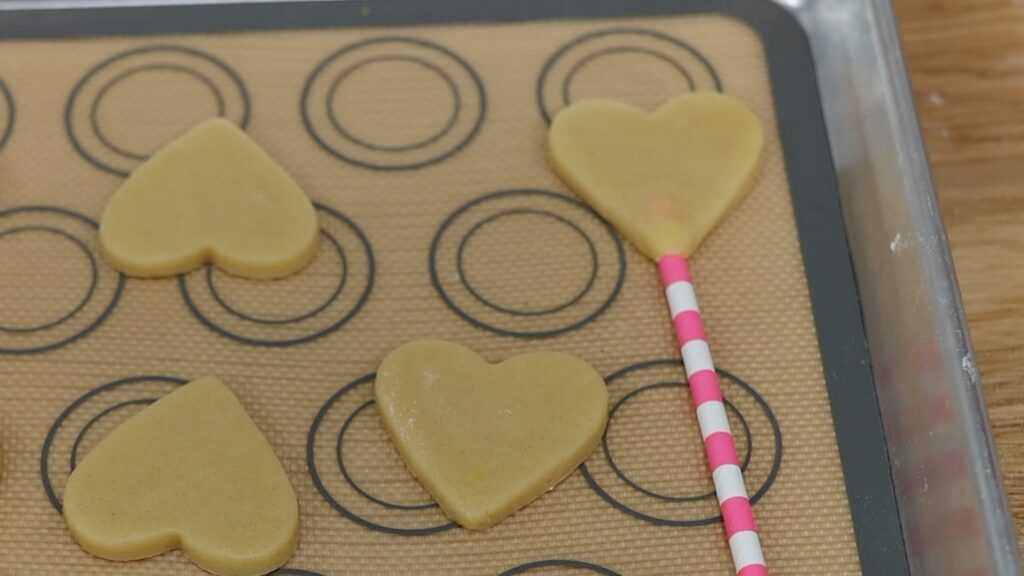
Add sprinkles, edible glitter o colourful sugar to make the cookies even more intricate. They're a delicious snack or party favor. To make cake toppers, bake the cookies on a paper straw and then poke the straw into a cake.
#9 What to do with leftover frosting you want to use later: store it
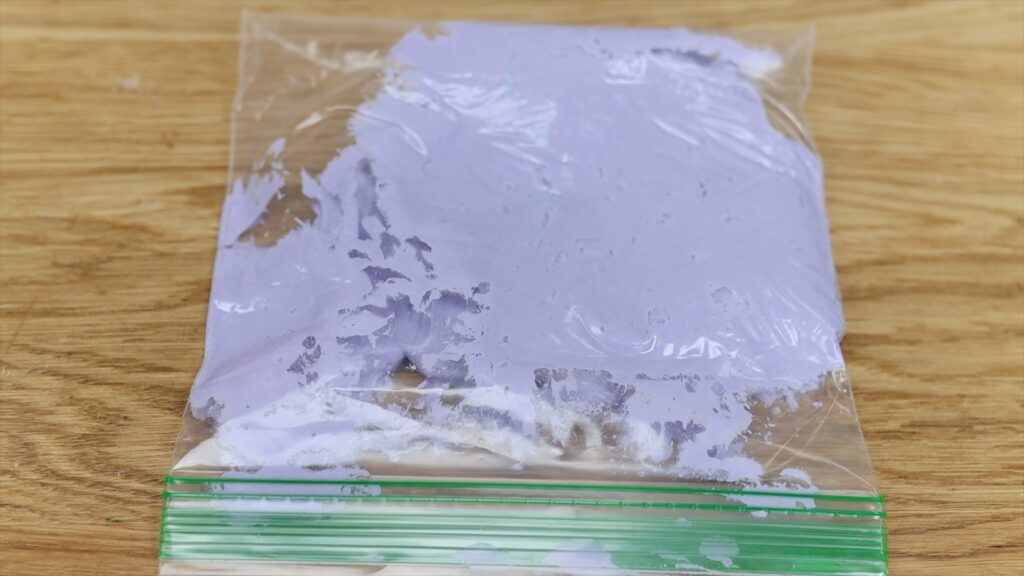
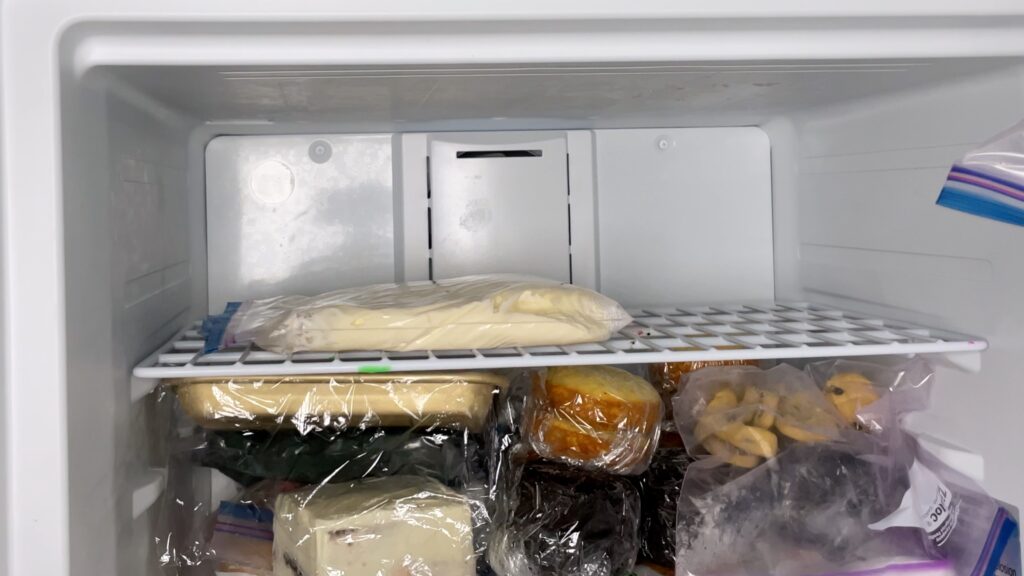
If you don’t want to use the leftover frosting straight away you can save it for later. Buttercream can be stored for up to two months! Put it in a ziplock bag, seal it, and freeze it. You can store it in the fridge for 2 weeks if you prefer.
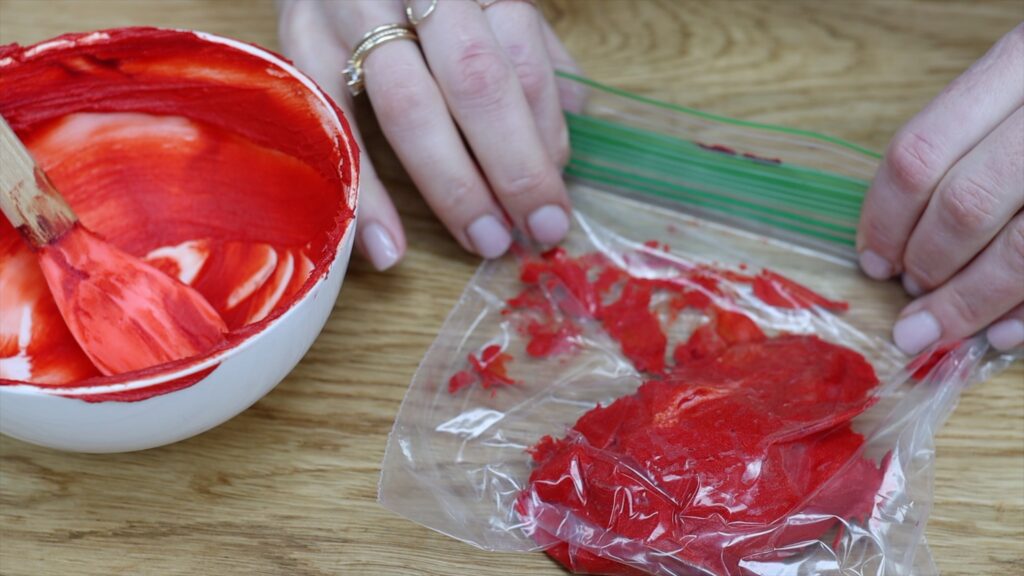
When you take it out, leave it for a few hours to thaw. Then squeeze itinto a bowl and stir it to knock out any air bubbles so it's smooth. Now it's ready to use!
This is really useful for black and red buttercream, which take a lot of time and gel to make. I store even small amounts of leftovers to use for future cakes, when having those colours ready saves a lot of time!
It’s useful for even a few spoonfuls of frosting because sometimes you only need a bit of a certain colour for a design. Instead of tinting it from scratch you can just pull it out of the fridge or freezer when you need it!
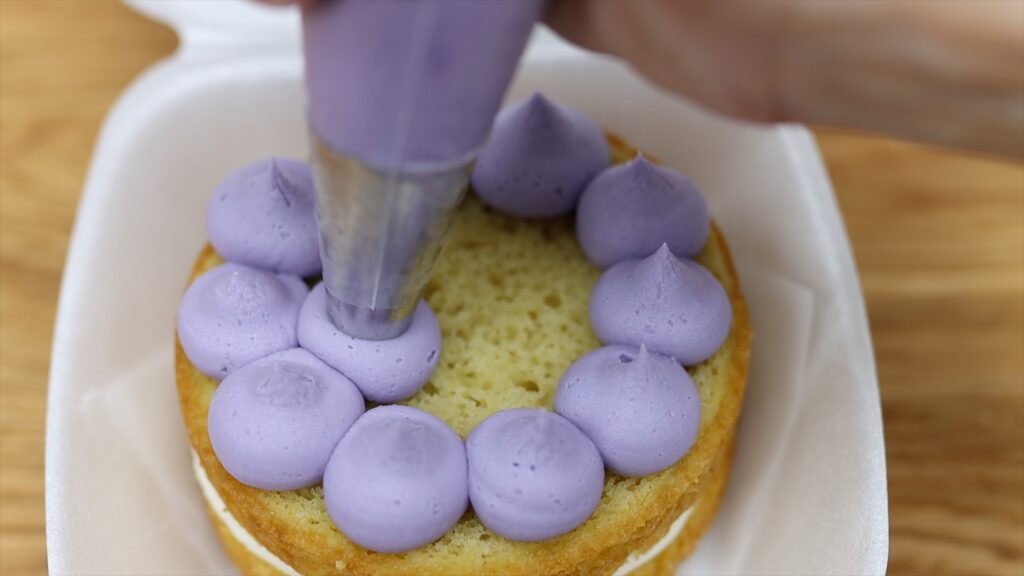
Ziplock bags are an easy way to store the buttercream and you can cut a hole in one corner to squeeze the buttercream into a piping bag or ziplock bag to use for decorating. This is a bento box cake from my tutorial on 4 ways to make lunchbox cakes:
You can of course store plain white buttercream too, not just colours. I like to make double batches of my 4 Minute Buttercream, which is the biggest batch that will fit in my mixer and then store what I don’t need until I make another cake. You’ll need big, gallon ziplock bags to fit an entire batch of buttercream. Once it thaws you can cut off a corner and squeeze it out into a bowl, ready to use!
I hope you’ve found these ideas useful. Please share any of your ideas with everyone else in the comments!
Struggling with condensation, piping bag fails, messy lettering and crumbling cake? Read on to find out how to avoid and fix these common cake mistakes!
#1 Poked cakes
I think this one has happened to everyone! You put lots of time and effort into getting really smooth frosting and then - oops! You poke a finger into the cake by mistake!
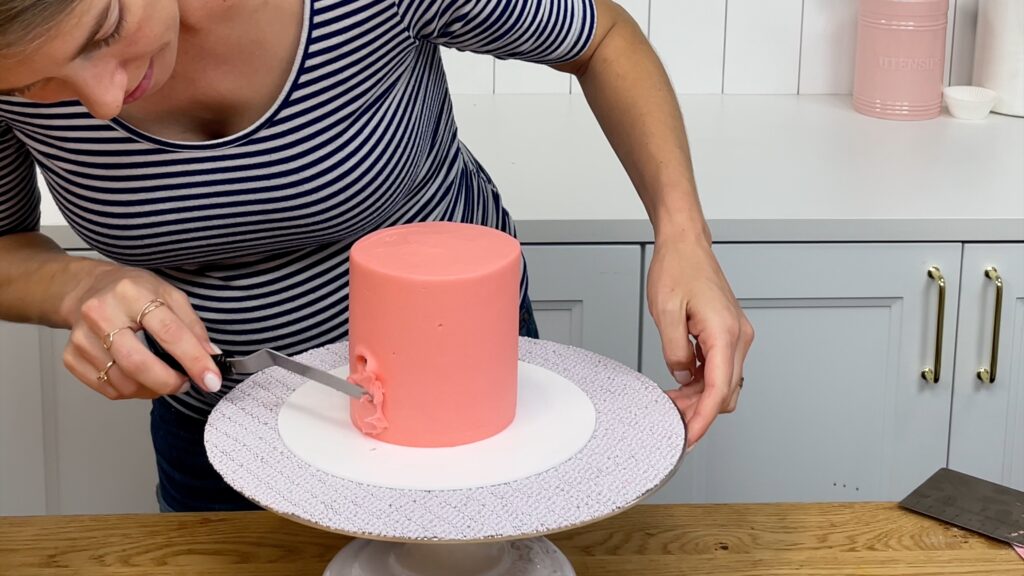
Spread some more frosting over the damaged area to cover the hole or holes. Don't worry about adding even more texture to your cake for the moment.
Now scrape around the cake with a cake comb to smooth the frosting again. This will make the sides neat but it will push a bit of buttercream up above the top edge. Swipe sideways with an offset spatula or cake comb to tidy that up. Your cake will look as good as new!
#2 Dented cakes
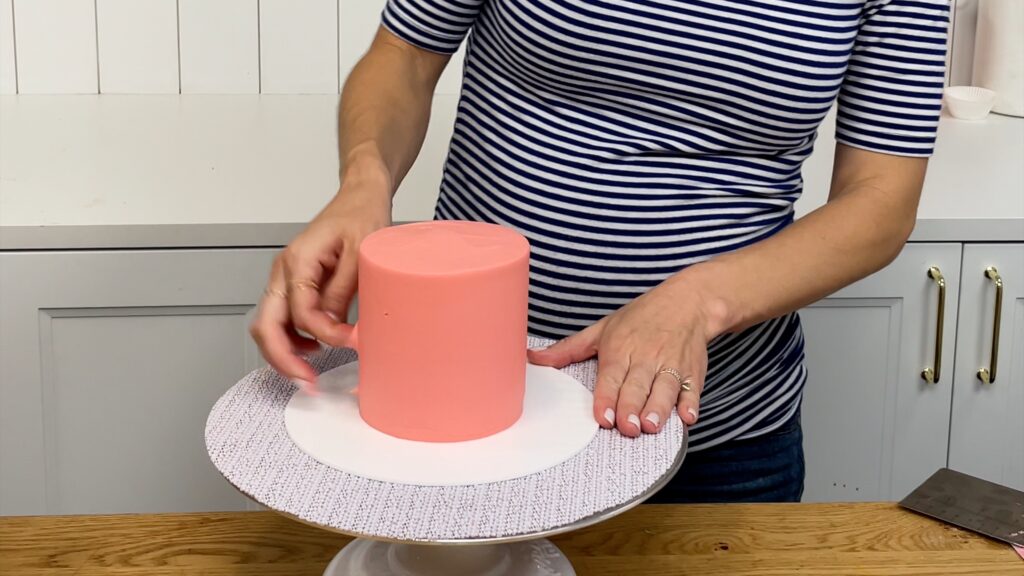
If you poke or dent the frosting after it sets you can add a detail over that area. This cake mistake has happened to me countless times when I try to squeeze too many cakes into my fridge!
A texture detail is ideal because spreading fresh frosting completely flat against frosting that has set is almost impossible. You’d never know there was a big dent underneath this textured frosting and sprinkles!
#3 Ugly borders
If you pipe a border onto a cake and decide you don’t like it, there’s an easy fix. This solution only works if the frosting on the cake has set. (It’s always a good idea to chill the cake before piping a border so that the frosting gets firm and can support the weight of the piped border without drooping.) When the frosting has set you can easily scrape off any borders you don’t like. The frosted cake will hold its shape and won’t get damaged but the freshly piped border will slide straight off! Now that the cake mistake is removed, you can leave the top of the cake plain or pipe another border.
#4 Piping tip bursts out of piping bag
If the hole in your piping bag is too big for your piping tip, the tip might burst through it. This is especially likely if the frosting is stiff so you have to squeeze the bag quite hard to pipe it.
A quick fix for this cake mistake is to drop that tip into a new piping bag with a slightly smaller hole cut at the end. Then drop the entire piping bag (the one filled with frosting) into the new piping bag and continue piping!
#5 Frosting squirts through holes in the piping bag
If you reuse your piping bags you’ll notice that eventually they get holes in them. Your frosting will squirt through those holes while you’re piping.
To prevent this, wipe the frosting off the outside of the piping bag so that the bag is clean. Then stick tape over the holes and the tape will stick to the clean plastic or canvas.
Sometimes you decorate a cake with details or a design you don’t like or a stencil doesn’t work properly. This is a homemade parchment paper stencil, which I show how to make in this ice cream cake tutorial. It peeled away from the cake before I was ready and it smudged the edge of the shape:
As long as the frosting on the cake has set you can scrape the design off without damaging the frosting underneath. Then you can try the stencil again or use a different design to decorate the cake.
#7 Messy lettering
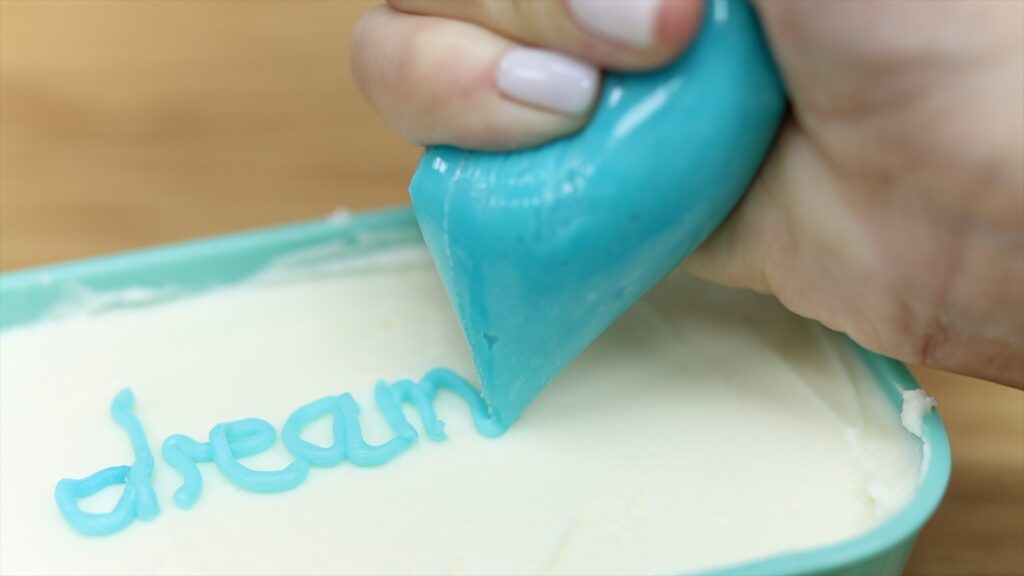
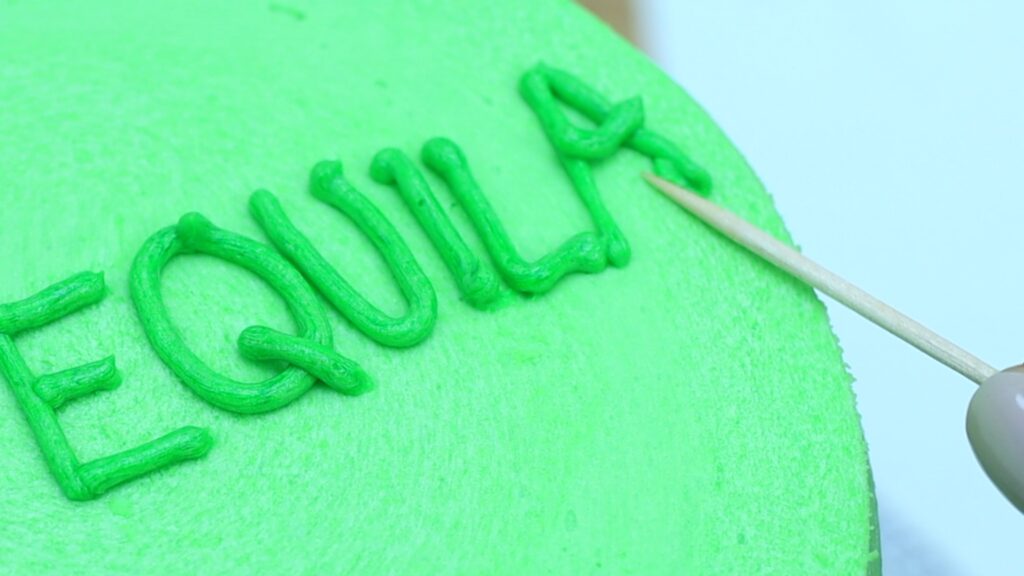
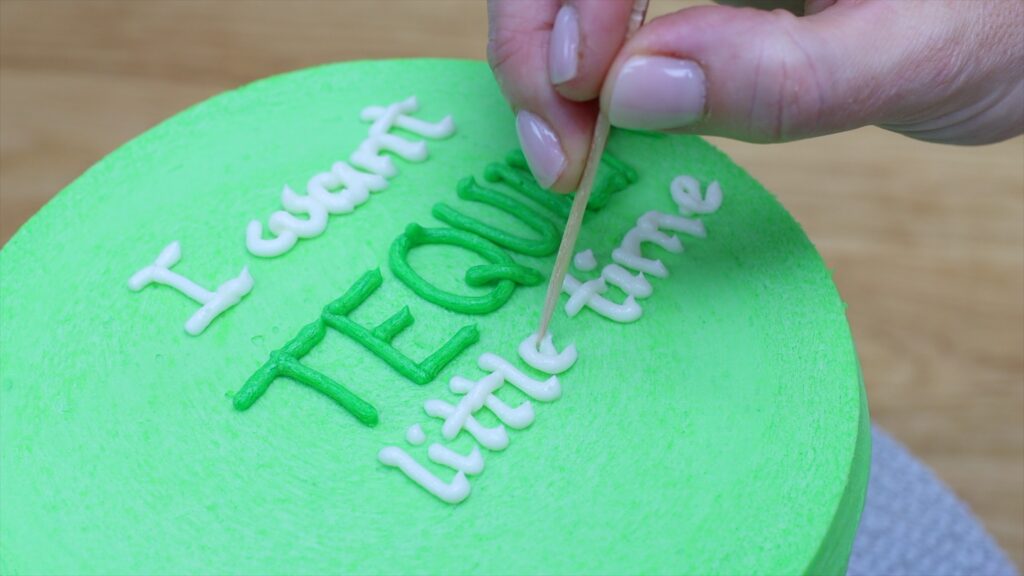
Writing on cakes can be tricky. If you don’t like your letters you can tidy them up with a toothpick. Nudge the letters to lengthen or adjust lines or widen the holes in letters like E or A.
Always do lettering on a cake that has been chilled so the frosting is firm. That way, if you don’t like the letters you can scrape them off without damaging the frosting underneath.
#8 Imperfections in frosting
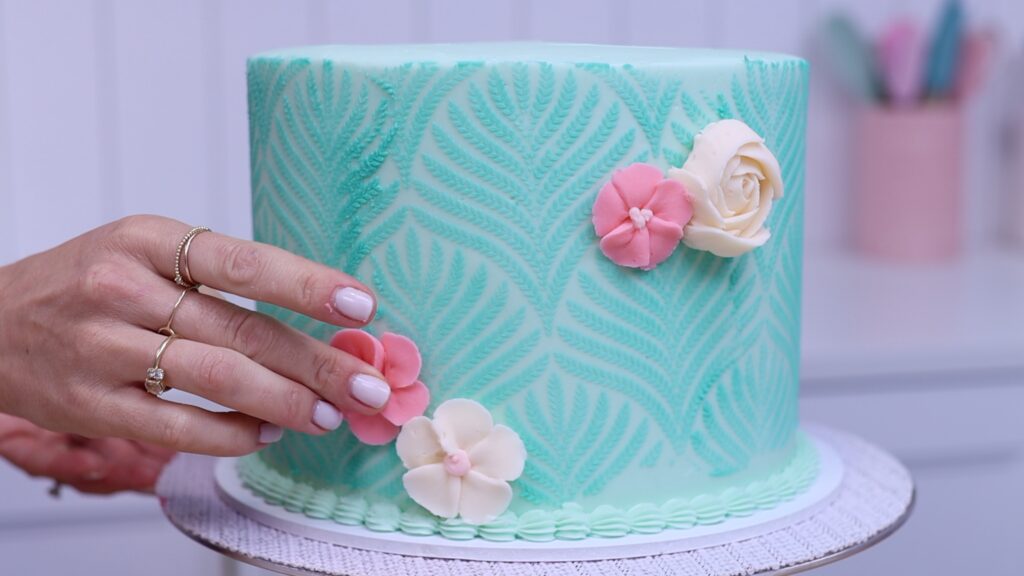
If you have air bubbles in your frosting or an obvious join in a stencil design, cover them up. You can be strategic with where you pipe details to hide those imperfections. Here I’m using piped flowers to cover up the messier parts of my stencil design:
#9 Buttercream dries out
Buttercream dries out when it’s exposed to air. If there’s a gap between preparing piping bags and using them, the frosting at the tip of the bag will crust. It won’t be sticky anymore so it won’t work for piping.
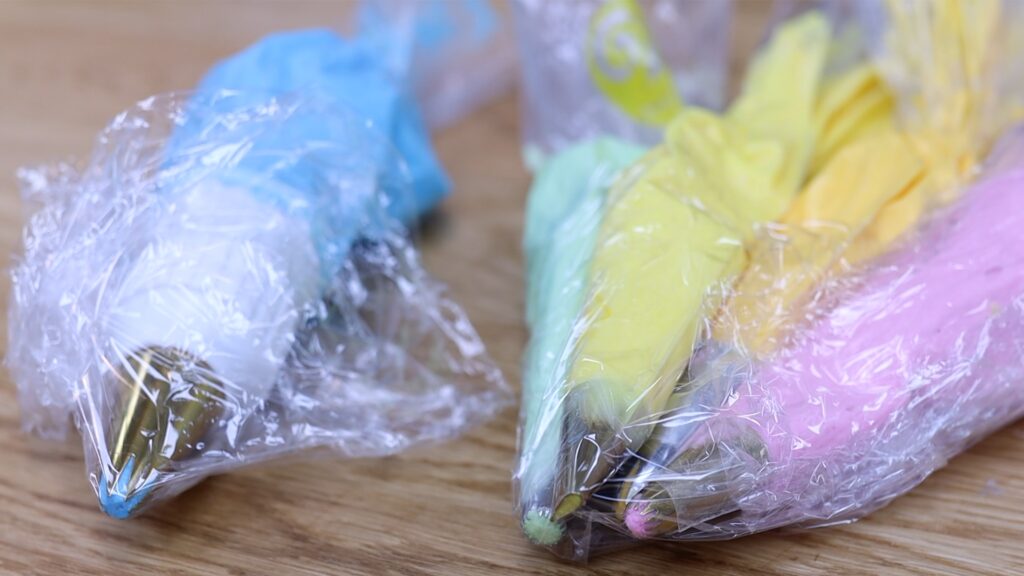
There’s a very quick fix for this cake mistake: squeeze the bag to push out that first bit of hard buttercream. The buttercream left in the bag will still be soft and sticky and ready to pipe with! To prevent this from happening, cover your piping tips with cling film or Saran Wrap when you’re not using them for long periods of time and the buttercream won’t dry out.
#10 Cake crumbles
If your cake layers crumble or pieces break off, use buttercream as glue to attach the broken pieces back onto the cake. After pushing the piece where you want it to go, put the cake in the freezer for 5 minutes.
Buttercream gets very firm when it sets so it will secure the broken piece there while you frost your cake. The frosting will hide the cake mistake. By the time you’ve finished decorating you’ll never know it’s pieced together like a puzzle inside!
#11 How to fix condensation on cakes
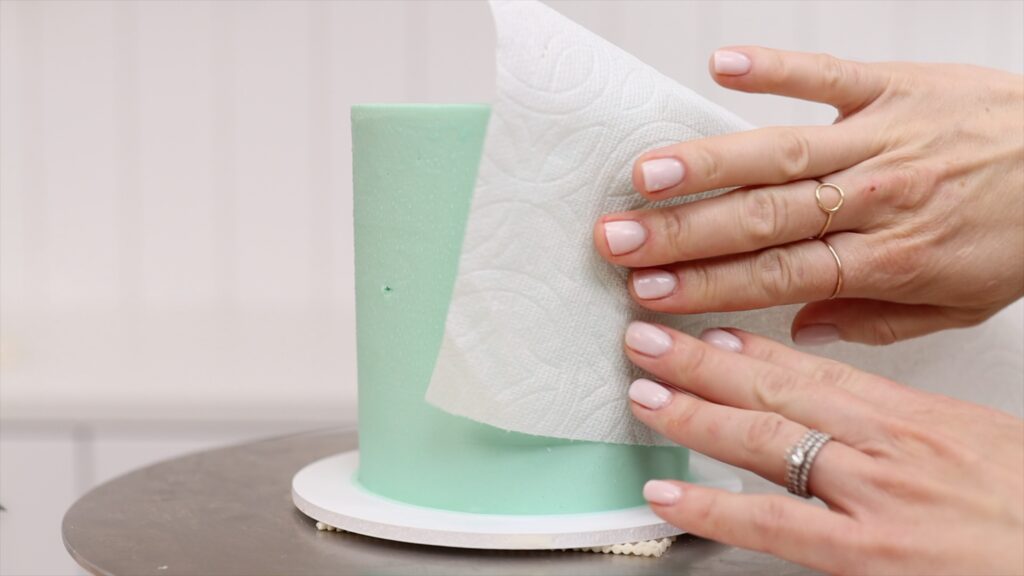
One of the most common problems for cake decorators is condensation on their cakes. These tiny droplets form for two reasons. The first is a drastic change in temperature. This happens if you move a cake from the fridge or freezer to a hot room. Dab the condensation gently with a paper towel to absorb it and as the cake warms up the droplets will stop forming.
To prevent condensation, change temperatures gradually. Move cakes from freezer to fridge for 24 hours before moving them to a cool room.
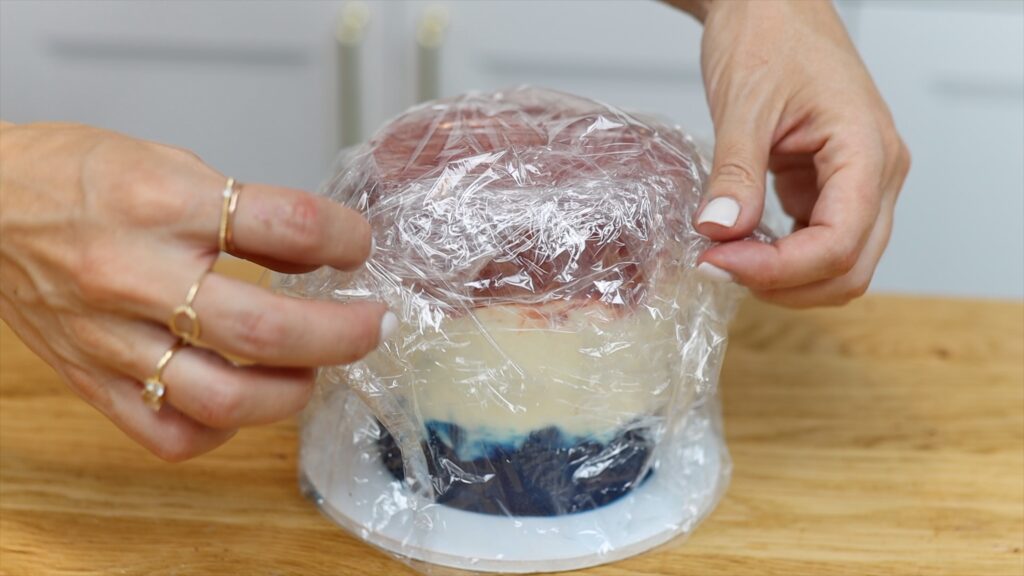
The second cause of condensation is the moisture in the fridge or freezer. After chilling a cake to set the frosting, wrap it in cling film or Saran Wrap to seal the cake. This will protect it from moisture in the fridge. When you take the cake out of the fridge, unwrap it straight away while the frosting is still cold and firm and you won’t damage it.
I hope these quick fixes for cake mistakes have been useful! Learn more techniques, designs, tips and tricks on the British Girl Bakes cake school. Tell me in the comments about your cake fails that you’re ready to look back and laugh at!
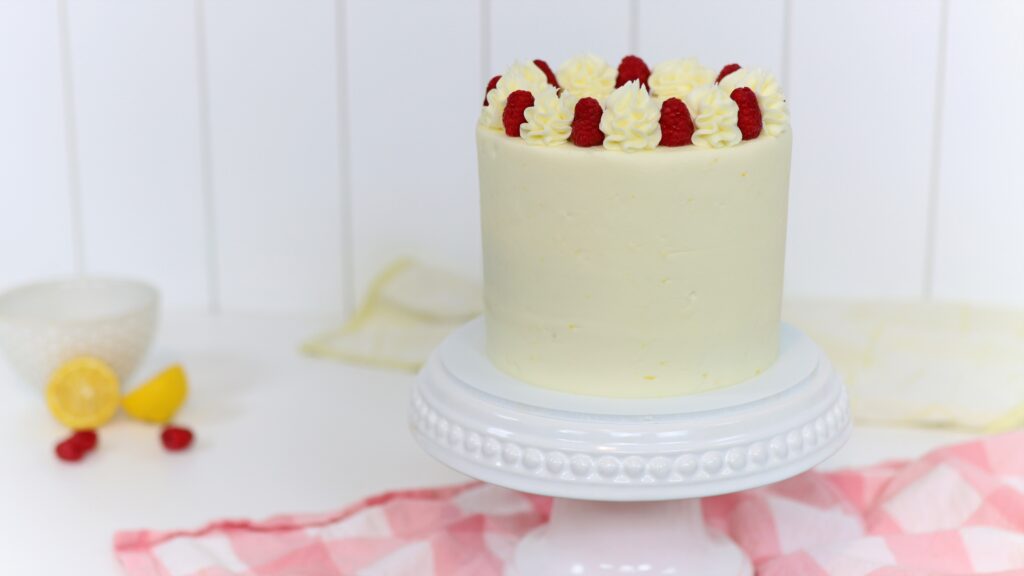
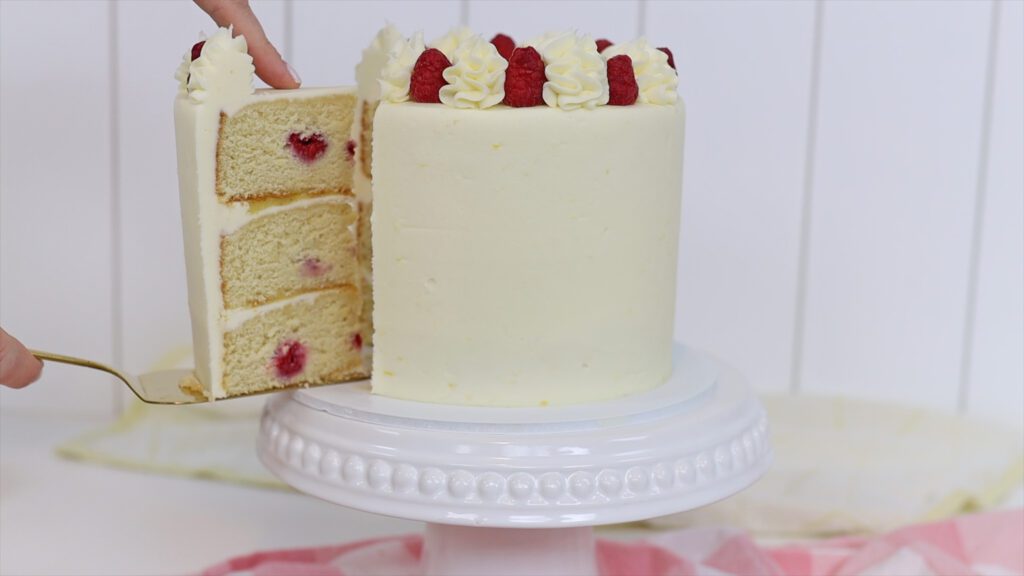
This lemon and raspberry cake is packed with lemon in the cake layers, filling, and frosting! Juicy raspberries are baked into the cake layers and placed on top of each slice for maximum flavour.
How to make lemon cake layers
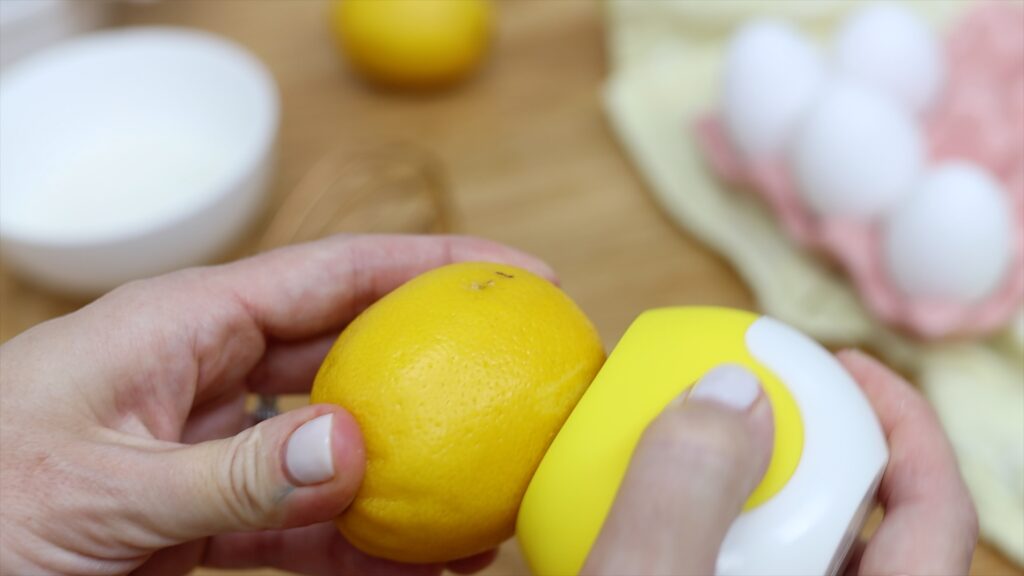
Making the cake layers for this cake is very straightforward. Cream the butter and sugar together until they're fluffy, which makes a light cake that rises well. Then grate lemon peels with a zester or the fine side of a cheese grater. This makes thin slivers that don't add texture to the cake but they do provide lots of flavour.
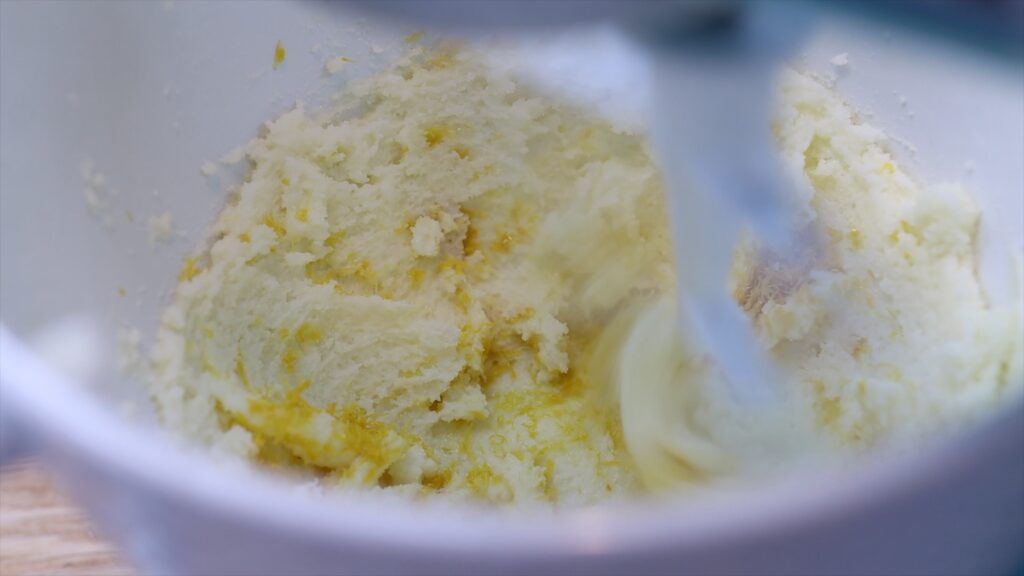
Add the lemon zest to the butter and sugar while you’re creaming them to infuse them into the base of the cake batter. This will make the cake layers really lemony.
Add the eggs one by one, mixing for about 30 seconds after each one so that they incorporate properly. Add vanilla and mix that in, too. Whisk together the flour and baking powder and salt in a bowl. Add half of that to the batter, mixing only until it’s just combined. When you don’t see any flour in the batter anymore, stop mixing! Then add the milk and sour cream, mix those in, and then the rest of the flour mixture.
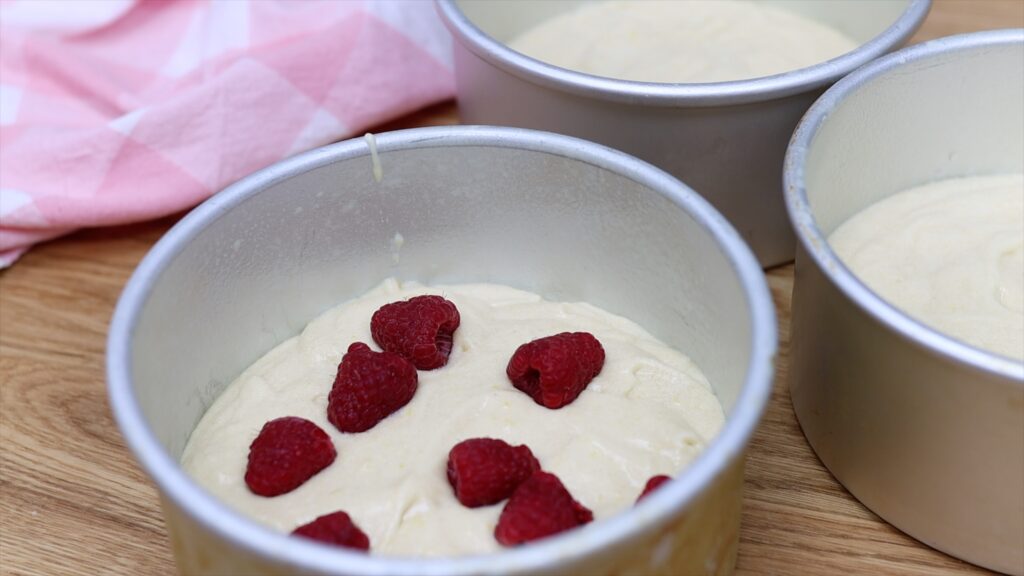
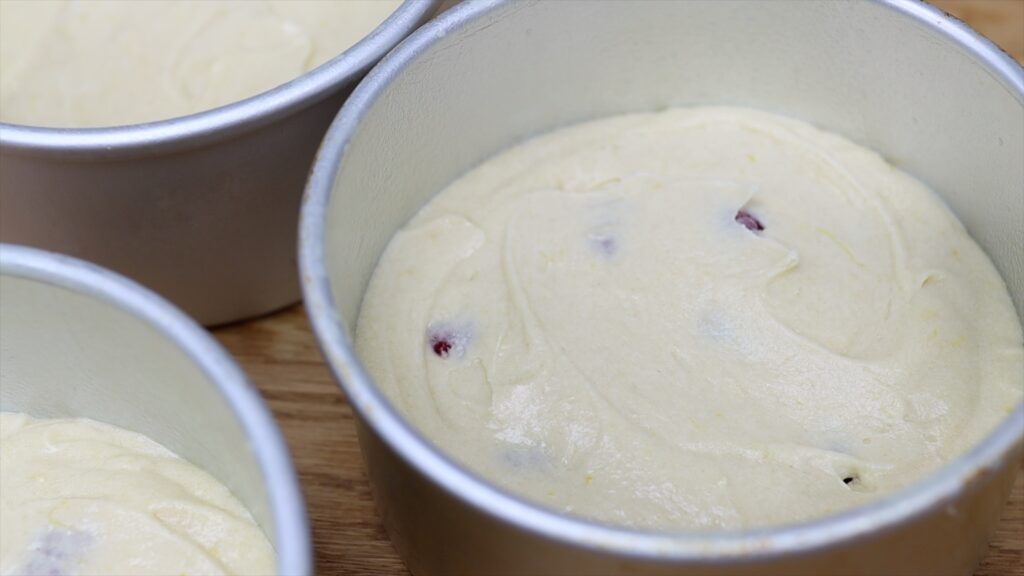
Divide the batter between three greased baking pans. I like to line my pans with parchment paper for this recipe to make sure the cakes come out easily. Set aside 8 raspberries and divide the rest between the cake pans, nudging them into the batter with a spatula. I like to add the raspberries now instead of mixing them into the batter in the mixing bowl for two reasons. You won't break the raspberries down this way, so you'll see beautiful whole raspberries in each slice. Also, you can put the same number of raspberries into each pan for an even distribution throughout the cake.
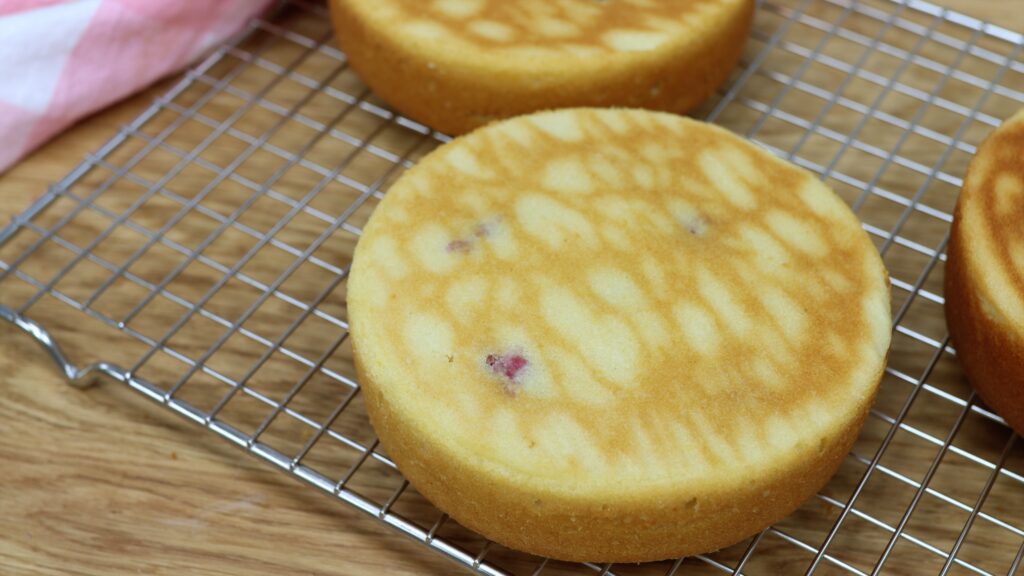
Bake the cake layers at 325F or 160C for 30 minutes. When the centers don’t wiggle when you jiggle the pan, the layers are ready. As a double check, a toothpick pushed into the middle should come out clean. The recipe listed below makes a three layer, 6 inch cake but you can scale the recipe by clicking the "X2" or "X3" buttons. Double the recipe to make a three-layer 8 inch cake.
Let the cakes cool completely while you make the filling and frosting.
How to make lemon curd
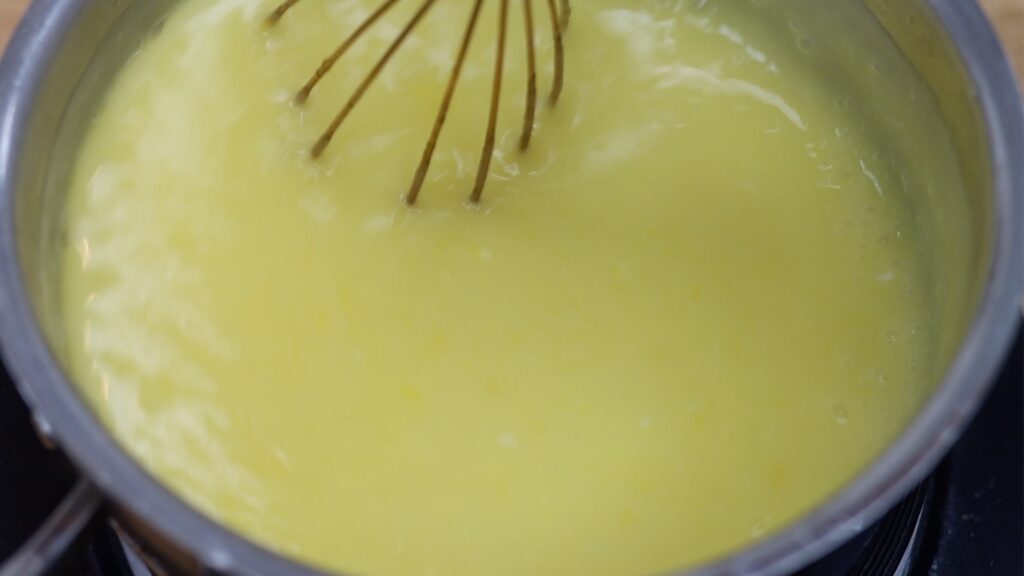
Lemon curd is easy to make if you’re patient enough to let it cook slowly. The ingredients are simple: lemon juice, lemon zest, butter, sugar, and eggs. Put all of the ingredients into a small saucepan over a low or medium low heat, depending on your stovetop. By cooking lemon curd very slowly and gently you’ll prevent lumps so your lemon curd will be beautifully smooth.
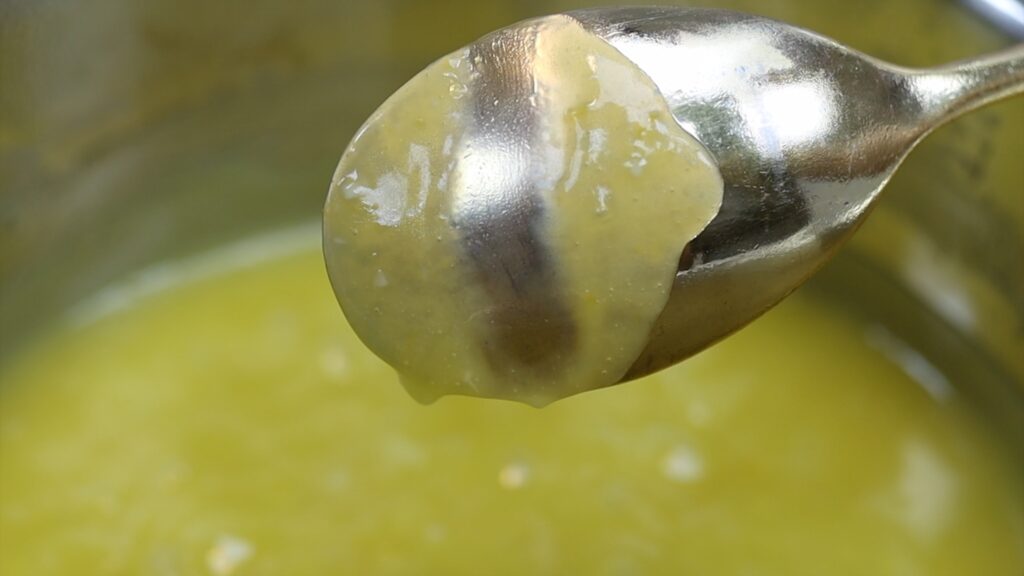
It takes about 30 minutes to cook lemon curd over a low heat. If you’re in a rush, buy a jar of lemon curd instead! But homemade lemon curd is one of the best tasting things I’ve ever had so if you have time, I really recommend making it from scratch. You’ll notice the curd thicken gradually and your whisk will start to leave texture behind in it. To test it, dip a spoon into it and check the back of the spoon. The lemon curd should cling to the spoon and if you run your finger through it, it will leave a clear trail.
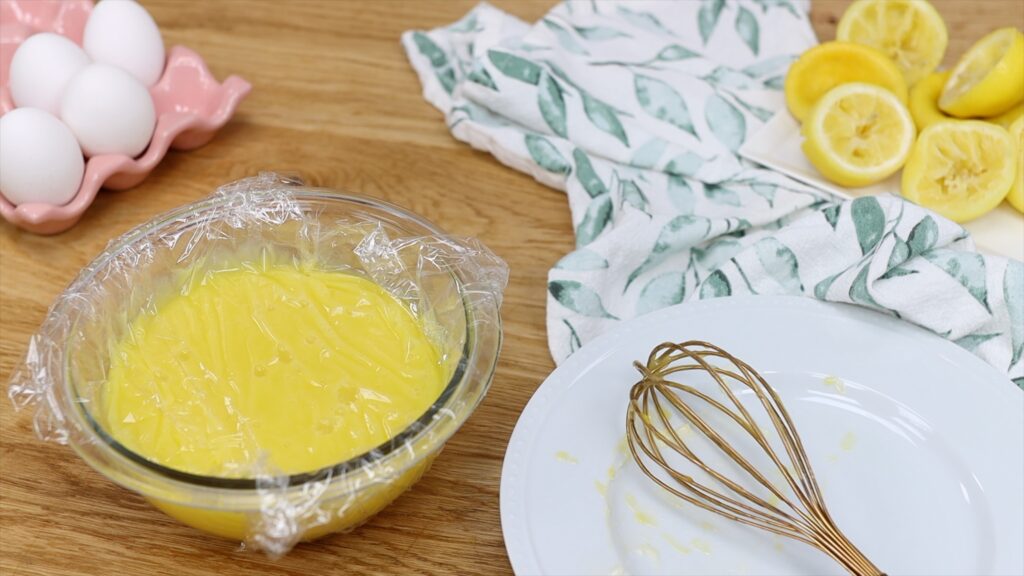
Pour the curd through a sieve into a bowl. Cover it with plastic wrap, pushing the plastic down onto the surface to prevent a skin forming on the curd. Put it in the fridge and it will thicken as it cools.
How to make lemon buttercream
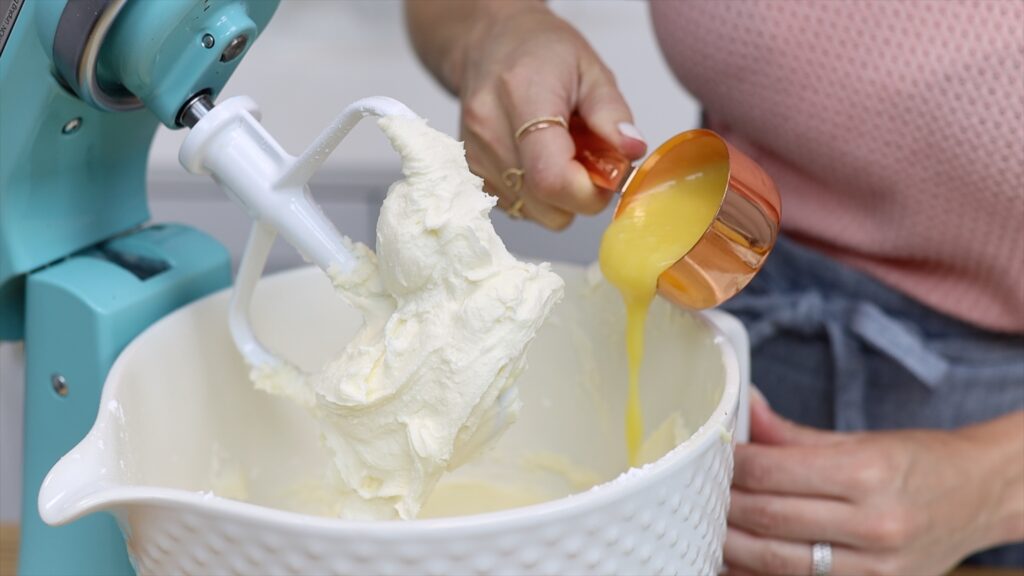
Now make lemon buttercream to frost the cake. Mix together room temperature butter and powdered sugar or icing sugar on the lowest speed setting of your mixer. After about 5 minutes it will be smooth but very thick or stiff. Add vanilla and salt and mix those in. Normally you’d add milk or cream to thin it out but instead, add the cooled lemon curd. Start with two tablespoons and mix that in and check the consistency. Continue adding a tablespoon of lemon curd at a time until the buttercream is easy to stir and your spatula leaves soft peaks in it. If you add too much liquid you’ll make the buttercream runny and it will slide down the cake when you frost it.
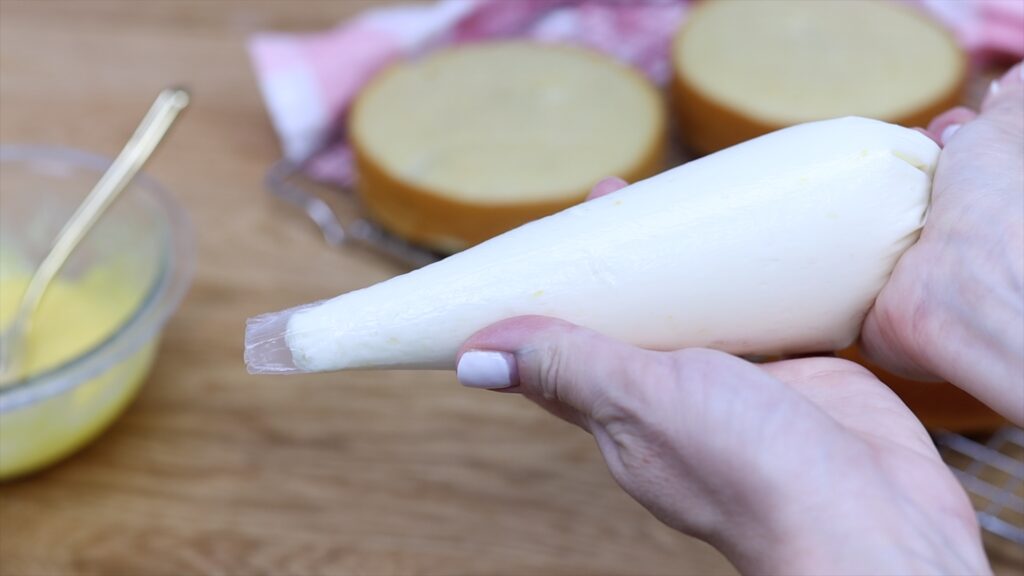
Spoon some of the buttercream into a piping bag without a piping tip. You’ll use this for the filling in the cake in a moment.
How to assemble this lemon and raspberry cake
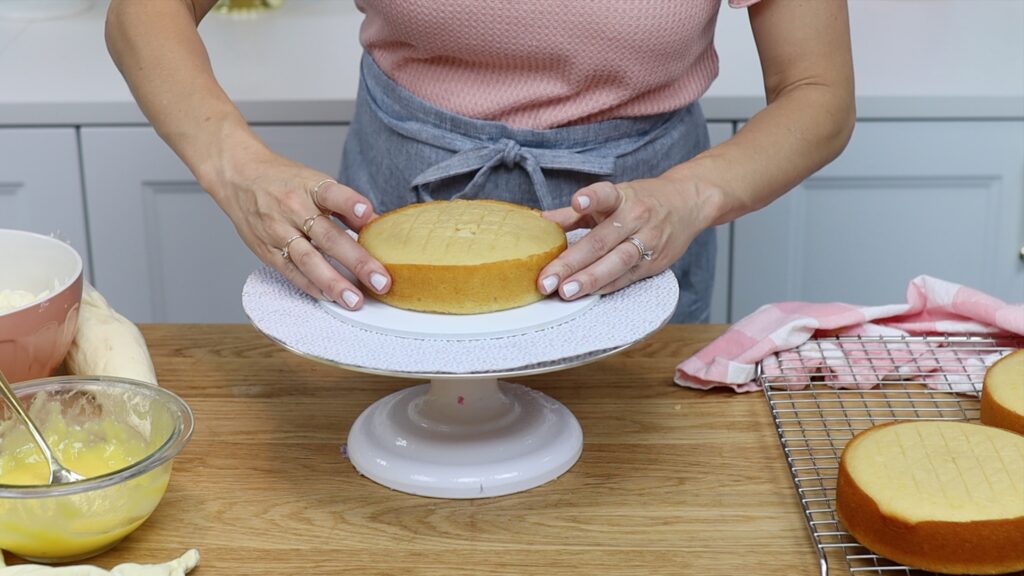
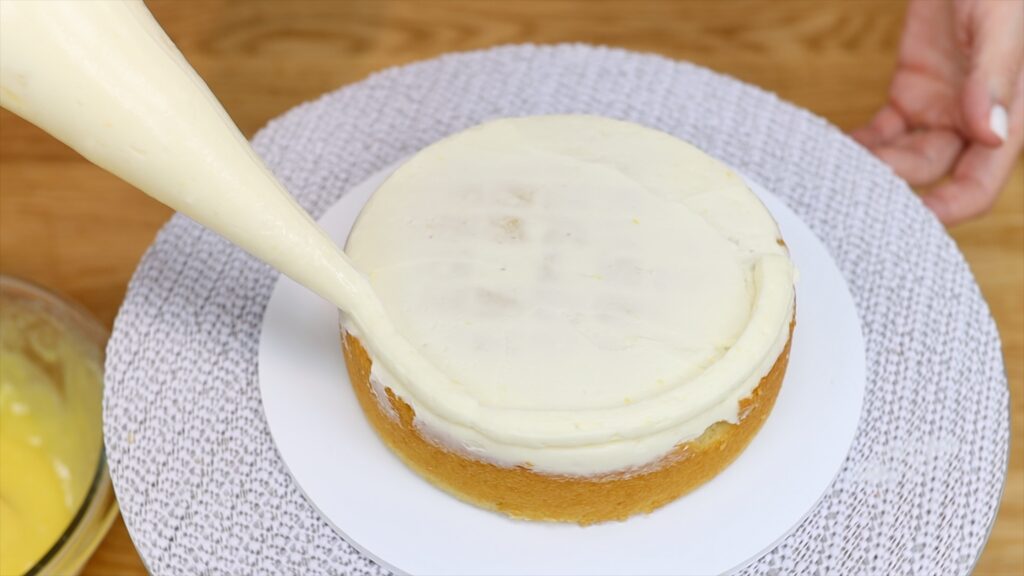
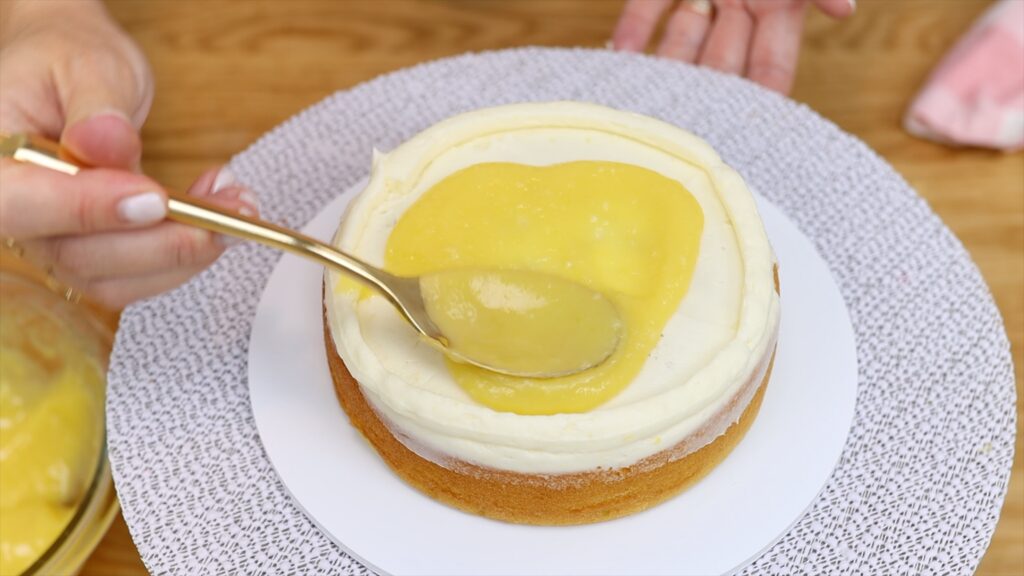
To assemble your cake, pipe a dot of lemon buttercream on the middle of a cake board. Press your first cake layer into that and the dot will hold it in place when you frost it later. Spread a thin layer of buttercream onto the cake and then pipe a ring of buttercream around the outer edge.
This is called a buttercream dam and it holds the lemon curd in place. This way it won't ooze out from between the cake layers. If you love lemon curd, try my Lemon and Blueberry Cake, too!
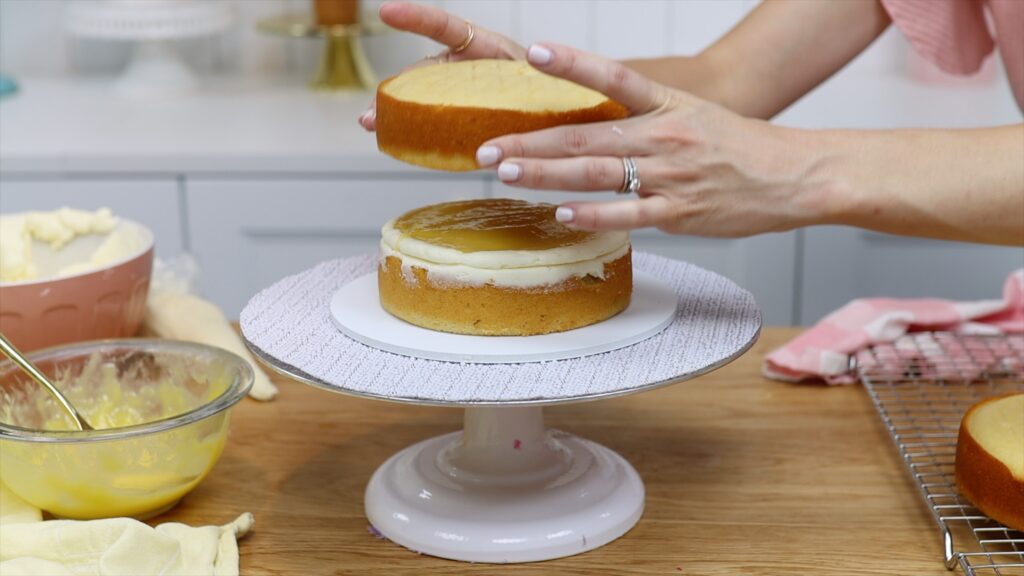
Place the next cake layer on top and repeat. The thin layer of buttercream on each cake layer stops the lemon curd absorbing into the cake. Instead, it will sit on top and you really notice it when you bite into the cake.
How to frost this lemon and raspberry cake
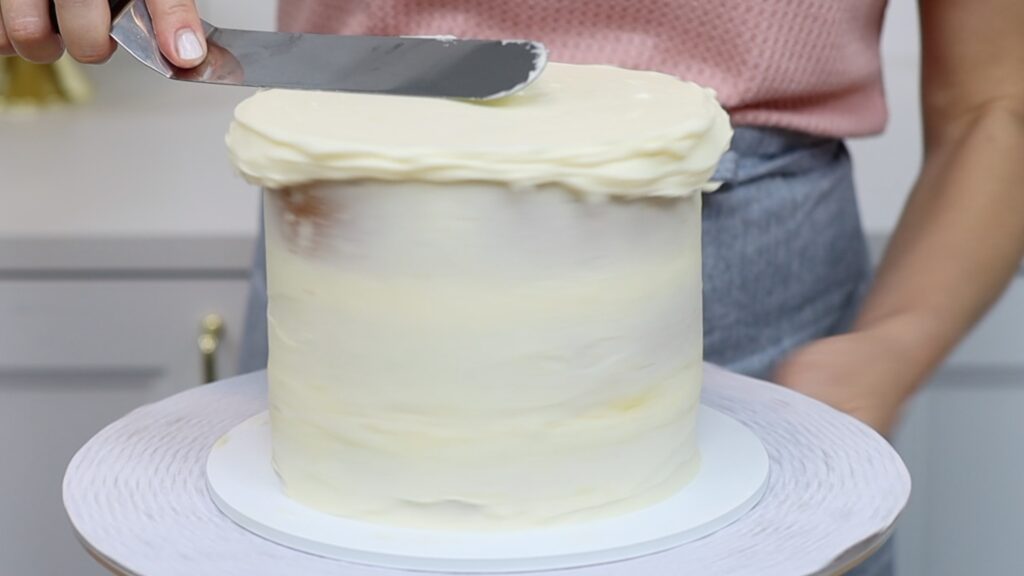
Cover the cake in a thin layer of lemon buttercream to trap any crumbs that come off the cake. Then put the cake in the fridge for 30 minutes or the freezer for 15 minutes to set that layer of frosting. Spread another layer of frosting on top, which will be crumb free. Since this is the final layer of frosting, it’s worth taking your time to get the sides smooth and the top flat and level. I teach in LOTS of detail how to frost a cake in my online courses The Basics of Cake and also The Basics of Buttercream. Sign up on my cake school or join my ClubPLUS for access to every MasterCourse, MiniCourse and Live Workshop!
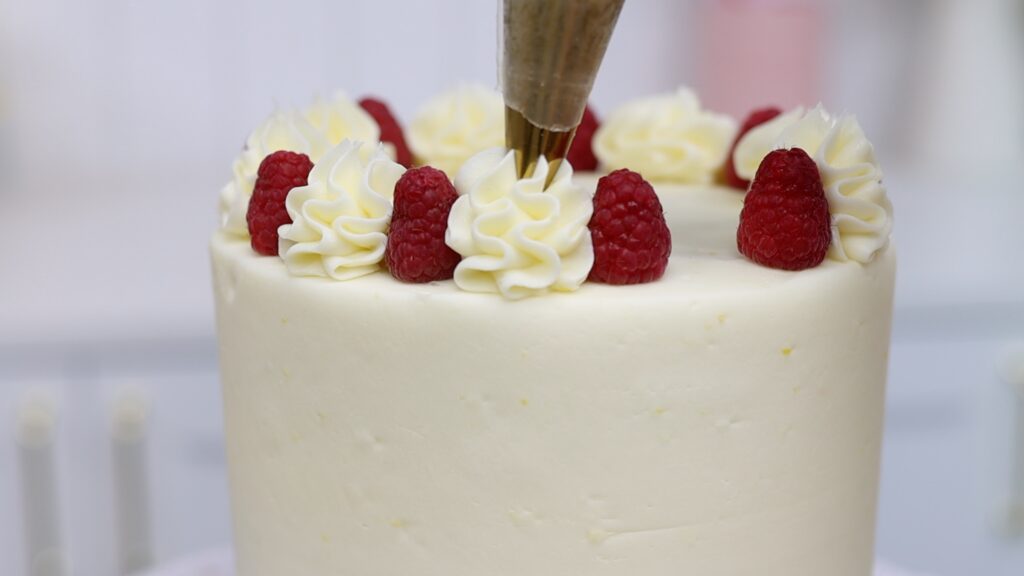
To decorate this cake, use those 8 raspberries you set aside earlier. Arrange the raspberries around the cake, placing them opposite each other to space them evenly. Scoop up the last little bit of lemon buttercream and put it into a piping bag fitted with a star tip like a 1M tip. Now pipe swirls or ruffles in between the raspberries.
By counting the number of times you go back and forth and keeping that number the same for each ruffle, all of your piping will be the same height.
How to store this lemon and raspberry cake
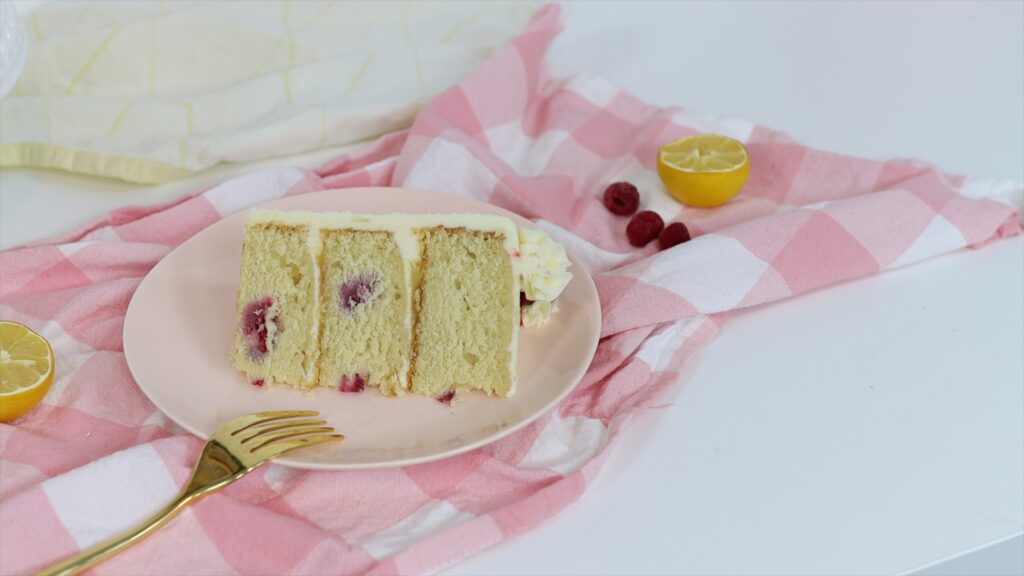
Lemon curd needs to be refrigerated so keep this cake in the fridge if you make it the day before. Take it out 2-4 hours before your serve it so that the cake and frosting comes to room temperature, when it tastes the best! I LOVE the cross section of these slices! The pairing of the sweet lemon buttercream with the tangy lemon curd filling and juicy raspberries is absolutely perfection!
This lemon and raspberry cake has lemon in the cake layers, filling, and frosting, with juicy raspberries baked in and placed on top!
Ingredients
UnitsScale
For the lemon cake layers:
1cupbutter
1 1/2cupsgranulated white sugar
2 lemons
4 eggs
2 teaspoons vanilla
2cupsall-purpose (plain) flour
2 teaspoons baking powder
1/4 teaspoon salt
1/2cupsour cream
1/2cupmilk
A punnet of raspberries
For the lemon curd filling:
1/3cup fresh lemon juice
1 tablespoon grated lemon zest
1/3cupwhite sugar
1/4cupunsalted butter
2 large eggs
For the lemon buttercream:
2 sticks butter
2 2/3cupspowdered sugar
1/4 teaspoon salt
1/2 teaspoon vanilla extract
2-4 tablespoons of lemon curd
Instructions
To make the lemon cake layers:
In a mixer with a beater attachment, mix butter with sugar on medium speed until pale and creamy, about three minutes. Scrape down to the bottom of the bowl once during mixing to make sure no butter or sugar is stuck at the bottom.
Meanwhile, zest the lemons using a zester or the fine side of a grater. Add to the butter and sugar mixture and mix to combine.
Add the eggs one at a time, mixing on the lowest speed after each egg until incorporated, about 30 seconds.
Add vanilla and mix on lowest speed for about 30 seconds to combine.
In a bowl sift and whisk together flour, baking powder and salt. Add half of this mixture to the mixing bowl and mix on the lowest speed to incorporate.
Add milk and sour cream and mix into the batter. Add the rest of the flour mixture and mix only until just combined. The batter will be runny and pale in colour.
Grease three 6" pans and optionally, line with parchment paper rounds to prevent sticking. Divide the batter between them. Set aside 8 raspberries and divide the rest between the cake pans. Nudge the raspberries under the surface of the batter with a spatula.
Bake at 160ºC or 325ºF for 30 minutes or until a toothpick inserted into the middle of the cake comes out clean.
Let cakes cool in their pans for 5 minutes. Use a spatula to loosen cake from the edges of the cake pan and then turn onto a wire cooling rack. Leave to cool completely.
To make the lemon curd:
Put all of the lemon curd ingredients in a small saucepan over low or medium-low heat (depending on your stovetop). Bring to a simmer, whisking constantly until it thickens, which will take about 30 minutes. To test it, dip a spoon into it and it should coat the back of the spoon. Run your finger through that coating and you should leave a clear trail behind in the curd.
Pour the lemon curd through a sieve into a bowl, pushing through the sieve with a spoon if necessary.
Cover the bowl with plastic wrap, pushing it down to sit on the surface of the curd. Refrigerate for at least two hours and the curd will thicken more.
To make the lemon buttercream:
Using an electric mixer, mix butter and powdered sugar on the lowest speed until smooth, about 5 minutes. Add vanilla and mix to combine.
Add two tablespoons of the cooled lemon curd and mix into the buttercream. Continue adding a tablespoon at a time until the buttercream is easy to stir and your spatula leaves soft peaks.
Fill a piping bag 3/4 full with the lemon buttercream.
To put it all together:
Pipe a dot of buttercream onto the middle of a plate or cake board and press your first layer of cake onto it. Spread a thin layer of lemon buttercream on top and then pipe a ring of buttercream around the edge to act as a dam or wall. Spoon lemon curd into the middle and spread it around to fill the buttercream dam.
Place your next layer of cake on top and repeat the filling: spread lemon buttercream, pipe a dam, and spoon lemon curd into the middle.
Place your final cake layer on top and then chill the cake for 30 minutes in the fridge or 15 minutes in the freezer.
Frost the cake with a thin layer of lemon buttercream (a crumb coat) and then a final layer.
Place the 8 raspberries you set aside earlier onto the top of the cake, arranging them opposite each other to space them evenly.
Spoon the rest of the lemon buttercream into a piping bag fitted with a 1M or 2D piping tip. Pipe a swirl or a ruffle in between each raspberry.
Notes
If you don't have sour cream or milk you can omit both and substitute them with buttermilk.
You can refrigerate this cake for a week in an airtight container like a tupperware.
This cake is best served at room temperature! If you refrigerate it, take it out of the fridge two hours before serving it.
For a three-layer 8" cake, double this recipe (click "X2" at the top of the recipe).
These lunchbox cakes are an adorable, delicious treat and they’re easy to make! I’ll show you how to make these with cupcakes, mini cake pans, and sheet cakes.
#1 Bento box cake
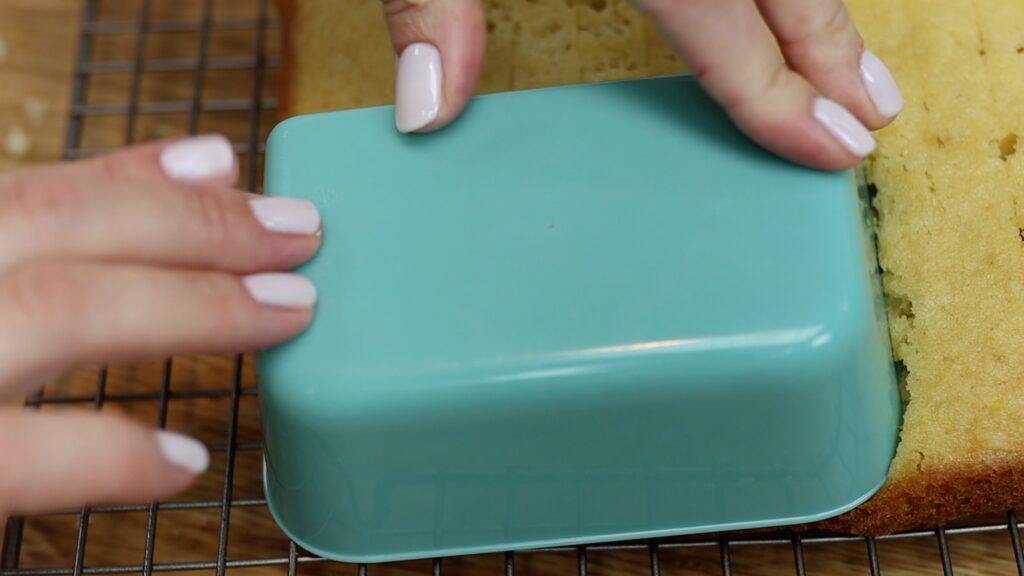
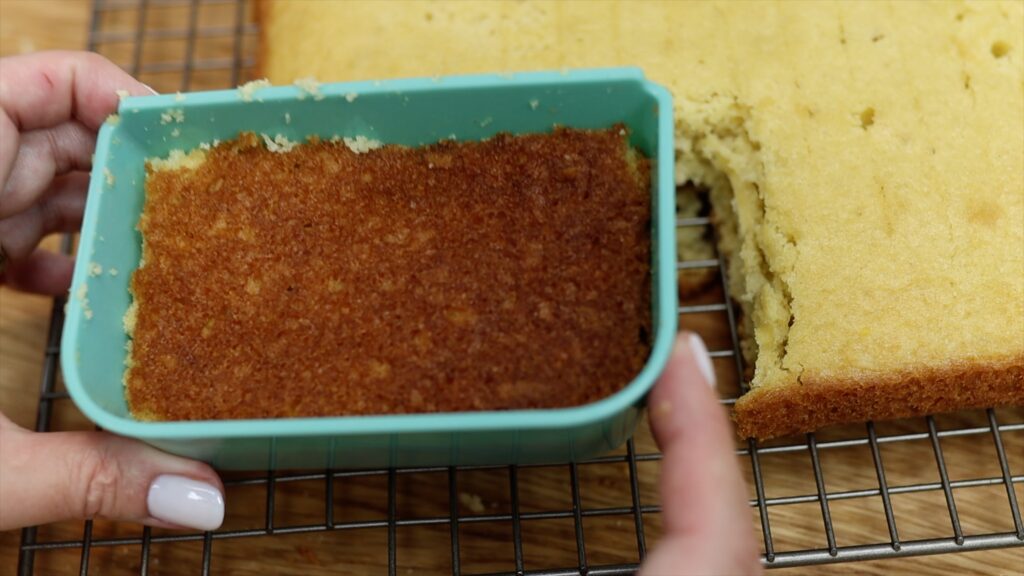
Let’s start by making a cake that fits perfectly in a bento style lunchbox. Bake a sheet cake or any other shape of cake and let it cool. Press one of the sections of a lunchbox down into it, like cookie cutter.
Push the cake down to the bottom of the lunchbox container and brush off any crumbs. Now it’s ready to frost and decorate!
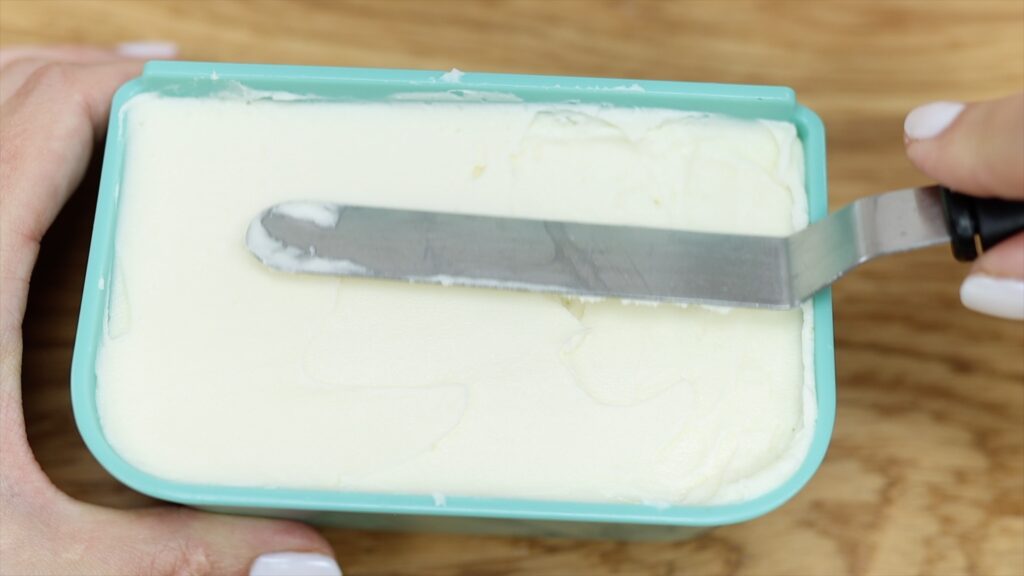
I like to pipe my 4 Minute Buttercream onto these but you can use any kind of frosting. Smooth it with an offset spatula or choose piped texture instead.
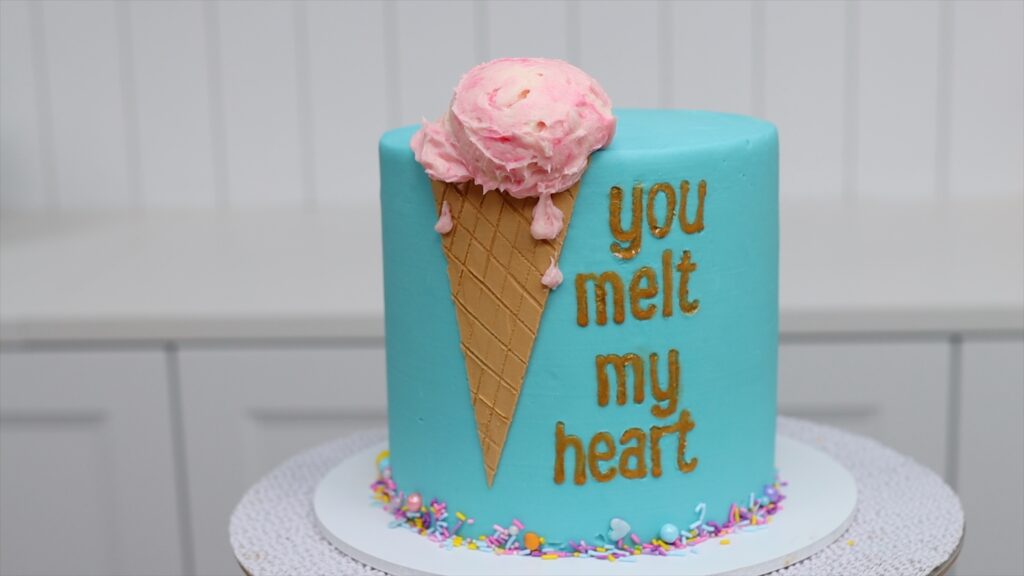
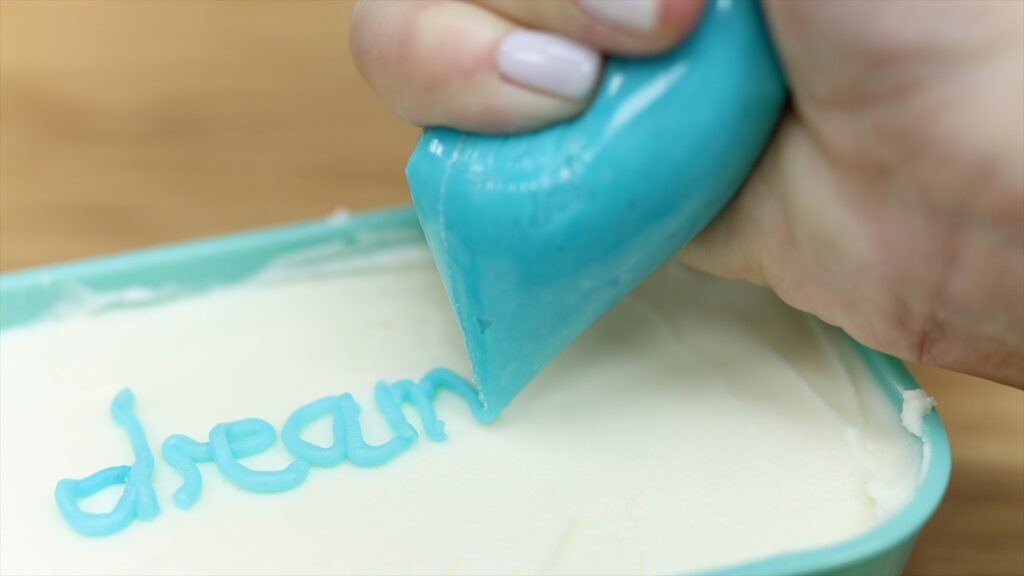
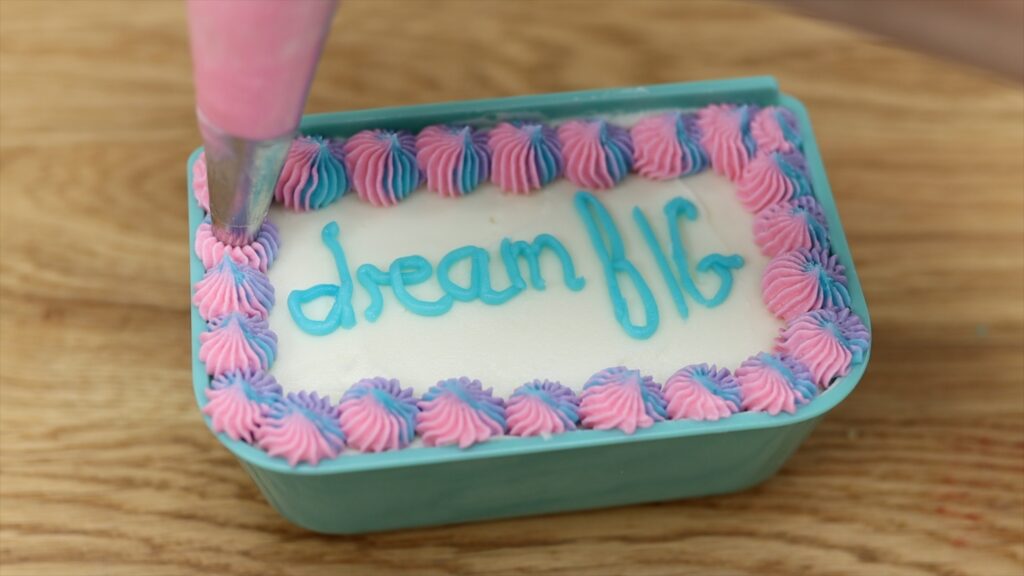
To personalize your lunchbox cake with a message all you need is a spoonful of frosting. Put it in a piping bag with small round tip or, even easier, a sandwich bag! Cut a little piece off one of the bottom corners and then squeeze the bag to write your message.
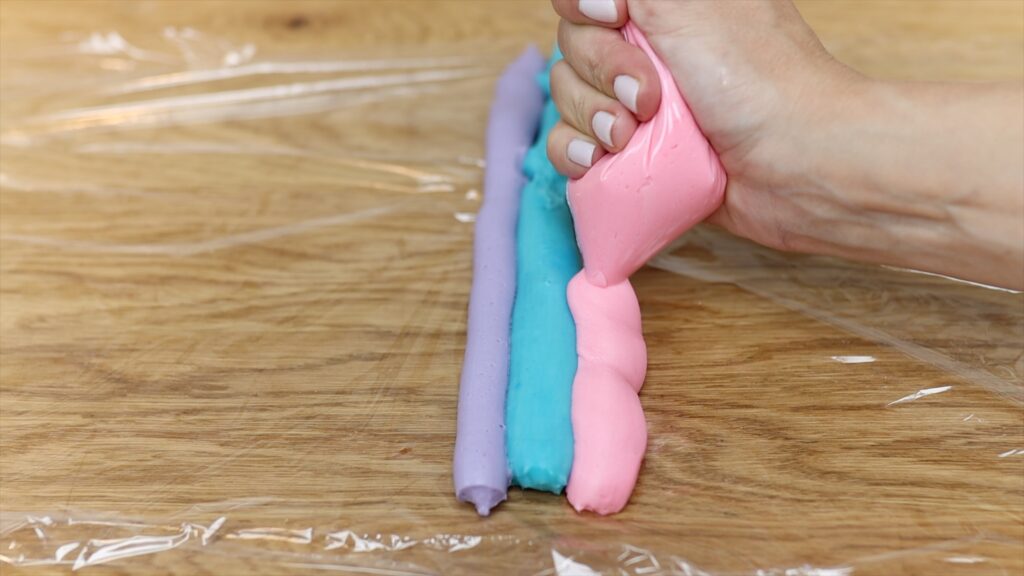
I’ll show you lots of ways to decorate these lunchbox cakes throughout this tutorial. One of my favourites is to pipe different colours of frosting onto a piece of plastic wrap.
Roll it up into a log and cut off one end. Drop that end down into a piping bag fitted with a star tip and squeeze colourful rosettes all around the edge of your cake.
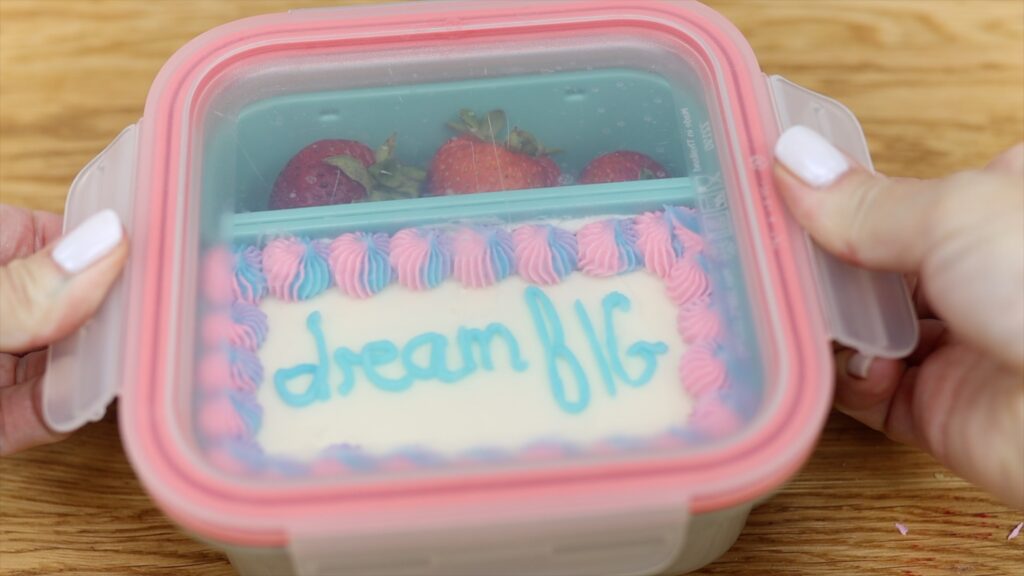
Put the container back into the lunch box, snap the lid on, and it’s ready to go!
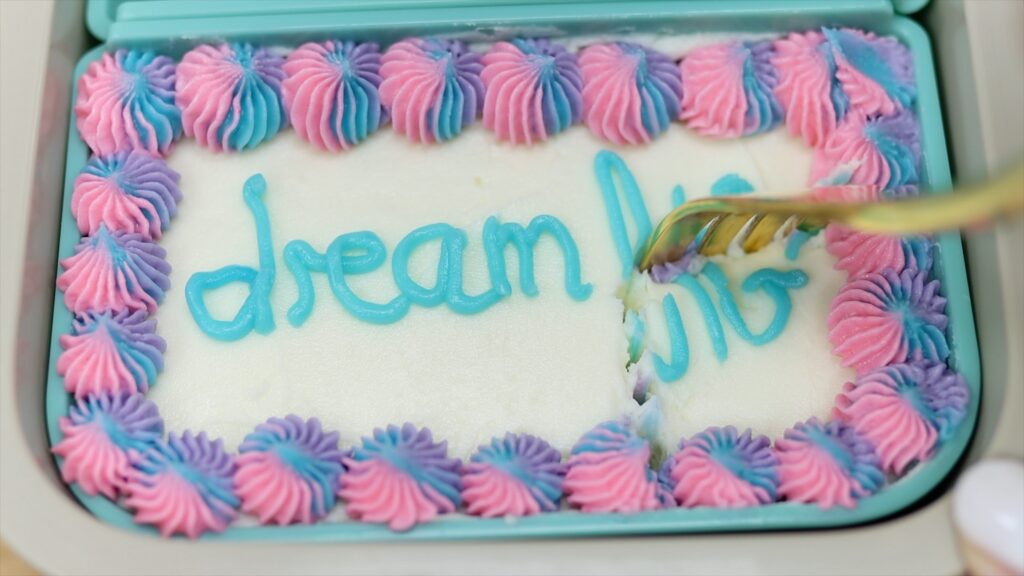
You can eat this right out of the lunchbox with a fork. It’s perfect to take to school or work or on a picnic or wherever!
#2 Make lunchbox cakes with mini cakes
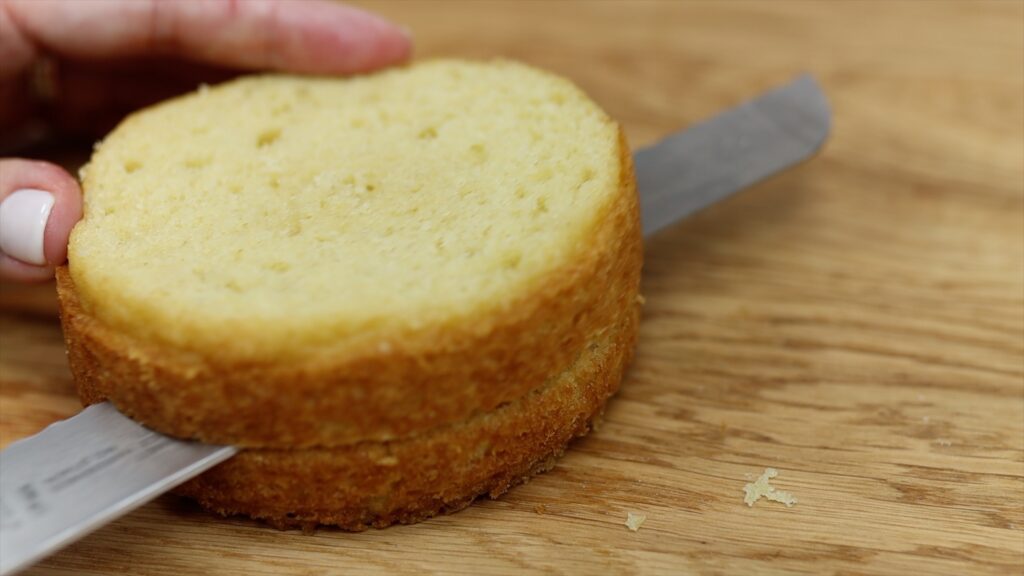
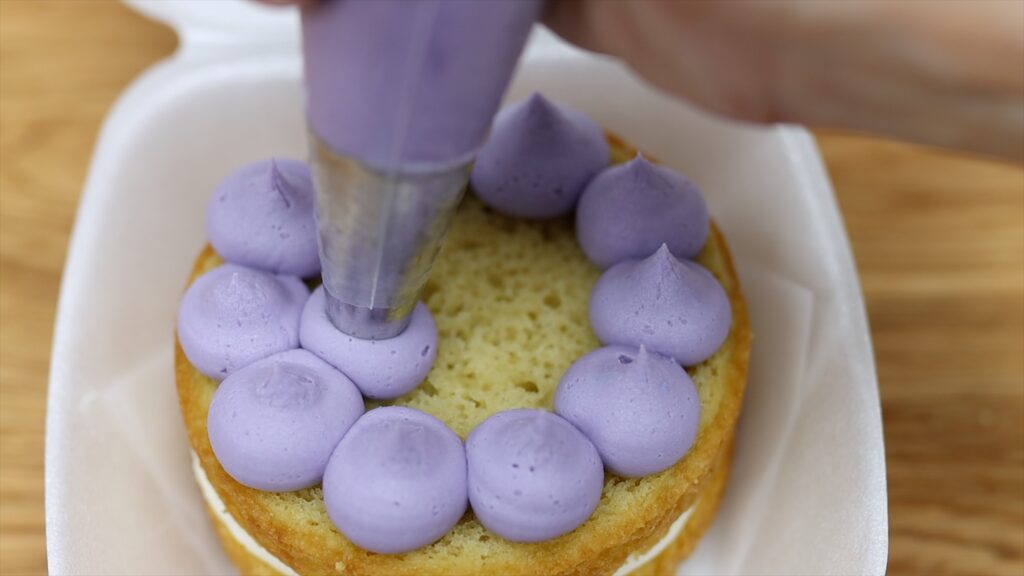
If you have 4” cake pans you can bake mini cake layers in those. Use a serrate knife like a bread knife to trim the tops off so that they’re flat. Divide the cake in half horizontally to make two layers so you can put filing in the middle.
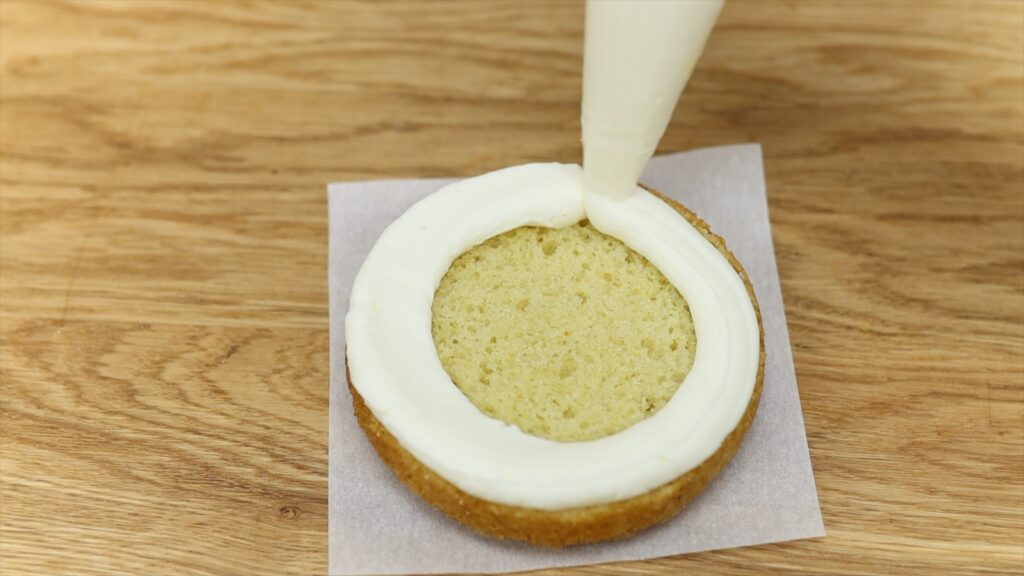
Cut a square of parchment paper or wax paper or baking paper that’s just big enough to fit the cake. Place the first cake layer on that. For runny fillings, pipe a ring of frosting around the outer edge of the first cake layer. This is called a buttercream dam.
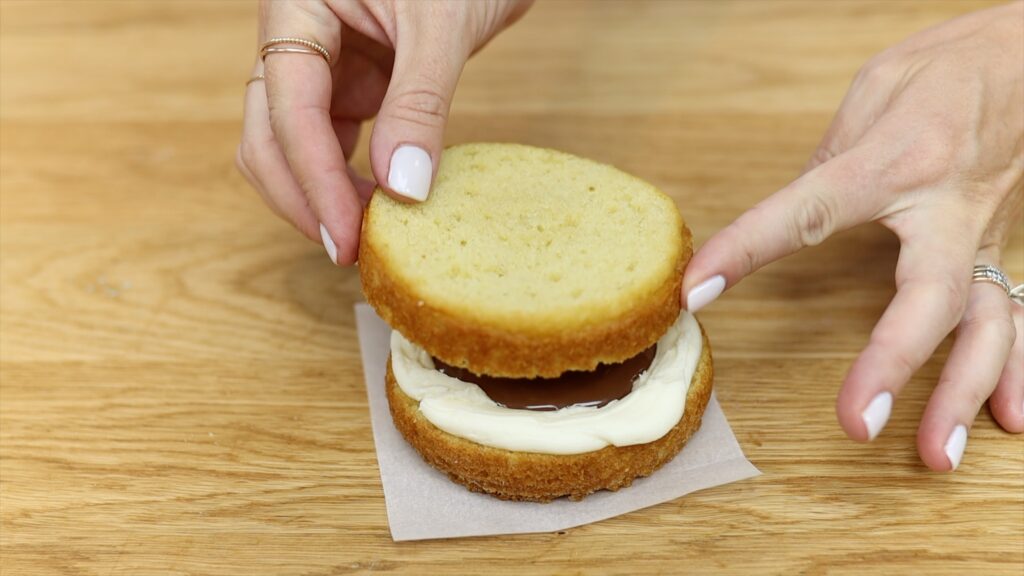
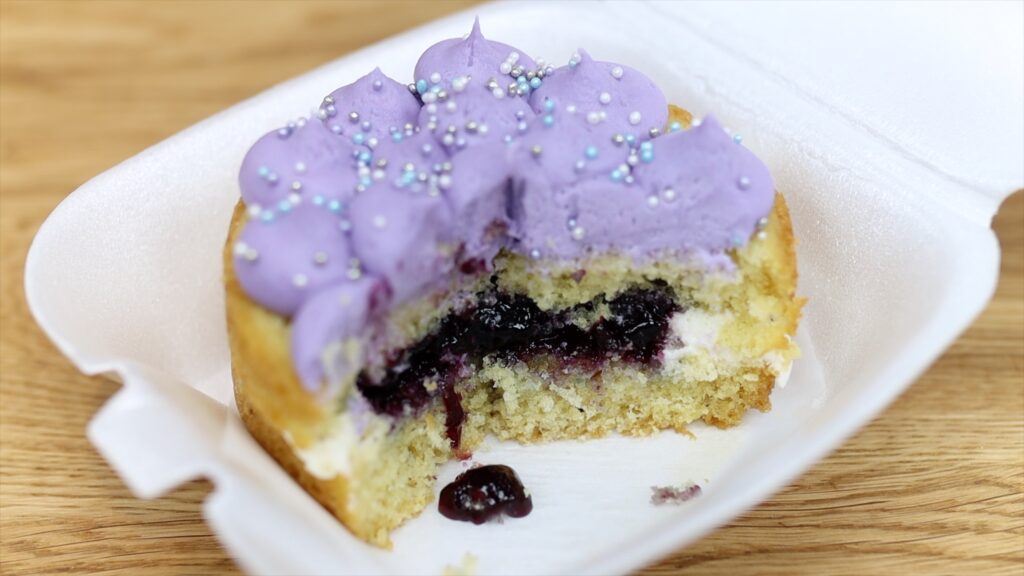
Now spoon your filling into the middle. These dams are perfect for fillings like jam, lemon curd, caramel and Nutella. Lower the next cake layer on top.
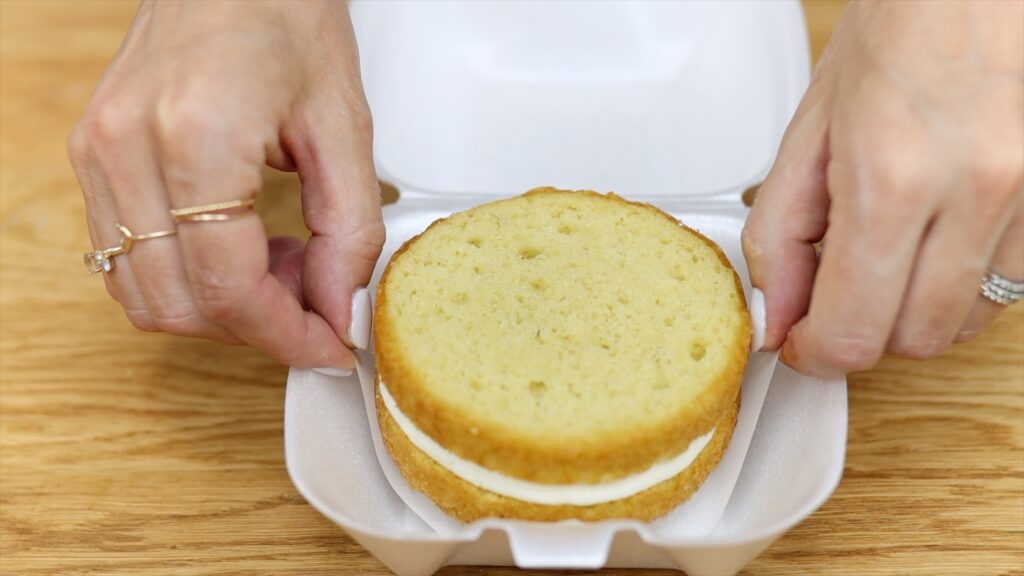
Pick up the cake by pinching opposite corners and move the cake into food container. I like to decorate these lunchbox cakes inside the container so that you don’t accidentally damage them by moving them later.
Piping is a quick and easy way to cover the tops of these cakes. I piped these rings of frosting kisses with a 1A round piping tip. Add some sprinkles to jazz it up if you like.
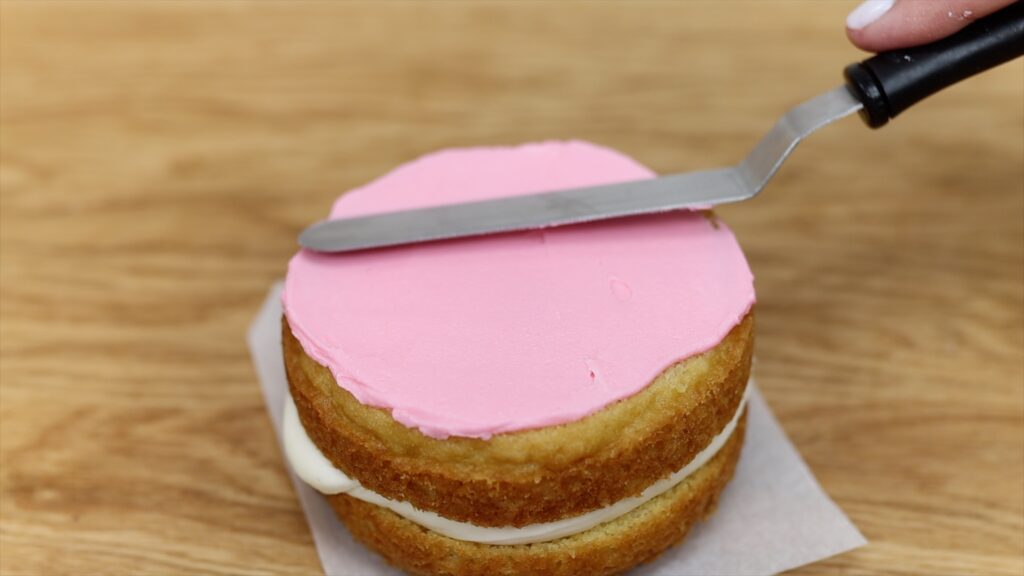
You can spread frosting to cover the top instead, which is easiest to do before putting the cake into the container.
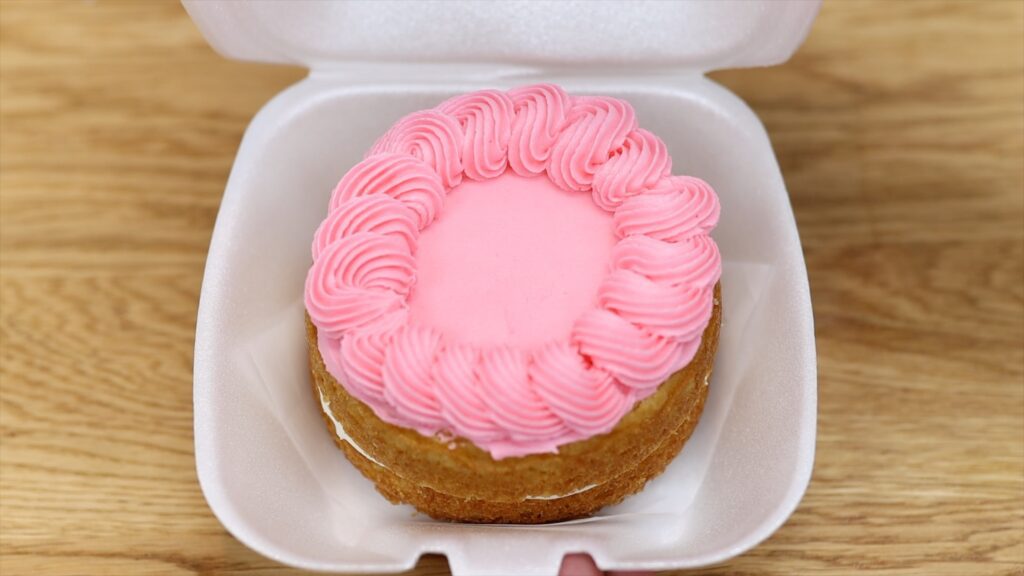
I piped this border using an open star #32 tip.
By making your cakes just big enough to fit into the container they won't slide around when you carry them. These are fun and delicious treats to enjoy anywhere!
#3 Make lunchbox cakes with a sheet cake
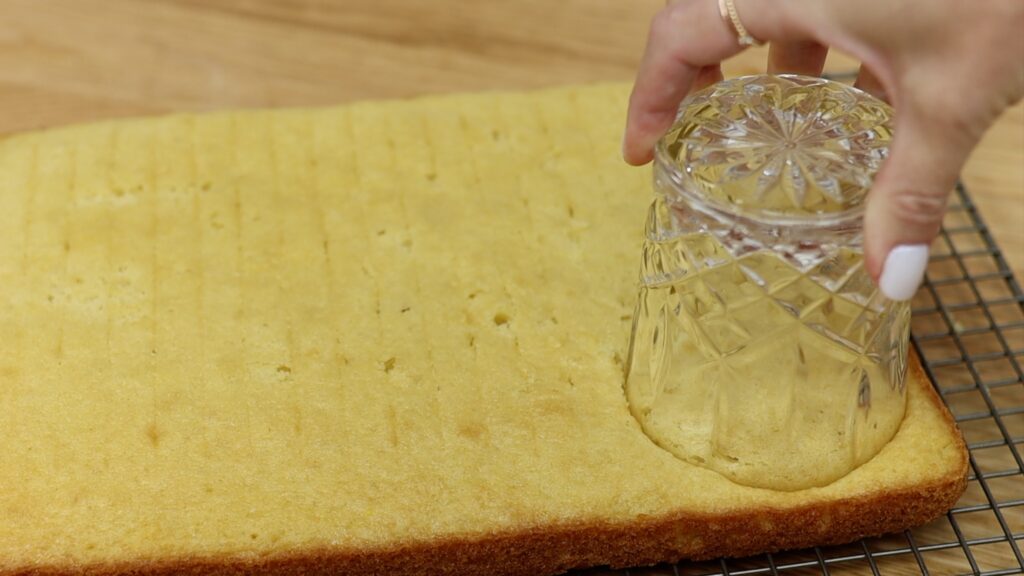
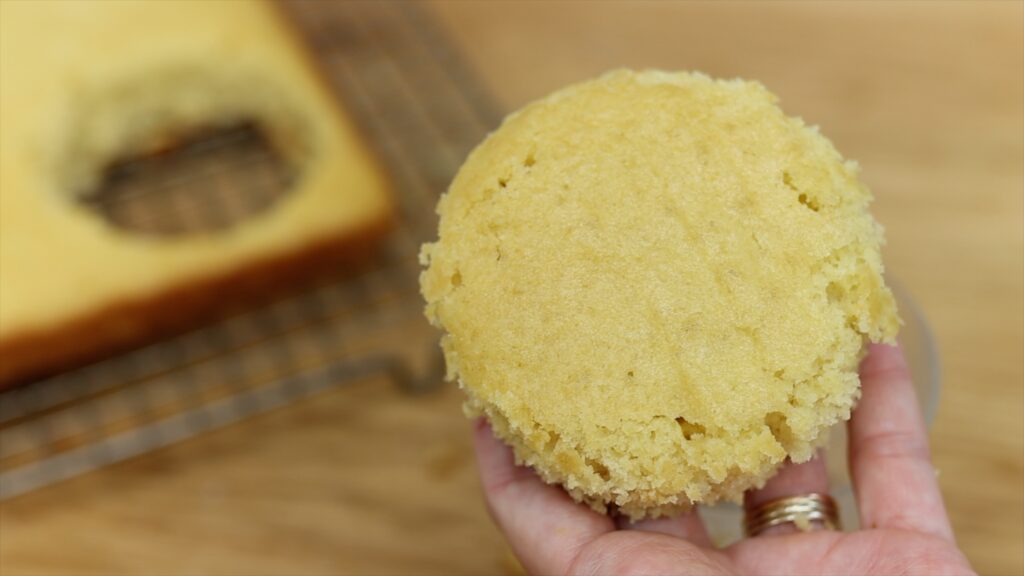
If you don’t have a mini cake pan you can bake a sheet cake or any shape of cake instead. Then use something round that’s about 4 inches wide to cut out your layers. A large round cookie cutter is ideal or even the rim of a glass will work.
You can assemble and fill these cakes just like cakes baked in mini pans. However, the edges of the cake aren’t caremelized and sealed like they are when you bake them in a pan. This means the cake won’t stay moist for as long. If you plan to frost onto the top of the cake, cut the layers out of the sheet cake as close to serving as possible. The other option is to frost the entire cake so it doesn’t dry out.
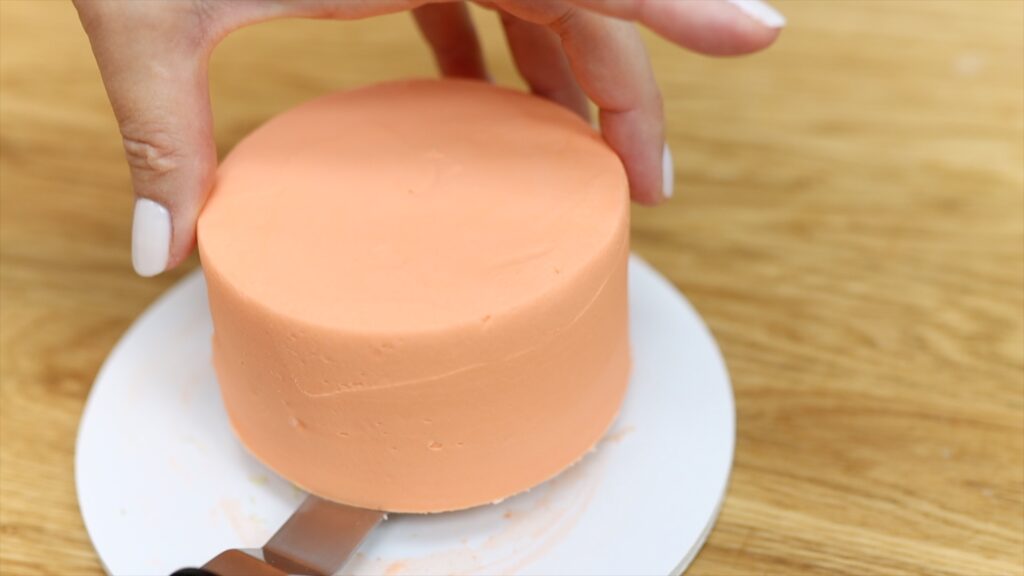
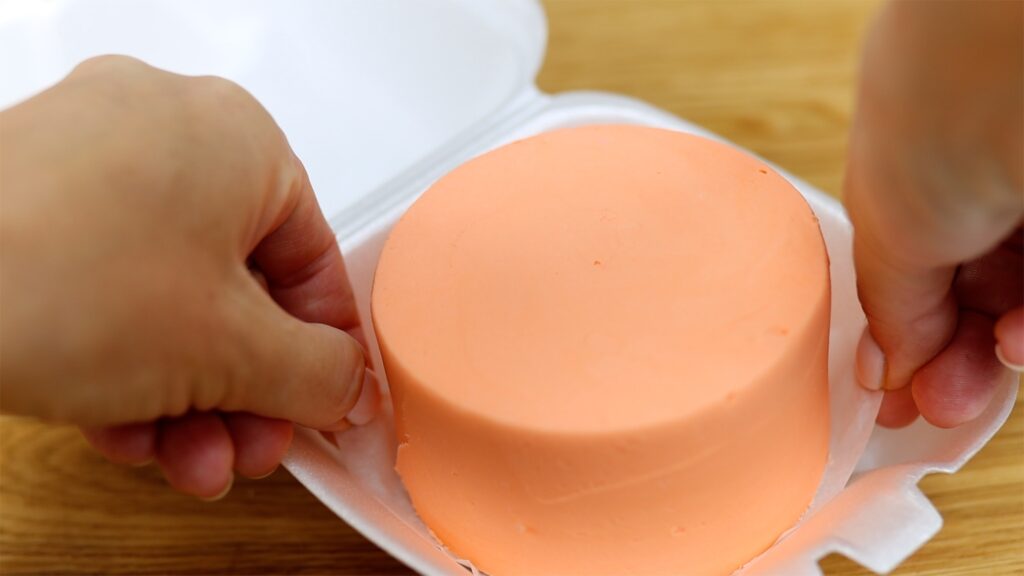
Mini cakes are tricky to frost because they’re so lightweight so they don't hold their place very well. You can attach the cake to a cake board with a dot of buttercream, which will act as glue. The put the cake in the freezer for 15 minutes. The dot of buttercream will set and hold the cake in place as you frost it. Cold cake layers are firmer and less crumbly and wobbly than when they’re at room temperature so after being in the freezer for just 15 minutes, the cake will be much easier to frost. After frosting the cake, put it back in the freezer for another 15 minutes. This will set the frosting. Then slide an offset spatula or knife underneath the cake to lift it up off the cake board. Balance it with your fingers if you need to and lower it into a food container.
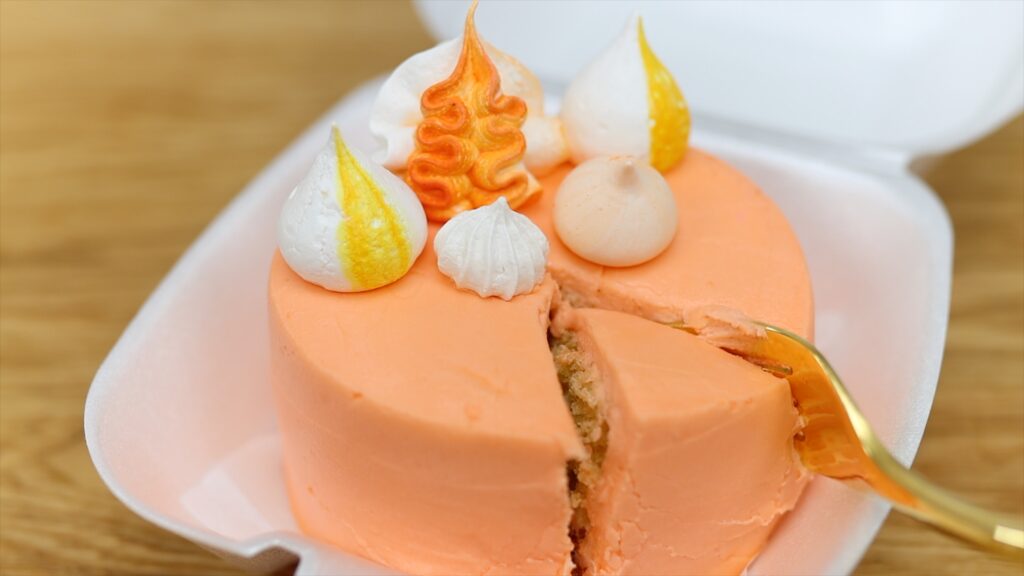
Meringues are really easy to make and they look so pretty on these lunchbox cakes! Since the cake is sealed with frosting it will stay moist for longer than naked cakes.
#4 Cupcake cakes
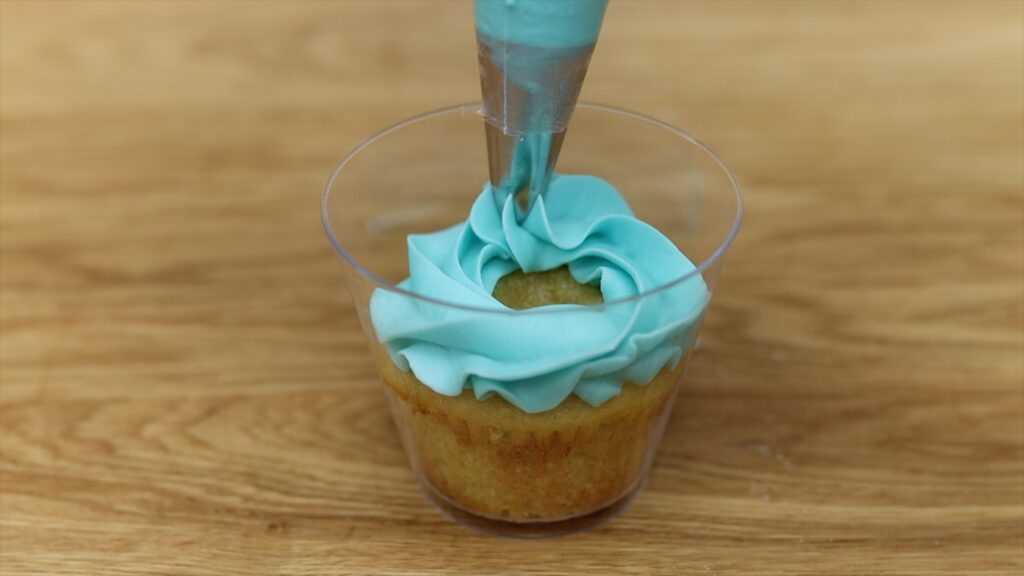
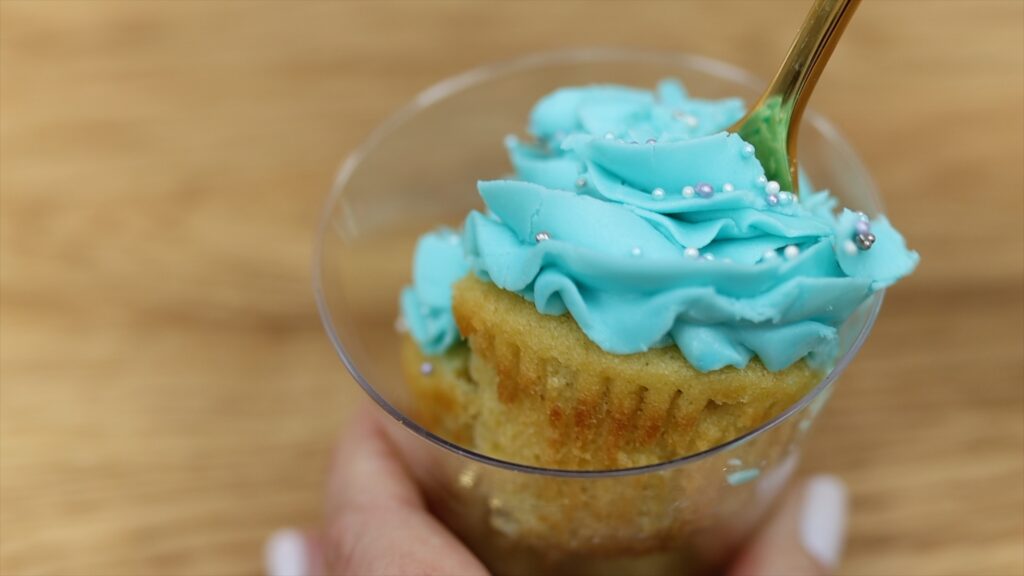
The quickest and easiest version of a lunchbox cake is to use a cupcake. Peel the wrapper off and put the cupcake in a plastic cup that's the same width as the cupcake. The cup will protect the cupcake and keep it upright when it’s inside a lunchbox.
Put some frosting in a piping bag with a star tip like a 1M tip and pipe as swirl onto the top of the cupcake. Stop before the top edge of the cup so that the cup protects the entire swirl. If you want to add sprinkles add them now, while the frosting is still soft and sticky.
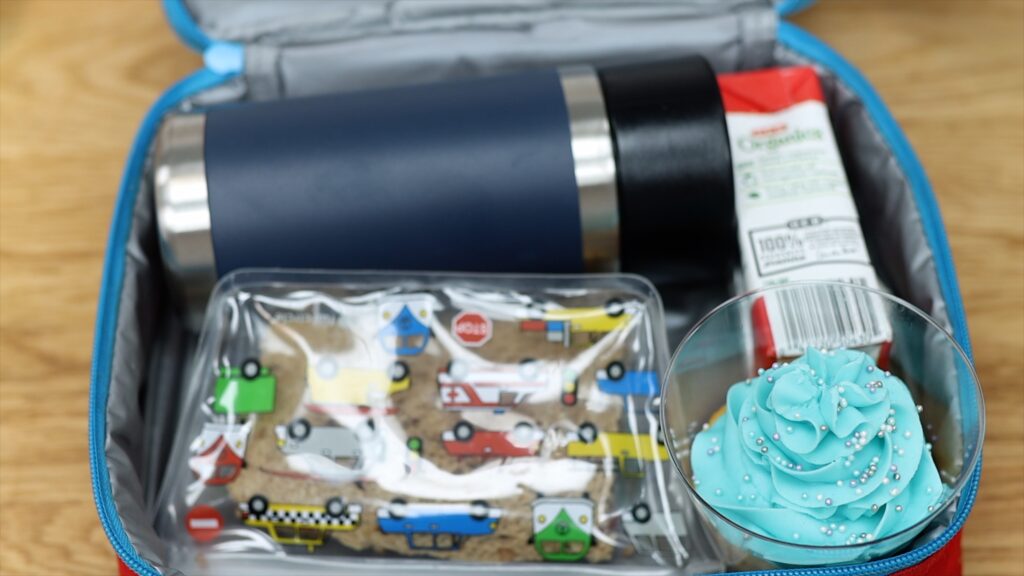
Then after packing a lunchbox, arrange the cup so that it’s surrounded by things that will keep it in place. The cup will protect those things from damaging the frosting. It also makes the perfect little bowl for this yummy lunchbox cupcake!
Which lunchbox cake are you going to make? Tell me in the comments!
Visit my cake school for online courses on hundreds of cake decorating techniques and designs and join the ClubPLUS for access to every MasterCourse, MiniCourse and Live Workshop on my cake school!
Hello! I thought it would be fun to share a tour of my cake studio a quick snapshot of life behind the scenes of British Girl Bakes. I'll show you:
my cake studio set-up
how I film and edit my tutorials
some upcoming projects and recipes
other sneak peeks behind the scenes.
My studio
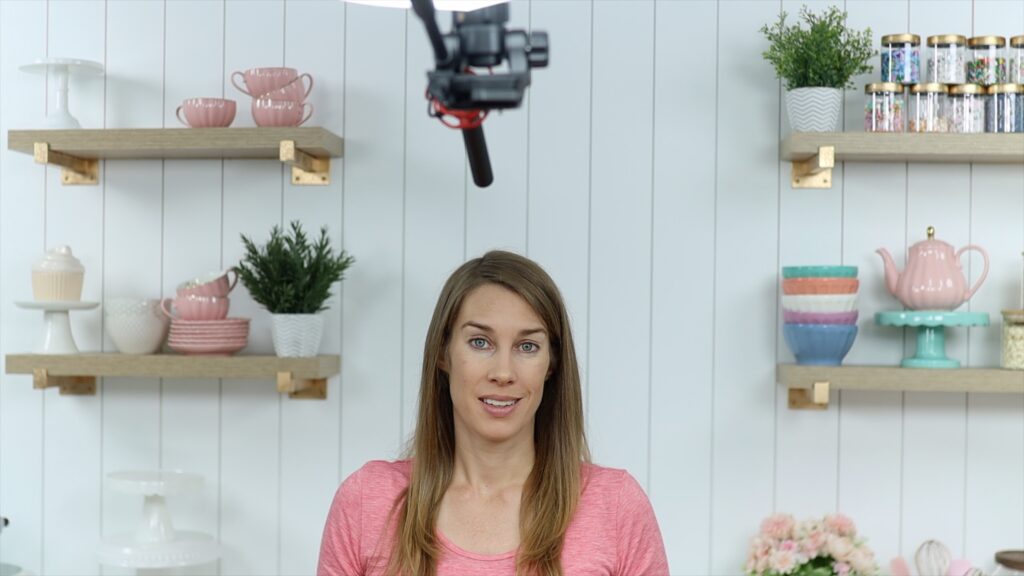
Let’s start with a little tour of my cake studio! This is where I prepare recipes, frost and decorate cakes, and record all of my tutorials and online courses. For the best audio quality and to reduce the echo, I’ve covered almost every flat hard surface with softer surfaces. I have curtains over the windows and doors, rugs on the floor, and sound boards on the walls and ceilings.
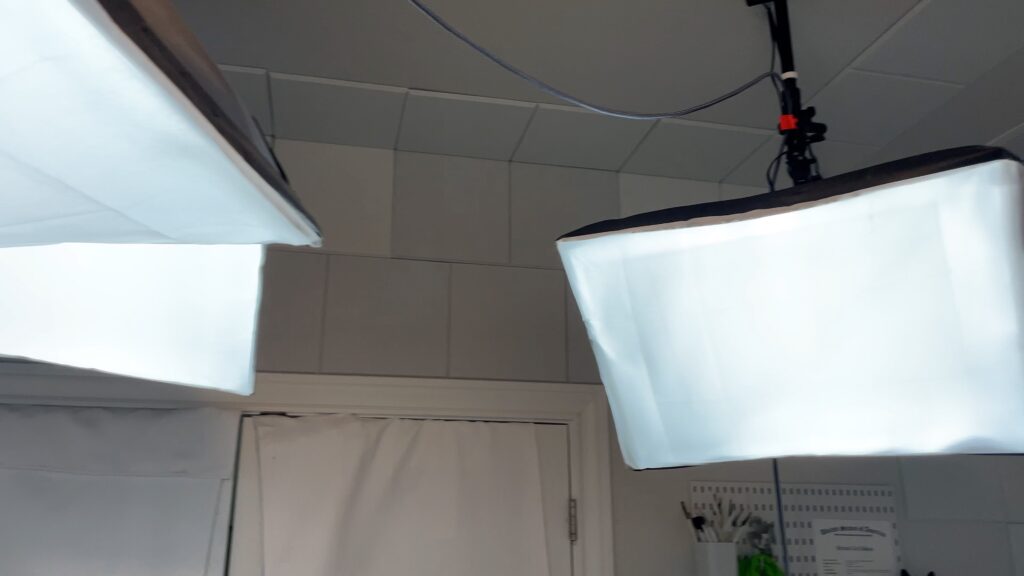
My favourite part of the studio is having fantastic light at any time of day. Using artificial lights means that the lighting is consistent throughout videos even if they’re filmed at different times. This works best for me because a lot of filming happens after my kids go to bed.
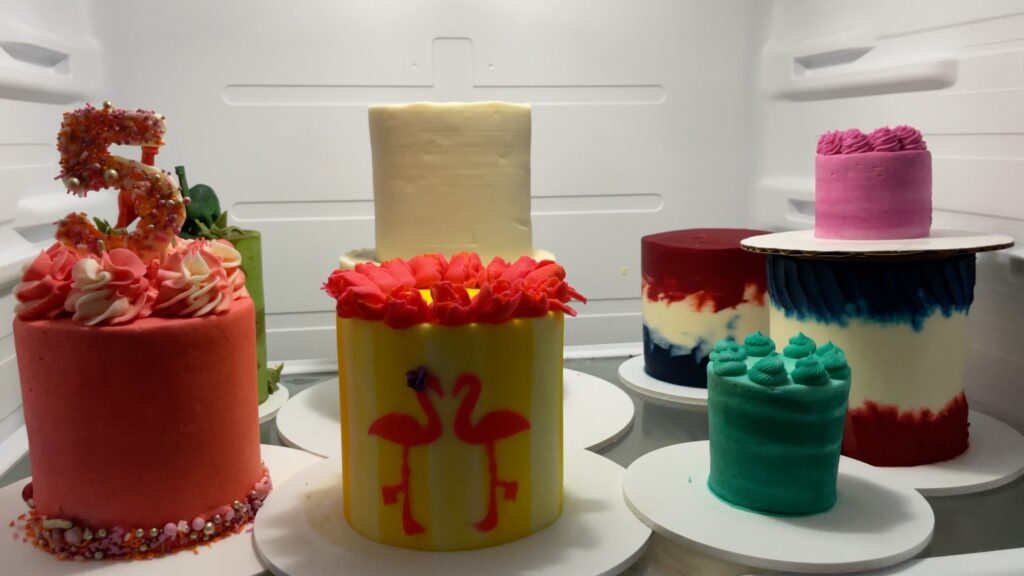
I have a fridge and two freezers full of cakes! These are cakes I’m still busy decorating or ones that took me so long to decorate that they’re not edible anymore. I’ll frost over them soon and use them for another cake design.
How I make cake videos for YouTube and my online cake school
Let’s take a peek at the process of making a video in my cake studio.
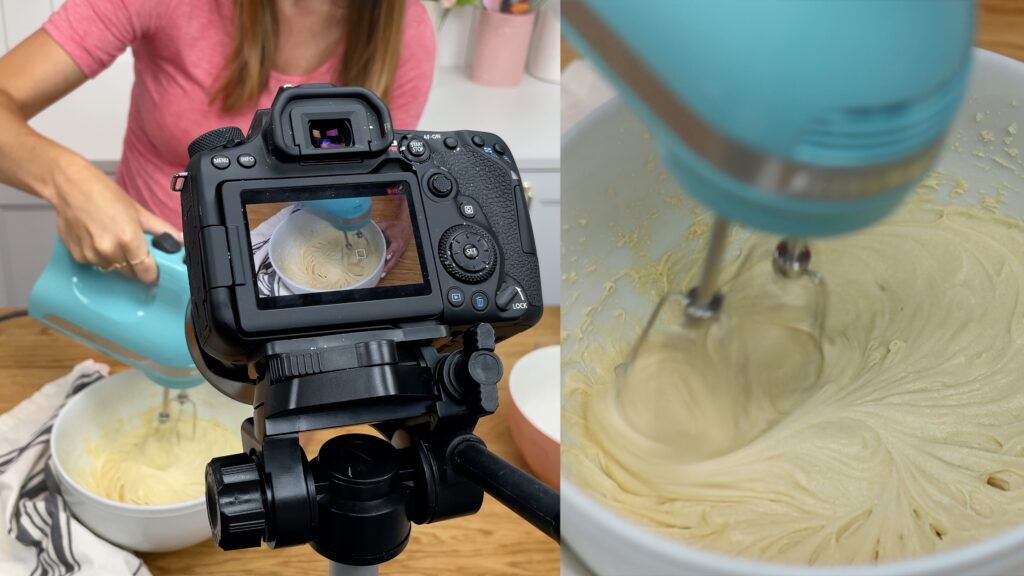
I mix, frost and decorate cakes in here while filming from different angles. On the left you can see what the bigger picture of what’s happening, but I don’t usually film that. Instead, I like to film close-up video like you can see on the right. This shows everything much more zoomed in so you can really see what's happening. It takes at least twice as long to film making a cake than it would without filming it.
Now we need to turn at least an hour of these video clips into a tutorial that’s much quicker and more interesting to watch. My videos and editing projects are stored on 14 external hard drives of 4TB each. The file sizes are HUGE!
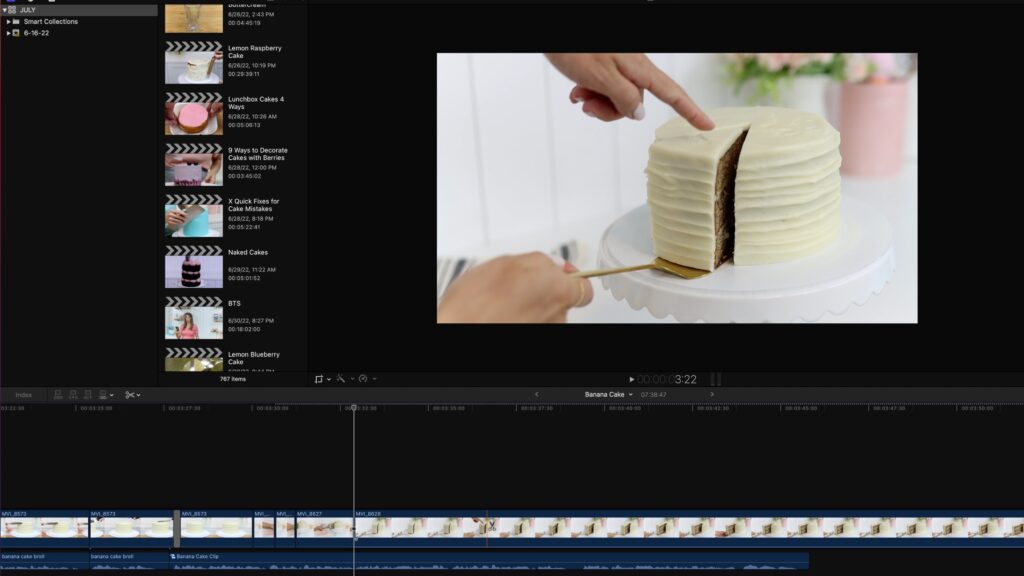
I use Final Cut Pro for editing and I drag all of the video clips into a new project. First, I skim through them to check that everything looks good. Then I type out what I want to say to explain the recipe or technique or design I'm demonstrating. By taking time to think about it and write it out, I make sure I include everything I want to say but in the most concise way possible! This way, you don’t have to listen to me rambling about something I could say in a few seconds. I’m a very impatient person and I like to learn things quickly so that’s how I teach, too.
Ok, back to the cake studio for the next step! Now it’s time to record the audio and that’s what this microphone’s for up here. I used to record in my closet because it had the least echo in my house but I definitely prefer this space!
Back on the computer, I drag the audio file into my project. Then I trim the video clips to take out the unnecessary parts. I also time it so that as I’m talking about something, that part of the process is playing in the video.
Editing the video is REALLY slow. There’s almost always a lot of coffee involved! As an example, the final tutorial footage for slicing this Banana Layer Cake is just over 5 seconds long. How long do you think it took me to edit those 5 seconds? 9 minutes! Slicing shots are some of the most time consuming so it’s not all this slow though.
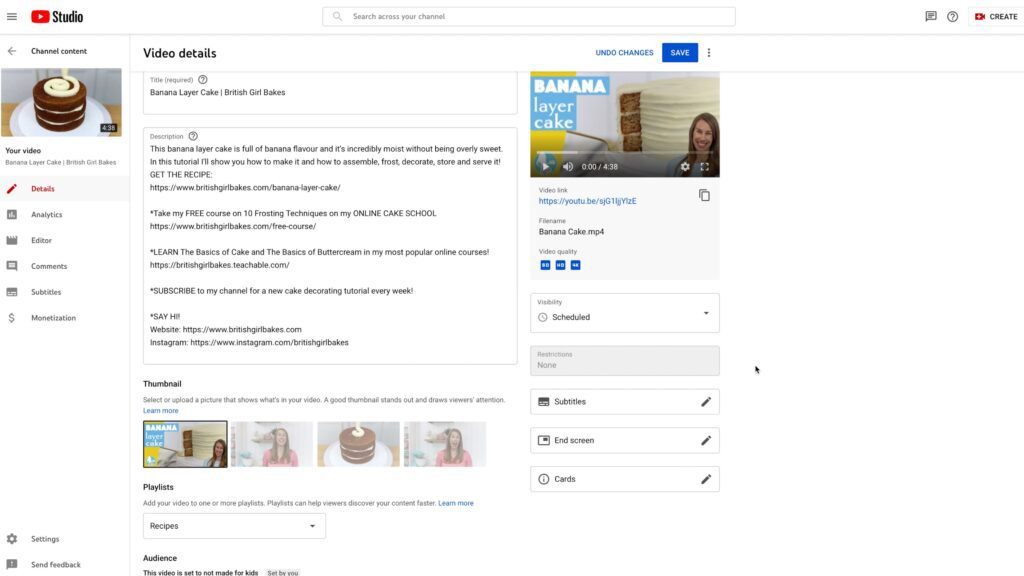
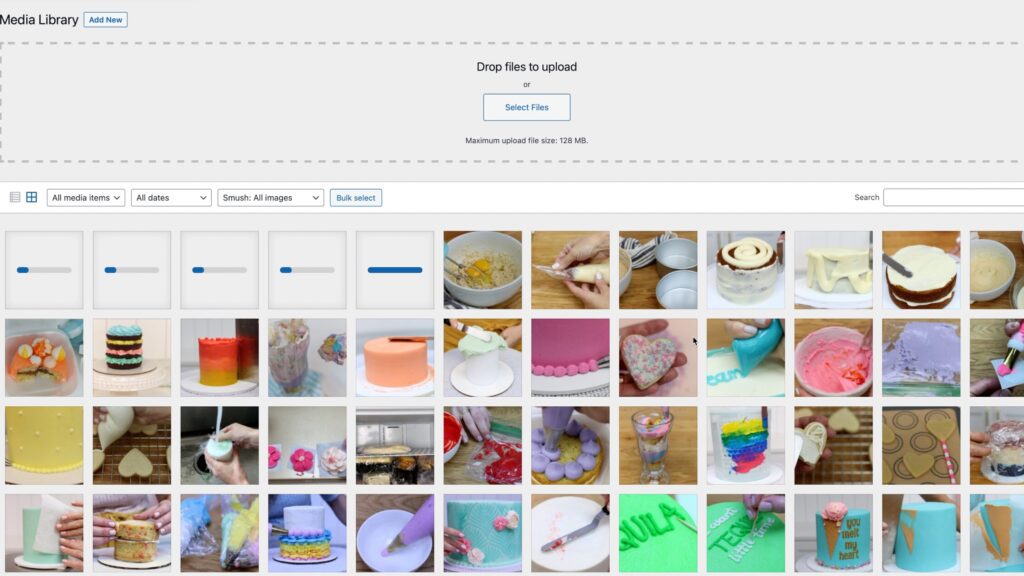
Ok, final steps! I upload the finished tutorial to my YouTube channel. I schedule it for a Tuesday, which is the day I share new tutorials each week. Then I drag my script onto my website for a written version of the tutorial. I slot in photos to show each step of the process and schedule this tutorial for the same time and date as YouTube. This way, people can read the tutorial instead of watching it. Now it's back to the cake studio to film the next cake!
And that’s the process! Here's how long each part takes:
One hour to decorate and film each cake
One hour to script the tutorial
10-15 minutes to record the audio
For the editing, it typically takes me 15 minutes to edit every 1 minute of finished video. For a tutorial of 5 minutes I spend about an hour and 15 minutes to edit.
One hour to create the website version of the tutorial
One hour to prepare a much shorter video for Instagram
What's new for British Girl Bakes
Baby Boy #3 will be arriving any day so life is going to get very busy in our house! I’ve been baking and decorating and filming a LOT of cakes over the last few months so I’ll be able to share new videos for the rest of the year. My YouTube tutorials and cake school content will continue as normal even if I don’t make it into my cake studio for a little bit after the baby arrives.
You can expect to see tutorials on some really fun cake decorating techniques like these naked cakes and some mouthwatering recipes for cake and frosting flavours. Also, I’ve just released my brand new MasterCourse on the Basics of Buttercream. You’ll find it on my cake school and it’s included in my ClubPLUS membership.
I hope it’s been interesting to see a bit of what it’s like behind the scenes! Ask me any questions in the comments or just say "hi" and tell me what kind of cakes you like to make!
Whipped cream frosting is light and refreshing and not too sweet. In this tutorial I’ll show you how to make it stable enough for piping and for smooth frosting on cakes. I'll also share how to store it and how to fix it if anything goes wrong!
What is stabilized whipped cream?
To frost or pipe with whipped cream you'll need it to hold its shape. Different ingredients can be added to whipped cream to stabilize it including cream cheese and sugar. My favourite combination is gelatin and powdered sugar or icing sugar. The sugar adds a bit of sweetness to the cream but doesn't make it nearly as sweet as other frostings like my 4 Minute Buttercream. Gelatin thickens the cream so you can pipe textured details that will hold their shape for days.
How to make stabilized whipped cream frosting
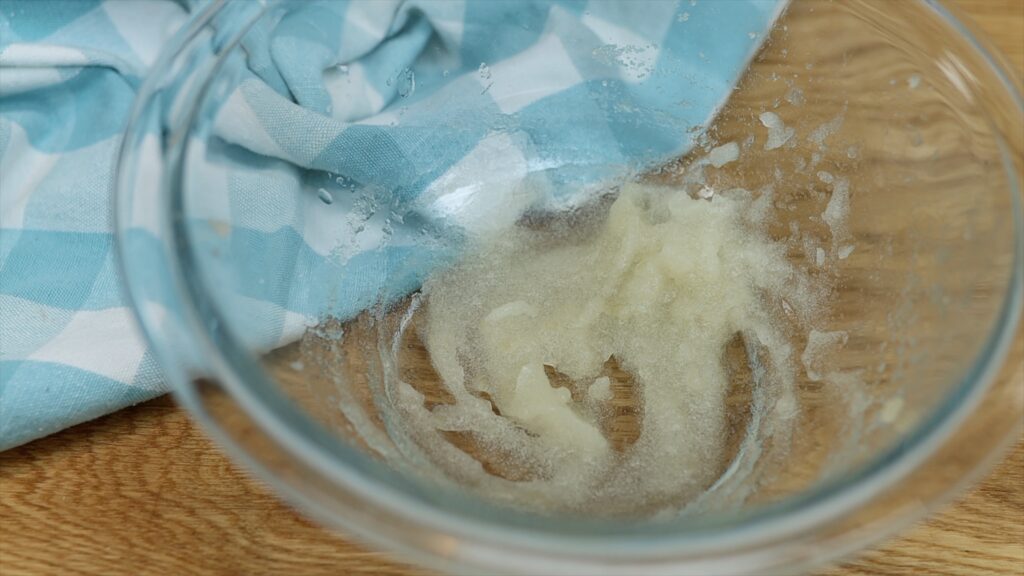
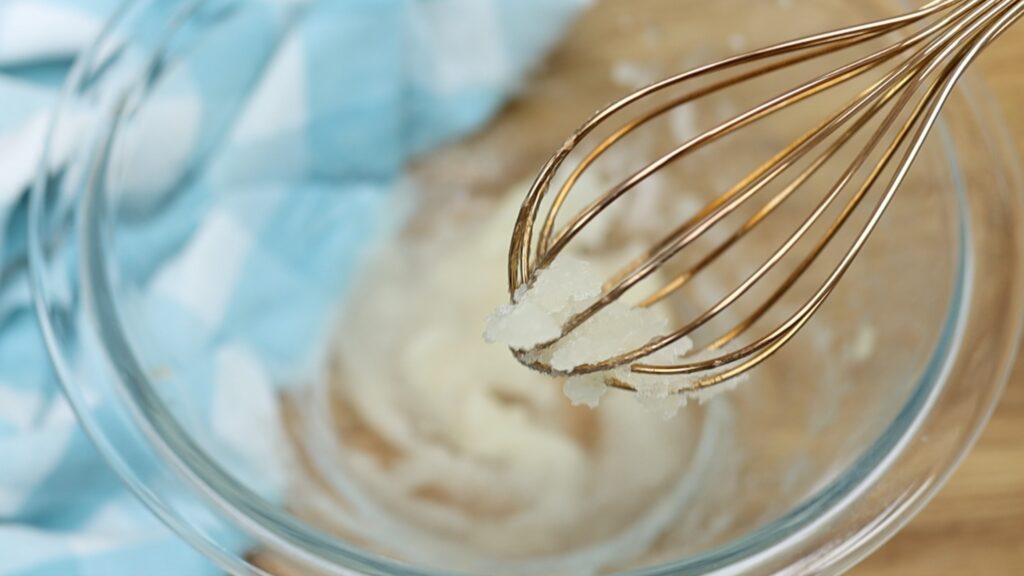
To make stabilized whipped cream frosting, the key ingredient is gelatin. Mix it with cold water until there are no big lumps but it will still be very grainy. Leave it to rest, called blooming, while you start on the whipped cream.
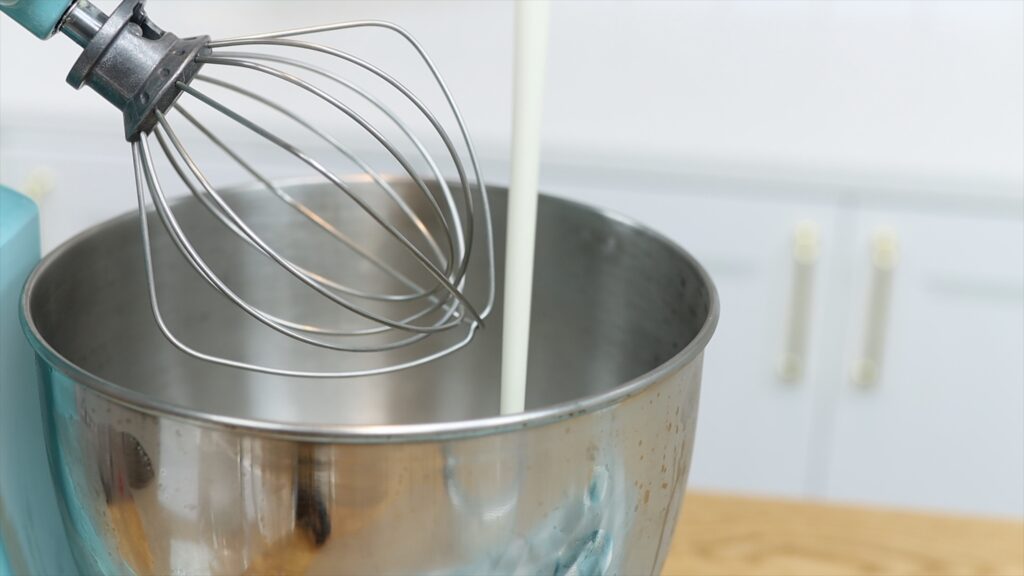
It’s best to chill your mixing bowl and whisk in the fridge, which will give you the thickest whipped cream. Pour heavy whipping cream or double cream into the mixing bowl and add powdered sugar or icing sugar and vanilla.
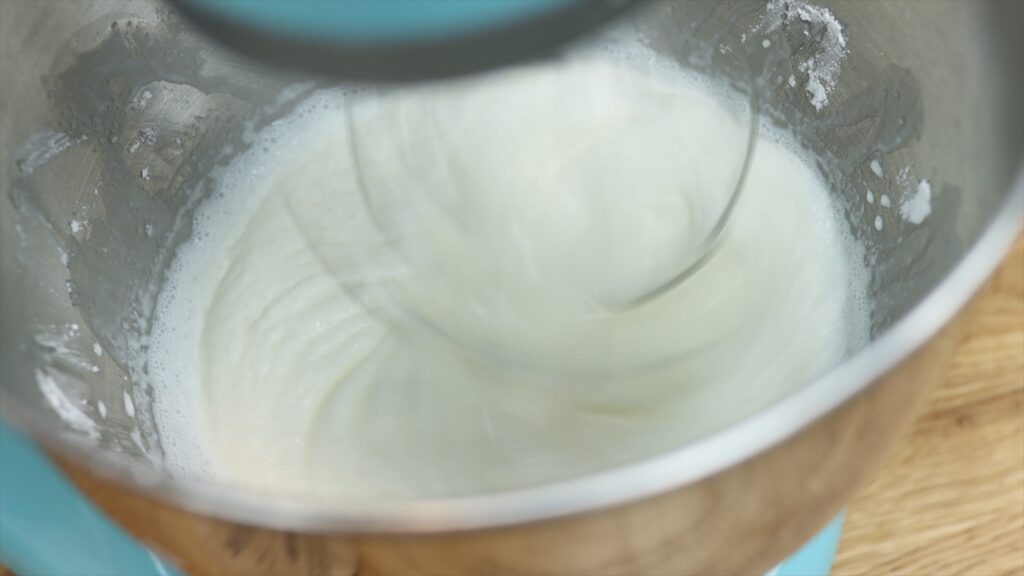
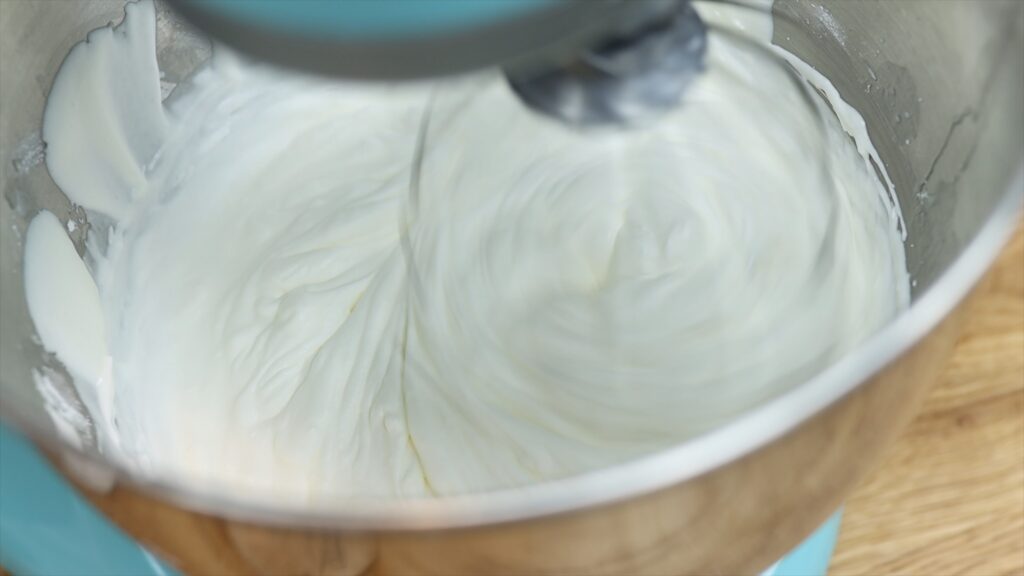
Whip the cream using a speed no more than 4 if you’re using a stand mixer. This allows you to watch the cream closely and don’t overmix it. After about 2 minutes you’ll notice that the cream looks thicker and a bit foamy around the edges. Stop mixing now.
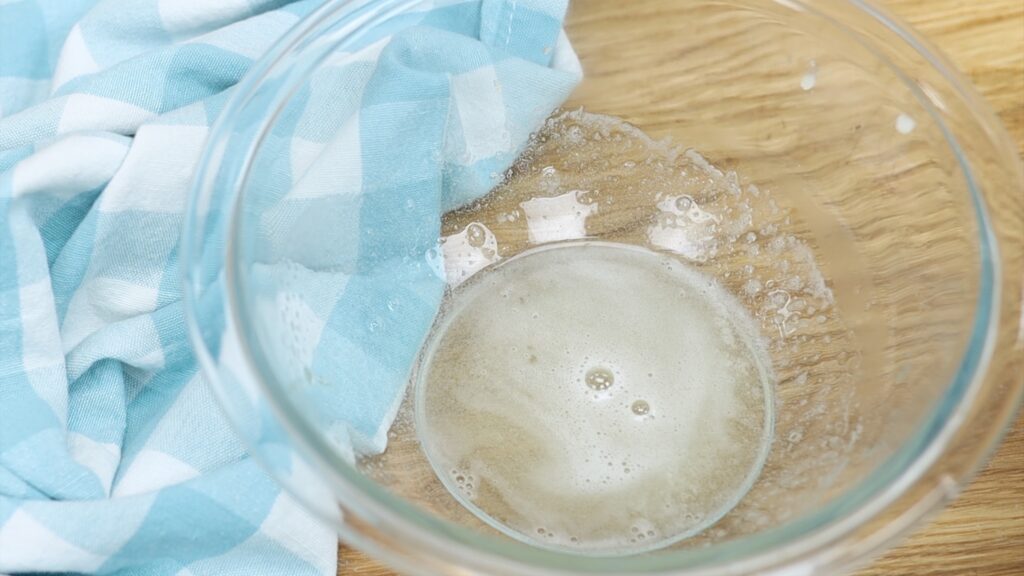
Your gelatin should be a solid jelly now. This means it has bloomed and it will give you the smoothest whipped cream frosting.
Put it into the microwave for 10 seconds to make it liquid again and stir it until it’s smooth. It shouldn’t be hot but if it is, let it sit for a few minutes until it’s barely warm.
Start mixing your cream again, still only using speed 2 or 4. Very gradually pour the gelatin into the mixing bowl. By incorporating it gradually you'll avoid any lumps.
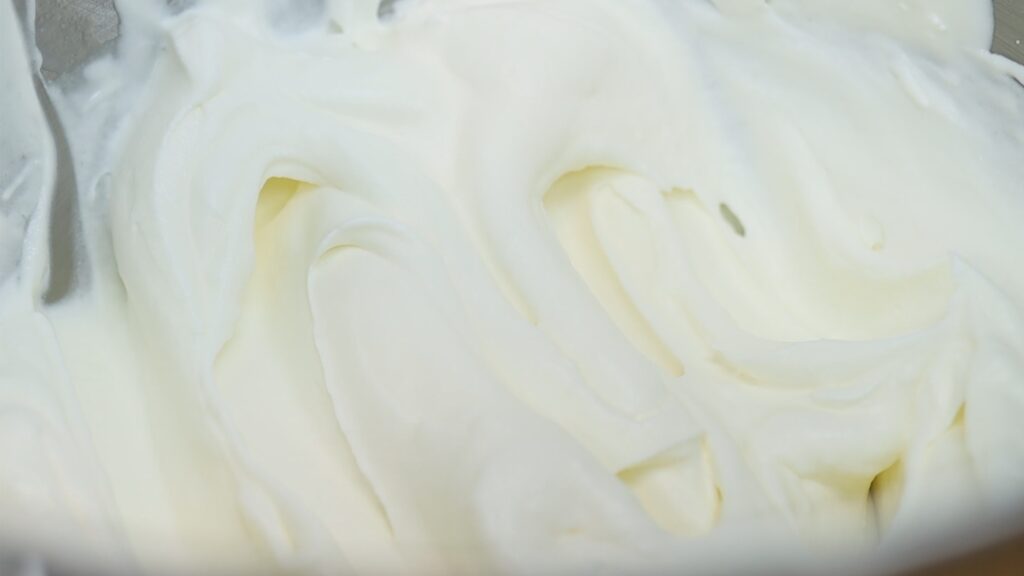
Keep whipping the cream for about another 2 minutes. You’ll see that the whisk is leaving very defined texture behind it. You'll know the whipped cream is ready if the texture doesn't sink back into the cream when you stop the mixer. If you drag a spatula through it, you should leave clear trails in the whipped cream. It should hold peaks when you pull the spatula up. If you take your whisk attachment off and hold it up, the peak should still point upwards. Look how gorgeously smooth and silky this is!
Why does my whipped cream look curdled or lumpy?
The most common challenge with whipped cream frosting is that the consistency isn’t right. Let's do some troubleshooting to fix these problems.
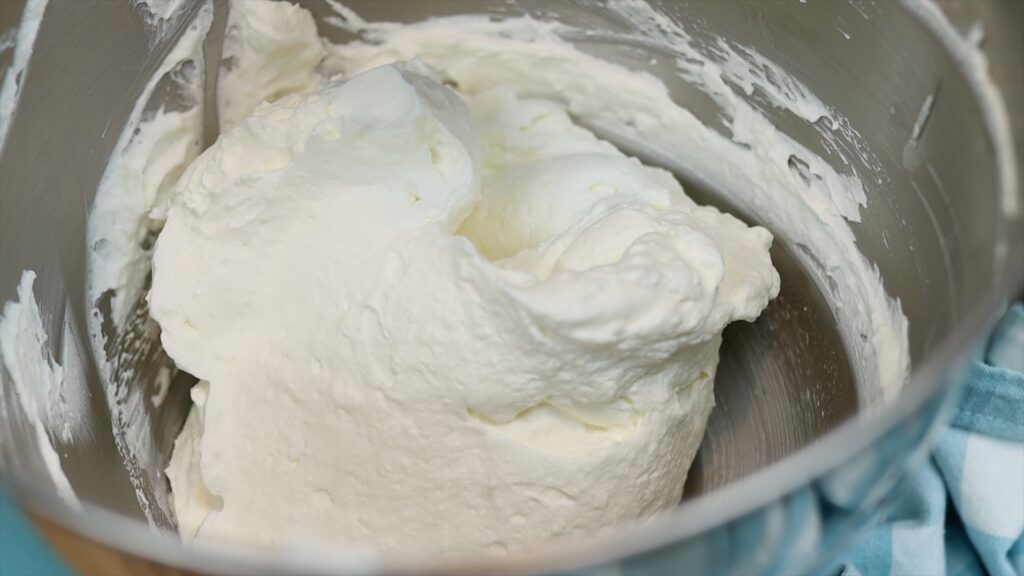
If you stop whipping the cream before it forms peaks, it won't be stiff enough to hold its shape. When you pipe or spread it onto cakes or cupcakes, it will droop or sink or slide off.
When whipped cream looks curdled and lumpy it’s either overmixed or there’s a problem with the gelatin.
If you mixed the cream for too long, add some more cream. Fold it in and the whipped cream should become smooth again.
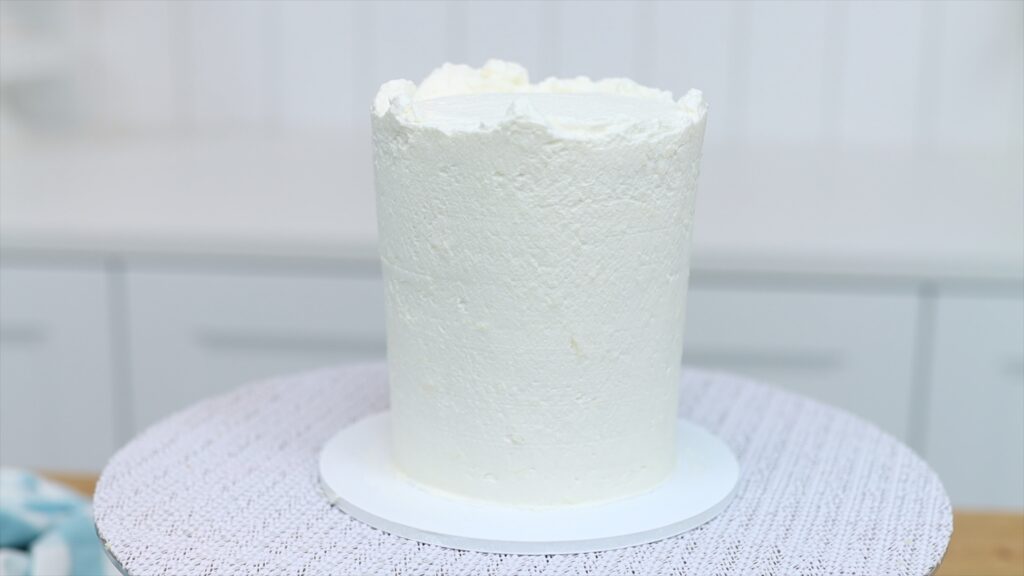
As far as the gelatin, make sure you let it bloom after you mix it so that it becomes solid. Then remelt it and stir it so it’s smooth. Make sure it’s not hot when you add it to the cream and also make sure you add it slowly while the mixer is mixing. If you add it all at once when the mixer is turned off it will make the whipped cream lumpy. Even after scraping around the cake several times with a cake comb, the whipped cream frosting will not look smooth:
If that happens, I think the best solution is to frost the cake and then add some rustic texture. Press your offset spatula gently into the frosting and spin the cake, slowly pulling it up the cake. This will disguise the slightly uneven consistency of your whipped cream.
How to frost a cake with whipped cream
You can use this whipped cream to fill and frost cakes and cupcakes and you can also pipe with it. Once you’ve assembled your cake, cover it in a crumb coat. This is a very thin layer of frosting to trap any crumbs so that they don’t get into your final layer of frosting. Don’t worry about making this frosting very neat because you’re going to cover it up in a moment.
Spread the final layer of whipped cream frosting more thickly. Then scrape around the cake several times to get smooth, straight sides. Touch up any indents by spreading more whipped cream frosting over those areas and then scrape again.
Make sure you spread the frosting up above the top edge of the cake so that it sticks up. This way you’ll create sharp angles from the sides to the top of the cake.
How to pipe with whipped cream
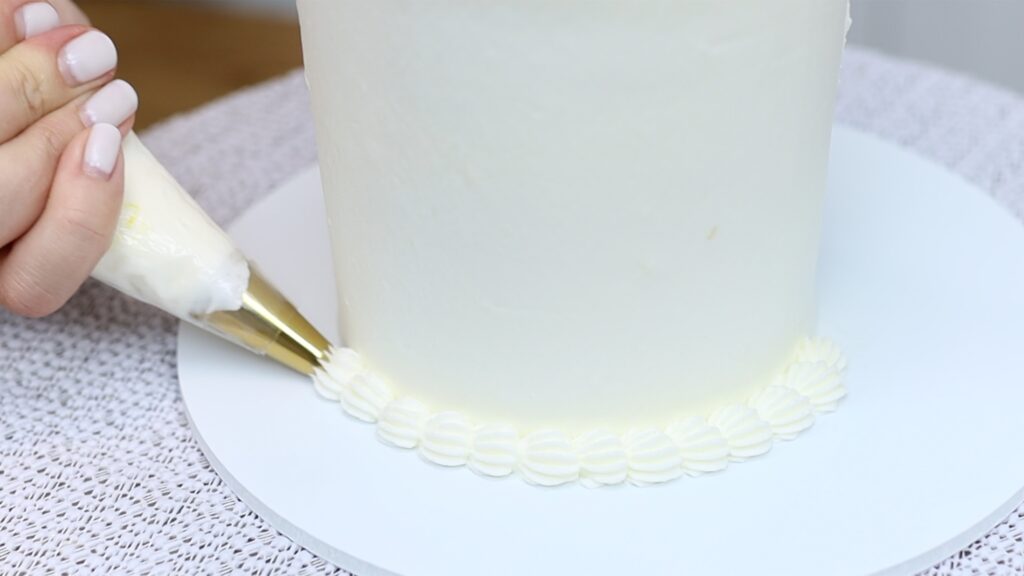
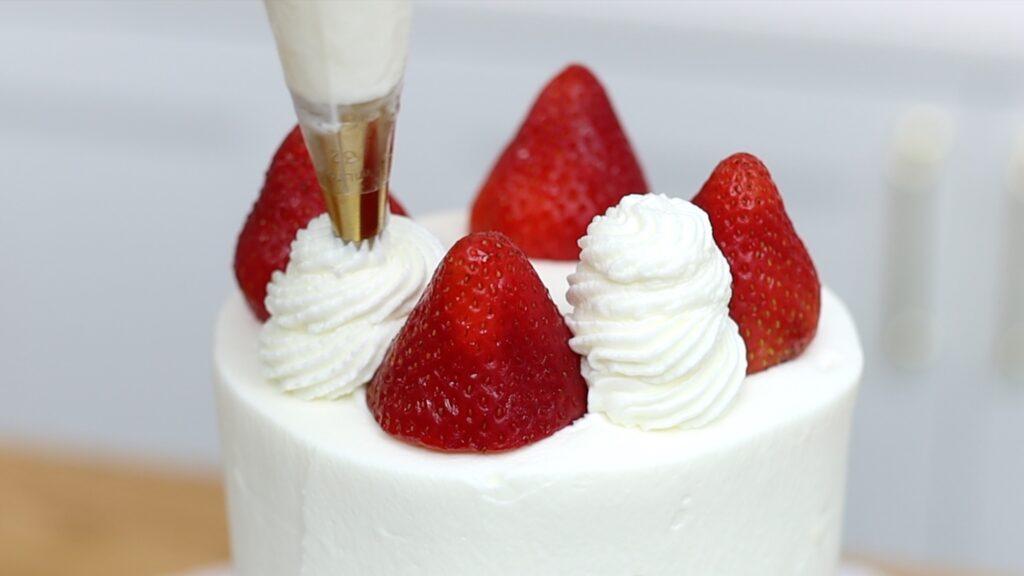
This stabilized whipped cream is stiff enough to pipe borders and swirls and other details. The border around the bottom of this cake is a #32 open star tip. I used the same tip to pipe swirls onto the top of the cake. You can see all the definition of the texture in the piping because of the gelatin in the whipped cream, which makes the whipped cream frosting stiff enough to hold its shape.
How to store whipped cream
To store a cake frosted with whipped cream, put it in the fridge in an airtight container like a Tupperware. Cream absorbs the taste of anything else in the fridge so being airtight is important!
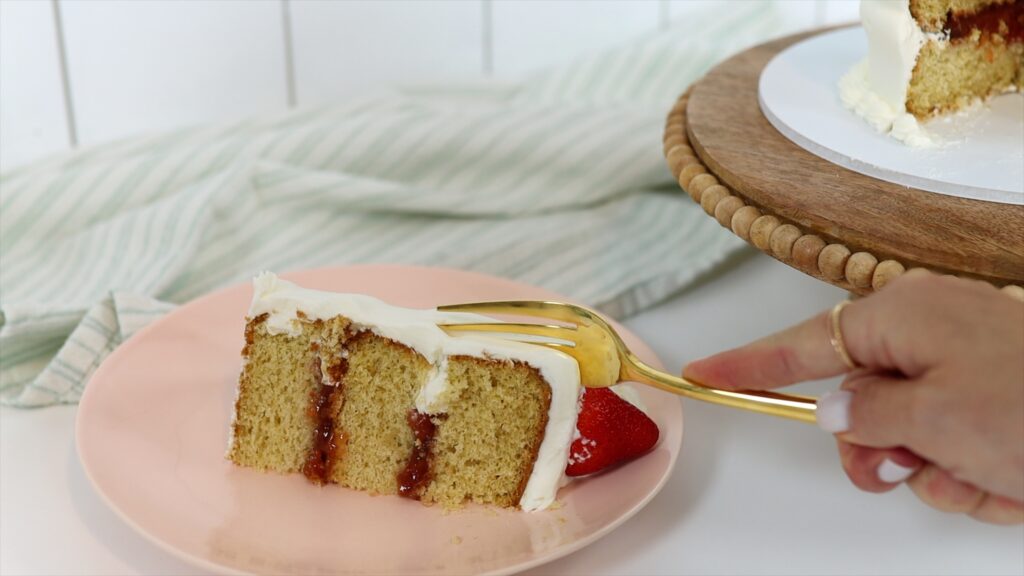
The cake will taste best about an hour after taking it out of the fridge as it comes to room temperature and gets softer. This is my Very Vanilla Cake with strawberry jam filling.
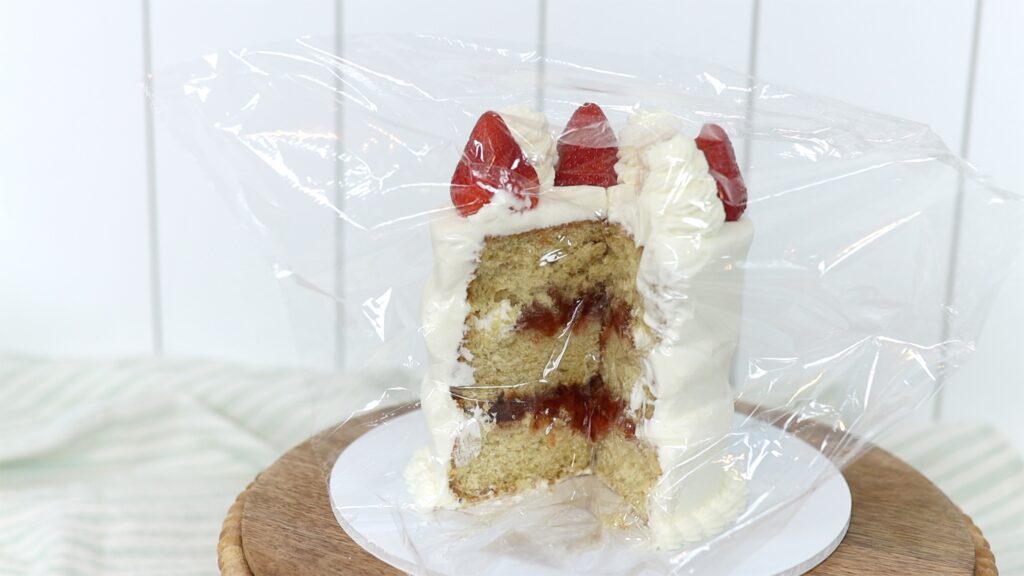
After slicing the cake, if you don’t finish it press cling film or Saran Wrap against the sliced cake. Push it gently into the frosting around the edges to secure it. Then put the cake back into the fridge.
Store any leftover whipped cream in airtight container in the fridge for 3 days.
I hope I’ve answered all of your questions about whipped cream frosting! If I didn’t, ask me in the comments!
Whipped cream frosting is light and refreshing and not too sweet. By stabilizing it you'll be able to frost a cake and pipe with it!
Ingredients
UnitsScale
1 1/2 tablespoons cold water
1 teaspoon gelatin
1 1/2cupsheavy whipping cream or double cream
1/3cuppowdered sugar
1 teaspoon vanilla
Instructions
For the thickest whipped cream frosting, chill a metal mixing bowl and whisk attachment in the fridge for an hour before you start this recipe.
In a small bowl, whisk cold water and gelatin until there are no big lumps in it. It will still be very grainy. Set it aside.
Pour heavy whipping cream or double cream into your cold mixing bowl and add powdered sugar or icing sugar and vanilla. Whip the cream using the cold whisk attachment on medium low speed (no more than 4 if you’re using a stand mixer) for about 2 minutes. When the cream looks thicker and a bit foamy around the edges, stop mixing.
Your gelatin should be a solid jelly now. Microwave it for 10 seconds to make it liquid again and stir it until it’s smooth. If it feels warm, let it sit for a few minutes until it’s barely warm.
Start whipping your cream again, still only using speed 2 or 4. While the mixer is on, very gradually pour the gelatin into the mixing bowl. After about another 2 minutes you’ll see that the whisk is leaving very defined texture behind it, which doesn’t sink back into the cream even if you stop the mixer. It should be smooth and hold peaks on a spatula or whisk.
Notes
This recipe makes enough whipped cream frosting for a three-layer 4" cake or a two-layer 6 cake.
For a three-layer 6" cake or a two-layer 8" cake, double the recipe by clicking "X2" at the top right of the recipe.
You can store this whipped cream frosting in an airtight container in the fridge for 4 days.
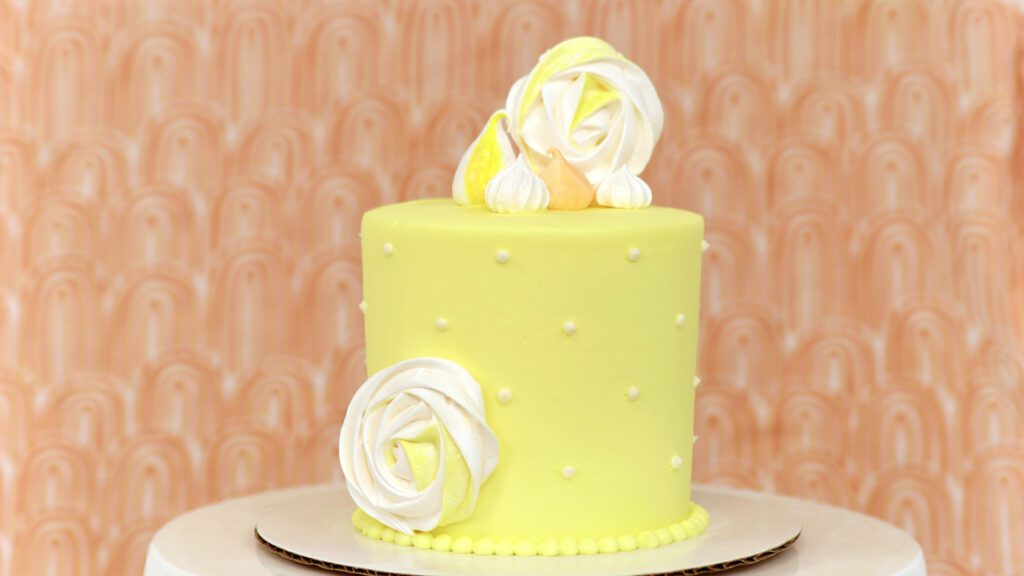
Meringues are beautiful and delicious and so easy to make! I’ll show you how to make meringues that are crispy on the outside but soft on the inside. In this tutorial you'll learn how to:
make meringues: every step from mixing to baking
flavour and colour meringues
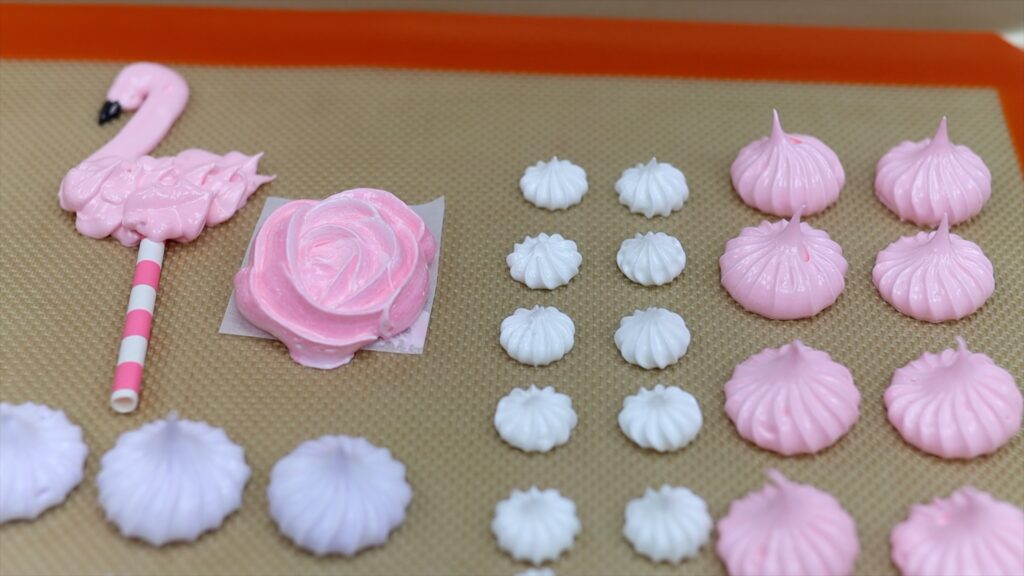
make 5 different shapes like kisses, animals and roses
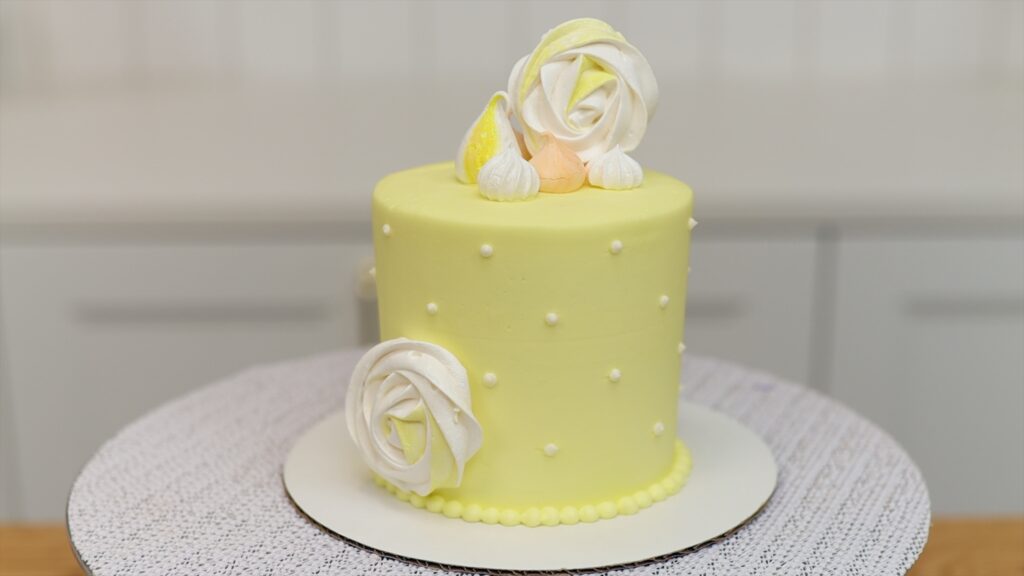
attach meringues to cakes
store meringues so they don’t get sticky or soggy.
How to make meringues
To make meringues you’ll need a whisk, salt, sugar, and egg whites. The full recipe in cups and also in grams is at the bottom of this tutorial.
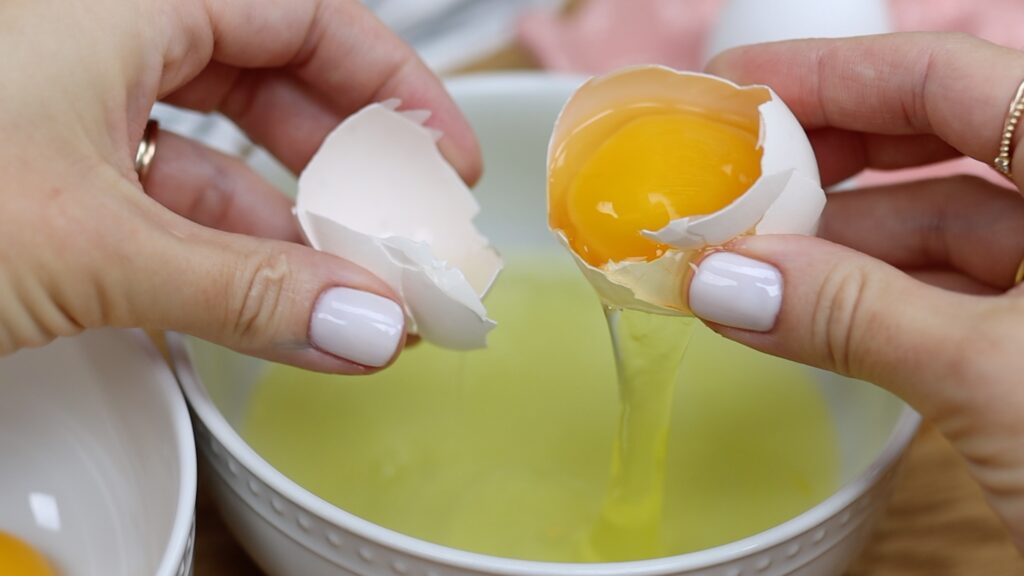
Start by cracking the eggs and separating them. Pass the yolks back and forth between the shells, letting the egg whites fall down into a bowl. Drop the yolks into a separate bowl or a Tupperware. You can use these for lemon curd or custard or another dessert.
Bring about two inches of water to a boil in a saucepan.
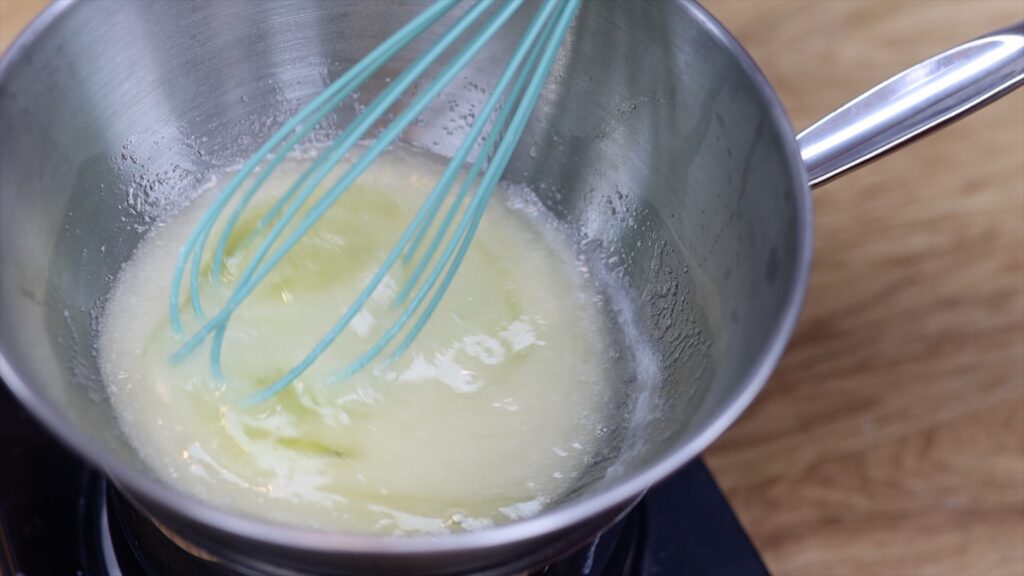
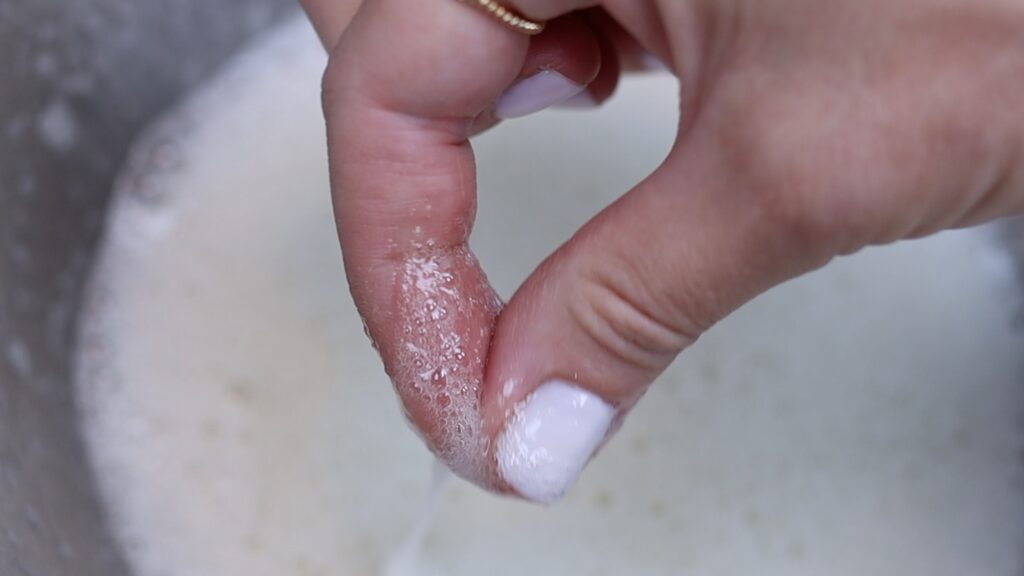
Pour the egg whites, sugar, and salt into a metal bowl. If the bowl of your mixer is metal, use that to reduce clean-up. Lower the bowl onto the pan of water, making sure the bottom doesn't touch the surface of the water. Turn the heat off and whisk the mixture together for two minutes. It will get frothy and after two minutes, pinch a bit between your fingers. If it’s smooth, it’s ready. If not, whisk it for another 30 seconds.
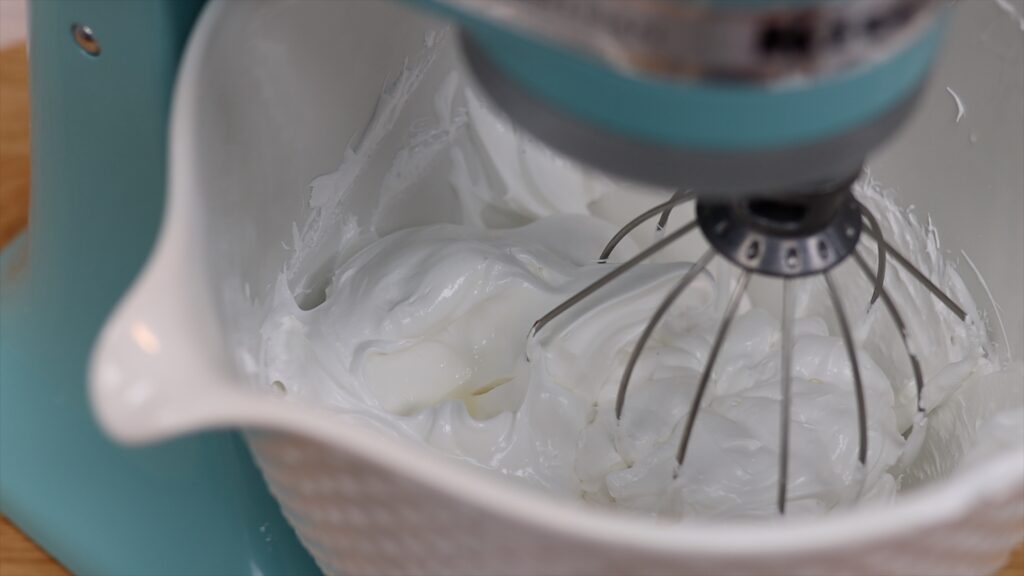
Take the bowl off the heat and now you’ll need a whisk or the whisk attachment for your mixer. Whisk the egg white mixture for 9 minutes on high speed. You’ll notice them go from yellow and frothy to bright white and silky. They’ll expand with all of the air you’re incorporating into them.
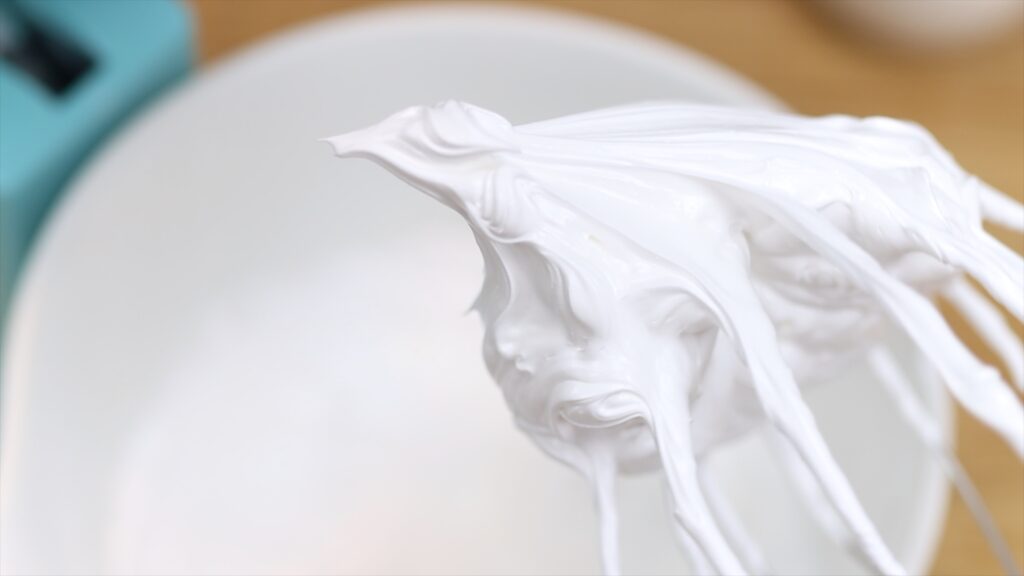
You’ll see lots of texture left behind in the meringues by the whisk. When you lift up the whisk, the meringue will hold its shape. These are called stiff peaks. Once you whip the meringues to this stage they'll hold their shape when you pipe.
How to flavour and colour meringues
When your meringue mixture reaches the stiff peak stage, add whatever flavour you like. My favorites are vanilla or almond or lemon extract. Mix the meringue just enough to incorporate the flavour extract.
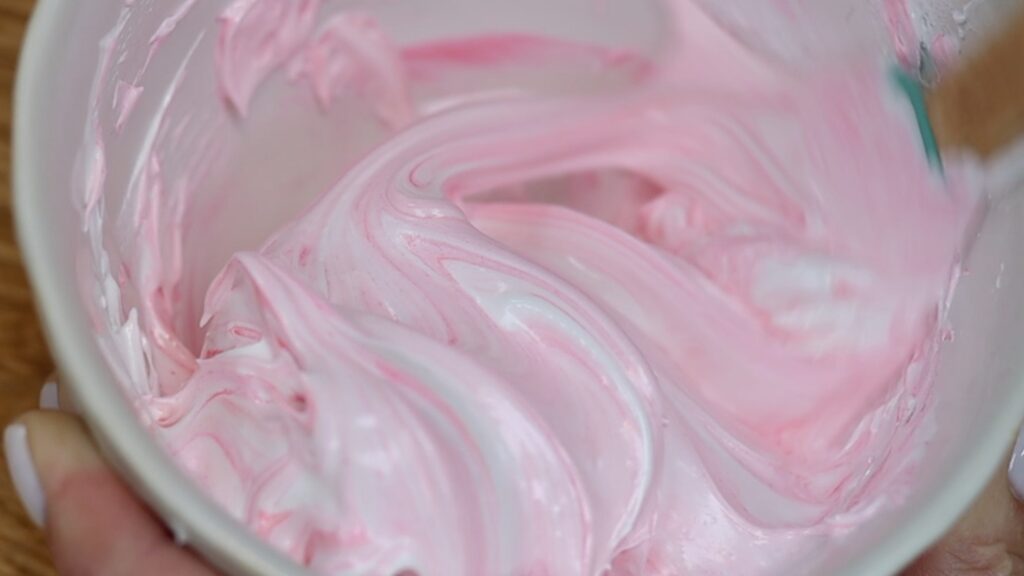
Add colour to the meringue now if you want to tint the entire batch. To tint it different colours divide the meringue into separate bowls. Gel colours are more concentrated than liquid colours so I recommend using those to tint meringue so that you don’t water it down and make it runny. Fold the colour in, mixing as little as possible so you don’t knock the air out of the meringue.
How to pipe meringues
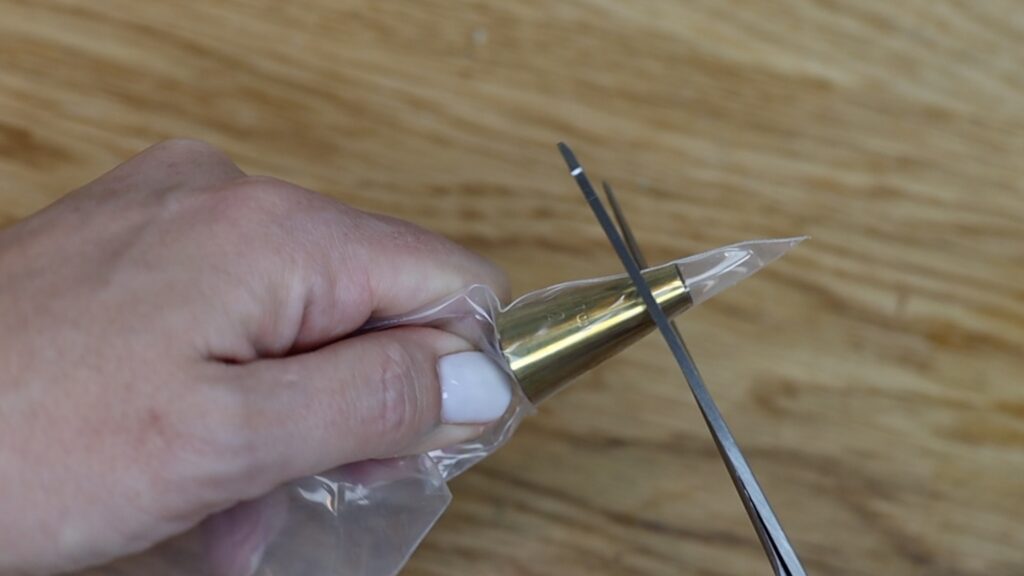
Drop a tip into a piping bag and push it down to the end. If it's a new piping bag, score a line around the midpoint of the tip. Push the tip up out of the way and then cut along the line you scored. Then push the tip back down and it will be snugly inside the piping bag, ready to use! Check out this tutorial for 15 piping hacks for cake decorating!
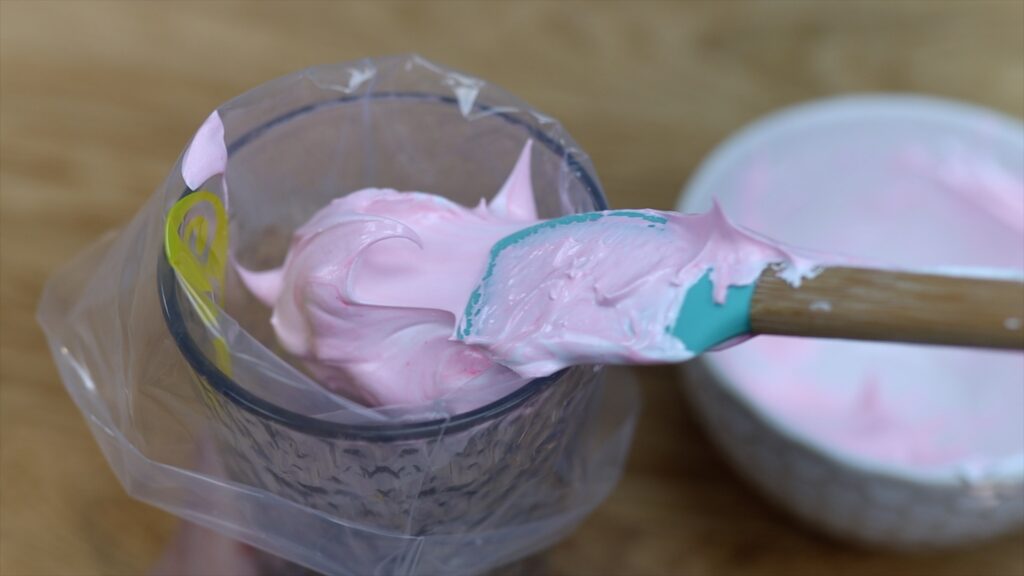
Meringue is very sticky but try this method to avoid mess! Fold the piping bag over a glass to hold it open and then spoon the meringue into it. When you unfold the bag and pipe with it, you won’t get any of that meringue on your hands.
Line a baking tray or sheet with parchment paper or a silicone mat and now let’s pipe some meringues! I'll show you how to make meringues in five different ways, which you can use for cake decorating or to serve as a snack, treat, party favour or dessert!
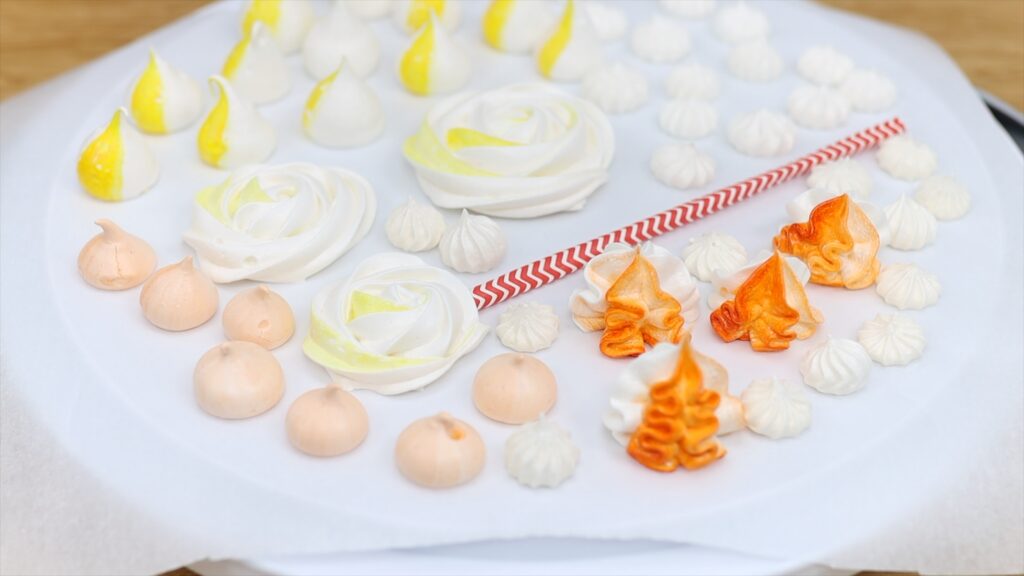
#1 Meringue rosettes
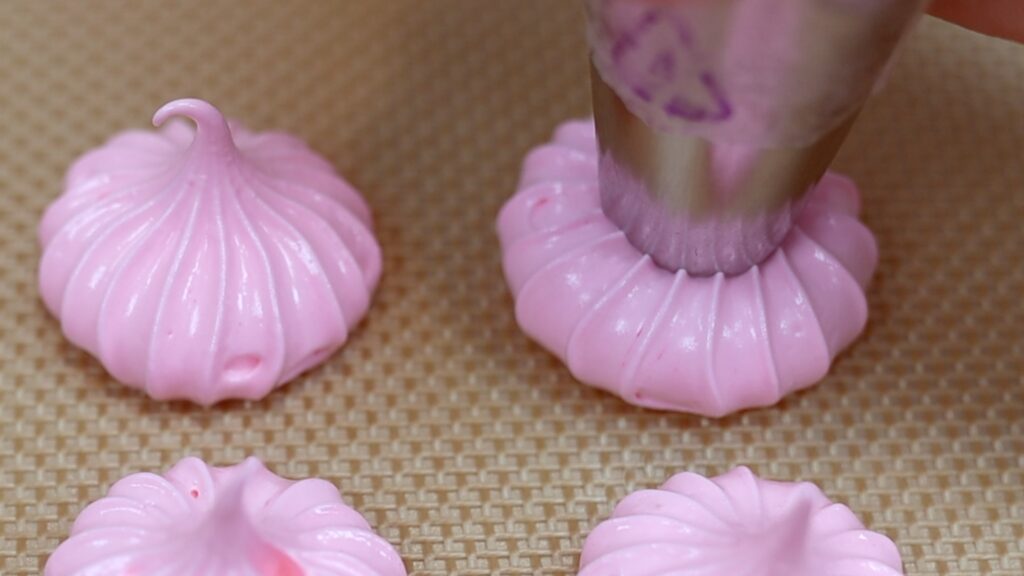
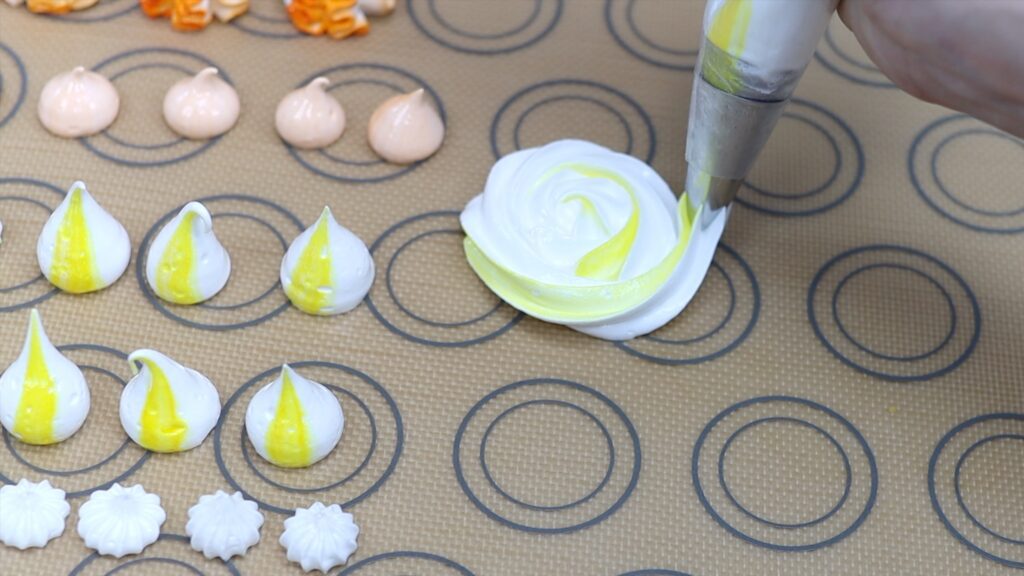
I’m starting with a large, open star tip called an 8B to pipe some rosettes. Hold the tip so it’s slightly above the tray and squeeze the piping bag to make the meringue bulge out. Stop squeezing at the same time as lifting the bag and that will leave a neat peak on the rosette.
To use the same piping tip with another colour, squeeze the first colour out of the bag. Push the piping tip out and wash and dry it. Then put it in another bag that you fill with the second colour.
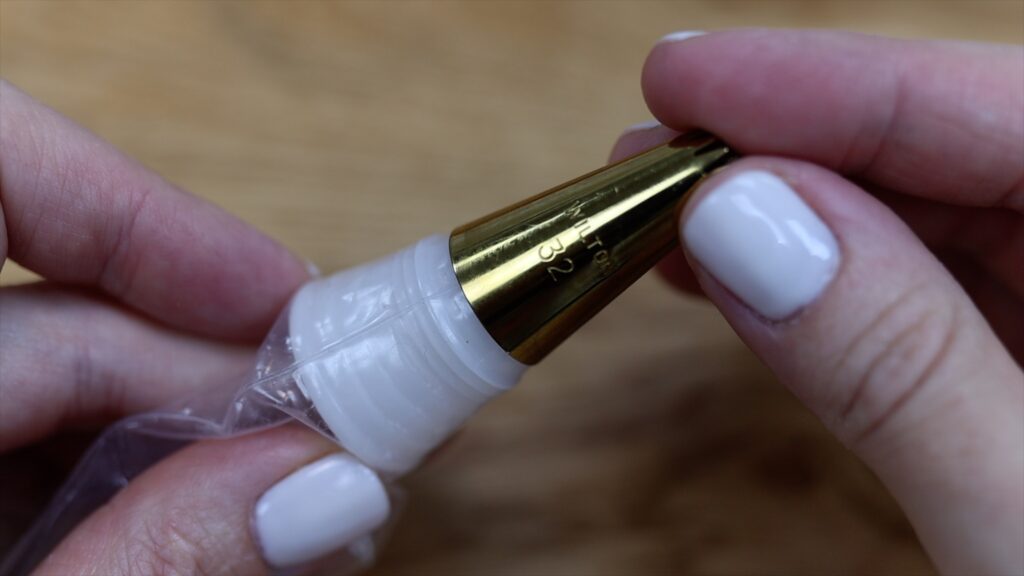
Couplers are a much quicker and easier method to use the same colour of meringue with different piping tips. You can switch between colours effortlessly and you won’t have nearly as much to clean up at the end! Drop a coupler into a piping bag and place a piping tip on it on the outside of the bag. Then screw the coupler ring on to hold the piping tip in place.
#2 Striped meringue kisses
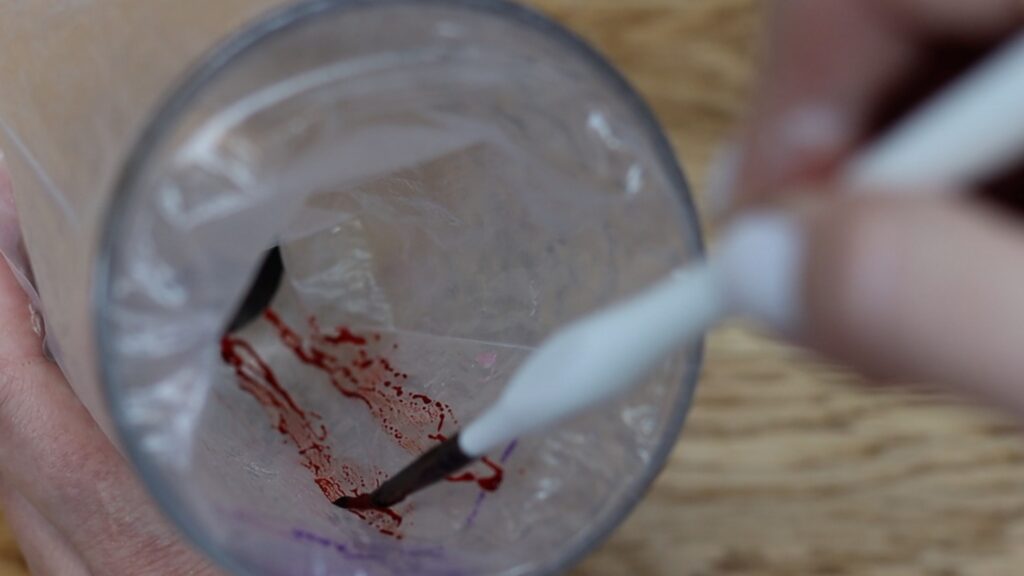
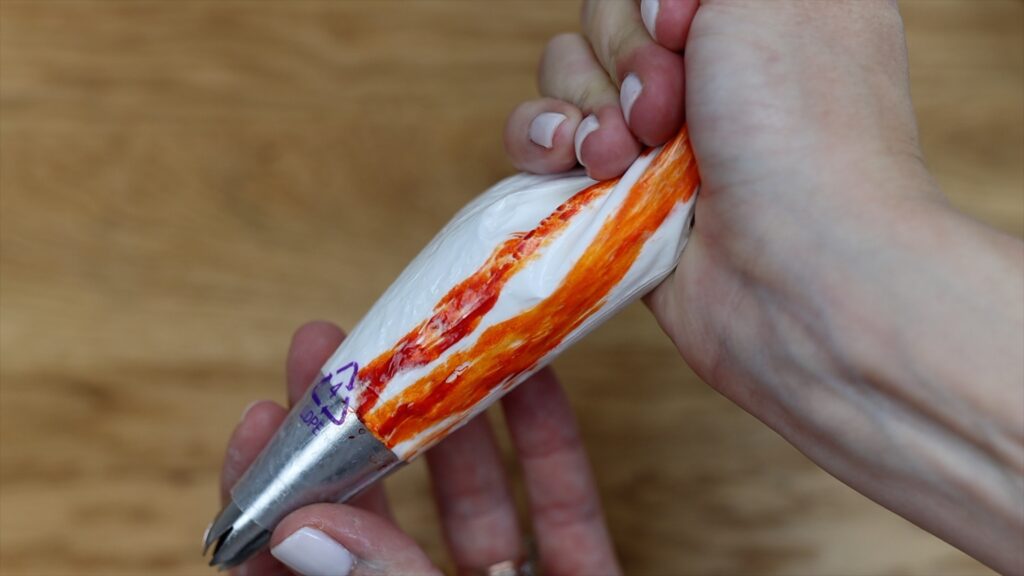
I love gel colours to tint my 4 Minute Buttercream and also for meringues. You can mix gels into meringue to tint it but try this for really bright striped meringues. Hold the piping bag open and use a paintbrush to paint stripes of colour along inside of the bag. You only need a tiny amount because gels are so concentrated.
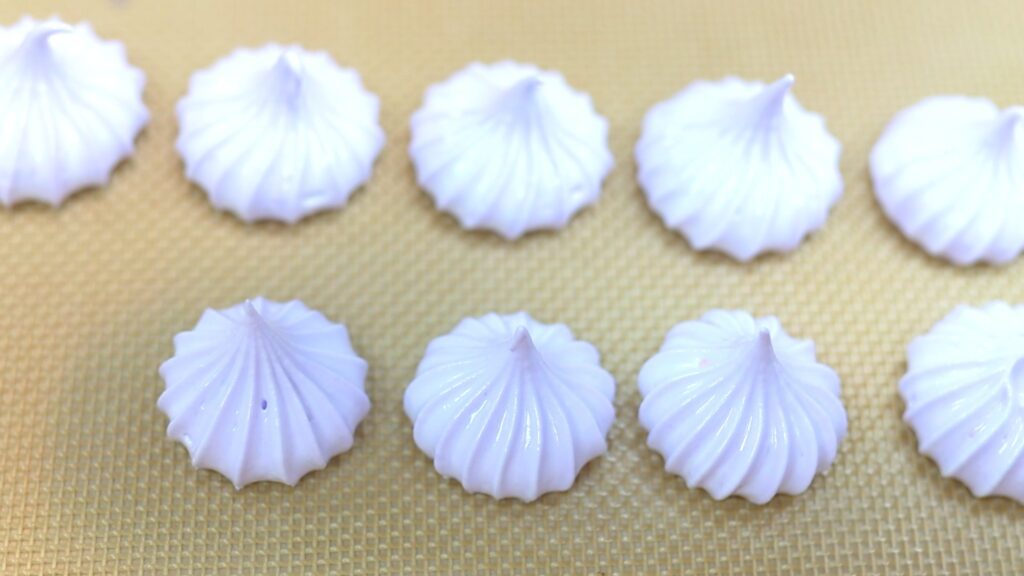
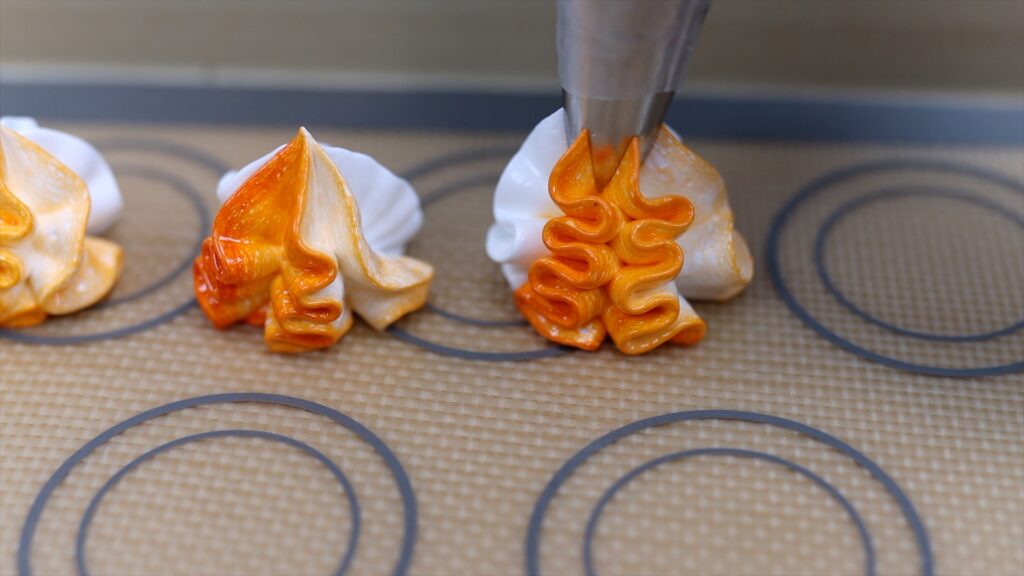
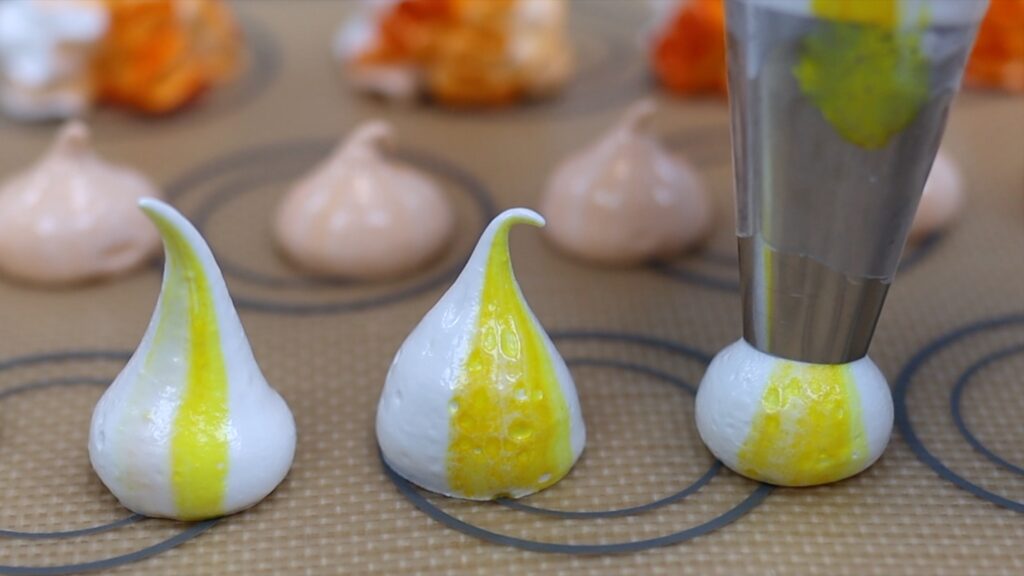
Fill the piping bag with meringue and then pipe whatever shapes you like. The ruffly rosettes above are piped with a 1M star tip. For meringue kisses or dollops like the ones below you can use any round tip. I used a 1A.
The colours are much more vivid than if you mix them into the meringue. For example, compare the bright orange to the pale orange you can see in the second row of meringues on the tray above. That orange was made by mixing gel into a bowl of meringue before piping.
#3 Meringue pops
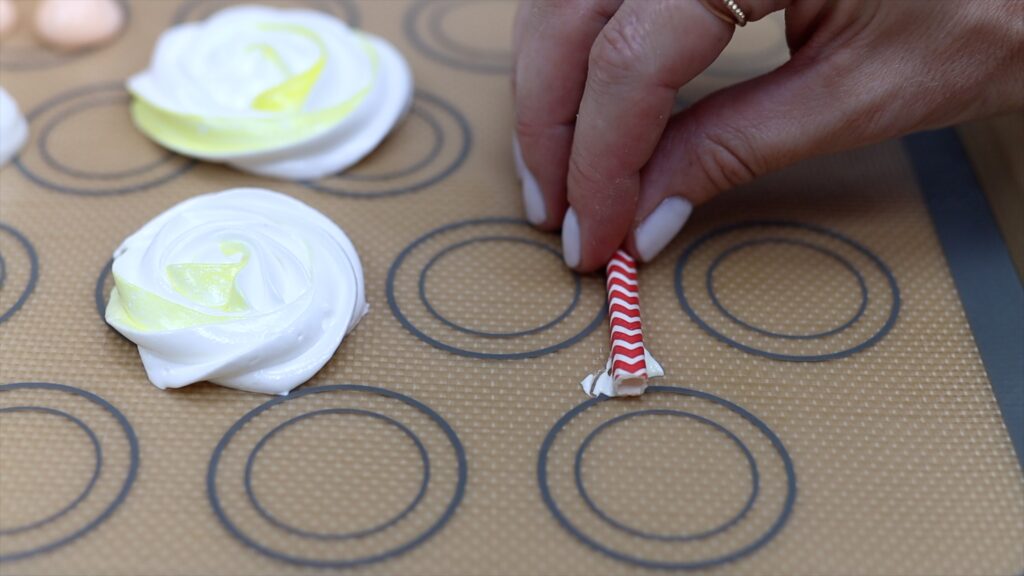
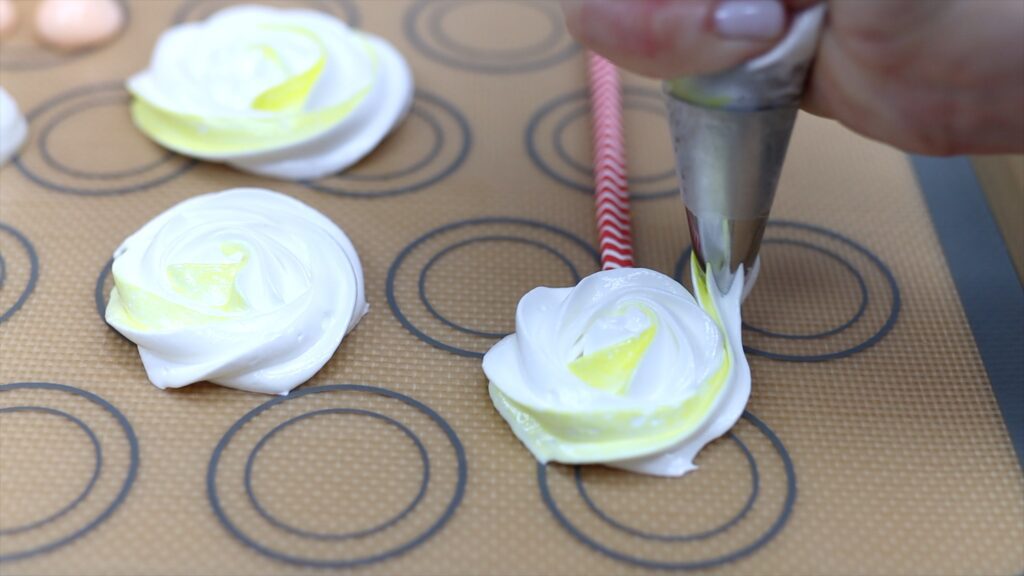
Another way to use a 1M tip is to pipe these swirls, spiraling outwards. You can place these straight onto a cake or prepare them on straws.
Wondering how to make meringues that can be used as cake toppers? Pipe a tiny bit of meringue onto the tray and press a paper straw into it. The meringue will hold the straw in place. Then pipe over the top of the straw. After baking these you can use the straw to push the meringue into the cake as a cake topper.
#4 Meringue animals
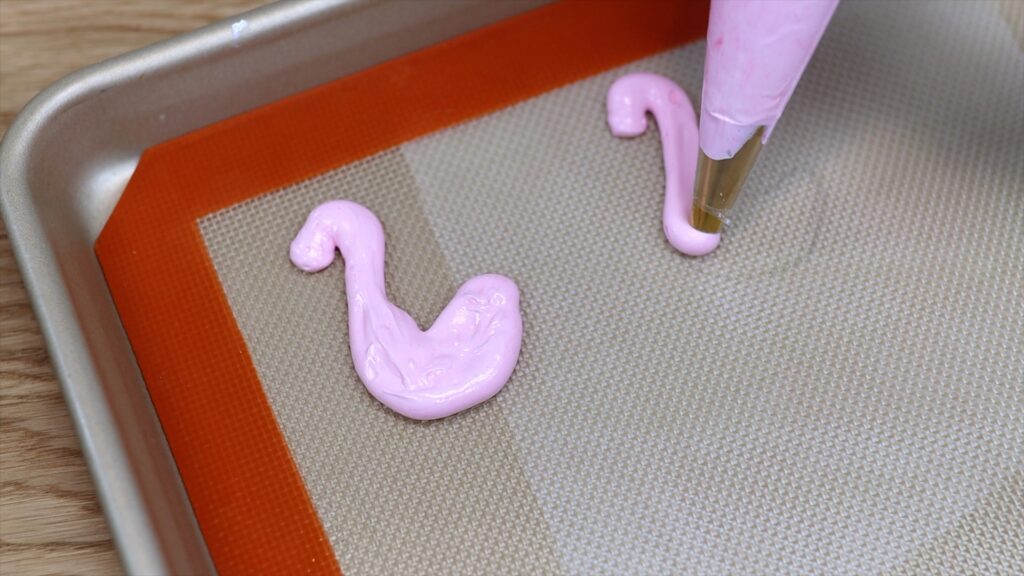
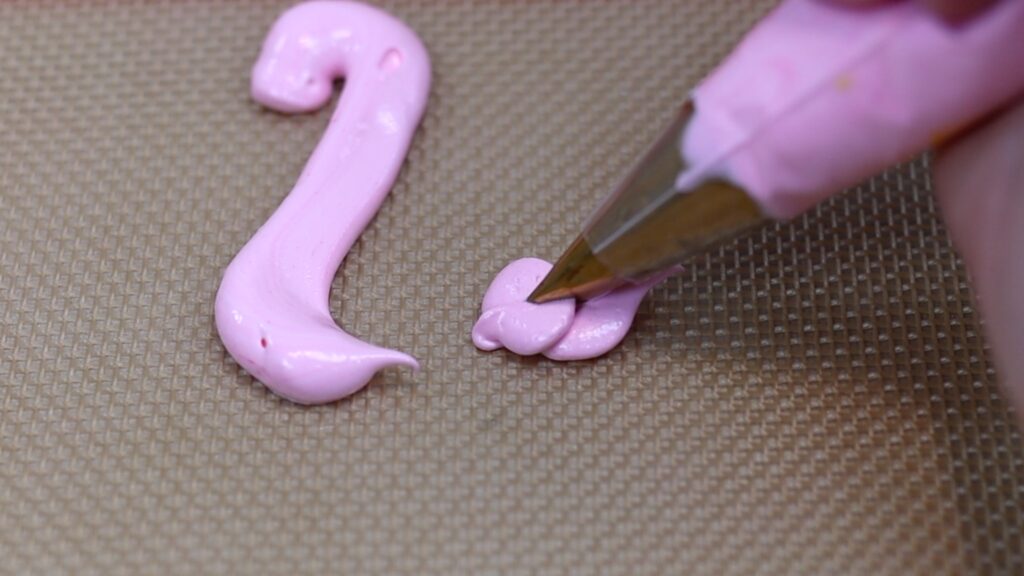
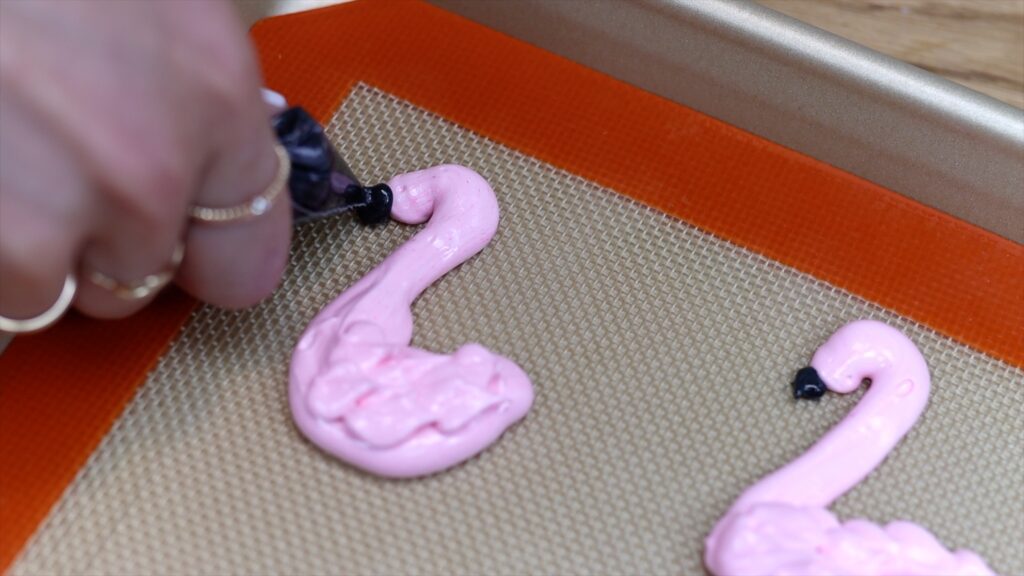
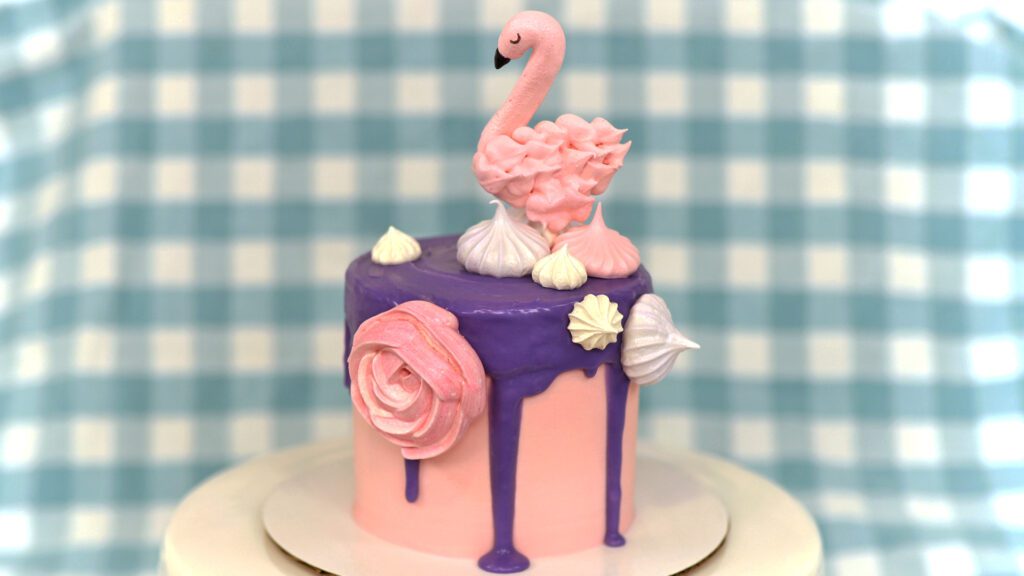
Intricate and adorable, a fun technique is how to make meringues shaped like animals! Draw or trace or print an outline or design and put it under parchment paper or a clear silicone mat. Then trace it with meringue. This is a medium round tip, a #12, and this is going to be a flamingo. Use a toothpick to smooth out any textured markings.
I don’t recommend using just a round tip because with stiff meringue it’s difficult to get a neat, smooth surface. You can add lots of amazing textures using different piping tips. If you're not using couplers, squeeze the leftover meringue from one piping bag into another piping bag with a different tip.
This is a leaf tip called a #352, which I’m using to pipe feathers onto this flamingo. Hold the two points of the tip above each other, like jaws, and squeeze to form a bulge. Pull the tip away to leave a point on the feather.
If you’re piping a shape for the first time, it’s a good idea to make more than one. Try different techniques to make different versions. It only adds a few seconds now, compared to having to start all over again after baking one that you don’t need up liking.
To make black meringue you'll need black gel. Since it's very concentrated you won't need more than a few drops to make jet black meringue. For tiny details like flamingo beaks, a sandwich bag works really well. Push the meringue down to a bottom corner of the bag and cut a tiny piece off the corner. Squeeze the bag to pipe the meringue. I’m making two flamingos so I can choose my favourite after they bake.
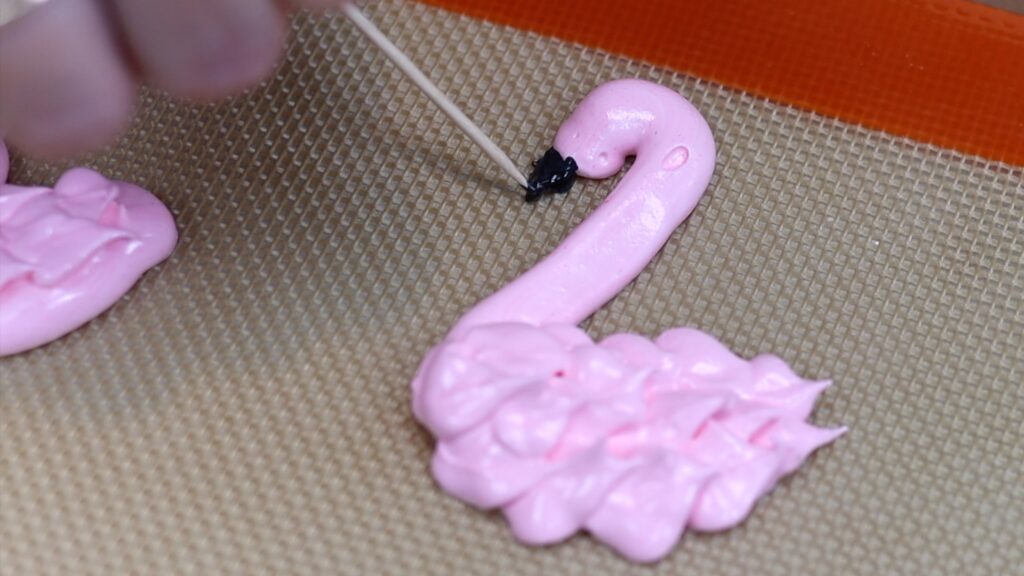
Use a toothpick to manipulate the meringue to make the shape you want and to smooth the texture in the piped meringue.
To draw lines for the eyes you can dip a toothpick into meringue and draw with that. The other way is to wait until the meringues are baked. Then you can use an edible marker to draw the line. I find this way to be a bit neater than the toothpick method. To use meringue designs as cake toppers, pipe them onto a straw or poke a straw in carefully after piping but before baking.
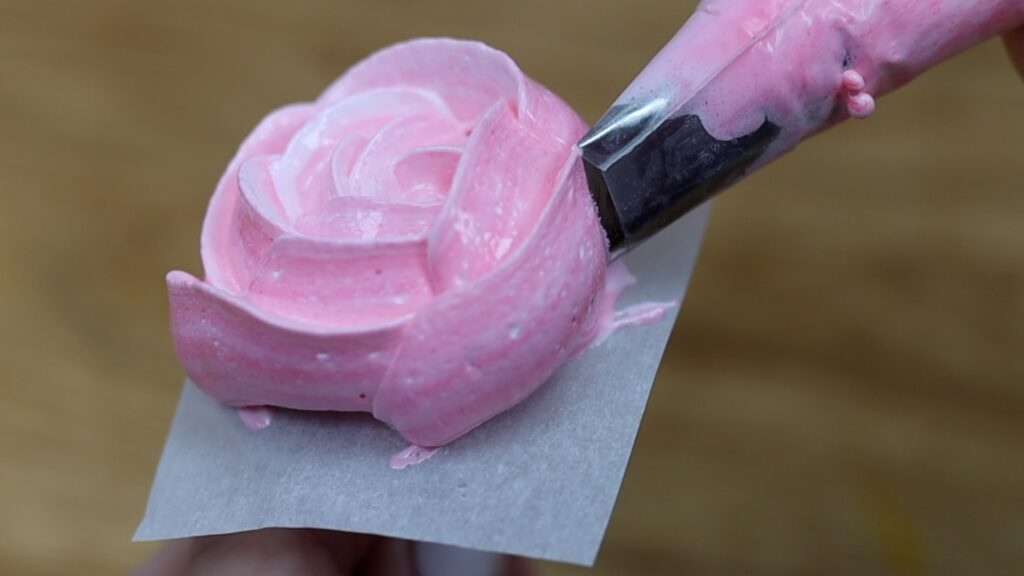
#5 Meringue roses
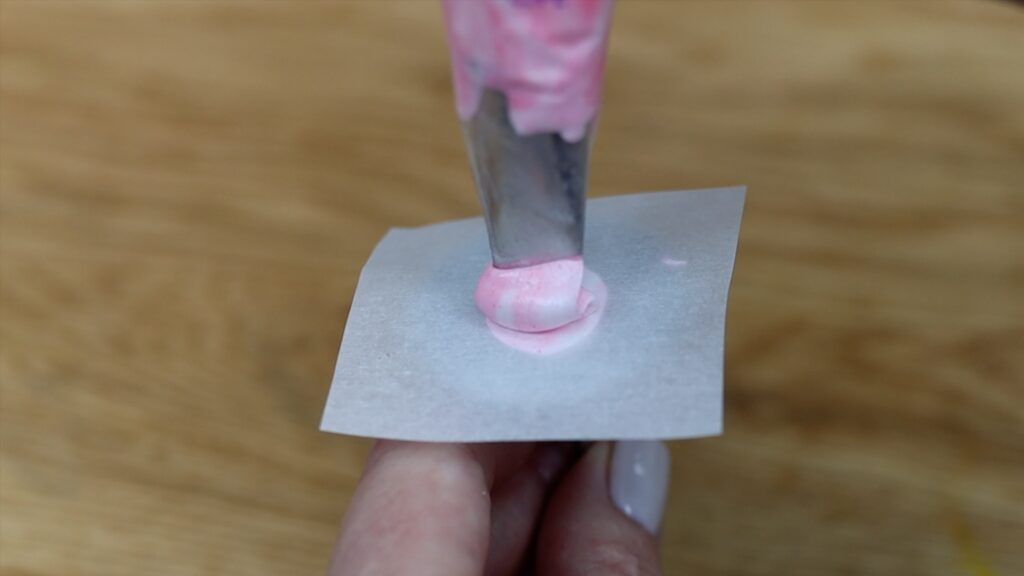
You can pipe flowers with meringue just like you would with buttercream. You’ll need a petal shaped piping tip, a little square of parchment paper and a flower nail. Squeeze some meringue onto the head of the nail and press the parchment onto that to attach it. Pipe a blob of meringue onto the middle of the parchment to start the rosebud.
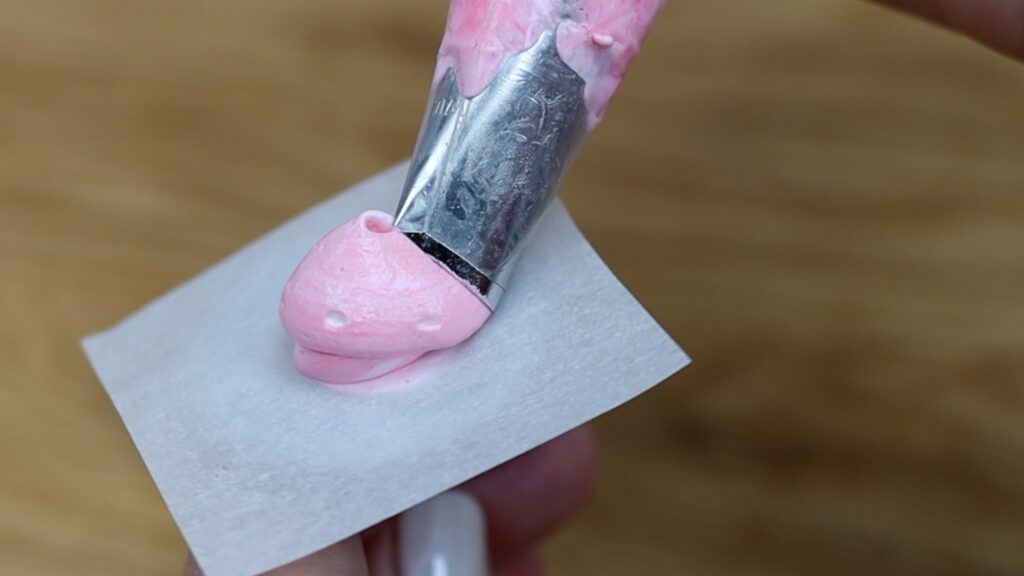
Then hold the narrow end of the teardrop shape of the petal tip pointing upwards. Squeeze the bag and spin the nail to pipe a spiral of meringue that wraps around the blob you just piped.
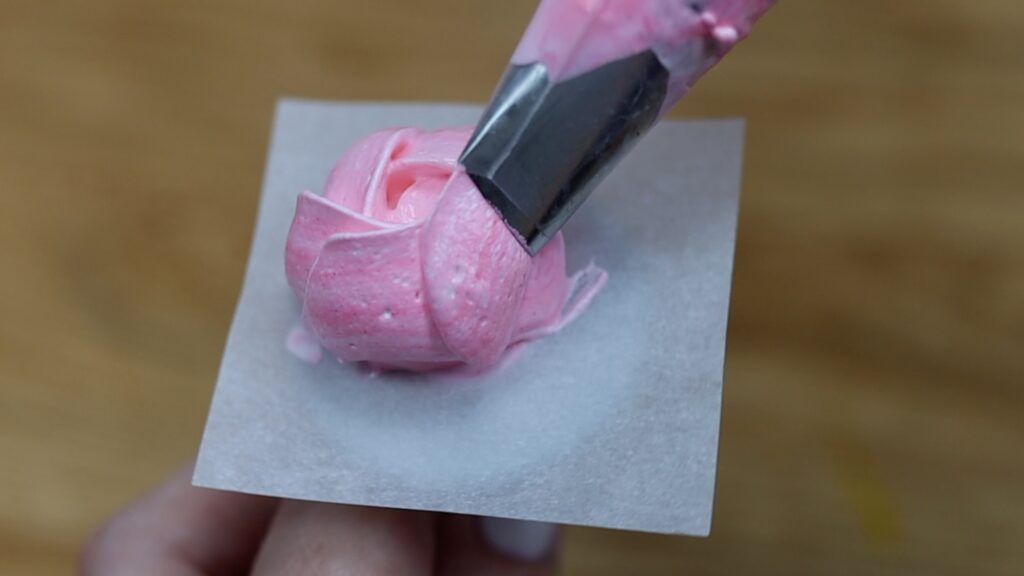
Now pipe petals around the rosebud, overlapping each one. Angle the top of the tip inwards to keep the petals tight.
Continue wrapping the petals around the flower. Gradually angle the top of the tip further out so that the petals start to fan out. When the rose is as big as you want it, pinch the parchment and slide it off the flower nail. Balance it on your fingers underneath the parchment and lower it onto the baking tray.
How to bake meringues
Bake meringues at 200F or 95C for 85 minutes. Then turn the oven off but leave the tray in for an hour before you take it out. The gradual heating and cooling will prevent the colours from yellowing and also prevent cracking of the meringues.
These meringues are crispy on the outside but when you bite into them, the centers are soft and slightly chewy. In a second I’ll show you how to store them to keep them like this!
How to make meringues stick to a cake
Here are three ways to attach meringues to a cake. You can push them into a drip while the drip is still sticky, before it sets, and they’ll attach easily.
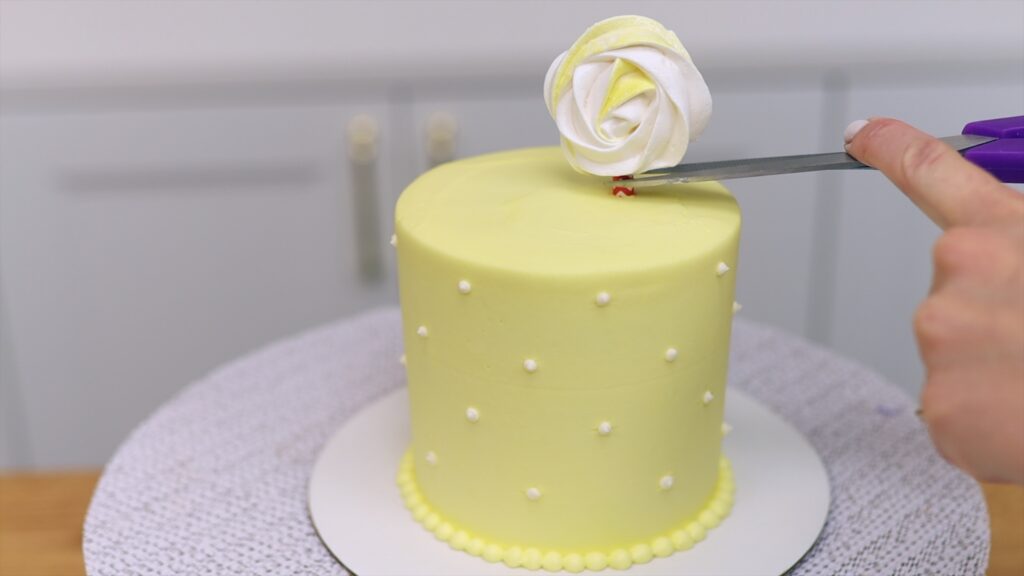
If you baked a meringue on a paper straw you can push the straw into the cake. This makes the meringue stand up on top of the cake, like this flamingo. Leave some of the straw visible or cover it up with more meringues. To hide the straw, push the meringue all the way down into the cake. Don't push directly on the meringue because it will crack. Instead, use scissors or tweezers to grip onto the straw and push it down.
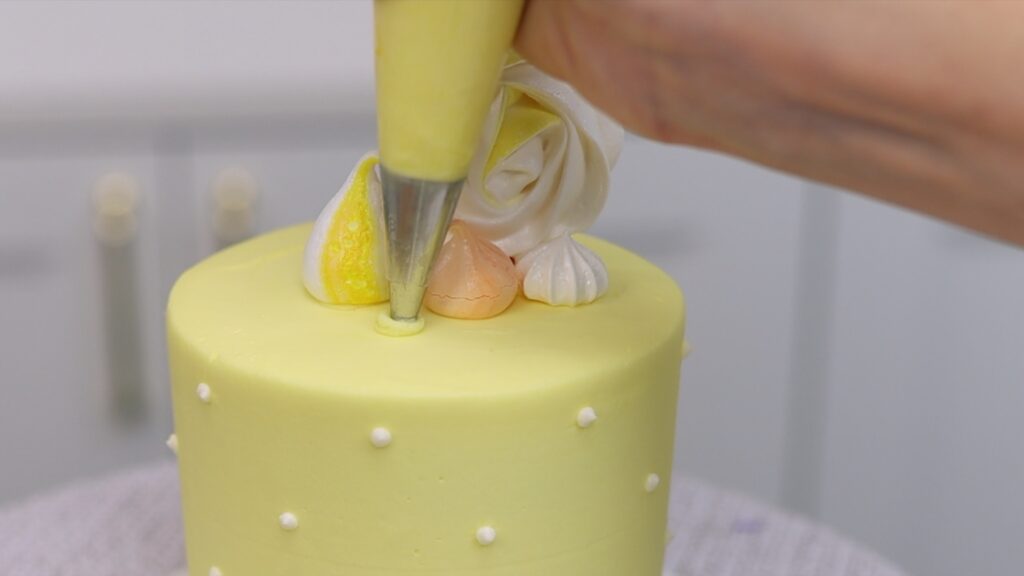
To attach meringues to a cake after the frosting has set you'll need someone to act as glue. I like to pipe or spread a tiny bit of fresh frosting onto the cake wherever I want to place a meringue. You can pipe or spread it onto the bottom of each meringue instead. Then push the meringue gently onto the frosted cake to attach it.
This works on the top of the cake but also on the sides! When the frosting dot sets it will keep the meringue securely in place. Isn't this cake gorgeous? Visit my cake school for online courses on hundreds of cake designs and techniques and sign up for my free course in the menu at the top of this bar!
How to store meringues
You can make meringues ahead of time and store them at room temperature or in the fridge or freezer. They should be separated by wax paper or parchment paper so that they don’t stick to each other. Use an airtight container like a Tupperware, which keeps them crispy. This way they won’t get soggy or sticky. You can store meringues at room temperature or in the fridge for two weeks or in the freezer for a month.
I can’t wait for you to try these meringues! Here's the recipe and you can convert between US measurements (cups) and Metric (grams and ml) by clicking at the top right of the recipe.
Meringues are beautiful and delicious and easy to make! They make yummy treats and gorgeous cake decorations.
Ingredients
UnitsScale
4 egg whites (160g)
1cupgranulated white sugar
a pinch of salt
1/4 teaspoon flavour extract
optional: gel colours
Instructions
Bring about an inch of water to a boil in a small saucepan.
Pour egg whites, sugar and salt into a metal mixing bowl. Place the bowl on top of the saucepan and turn off the heat. Whisk for two minutes, until the mixture feels smooth when you pinch some between your thumb and finger.
Whisk the mixture on high speed for nine minutes, until it turns bright white and shiny. The whisk will leave texture behind in the meringue as it whisks and when you lift the whisk up, the meringue will hold its shape and make stiff peaks.
To tint the entire batch, add gel colour now. Add flavour and mix until combined.
To make different colours of meringue, divide the meringue into separate bowls and add gel colours to each bowl. Gently fold the colour in using a spatula.
Spoon the meringue into piping bags and pipe shapes onto a baking tray lined with a silicone mat or parchment paper.
Bake at 200F or 95C for 85 minutes. Turn the oven off and leave the meringues inside for one hour to cool gradually.
Store meringues in an airtight container for two weeks at room temperature or in the fridge or you can freeze them for one month.
Notes
To make meringue pops you'll need a paper straw for each meringue. Pipe a dot of meringue onto the parchment or silicone mat, press the top of the straw into the dot, and pipe over it.
Here are 3 easy rainbow cake designs that are quick to decorate but stunning to look at!
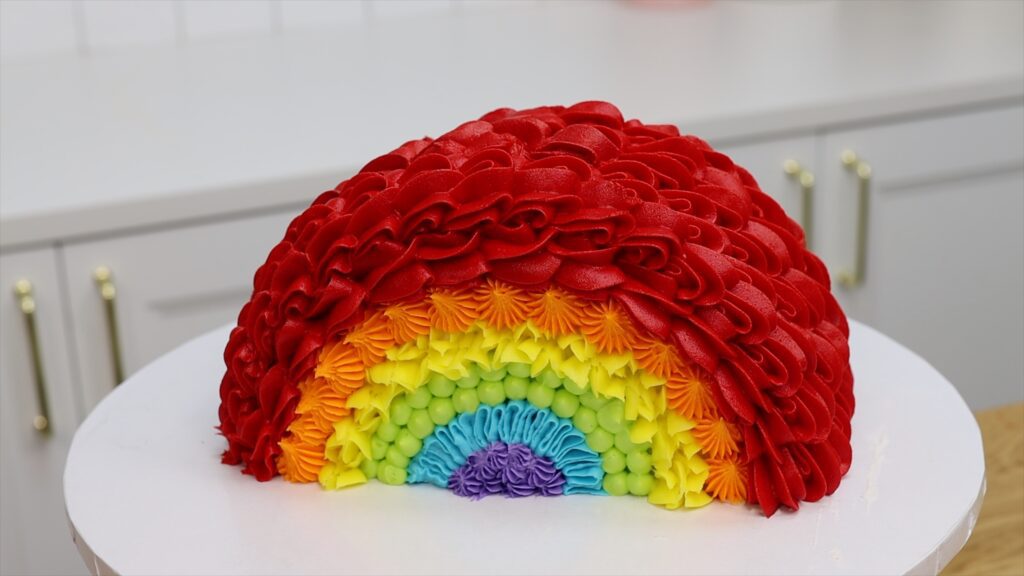
#1 Piped rainbow cake
For this first easy rainbow cake design I’m using sprinkled cake layers for an extra burst of colour. This is my Very Vanilla cake with pink nonpareil sprinkles, called hundreds and thousands in the UK. You could use rainbow sprinkles to make the cake rainbow coloured inside and out!
After assembling your cake, cover it with a thin layer of frosting called a crumb coat. This doesn’t need to be perfect because it’s going to be covered up in a minute. However, getting it nice and smooth will make the rest of the decorating easier and neater. Let the frosting set while you prepare your colours.
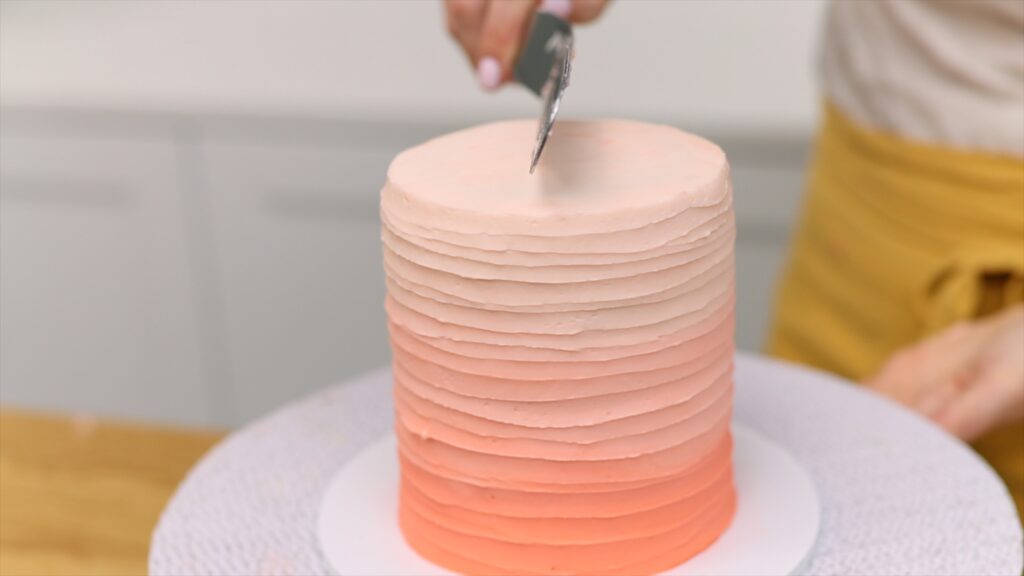
After the crumb coat sets, spread more frosting onto the top of the cake and smooth it. The top of the cake is going to be visible at the end so you want it to be neat. After smoothing the frosting on top, use a cake comb to flatten it around the sides.
How to pipe rainbow colours onto the cake
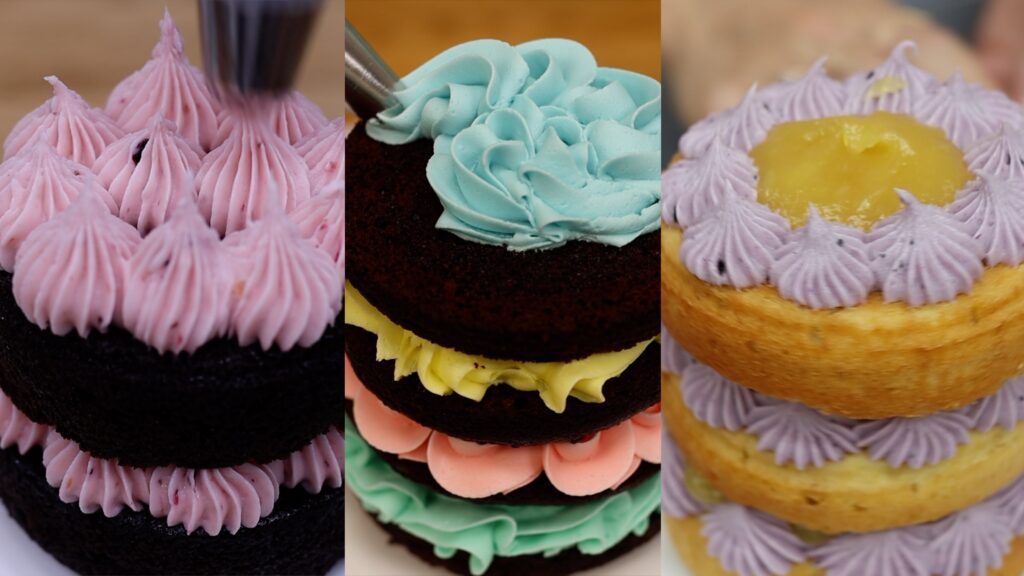
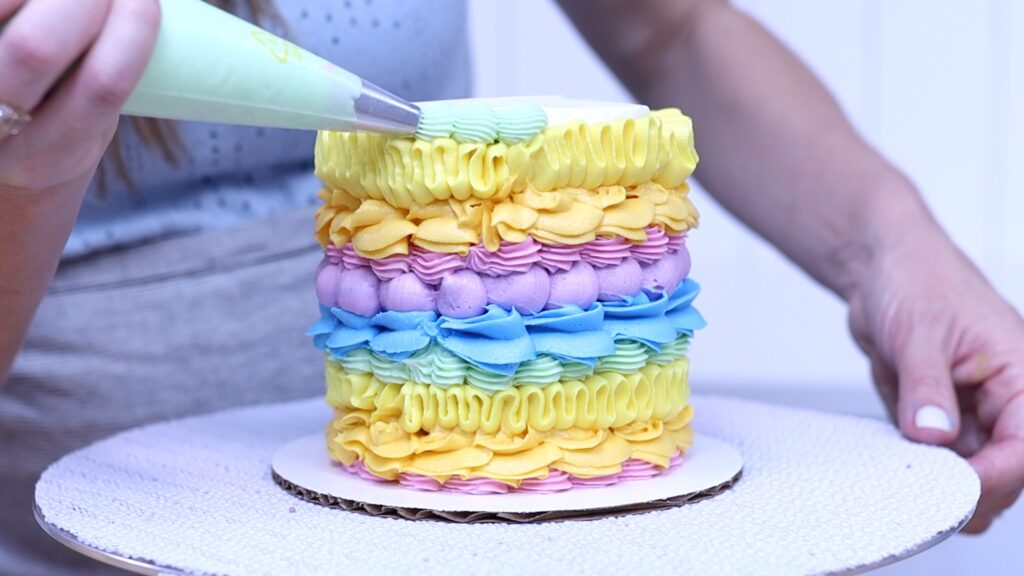
For the most eye-catching results choose several different piping tips. My favorites are star tips like a 1M, #32, #4B, #199 and petal tips like a #104 or #125.
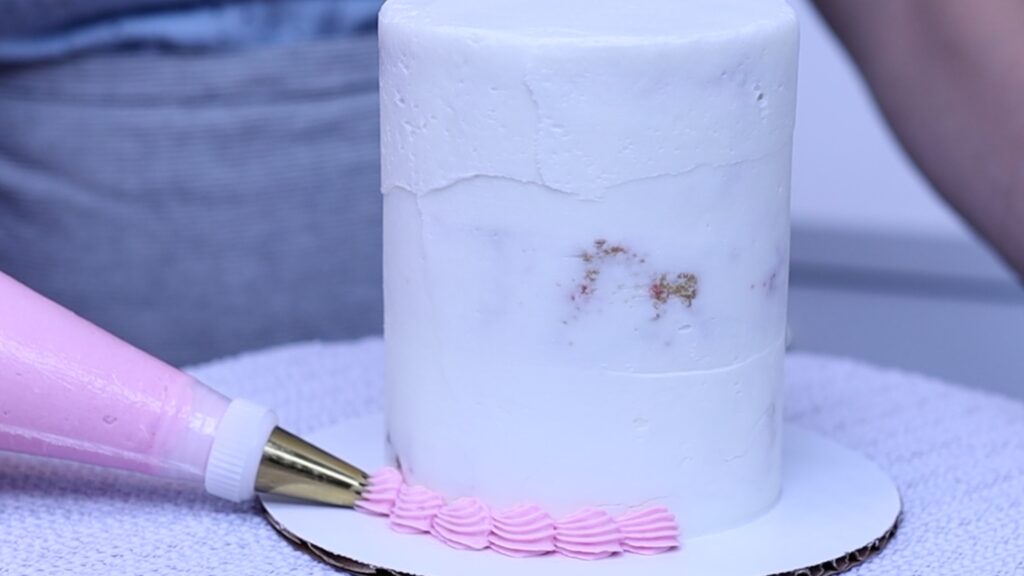
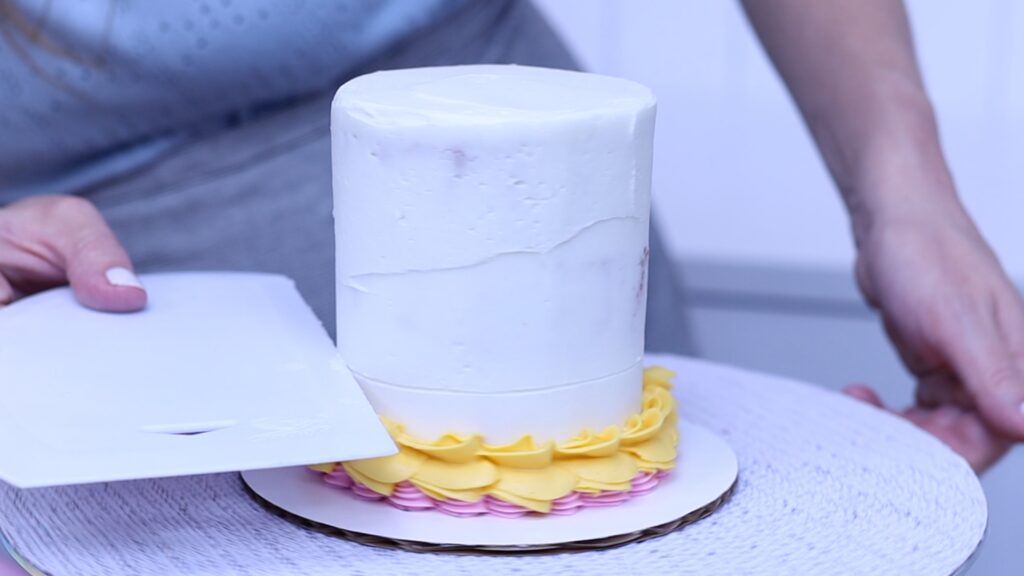
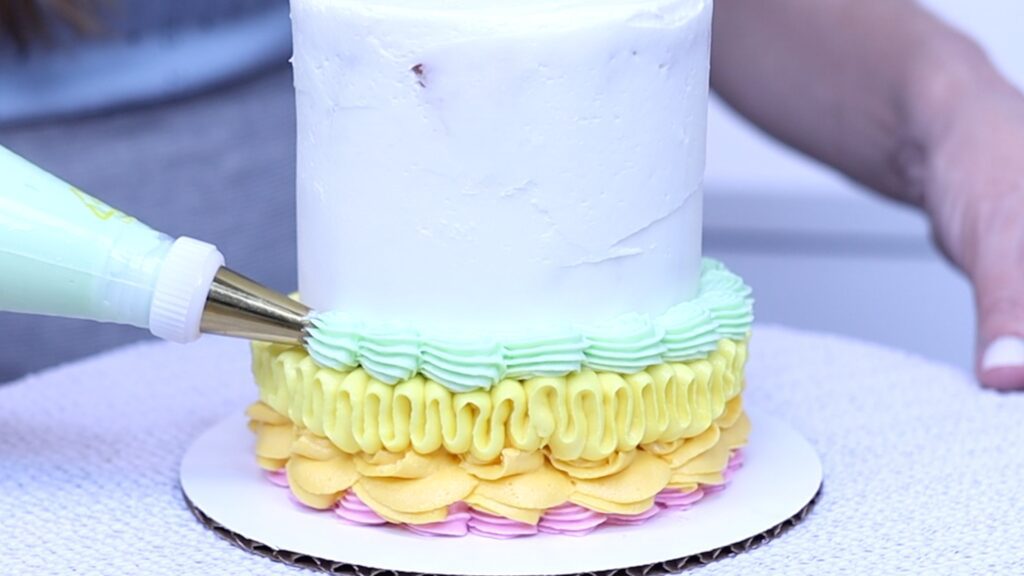
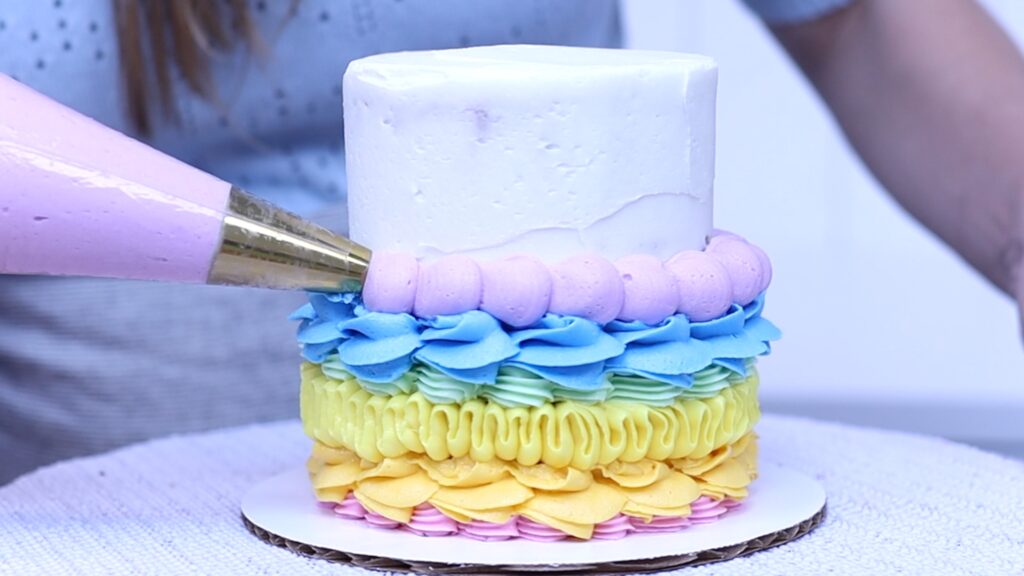
Choose a colour to start with. This is a #32 open star tip with my 4 Minute Buttercream tinted pink with gel colours. To pipe a shell border like this, hold the piping bag on its side and squeeze the buttercream out. Hold still for a moment to let the buttercream bulge out. Then pull away to leave a tail on the dot. Overlap each dot all around the cake to pipe a row of these shells or waves.
Where you start and finish there will be a join that looks different to the rest of the texture. If you start above that with your next colour, all of the joins line up over each other. This can be the back of your cake.
This is a 1M star tip and I’m using the same technique to pipe a shell border with it. This piping tip is much bigger than the others so the piped details are bigger, too. It looks really big now but once the rest of the details are added, I think the variation looks nice.
Sometimes it’s useful to have a guideline to mark the top of the row of piping. You can use the straight edge of a cake comb to indent one into the crumb coat.
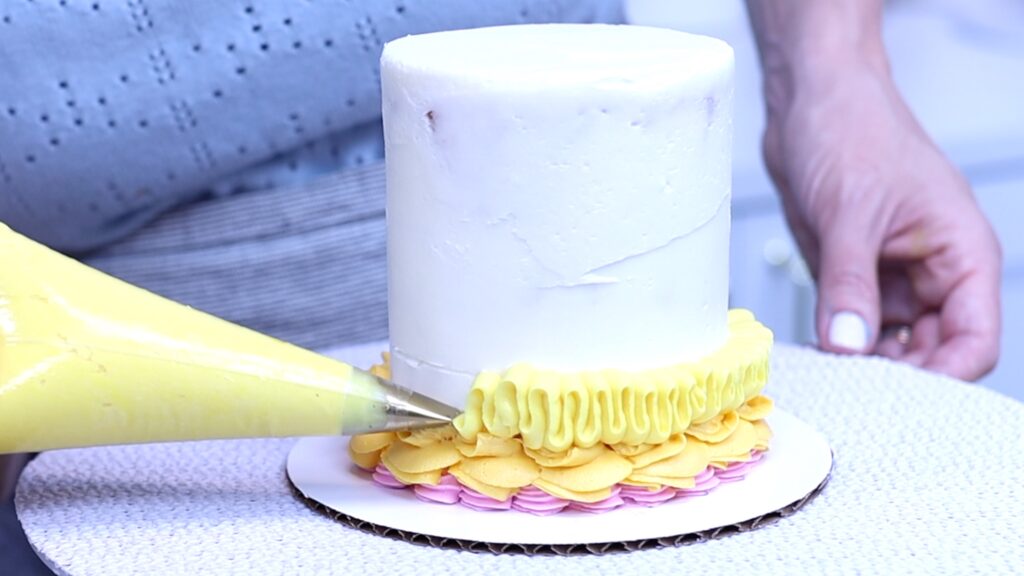
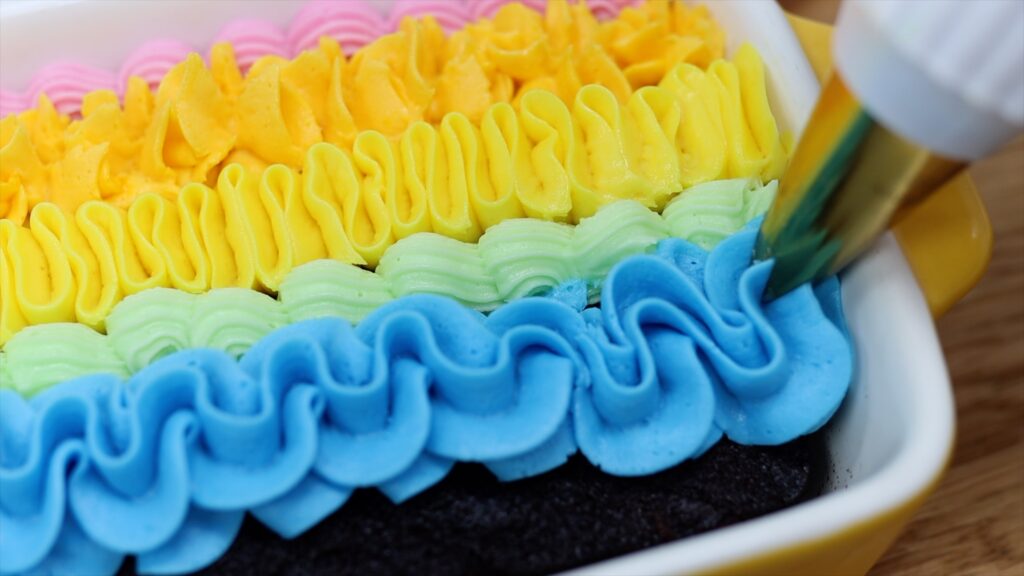
To pipe ruffles with a petal tip, hold the tip with the narrow end of the teardrop shape pointing outwards and the wide end pressed against the cake. Squeeze the bag as you move it slowly up and down around the cake. Pause for a split second at the top and bottom to allow the buttercream to curve softly around.
The bottom of the piping tip should touch the piping underneath it every time you go down. That way you’ll make sure you cover up the crumb coat completely with no gaps in between the different colours of piping.
There’s no “right” way to create the join between the beginning and end of piping. Create whatever texture you can and as long as you’re lining up your joins above each other, that side can face the wall when you display the cake so no one will see it anyway!
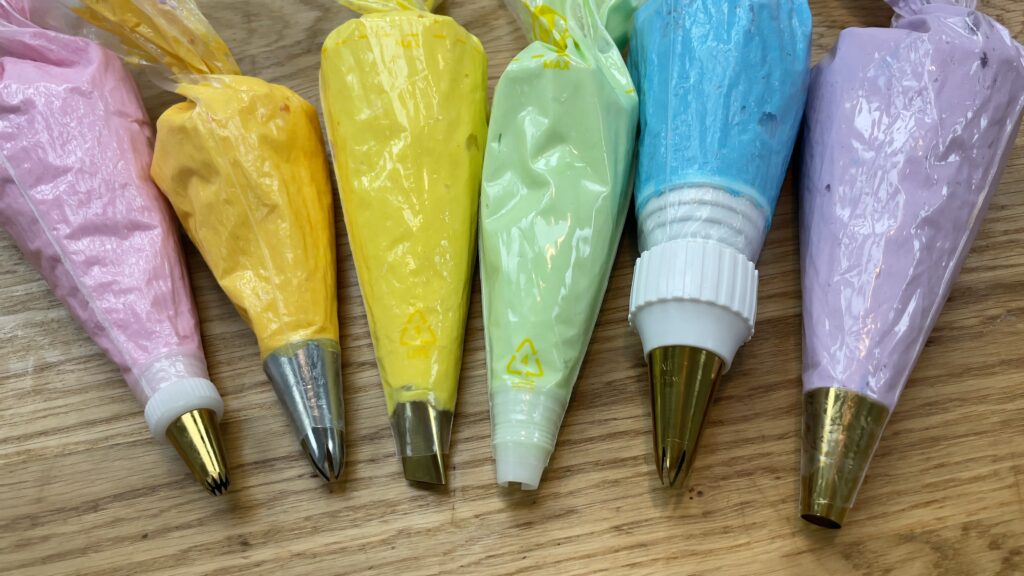
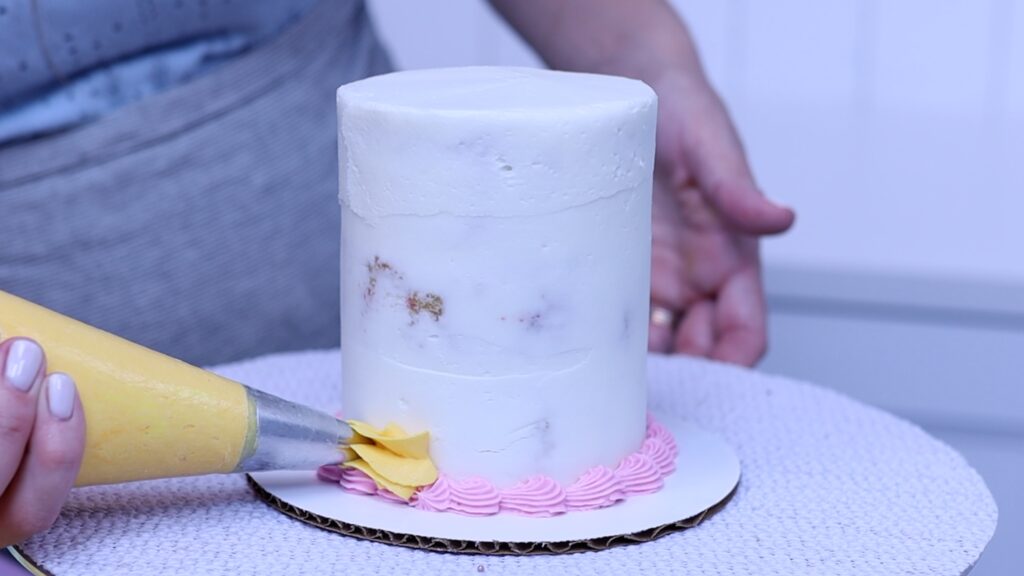
Couplers are useful if you want to be able to use the same piping tip with different colours. After piping with one colour, unscrew the ring to remove the piping tip and then place it on another coupler on another piping bag. Squeeze the bag to push out the previous colour until you see the new colour come through. For 4 reasons to use couplers, check out my tutorial on how to use couplers.
Being able to switch between piping tips by using couplers really saves a lot of time when you’re piping. And by re-using piping tips with different colours, you’re limiting the number of tools you need to buy. You're also reducing clean up afterwards! Since the same texture on the cake has different colours, it still adds lots of variety in your design.
I’m using pale rainbow colours but you can use bright colours instead. To make darker buttercream you’ll need to add a few more drops of colour when you tint your frosting. I’m using my 4 Minute Buttercream which takes on colour very easily so with just a few drops you can create really bright and bold colours.
Round tips like this 2A pipe dots or beads. The bigger the tip, the bigger the beads. Use the same shell border technique to pipe beads with tails and overlap each one.
When you get to the top of the cake and you’re tempted to stop, keep in mind that the cake will look neatest if your final row of piping sticks up above the top edge of the cake.
Voila! Beautiful colours and textures that make a quick and easy but stunning cake design!
#2 Rainbow layer cake
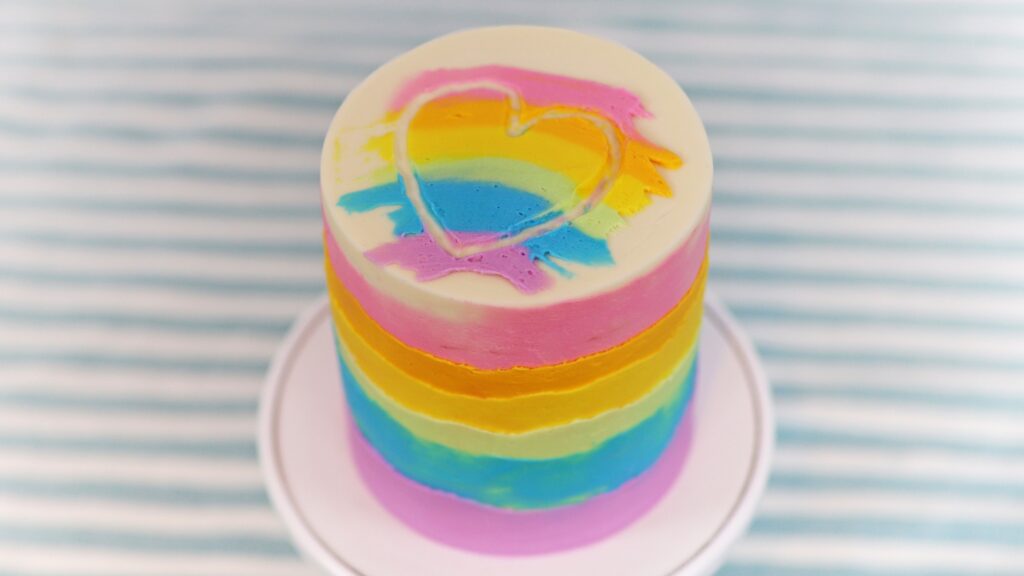
Skip the texture and create flat layers of your rainbow colours around a cake with this next technique.
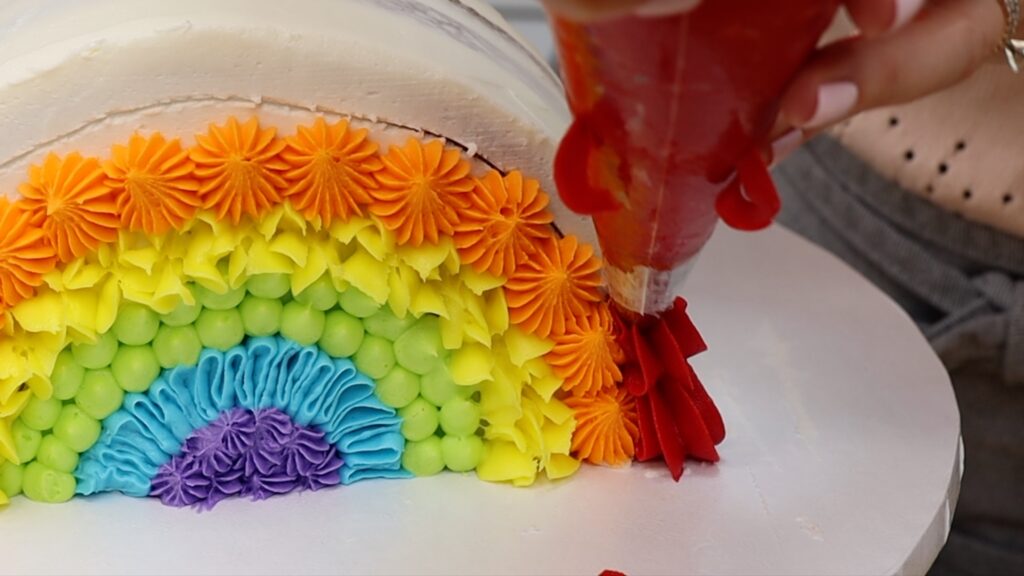
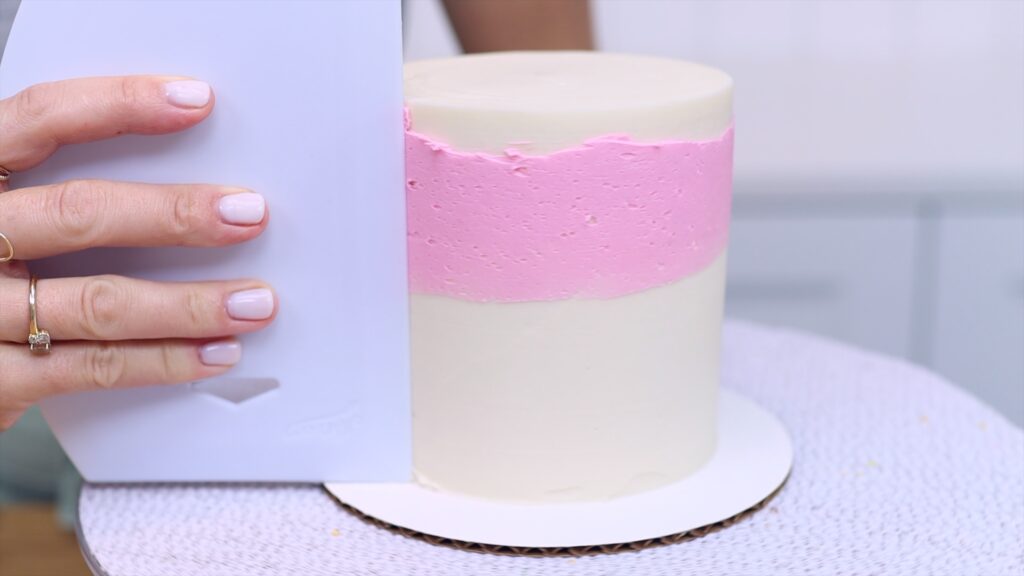
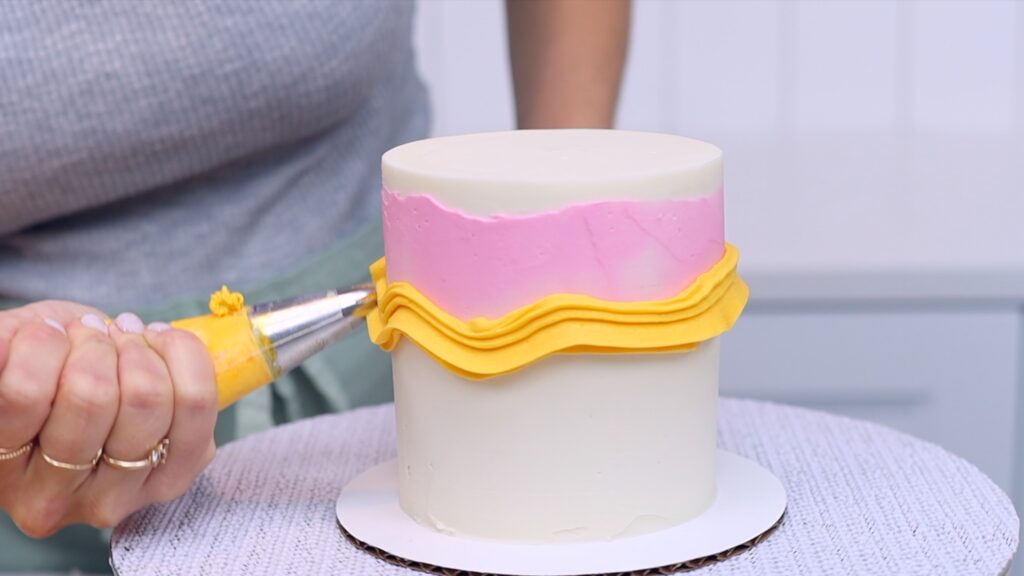
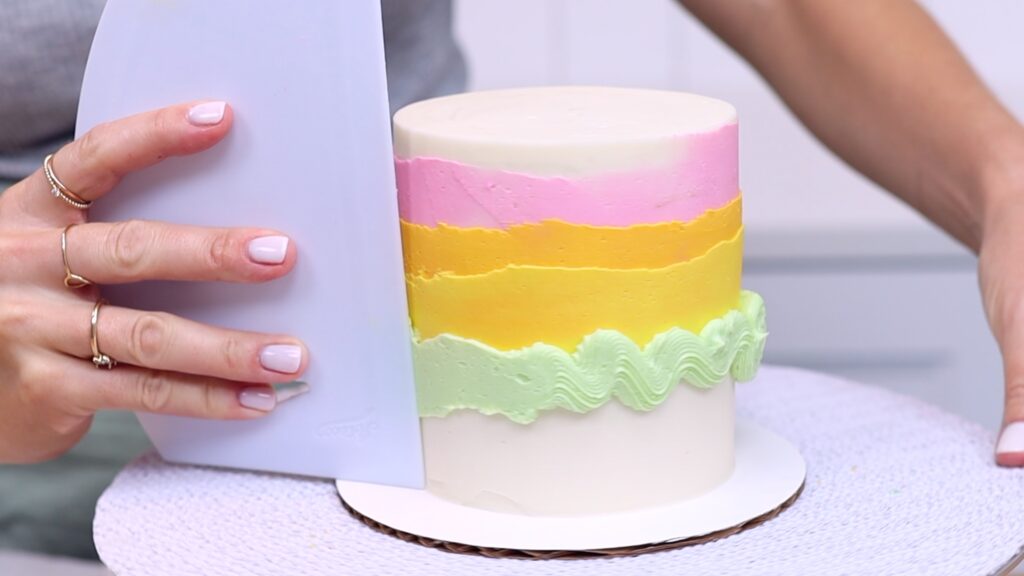
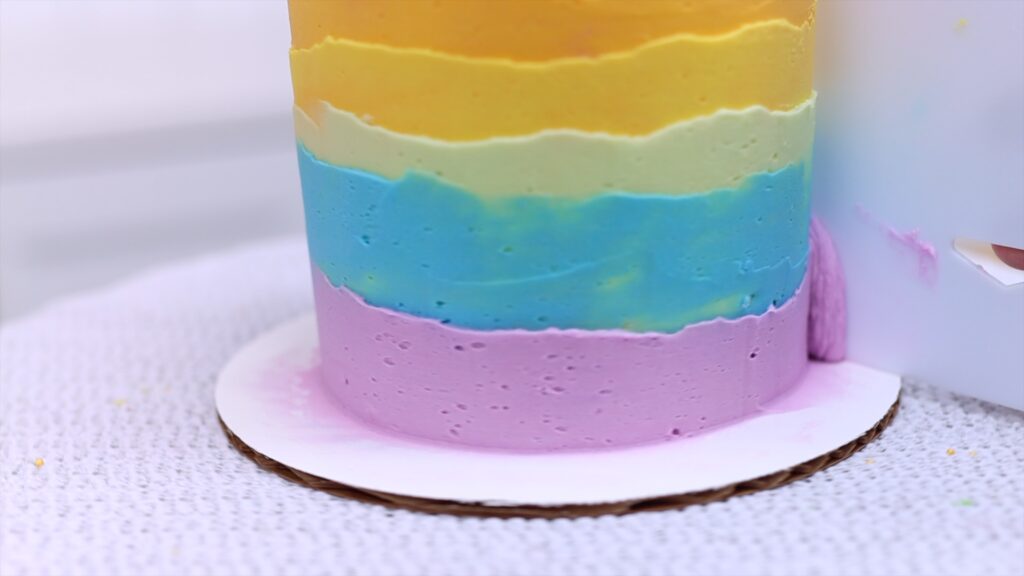
You can either spread or pipe the colours onto the cake. Since I already have my colours in piping bags I'm piping them on but if you don't, it's quicker to spread them on. Start at the top of the cake, creating a ring of colour all around it. Then scrape around the cake gently with a cake comb to leave a thin, smooth layer of colour on the cake.
After each time you go around the cake, scrape the excess frosting off your cake comb into a bowl. If you take off more frosting than you want you might be able to see the frosting on the cake through the band of colour. Spread some of the scraped-off coloured frosting back onto the cake and then smooth it again.
Pipe or spread your next colour underneath, overlapping the first colour so that there’s no gap in between the two colours.
Three tricks to this rainbow layer cake design
First, use a crusting buttercream like my 4 Minute Buttercream. It gets really firm when it sets and makes this layering effect possible. With soft frostings like whipped cream, the colours blend into the frosting on the cake instead.
Second, take your time to get the frosting really smooth. These colourful layers won’t completely cover the cake and they won’t disguise messy frosting.
Third, chill the cake in the fridge for at least two hours before you do this. That way, the frosting will be very firm and you can pipe or spread and scrape the colours without damaging it. Also, the colours will set very quickly when they’re on top of very cold frosting so the colours will create layers over each other instead of blending together.
Make a rainbow on top of the cake
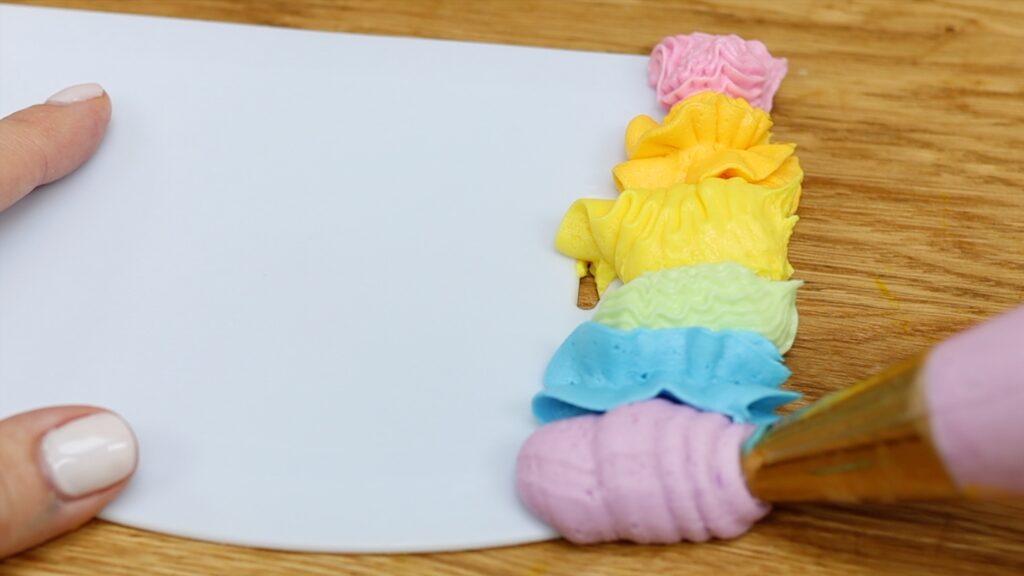
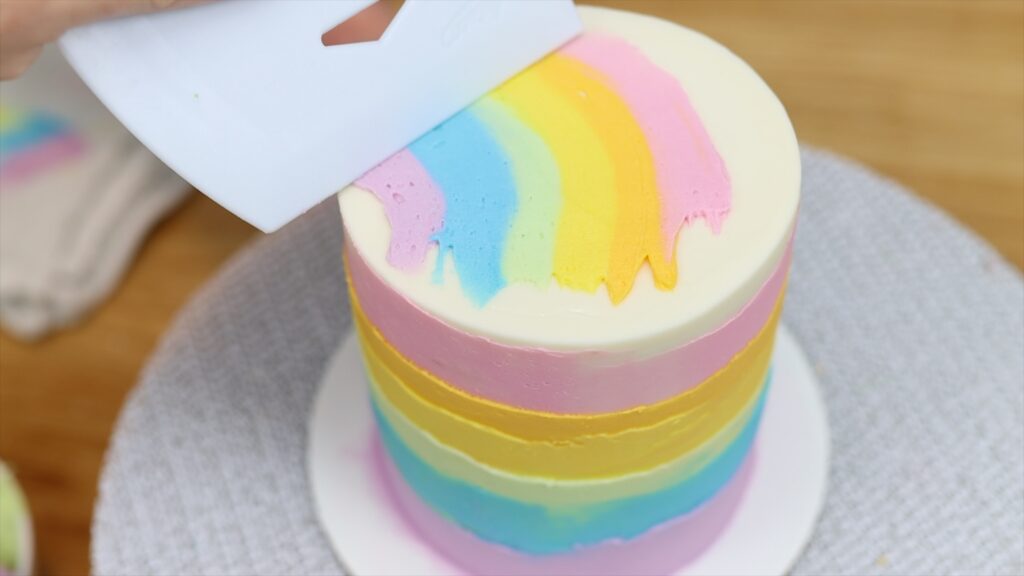
To add some detail to the top of this cake, squeeze a little bit of each colour of frosting onto the straight edge of a cake comb. My cake is tiny, it’s only 4 inches wide, so I’m using the bottom edge of the comb instead of the side.
Then lower the comb onto the top of the cake and pull it in a curved, arc shape over the top surface of the cake to leave a rainbow behind! You might need to spread on a bit more of some of the colours and scrape again to get good coverage.
You can use a piping tip or a toothpick to draw a design in the rainbow as well, if you like!
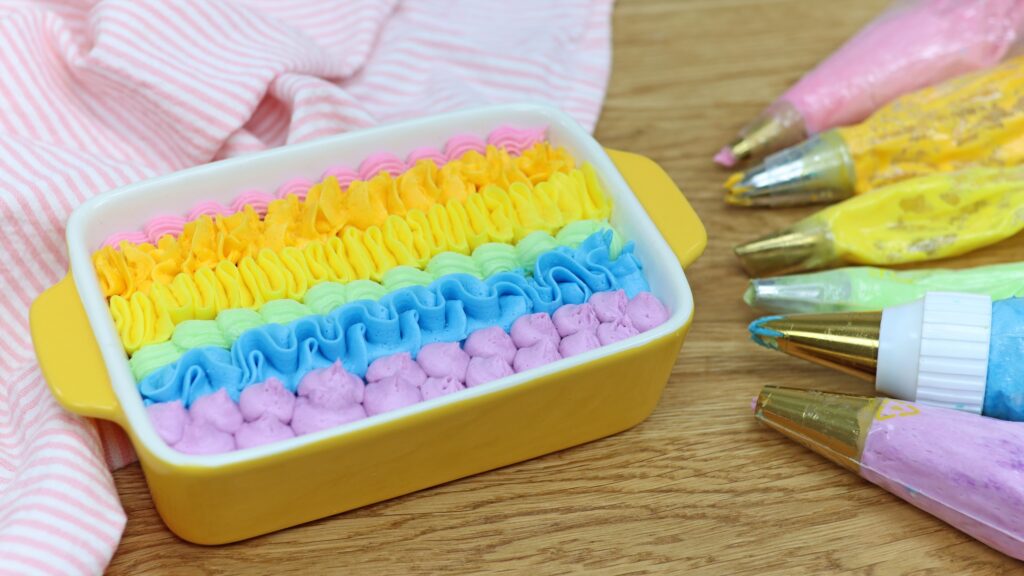
#3 Rainbow Tray Bake
If you want rainbow cake that’s very quick to decorate, this one’s for you! Pour your cake batter into a baking dish or casserole dish and bake it in that. Let it cool completely and then decorate your cake in the dish, so you don’t need to assemble and frost it first!
You can spread frosting onto the cake or use piping tips to create colourful texture like on the first cake. Piping down onto this cake is easier and quicker than piping onto the side of a cake!
The best bit about this rainbow tray bake cake is that transporting and serving it in a dish is so simple!
You can achieve endless cake designs without buying expensive tools! In this tutorial I’m going to show you five ways to use parchment paper for cake decorating.
#1 Patterned borders
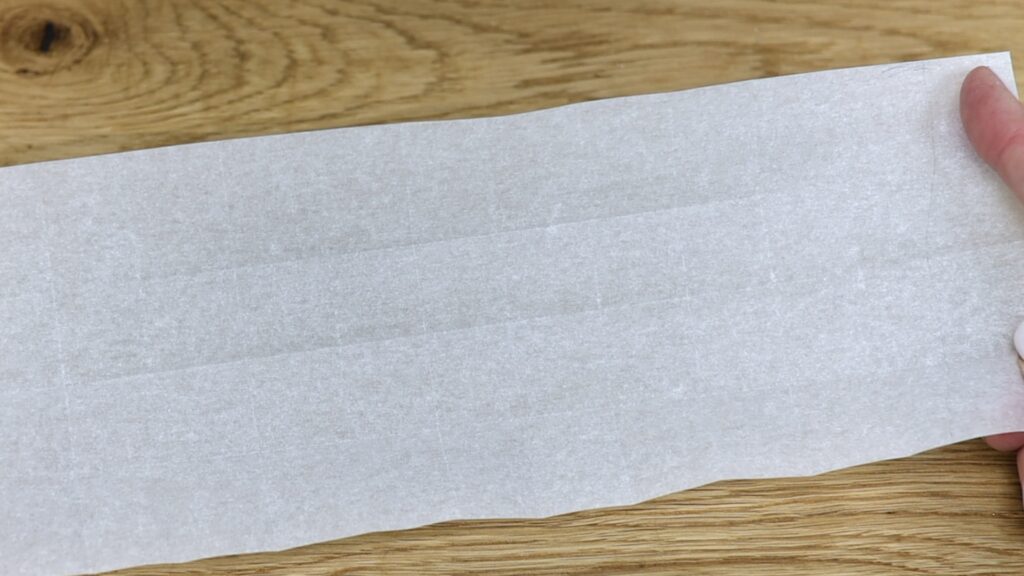
Use this technique to create perfectly symmetrical patterns like zig zags. Wrap a strip of parchment paper around a cake and draw a line where the two ends overlap. Don’t worry about the top edge yet.
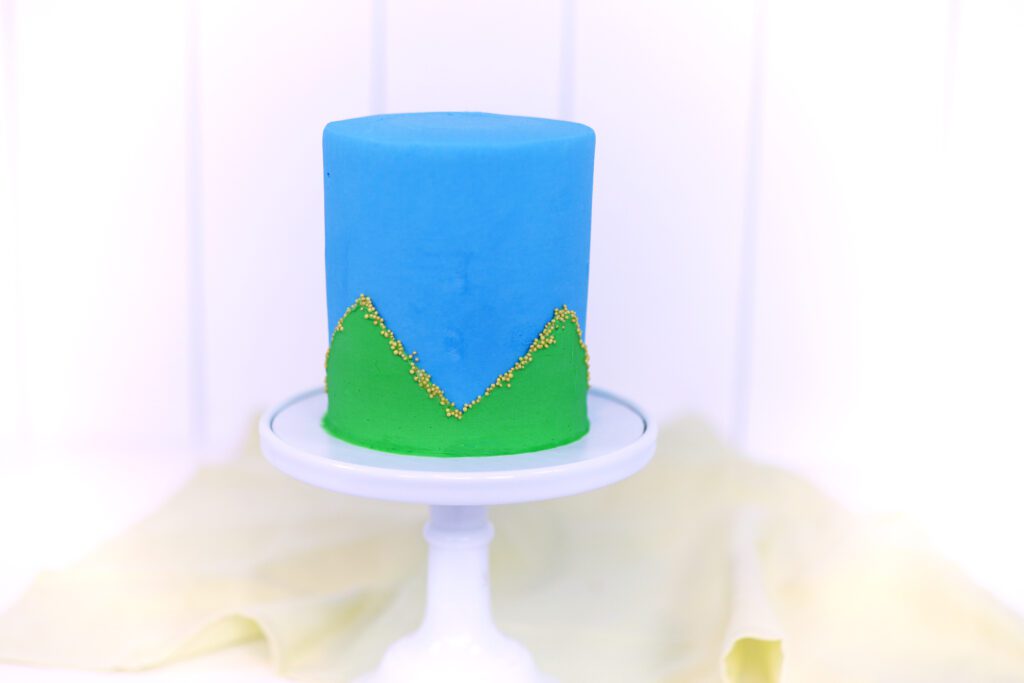
Fold the paper in half and half again until it's the width you want for each section of the zig zag. Create another fold to mark where you want the top of the zig zags to be. You can draw dots where the creases going up meet the crease along the top so that you can see them better. Then cut diagonally up from the bottom of one crease, to the top of the next. Go in one direction like left to right for now, and skipping every other dot.
Then cut in the other direction, from the bottom of one crease up to the next dot. This will create the other side of your zig zags. This is going to be your stencil.
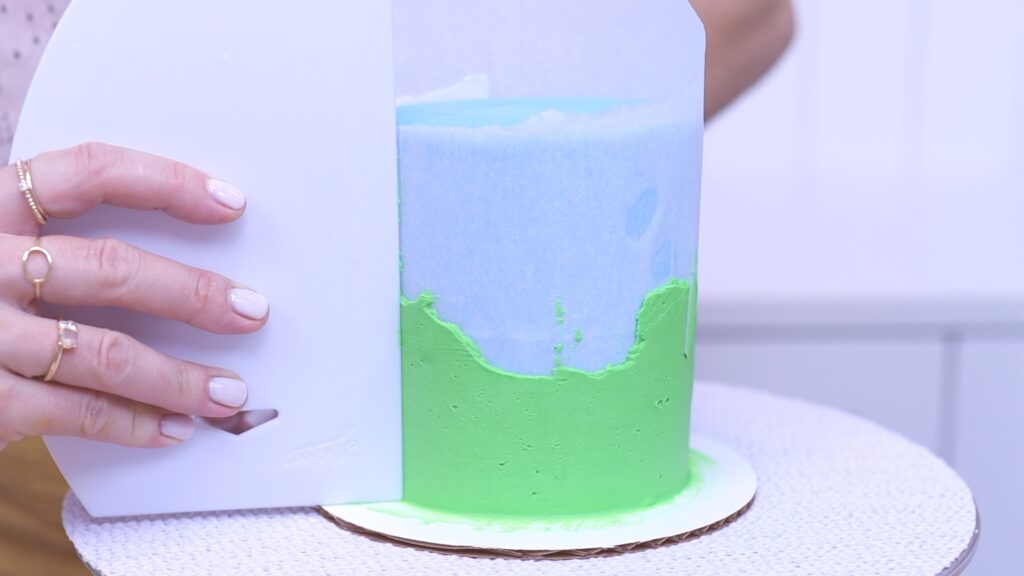
Wrap the zig zag stencil around your cake after the cake has been in the fridge for at least an hour so the frosting is cold and firm. After a few minutes at room temperature there will be tiny beads of condensation on the cake. These will make the parchment stick to the cake and stay in place.
Spread another colour of buttercream over the exposed cake that’s showing underneath the stencil. Once that’s covered up, scrape around the cake with a straight cake comb or frosting smoother to flatten this buttercream.
Spread more buttercream over any indents and scrape until until it’s completely smooth. Then peel away the zig zag stencil to leave the zig zag pattern behind on the cake!
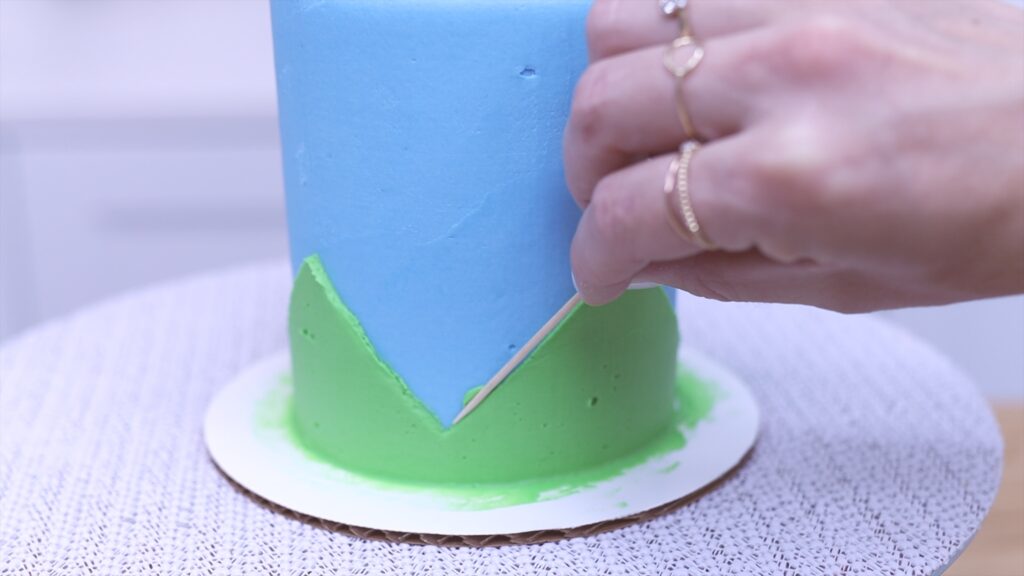
If there are any smudges of buttercream on the cake you can scrape them off with a toothpick. Since the frosted cake is cold, that frosting will be so firm that you won’t damage it with the pressure of the toothpick.
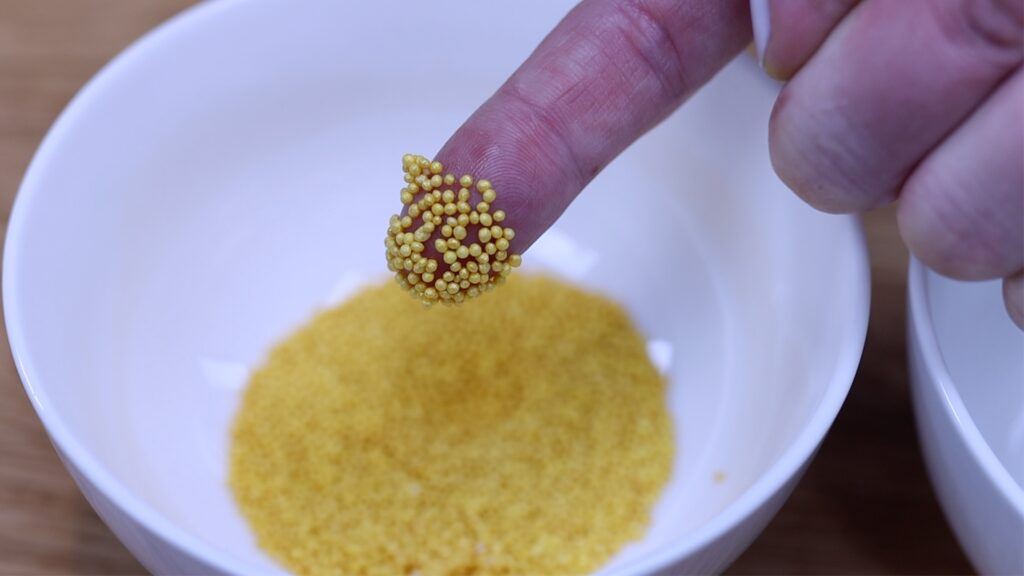
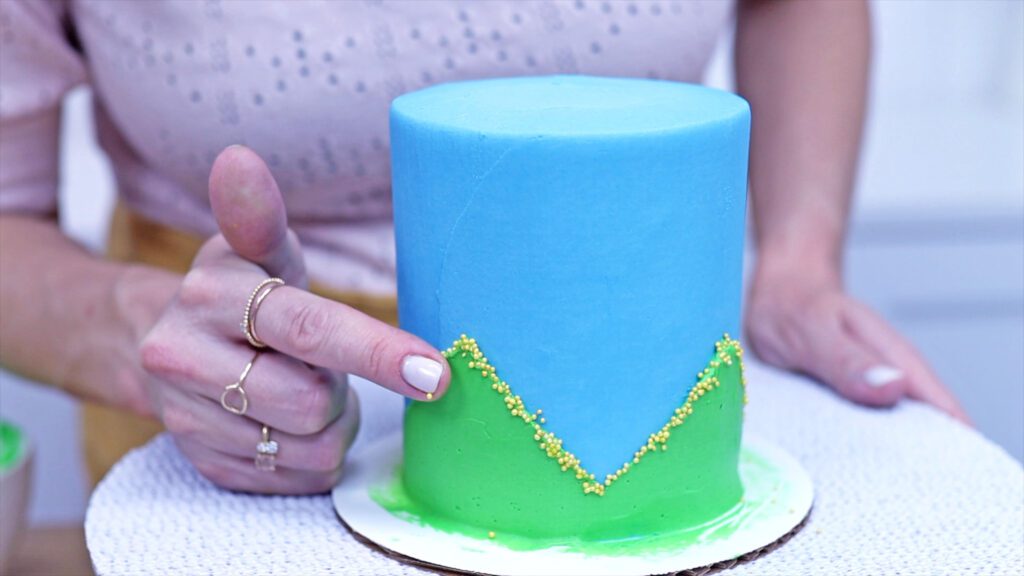
As an optional finishing touch, pour some sprinkles into a bowl and water into another bowl. Dip your finger into the water and then into the sprinkles so that they stick. Then push gently into the top of the zig zag. The sprinkles will stick to the soft sticky buttercream instead of your finger.
Chill the cake in the fridge for about an hour to set the zig zag buttercream. Then you can wipe the smudges off the cake board with a paper towel wrapped around your finger. Since the cake is cold you can brush right up against the frosting without damaging it.
#2 Dotted pattern
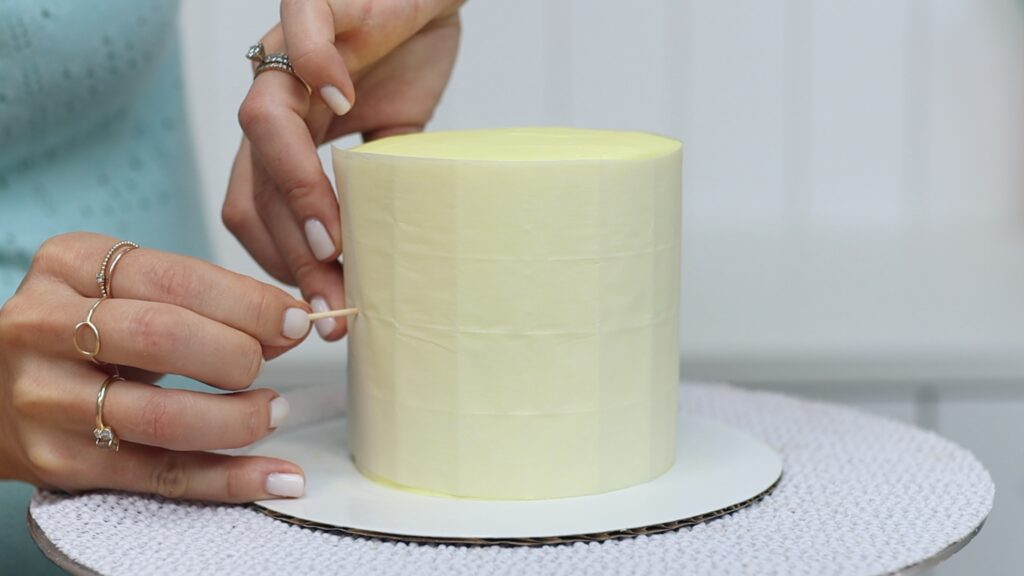
Another fun cake design to create with parchment paper is a dotted pattern. Just like the previous pattern, wrap a piece of parchment paper around the cake to measure it. Then fold it in half as many times as you like, horizontally and vertically, to form a grid pattern.
The vertical creases will meet the horizontal creases and form points, or I’ll call them joins in this tutorial. Wrap the parchment around the cake and push a pin or a toothpick through one of the joins to hold it in place.
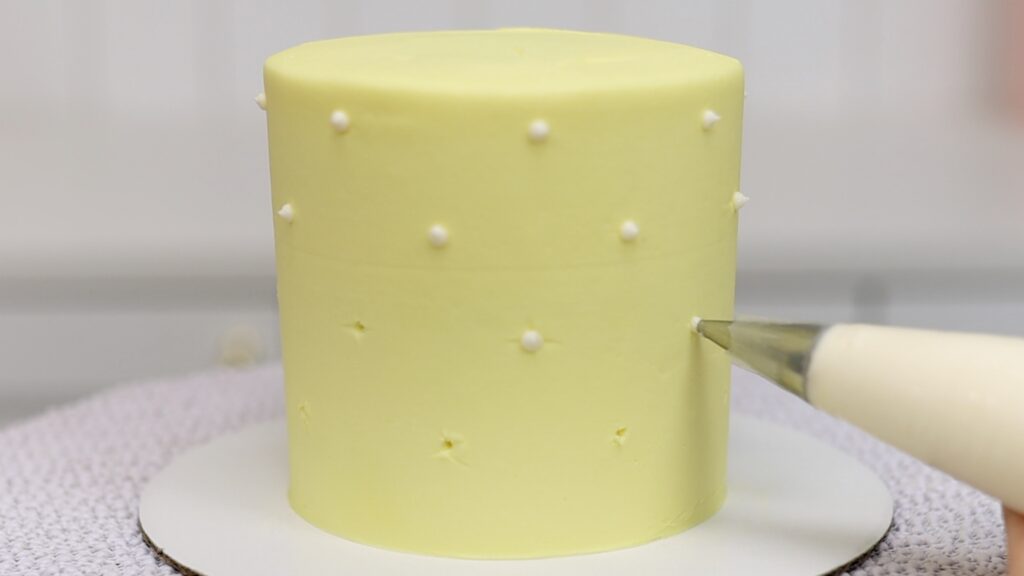
Then continue to poke a pin or toothpick through every join. Make sure you push through the parchment and into the frosting on the cake underneath. When you peel the parchment off you’ll have an even grid of dots that covers the cake.
Now use a piping bag with a small round tip to squeeze little dots of buttercream onto the dots. This makes a dainty, subtle pattern that compliments any other decorations without distracting from them. I have a recipe and tutorial for these meringues for cake decorating in case you want to make your own!
#3 Silhoette stencil
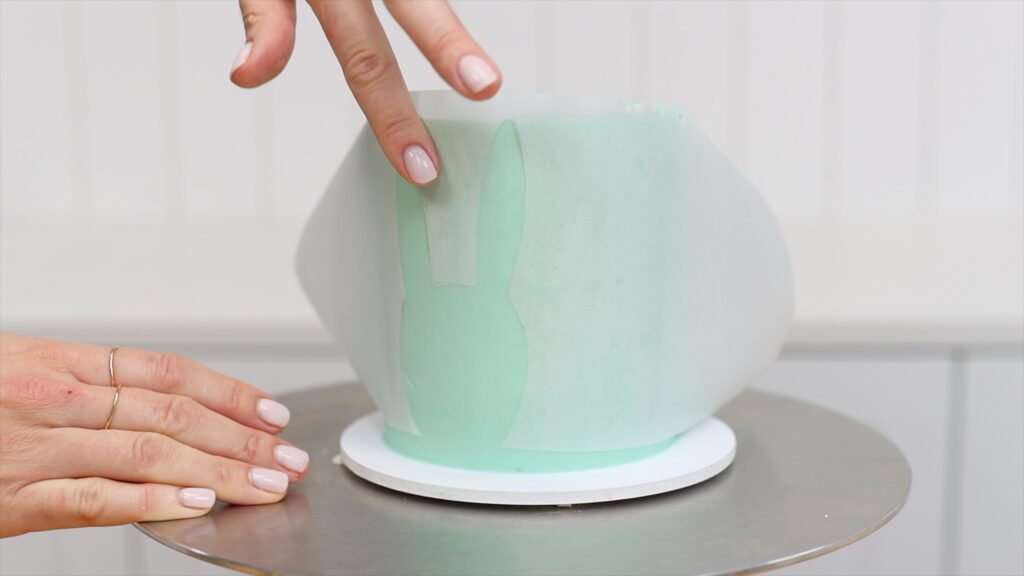
As well as patterns, you can use parchment paper for cake designs like animals. Use this technique for simple silhouettes or I’ll show you a much more detailed character in a moment. Draw or trace the outline of your shape onto parchment paper and cut it out. Wrap the parchment around the cake to use the cut-out shape as a stencil.
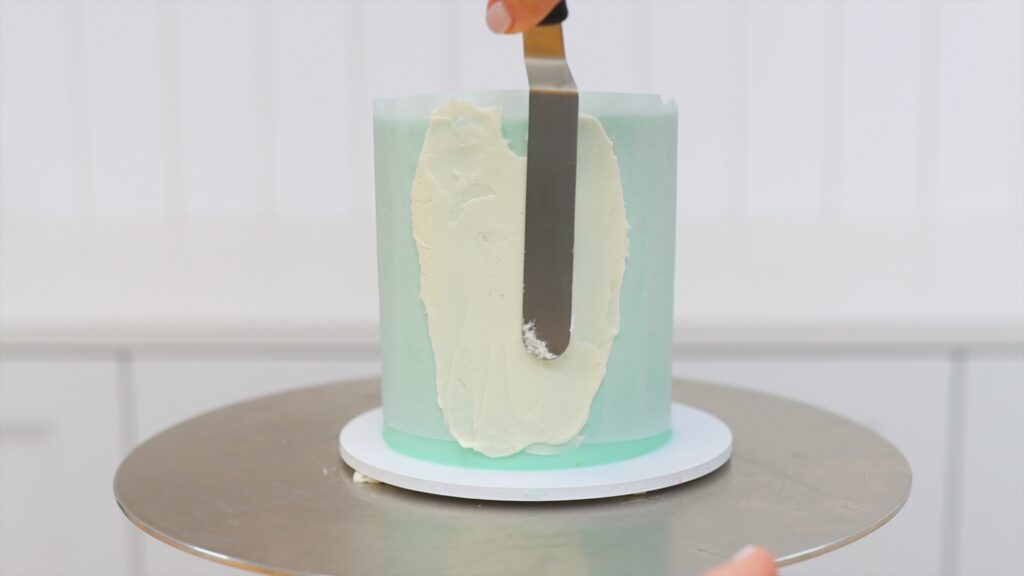
Spread buttercream over the stencil, pushing towards the middle of the shape instead of out towards the edges. This will give you the neatest outline because you won't push buttercream underneath the edges of the stencil. Scrape off the excess with an offset spatula or cake comb leaving a thin, smooth layer of buttercream behind.
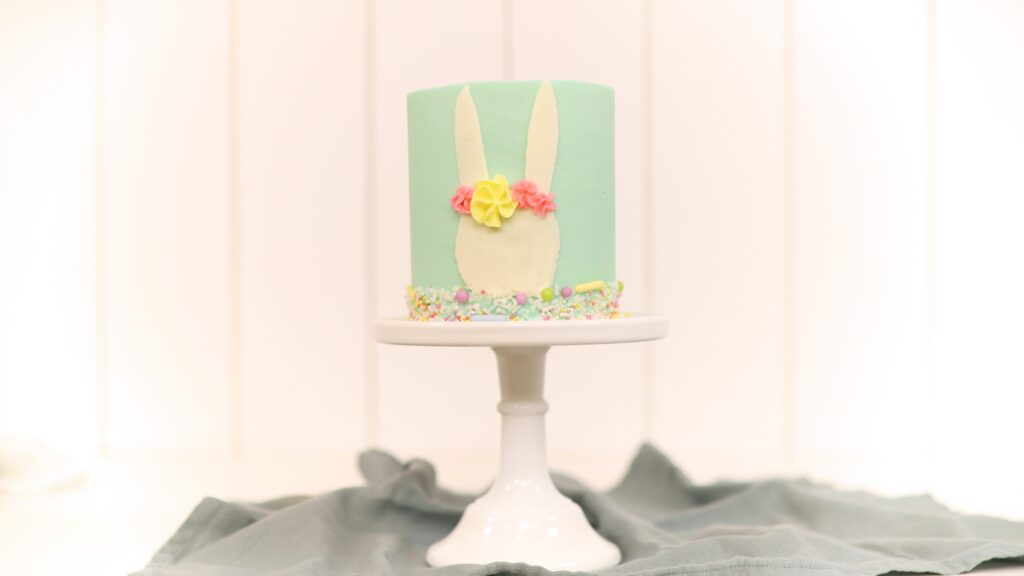
Peel the parchment off straight away, before the buttercream on the stencil sets. You'll leave a silhouette of your shape behind! To add some colour and texture you can pipe added details like these flowers.
#4 Character stencil
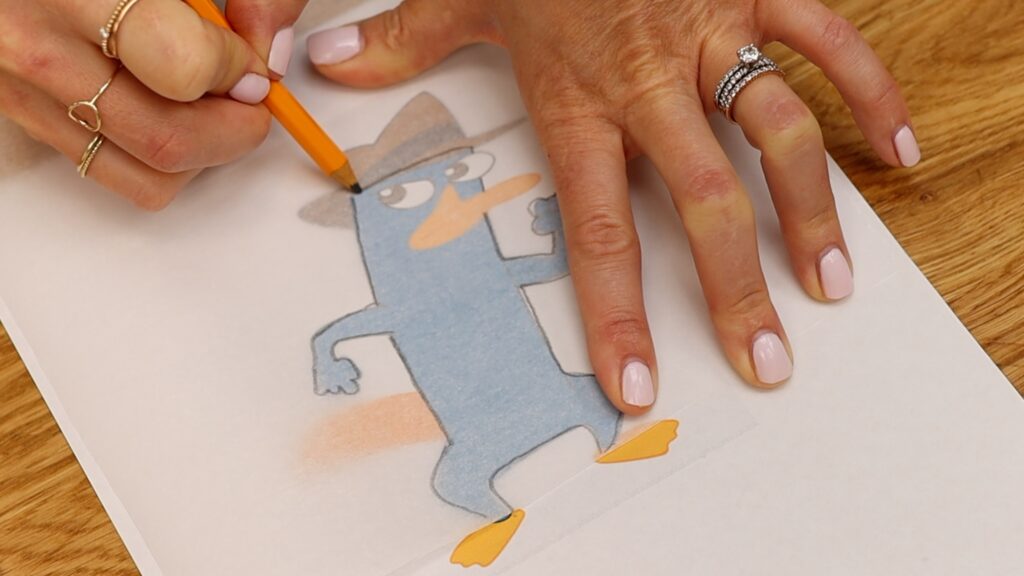
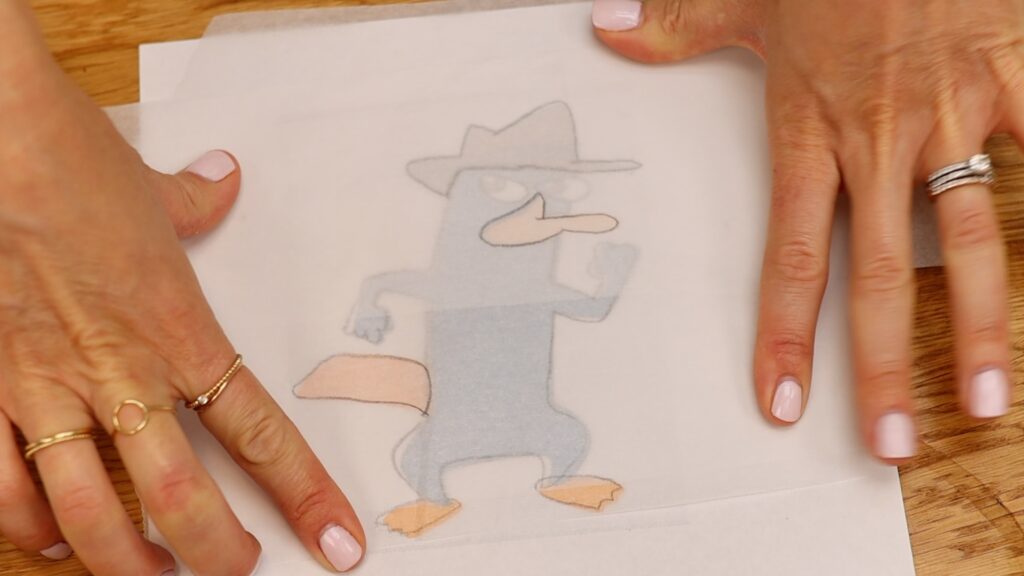
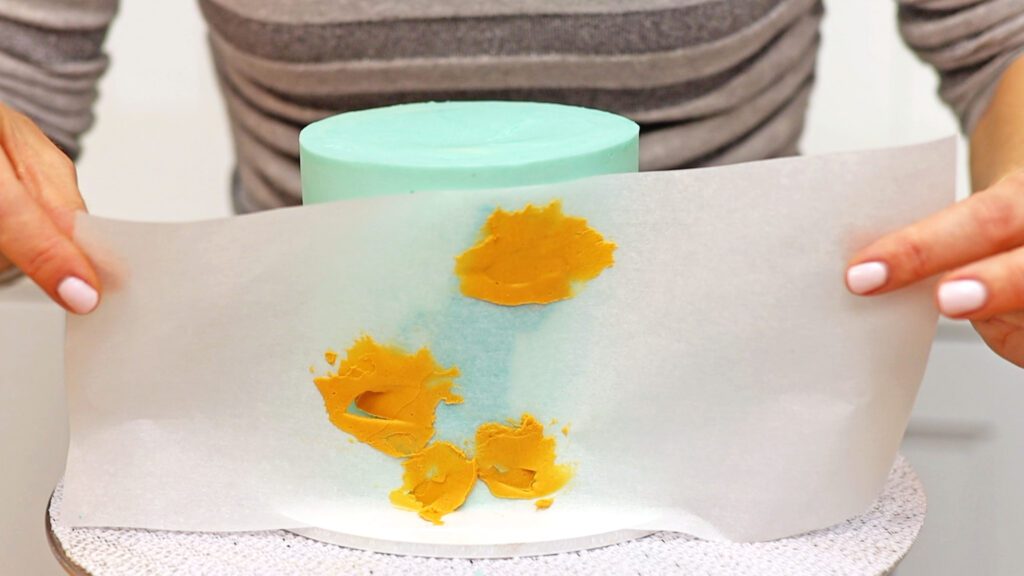
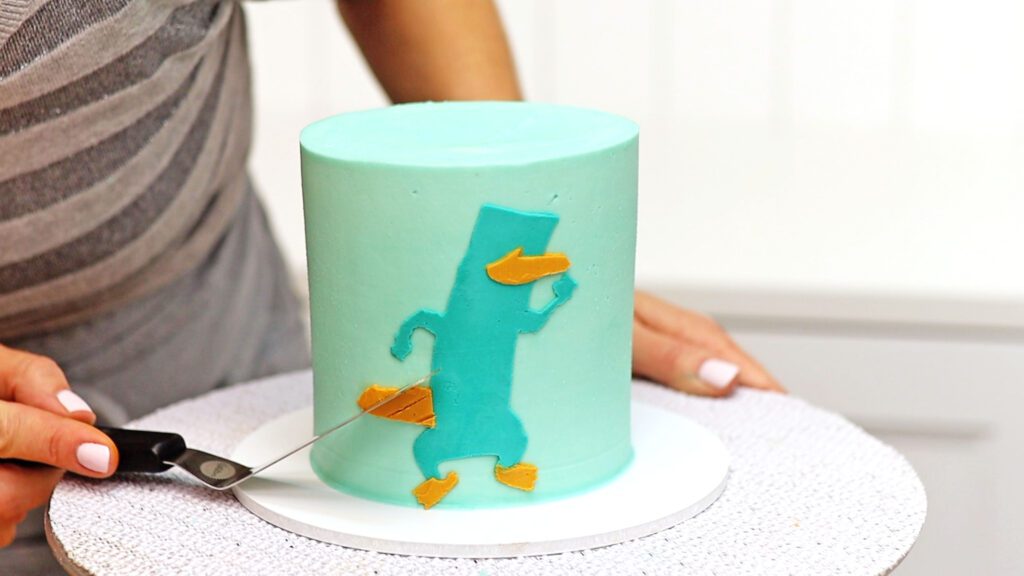
To add much more detail for character cakes, use several pieces of parchment paper to trace an image. Only outline the details of one colour at a time. For this platypus I’m starting with the turquoise body.
Then use a different piece of parchment to outline the details of the next colour. Repeat for all of the coloured details in your design. When you lay the parchment pieces over each other you'll see outlines of all of the details of the image.
Cut out all of the details to make stencils, which you’ll use for each colour separately. Then tint your colours to create the design. I use gel colours because they're very concentrated so they make very bright and bold colours. My 4 Minute Buttercream works really well for parchment paper designs because it gets so firm when it sets.
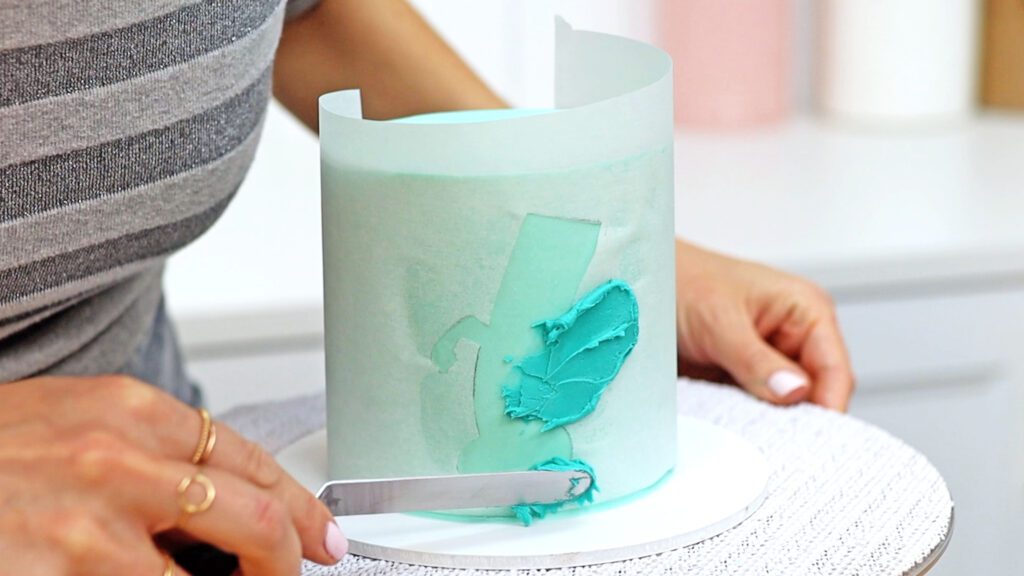
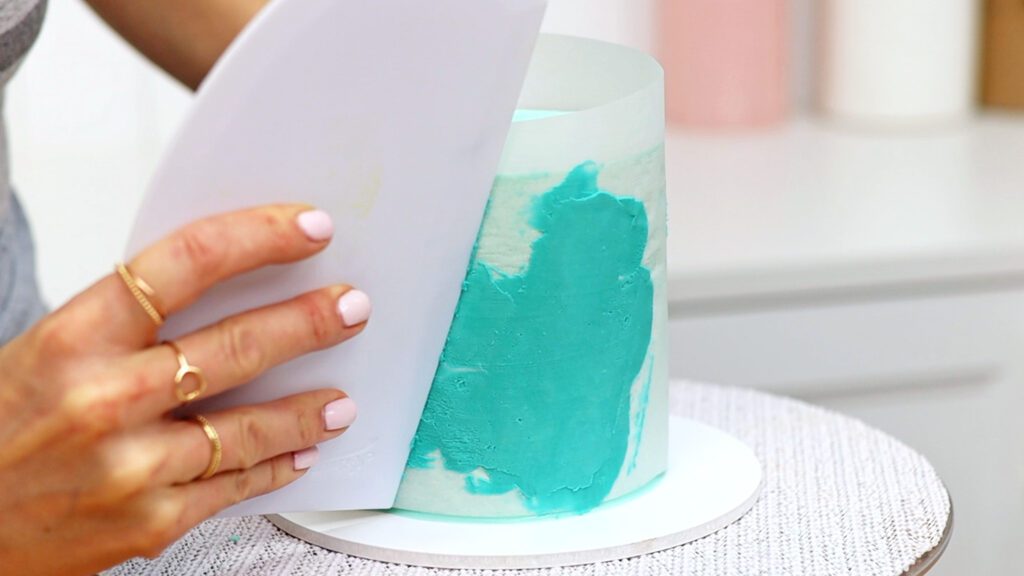
Start with the stencil for the background colour, which is the largest block of colour. Wrap the parchment around the cake and spread buttercream over the stencil to cover the shape you cut out.
Then scrape around the cake with a cake comb to take off excess frosting. Scrape a few times to leave a thin, smooth layer of frosting behind.
Peel the parchment away from the cake to leave your first details on the cake. Use a toothpick to touch up any smudges of buttercream around the edges of the shape. Then put the cake in the freezer for 10 minutes or the fridge for 30 minutes. Next, line up another parchment stencil on the cake. Chilling the cake sets the first stencil details so that this next stencil doesn’t damage them.
Use your toothpick or the edge of your offset spatula to create texture like the waffle grid on this tail. Do this straight after applying the stencil, while the buttercream is still soft.
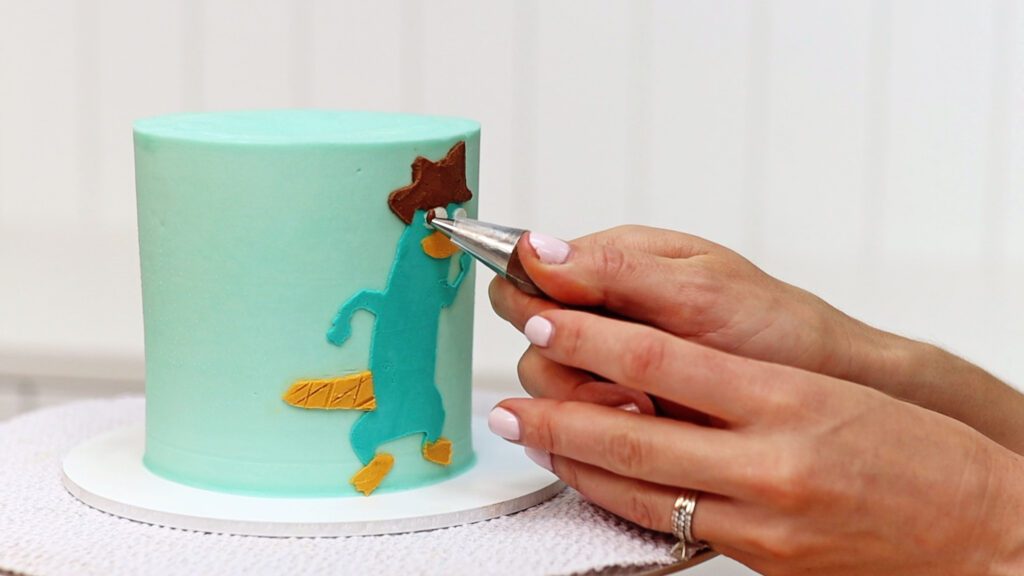
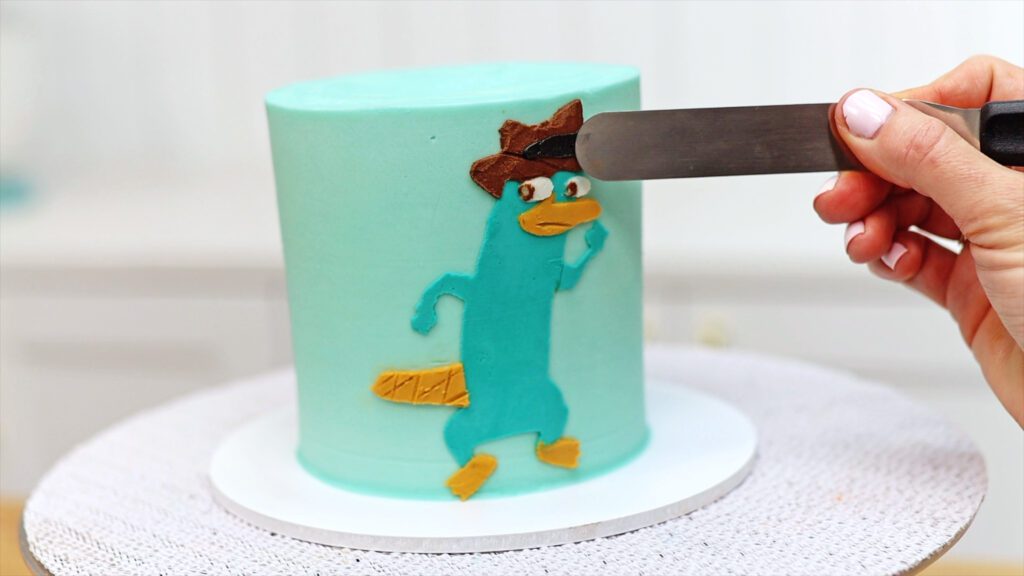
Continue with the rest of your stencils and coloured buttercream to add all of the details to your character. You'll need to chill the cake to set the buttercream between each stencil. For tiny details you might choose to use a piping tip instead of a stencil, like tiny eyeballs. I poked the piped eyes with my toothpick to expose tiny white dots in the centers.
You can use your offset spatula for thin lines like the mouth and the brim of this hat. Thin lines like the band around the hat could be done with a stencil. For a quicker option you can pipe the lines and then flatten the buttercream with an offset spatula.
And there it is! A detailed character made with homemade parchment paper stencils!
#5 Wrapped chocolate cake
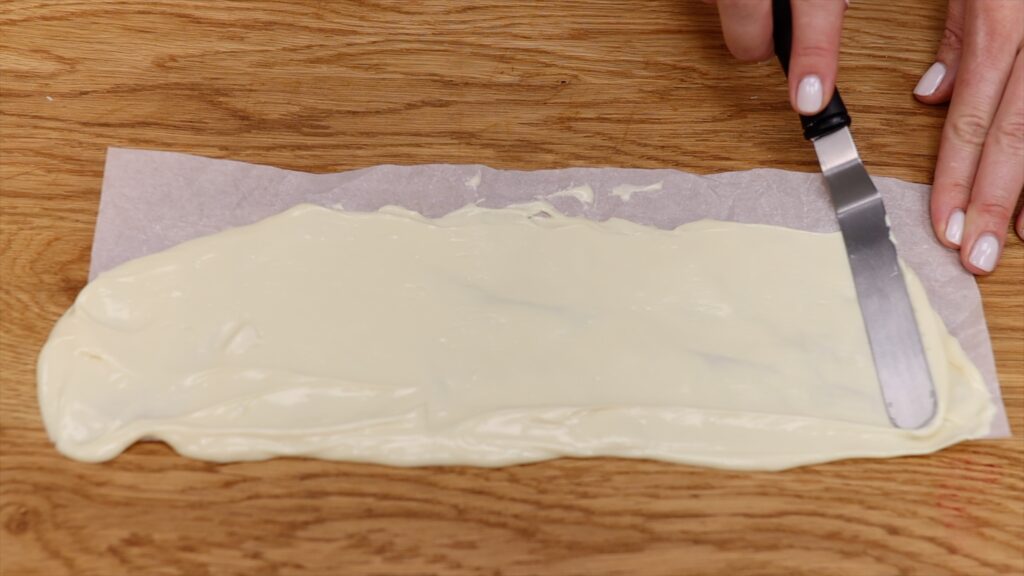
To wrap a cake in chocolate start by cutting parchment to wrap around the cake. You can scrunch it up if you want to add extra texture. Melt any kind of chocolate chips and then pour the melted chocolate onto the parchment paper. Spread it around with an offset spatula or the back of a spoon to level it. Go right up to the edges to completely cover the parchment.
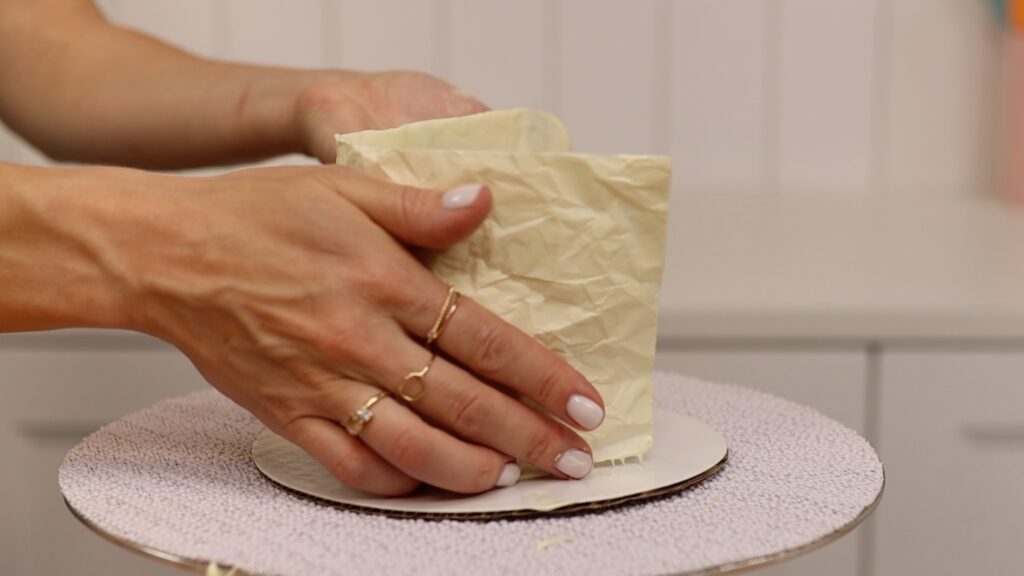
Slide your hands underneath the parchment straight away, before the chocolate sets, and lift it up. Rest the bottom edge on the cake board and wrap it around your cake. It’s easiest if the cake has been in the fridge so it’s firm and less wobbly than when it’s at room temperature.
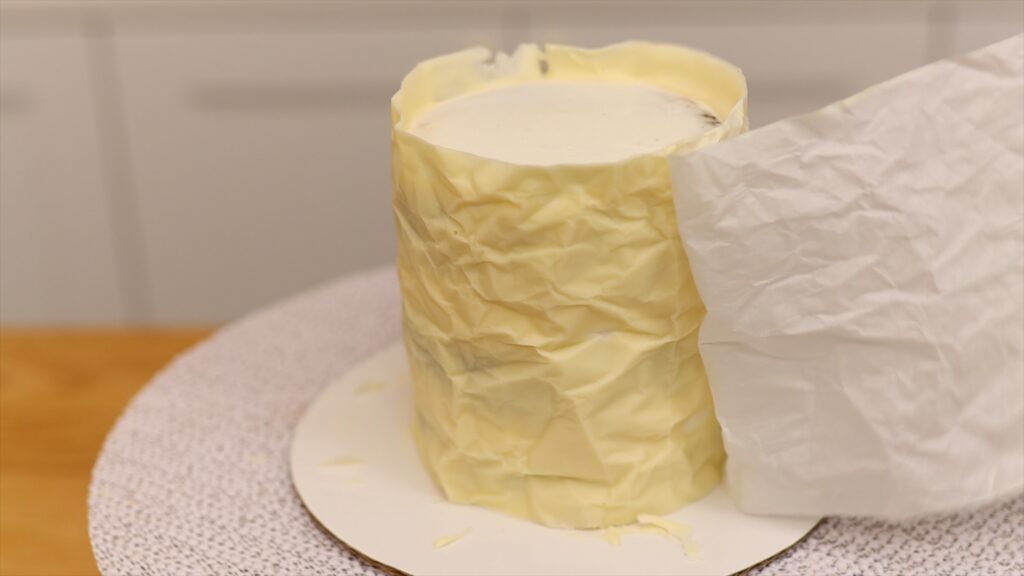
Put the cake wrapped in parchment into the fridge for an hour or the freezer for twenty minutes. This will set the chocolate and make it stronger than when it's a room temperature. Then peel the parchment off to leave the chocolate wrap behind.
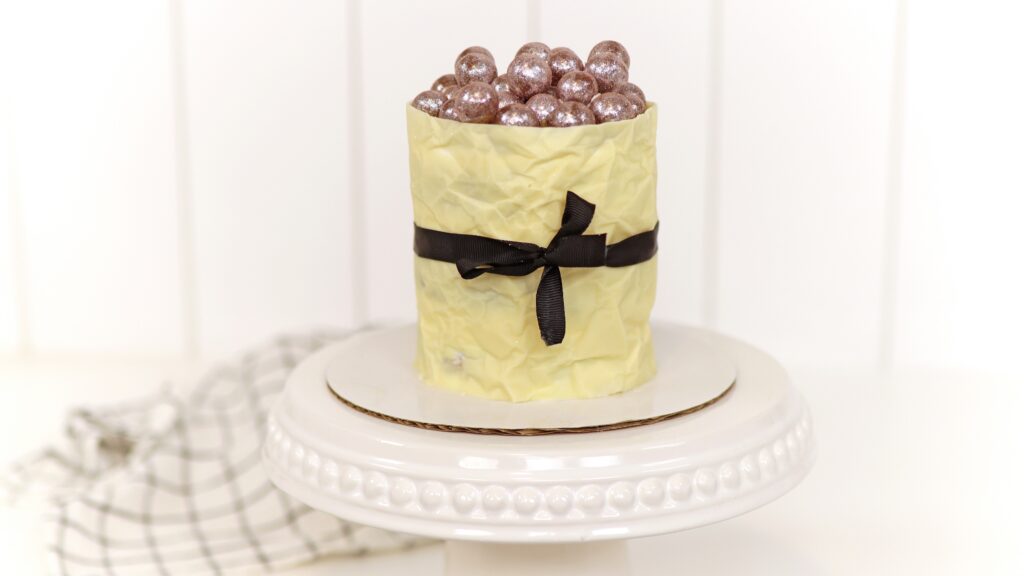
If you cut your parchment a little bit taller than the cake, you’ll have a wall to hold in any decorations like these glittery chocolate malt balls. So pretty!
I hope you’ve seen some ways you can save money on expensive cake decorating tools by using parchment paper instead! Check out my cake school for online courses on hundreds of cake decorating techniques and designs and join my ClubPLUS for access to every MasterCourse, MiniCourse and Live Workshop!